
Advertisement
Fun Facts
Did You Know?
Two to three broods annually in North Louisiana, with adults present from March through October. First spring adults emerge from winter-dormant chrysalises in late March or early April in the northern parishes, earlier in the southern portions of the 26-parish region. Multiple overlapping warm-season broods produce a continuous adult presence through summer. Late-season caterpillars form winter-dormant chrysalises in September and October
If This Animal Could Talk...
"Watch closely, respect my space, and let my habitat explain the rest of the story."
The pipevine swallowtail runs a protection racket that benefits half the swallowtail community in North Louisiana. It accumulates toxic aristolochic acids from its host plant, Dutchman’s pipe, stores them through metamorphosis, and emerges as an adult butterfly that tastes terrible enough that birds learn to avoid it. That lesson, once learned by an individual bird, extends to similar-looking butterflies, like spicebush swallowtails, dark female eastern tiger swallowtails, female eastern black swallowtails, and red-spotted purples.
The pipevine swallowtail’s range includes the eastern United States, the Gulf Coast, and even into the southwestern states. It’s a resident species, breeding wherever Aristolochia grows and ranging well beyond host plant areas for nectar foraging. It’s less common than the tiger swallowtails or spicebush swallowtails in most residential areas because its host plant is less common than those species’ host plants, but it flies and breeds throughout the region from early spring through fall.
What the Pipevine Swallowtail Actually Looks Like
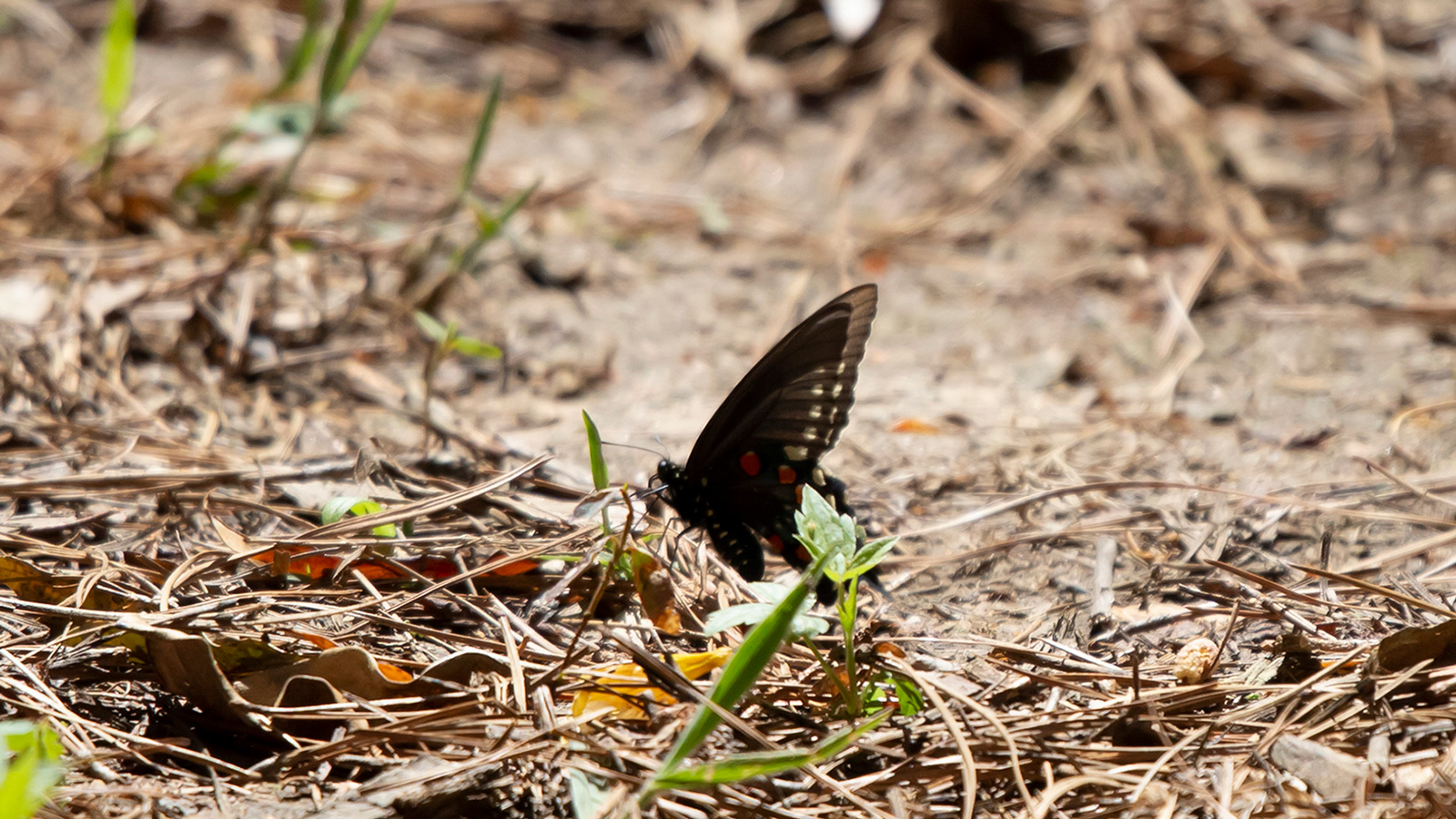
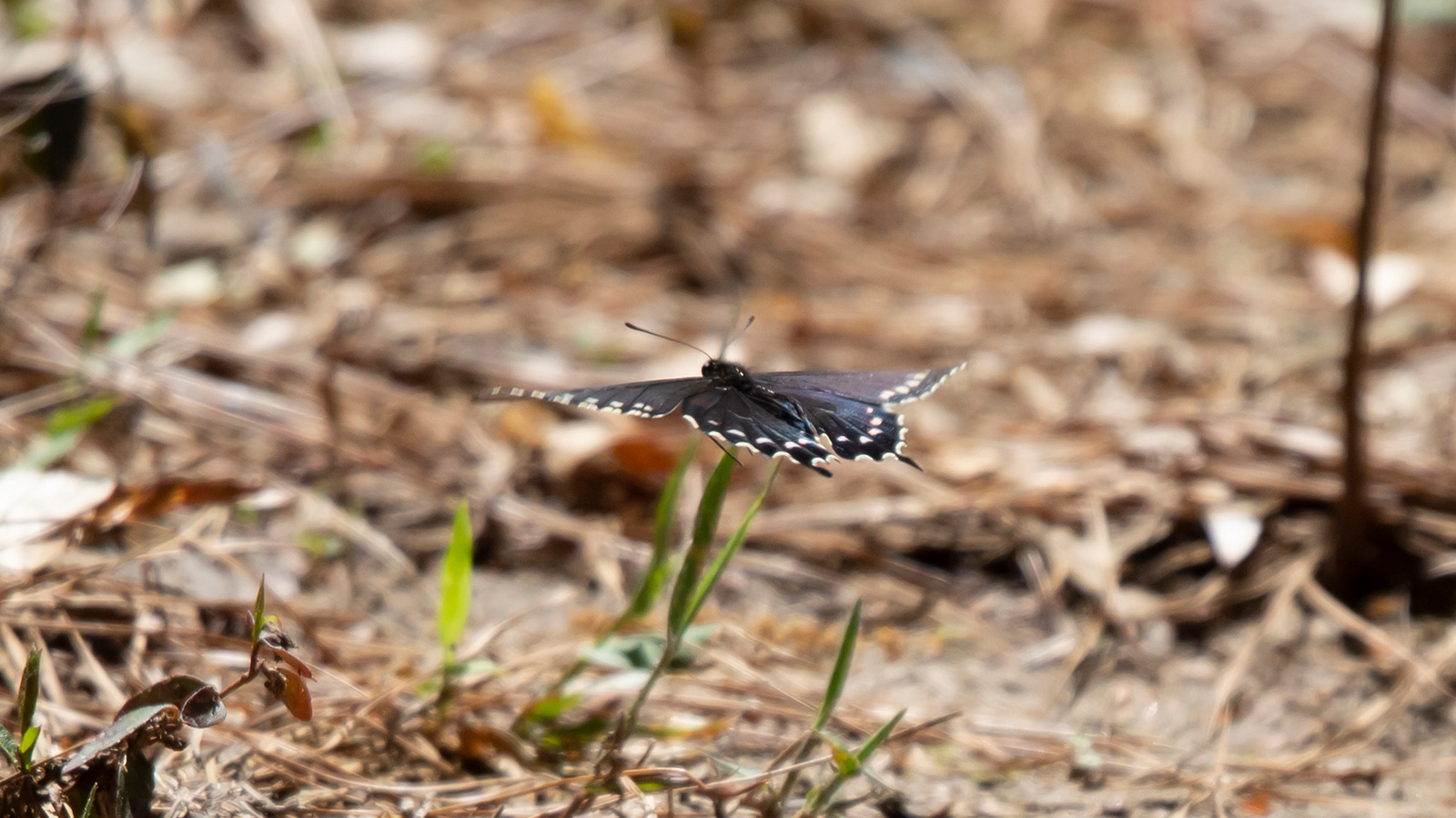
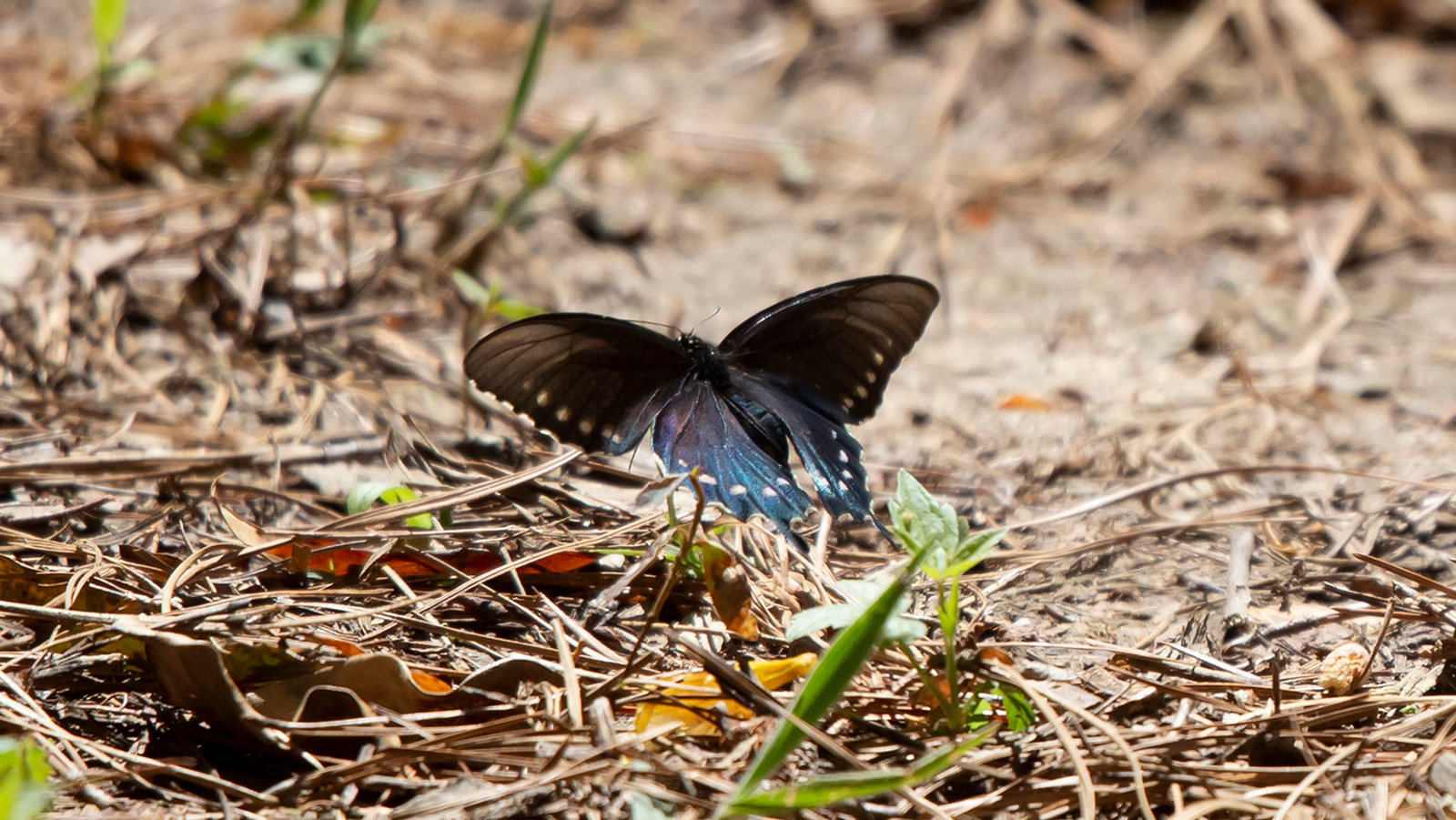
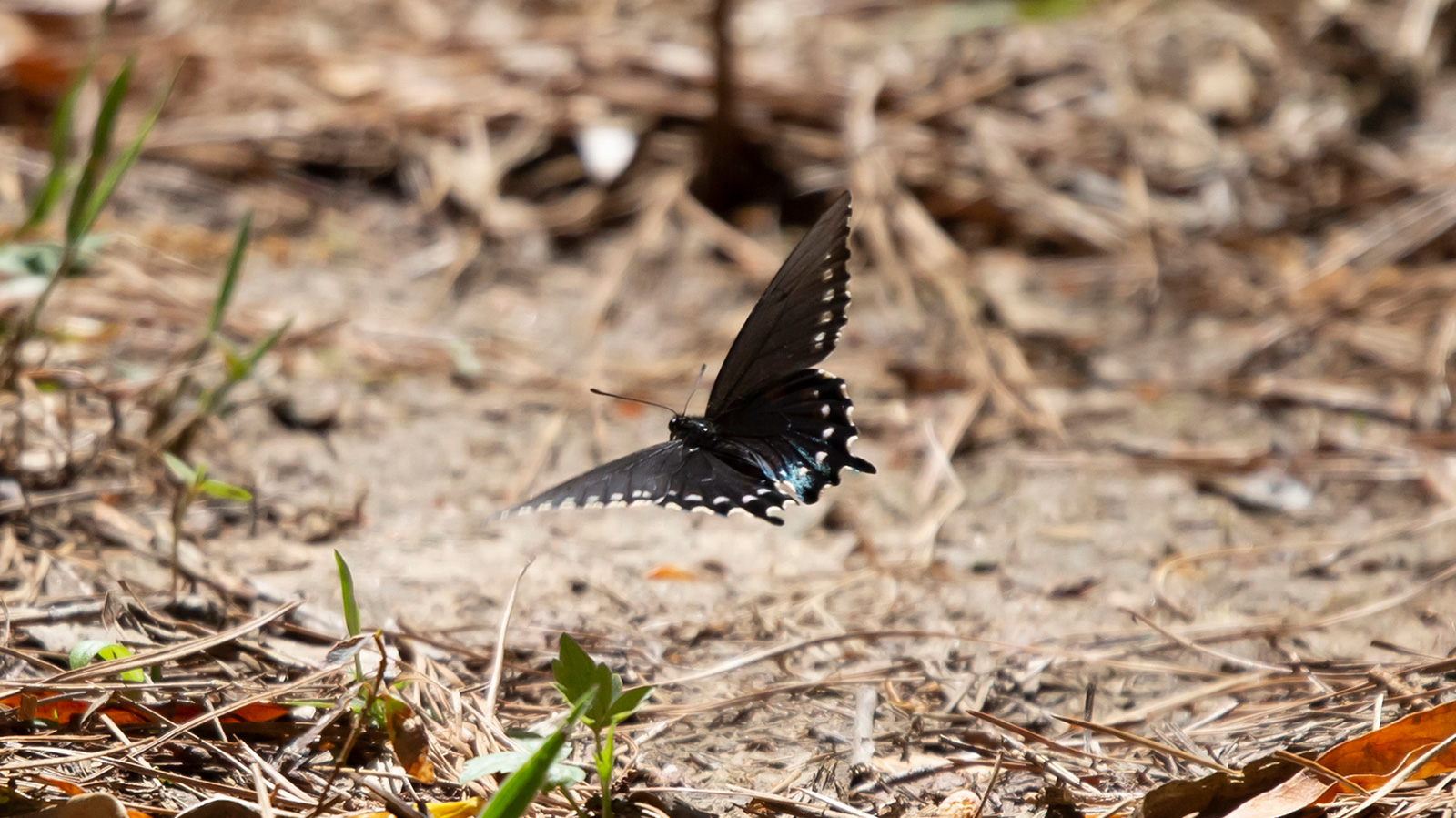
The adult male pipevine swallowtail is iridescent blue-green to blue-black on the hindwing upperside, with the metallic sheen shifting depending on the angle you see it from. It might look anywhere from deep black to brilliant teal, depending on the light. The forewing upperside is dark with a faint row of pale spots along the outer margin.
That hindwing underside has orange spots in a curved row on an iridescent blue background, visible when the butterfly perches with wings open at flowers. One tail on each hindwing, shorter than the tiger swallowtail’s and less pronounced than the spicebush’s.
Females typically are less iridescence on the hindwing upperside and more of the pale forewing spotting. The difference between male and female is subtler in pipevine swallowtails than in the eastern tiger or eastern black swallowtail.
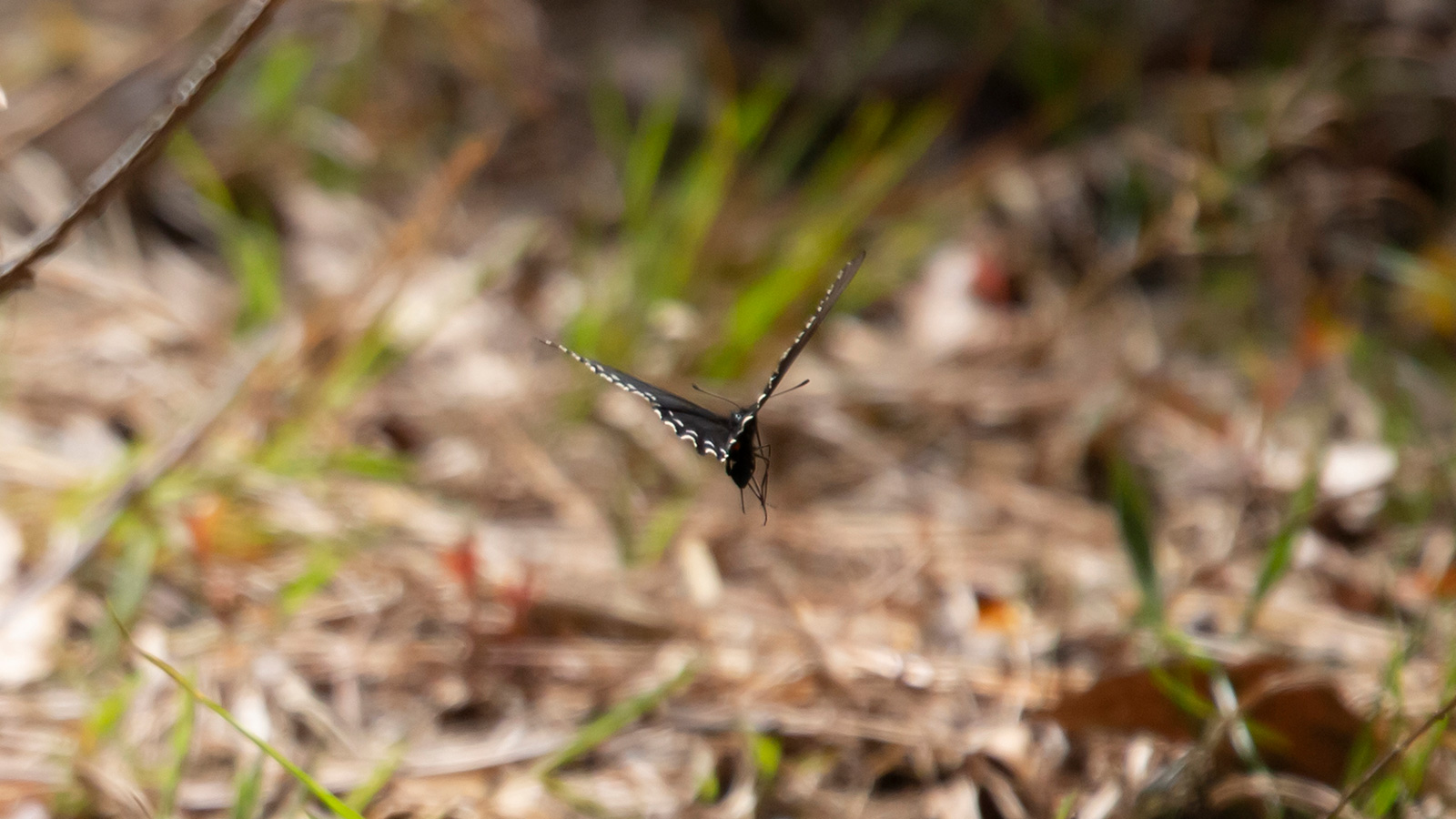
The hindwing underside provides the fastest field mark. At a nectaring individual, the orange spots on iridescent blue are immediately distinctive and separate the pipevine swallowtail from every other North Louisiana swallowtail at close range. At distance and in flight, the overall dark blue-black coloration and the rowing glide flight pattern are the primary cues, with size roughly similar to the spicebush swallowtail and smaller than the eastern tiger.
Where the Pipevine Swallowtail Lives
Pipevine swallowtails use woodland edge, forest interior, roadsides, and bottomland habitats throughout North Louisiana wherever native Aristolochia species grow. The native host plants in the 26 parishes include woolly Dutchman’s pipe, Aristolochia tomentosa, a woody vine of bottomland forests and rich upland woods, and Virginia snakeroot, Aristolochia serpentaria, a low-growing herbaceous species of forest interior and woodland edge habitats in the upland parishes.
Adults range freely across open and semi-open habitats for nectar, and a nectaring pipevine swallowtail at a garden milkweed or thistle patch does not confirm host plant proximity. Adults move over considerable distances for nectar and turns up anywhere in the 26 parishes during the warm season. Breeding, however, ties to Aristolochia, and understanding where the host plant grows predicts where the breeding population centers.
Cultivated Aristolochia species, particularly the widely planted Dutchman’s pipe vine, Aristolochia macrophylla, and Aristolochia elegans, support pipevine swallowtail breeding in residential gardens throughout North Louisiana wherever those vines are established. These cultivated Aristolochia create breeding opportunities in residential areas where native host plants may be absent, and the association between a mature Dutchman’s pipe planting and a reliable pipevine swallowtail breeding site runs consistent enough to be predictable.
Photo Gallery
The Caterpillar’s Host Plant Chemistry
The pipevine swallowtail caterpillar’s relationship with Aristolochia runs as a precise chemical dependency. The plant produces aristolochic acids as defensive compounds against herbivory. The caterpillar, rather than being deterred, sequesters those acids, incorporating them into its own tissues at concentrations that persist through the pupal stage and into the adult butterfly. Chemically, the adult carries a bag of compounds that taste terrible to birds and cause lasting digestive distress if consumed in quantity.
That caterpillar runs dark, with fleshy orange tubercles arranged in rows along the body, and groups of late-instar siblings often feed together on Aristolochia foliage in clusters. The grouping behavior in early instars runs conspicuous when the caterpillars are present and makes finding caterpillars on a known host plant site substantially easier than finding solitary feeders. By the final instar, caterpillars disperse somewhat before wandering to find pupation sites.
Its own warning coloration, dark body with orange tubercles, signals its toxicity through the same aposematic logic that the adult coloration uses. A bird that attempts to eat a late-instar pipevine swallowtail caterpillar receives the same deterrent outcome as a bird that eats the adult, which explains why the coloration rings honest and why the warning works. The system works because some individuals get eaten by naive predators to teach the lesson. The species produces enough offspring that this loss remains sustainable.
The Pipevine Swallowtail’s Year
Two to three broods annually in North Louisiana, with adults present from March through October. First spring adults emerge from winter-dormant chrysalises in late March or early April in the northern parishes, earlier in the southern portions of the 26-parish region. Multiple overlapping warm-season broods produce a continuous adult presence through summer. Late-season caterpillars form winter-dormant chrysalises in September and October.
First-generation adults are often the freshest individuals of the year, with full iridescent hindwing coloration and intact wing edges. As the season progresses, worn individuals with faded iridescence and frayed wing margins become common at nectar sources, representing adults from earlier broods that have survived long enough to show field wear. Fresh adults, likely recent emergences, mix with worn individuals through the summer and fall.
Males emerge slightly before females in each brood and establish territories or patrol routes through suitable habitat, intersecting with females during their host plant searching and nectar foraging flights. Mating occurs throughout the warm season, with peak activity in the periods immediately following each brood’s emergence.
What the Pipevine Swallowtail Eats
Adults feed on nectar from a wide range of flowering plants. Preferred nectar sources in North Louisiana include thistles, milkweeds, azaleas in spring, native clovers, phlox, ironweed, and native thistles. Pipevine swallowtails have a preference for tubular flowers where the proboscis length provides a nectar-access advantage, but they visit open-faced flowers regularly and are generalist foragers across the warm season. Adults also mud-puddle at damp soil margins for moisture and dissolved minerals, with males more frequently observed mud-puddling than females.
Caterpillars eat Aristolochia foliage, stems, and flowers. Host plant specificity runs essentially absolute: pipevine swallowtail caterpillars do not feed on plants outside the Aristolochia genus and starve if removed from host plant material. The chemical compounds in Aristolochia that make the caterpillar toxic are also what the caterpillar’s digestive system evolved to process. The dependency runs in both directions.
How they hunt and forage: Adults feed on nectar from a wide range of flowering plants. Preferred nectar sources in North Louisiana include thistles, milkweeds, azaleas in spring, native clovers, phlox, ironweed, and native thistles. Pipevine swallowtails have a preference for tubular flowers where the proboscis length provides a nectar-access advantage, but they visit open-faced flowers regularly and are generalist foragers across the warm season. Adults also mud-puddle at damp soil margins for moisture and dissolved minerals, with males more frequently observed mud-puddling than females. Caterpillars eat Aristolochia foliage, stems, and flowers. Host plant specificity runs essentially absolute: pipevine swallowtail caterpillars do not feed on plants outside the Aristolochia genus and starve if removed from host plant material. The chemical compounds in Aristolochia that make the caterpillar toxic are also what the caterpillar's digestive system evolved to process. The dependency runs in both directions.
What Eats the Pipevine Swallowtail
Relatively few predators eat adult pipevine swallowtails, the functional outcome of decades of predator education by the population. Eastern kingbirds are among the few North American songbirds that eat a variety of insects including some with chemical defenses, but pipevine swallowtails are not a preferred prey item even for kingbirds. Most bird species in North Louisiana that could physically capture an adult pipevine swallowtail have either learned to avoid the pattern through direct experience or inherited a behavioral avoidance of the color pattern through developmental exposure.
Young birds in their first season are the predators that test the system. First-year individuals that have not yet encountered the pipevine swallowtail’s chemical defense are the ones that attempt predation on adults and learn. Those individuals subsequently avoid the pattern and extend that avoidance to the mimic species in the same habitat. The mimicry system’s effectiveness depends on this predator education operating continuously as new birds enter the population each year.
Caterpillar predation runs heavier than adult predation. Parasitoid wasps and tachinid flies parasitize caterpillars despite the chemical defense, using chemical masking strategies that allow them to locate and parasitize defended hosts. Egg predation by ants and small arthropods occurs on host plant surfaces. Chrysalis predation by small mammals occurs when chrysalises are accessible at ground level. The adult stage, protected by the full toxic load accumulated through larval feeding, stands as the most defended stage and experiences the lowest predation rate of any stage in the life cycle.
How they hunt and forage: Adults feed on nectar from a wide range of flowering plants. Preferred nectar sources in North Louisiana include thistles, milkweeds, azaleas in spring, native clovers, phlox, ironweed, and native thistles. Pipevine swallowtails have a preference for tubular flowers where the proboscis length provides a nectar-access advantage, but they visit open-faced flowers regularly and are generalist foragers across the warm season. Adults also mud-puddle at damp soil margins for moisture and dissolved minerals, with males more frequently observed mud-puddling than females. Caterpillars eat Aristolochia foliage, stems, and flowers. Host plant specificity runs essentially absolute: pipevine swallowtail caterpillars do not feed on plants outside the Aristolochia genus and starve if removed from host plant material. The chemical compounds in Aristolochia that make the caterpillar toxic are also what the caterpillar's digestive system evolved to process. The dependency runs in both directions.
Telling the Pipevine Swallowtail from Its Mimics
The pipevine swallowtail functions simultaneously as a model that other butterflies mimic and a species that observers need to separate from those mimics. In North Louisiana, the mimic complex includes the dark female eastern tiger swallowtail, the female eastern black swallowtail, the spicebush swallowtail, and the red-spotted purple, which lacks tails entirely. All four gain predator protection through resemblance to the pipevine swallowtail’s warning coloration.
Separating the model from the mimics: the pipevine swallowtail shows iridescent blue-green covering most of the hindwing upperside, with no yellow spotting on the upperside in the standard view. The hindwing underside with orange spots on blue goes unique among the mimics.
The spicebush swallowtail has blue iridescence on the hindwing but shows orange spots on the hindwing upperside that the pipevine swallowtail lacks. The female eastern black swallowtail has yellow spot rows that the pipevine does not. The female eastern tiger swallowtail runs larger with a shadow of tiger stripes visible on the forewing.
That hindwing underside, visible at nectaring individuals with wings partially open, resolves most uncertain identifications. The pipevine swallowtail’s underside pattern of orange spots on metallic blue runs not precisely replicated by any of the mimics in North Louisiana.
The Mimicry System’s Effect on North Louisiana’s Butterfly Community
The pipevine swallowtail’s presence in North Louisiana’s 26 parishes shapes predator behavior toward dark swallowtails at a scale that extends well beyond the individual pipevine swallowtail population. A North Louisiana forest edge with an active pipevine swallowtail breeding population educates resident birds every season, and those educated birds extend their avoidance to spicebush swallowtails, dark female tiger swallowtails, and female eastern black swallowtails that pass through or breed in the same area.
Planting Dutchman’s pipe in a North Louisiana residential garden does not only support pipevine swallowtail breeding. It contributes to the predator education that benefits four other butterfly species in the same area. The pipeline from Aristolochia in the garden to reduced predation pressure on spicebush swallowtails at the woodland edge down the road does not function as a direct one, but it functions and operates through measurable behavioral mechanisms.
The Dutchman’s pipe planting does not function as a boutique conservation gesture. It functions as infrastructure for a chemical defense network that runs across multiple species simultaneously.
Supporting Pipevine Swallowtails in North Louisiana
Aristolochia tomentosa, the native woolly Dutchman’s pipe, exists from native plant nurseries and specialty growers serving the Gulf South and stands as the most ecologically appropriate host plant choice for North Louisiana residential gardens. It grows as a woody vine that needs a support structure and grows vigorously in moist, partially shaded conditions consistent with its bottomland forest native habitat. Established vines support multiple pipevine swallowtail broods per season and produce caterpillar populations that are reliably observable from late spring through fall.
Aristolochia macrophylla, the more widely available Dutchman’s pipe vine, also serves as a host plant and runs more readily available from mainstream nursery sources. Not native to North Louisiana but functioning as a host plant for the pipevine swallowtail and supports breeding populations in residential gardens. Any established Aristolochia vine in a North Louisiana garden in a warm, reasonably sunny location will receive oviposition from females in the area within a season or two.
Seasons
Pipevine swallowtails are present in North Louisiana from late March through October, with two to three broods producing a continuous adult presence through the warm season. Peak adult visibility occurs in spring as the first brood emerges and in late summer as later broods accumulate. Adults are most active at flowers during morning and early afternoon hours. Caterpillars are findable on Aristolochia host plants from late April through October with careful examination of host plant foliage.
The Aristolochia Network in North Louisiana
Woolly Dutchman’s pipe, Aristolochia tomentosa, grows in bottomland hardwood forests, rich upland slopes, and mesic woodland margins throughout North Louisiana’s 26 parishes. A woody vine that climbs by twining, reaching into the canopy in mature bottomland forest and scrambling through shrubby woodland edge vegetation in drier sites. The leaves are large, heart-shaped, and covered in soft gray-green hairs on the underside.
The flowers are curved, pipe-shaped, and brownish-purple, pollinated by small flies that enter and become temporarily trapped before the flower releases them dusted with pollen. The plant does not stand conspicuous on casual examination of a bottomland forest. The caterpillar clusters on the foliage are conspicuous, and they are the fastest way to confirm Aristolochia presence at a site.
Virginia snakeroot, Aristolochia serpentaria, the smaller, herbaceous host plant of the interior forest understory in the upland parishes. It grows at ground level in dry to mesic upland forest, producing small pipe-shaped flowers close to the ground and thin-stemmed leaves that trail through leaf litter. Pipevine swallowtail caterpillars use Virginia snakeroot but find it in less abundance than the woody vine, and populations centered on snakeroot tend to be smaller and patchier than those associated with the vine.
Finding caterpillars on Virginia snakeroot at a specific location confirms a breeding population using the forest interior rather than the edge, and those interior-breeding populations tend to be more stable because the host plant runs less subject to the disturbance events that affect edge vegetation.
Both native Aristolochia species are present in the 26 parishes but neither turns up common enough in the residential landscape to support widespread suburban breeding populations on its own. The role of cultivated Aristolochia vines in extending the host plant network into residential areas therefore runs substantial, and the correlation between Dutchman’s pipe plantings in residential gardens and pipevine swallowtail breeding activity at those sites runs consistent enough to be treated as a reliable planting-for-wildlife outcome.
The Chemical Defense in Detail
Aristolochic acids are a class of compounds that evolved in Aristolochia as a defense against generalist herbivores. In mammals, including humans, aristolochic acids cause kidney damage and are carcinogenic with repeated exposure. The pipevine swallowtail caterpillar has evolved the biochemical machinery to sequester rather than metabolize these compounds, incorporating them into its tissues at concentrations that make the larva unpalatable or toxic to most predators.
At no point in the caterpillar’s development does it experience the negative effects of the compounds. The sequestration represents an evolved adaptation, not an accident of chemistry.
The toxic load carries through metamorphosis intact. The pupal stage, during which the caterpillar’s body liquefies and reorganizes into the adult form, preserves the aristolochic acid content in the adult butterfly’s body tissues. Adults that have fed as caterpillars on aristolochic-acid-rich Aristolochia carry the full defensive chemical complement from the moment of emergence through the end of their lives. No toxicity decline occurs with age. An adult pipevine swallowtail in its fourth week runs as unpalatable as it was on its first day.
That persistence explains why the mimicry system educates predators effectively over time. A bird that eats one pipevine swallowtail gets a consistent negative experience regardless of when in the season the encounter occurs. The lesson gets reinforced reliably by every individual encountered, which produces a stable learned avoidance that the bird applies for the rest of its life.
Identifying Caterpillars and Eggs in the Field
The eggs are small and rust-red or reddish-brown, laid in clusters of three to twenty on new growth of Aristolochia stems and leaf undersides. Fresh eggs are waxy and slightly glossy; older eggs dull slightly before hatching. Egg clusters on Aristolochia are easier to find than on many other butterfly host plants because the female pipevine swallowtail deposits multiple eggs in the same location rather than the single-egg oviposition of the swallowtails in the Papilio genus.
A cluster of rust-red eggs on Dutchman’s pipe confirms active female oviposition at that site.
Early instar caterpillars are dark, often nearly black, and feed in groups that stay clustered through the first several instars. The aggregation behavior amplifies the visual warning: a cluster of dark caterpillars with orange tubercles runs more conspicuous and more aversive to a predator than a single caterpillar of the same color pattern.
By the fourth and fifth instars, caterpillars grow larger, the orange tubercles become more prominent, and the dark reddish-brown body coloration gives the late-instar caterpillar an appearance immediately recognizable once the search image becomes established. Late-instar caterpillars on a robust Dutchman’s pipe vine are visible from standing height without close examination.
The chrysalis runs brown or greenish-brown and attaches to woody stems and structural vegetation near the host plant. It blends with bark and dried vegetation effectively but stretches large enough at roughly an inch long to find with careful examination of surfaces within a few feet of the caterpillar’s last known position on the vine. Winter-dormant chrysalises attached to structural vegetation in late October and November carry the population through until spring emergence.
Documentation in North Louisiana
Regional documentation of Battus philenor relative to native Aristolochia populations has not been precisely mapped in citizen science databases for most of the 26 parishes. The correlation between host plant presence and breeding population presence means that targeted surveys of known Aristolochia tomentosa locations, particularly in the bottomland hardwood forests of the Ouachita, Red River, and Tensas drainages, would substantially improve the regional distribution record.
iNaturalist observations with specific location data, date, and life stage observed, whether adult, egg cluster, caterpillar, or chrysalis, are the most useful data contributions. Caterpillar observations on confirmed Aristolochia host plants carry more information than adult observations alone because they confirm breeding at a location rather than simply indicating adult movement through the area. Adult movement range extends large enough that an adult observation does not confirm a breeding population within any reasonable radius of the observation point. A caterpillar observation does.
Finding Pipevine Swallowtails in North Louisiana
Adults nectaring at milkweed, thistle, and native clovers in open areas throughout the 26 parishes are the most consistent access point for the species. Public parks and native plant gardens with milkweed plantings pull nectaring adults reliably from late spring through early fall.
Roadsides with native thistle stands in the upland parishes produce pipevine swallowtail sightings from road shoulders without difficult terrain. The hindwing underside, with its orange spots on iridescent blue, shows at flowers when the butterfly spreads its wings during feeding, and that view at close range settles identification immediately.
Bottomland forest margins along the Ouachita, Red River, and Tensas drainages in the eastern and central parishes are the most productive sites for finding the species in its native habitat context. Woolly Dutchman’s pipe climbs into the forest edge in these watersheds, and adults fly the edge vegetation throughout the breeding season. Caterpillar clusters on Aristolochia vines in these bottomland margins are a consistent late spring and early summer observation from trails and road shoulders adjacent to mature bottomland forest.
For residential observation, planting Dutchman’s pipe vine on a sunny fence or trellis and waiting two to three years for the vine to establish stands as the most reliable approach. Established vines receive female oviposition visits within the first season they are large enough to support caterpillar development, typically when the vine covers ten or more square feet of support structure. A mature vine on a residential fence produces multiple caterpillar cohorts per season and supports adult activity at the planting site throughout the warm season.
The Pipevine Swallowtail and North Louisiana’s Broader Butterfly Community
The pipevine swallowtail’s ecological function in North Louisiana extends beyond the direct predator-prey dynamics of its own population. Its role as the toxic model in the local mimicry complex makes it a keystone species for the dark swallowtail community, and its presence in a given area raises the baseline predator education for all four of the mimic species simultaneously.
That cross-species benefit does not function as a feature that most butterfly-friendly garden planting guides address, but it registers in predator behavior and translates directly to reduced predation pressure on spicebush swallowtails, dark female tiger swallowtails, and female eastern black swallowtails in areas with active pipevine swallowtail breeding populations.
North Louisiana residents who plant Aristolochia for the pipevine swallowtail are not only supporting one butterfly species. They are contributing to a chemical defense network that benefits a community of dark swallowtails in the surrounding landscape. The effect does not show visibly the way a caterpillar cluster on a vine shows.
It operates in bird behavior and survival statistics across the local butterfly population, and it scales with the size and density of the Aristolochia planting network relative to predator learning opportunities. A neighborhood with multiple Dutchman’s pipe plantings educates more birds more thoroughly than a single isolated planting, and the benefit to mimic species scales accordingly.
One Planting Decision
An established Dutchman’s pipe vine in a North Louisiana residential garden functions as infrastructure for a chemical defense network that benefits four other butterfly species in the surrounding landscape. The vine grows vigorously on any support structure and produces a resident caterpillar population within one to two seasons. Those caterpillars become adults that are not visitors the way nectaring butterflies are visitors. They are residents, born on site, returning to breed in subsequent seasons as long as the vine persists.
The pipevine swallowtail rewards finding on its own terms: iridescent blue-green hindwing, orange spots on a metallic background, a flight pattern slower and more deliberate than the Papilio swallowtails it shares territory with. A bird that has learned to avoid this butterfly has learned something that benefits four other species in the same habitat. North Louisiana still has the Aristolochia network, both native in the bottomlands and cultivated in residential gardens, to keep that education running every season.
That pipevine swallowtail does not rank as the most common swallowtail in North Louisiana, but it determines the predation landscape for the other dark swallowtails in the region. Breeding populations at bottomland Aristolochia sites in the Ouachita and Red River drainages maintain the bird education that benefits spicebush swallowtails, dark female tiger swallowtails, and female eastern black swallowtails across the same parishes.
Those populations are worth knowing about and worth documenting annually. An iNaturalist caterpillar record from a specific bottomland site in Morehouse or Richland Parish does not function as a duplicate of someone else’s record from Natchitoches. A different data point about a different breeding population in a different watershed.
Accessibility
Bottomland forest margins along the Ouachita, Red, and Tensas drainages in the eastern and central parishes carry adults flying the edge vegetation throughout the breeding season. A roadside with native thistle in the upland parishes draws nectaring adults from nearby breeding populations.
Residential gardens with established Dutchman’s pipe vine produce caterpillar observations from early May through September at eye level on the vine surface. One Dutchman’s pipe vine on a sunny fence produces resident caterpillars within two seasons and extends the mimicry protection to four other butterfly species in the surrounding landscape.
The pipevine swallowtail rewards finding before locating the Dutchman’s pipe, and worth locating the vine for finding the caterpillar, and worth planting the vine for establishing the resident population. Each step opens the next one.
More Info
Resources: the North American Butterfly Association at naba.org maintains identification resources and Louisiana checklists. iNaturalist accepts pipevine swallowtail observations from all 26 North Louisiana parishes with expert review. Butterflies and Moths of North America at butterfliesandmoths.org carries Louisiana range and flight period data. The Xerces Society at xerces.org provides native Aristolochia sourcing guidance for Gulf South gardens.
A Few More Facts
Live birth or eggs? no
When young are born: First spring adults emerge from winter-dormant chrysalises in late March or early April in the northern parishes, earlier in the southern portions of the 26-parish region.
What Is the Pipevine Swallowtail Often Confused With?
The adult male pipevine swallowtail runs iridescent blue-green to blue-black on the hindwing upperside, with the metallic sheen shifting with viewing angle from deep black to brilliant teal depending on the light. The forewing upperside runs dark with a faint row of pale spots along the outer margin. That hindwing underside provides the diagnostic view: orange spots in a curved row on an iridescent blue background, visible when the butterfly perches with wings open at flowers. One tail on each hindwing, shorter than the tiger swallowtail's and less pronounced than the spicebush's.
Drag the handle left and right to compare Pipevine Swallowtail side by side with the species it gets mistaken for most.
1 of 3
Advertisement
Accessibility
Accessibility
Bottomland forest margins along the Ouachita, Red, and Tensas drainages in the eastern and central parishes carry adults flying the edge vegetation throughout the breeding season. A roadside with native thistle in the upland parishes draws nectaring adults from nearby breeding populations.
Residential gardens with established Dutchman's pipe vine produce caterpillar observations from early May through September at eye level on the vine surface. One Dutchman's pipe vine on a sunny fence produces resident caterpillars within two seasons and extends the mimicry protection to four other butterfly species in the surrounding landscape.
The pipevine swallowtail rewards finding before locating the Dutchman's pipe, and worth locating the vine for finding the caterpillar, and worth planting the vine for establishing the resident population. Each step opens the next one.
Advertisement
Frequently Asked Questions
Does Pipevine Swallowtail live in North Louisiana?
Yes. The pipevine swallowtail runs a protection racket that benefits half the swallowtail community in North Louisiana. Throughout North Louisiana's 26 parishes it flies as a resident species, breeding wherever native Aristolochia grows and ranging well beyond host plant areas for nectar foraging. At a nectaring individual, the orange spots on iridescent blue are immediately distinctive and separate the pipevine swallowtail from every other North Louisiana swallowtail at close range.
How do you identify Pipevine Swallowtail?
The adult male pipevine swallowtail runs iridescent blue-green to blue-black on the hindwing upperside, with the metallic sheen shifting with viewing angle from deep black to brilliant teal depending on the light. The forewing upperside runs dark with a faint row of pale spots along the outer margin
What does Pipevine Swallowtail eat?
What the Pipevine Swallowtail Eats
Adults feed on nectar from a wide range of flowering plants. Preferred nectar sources in North Louisiana include thistles, milkweeds, azaleas in spring, native clovers, phlox, ironweed, and native thistles. Pipevine swallowtails have a preference for tubular flowers where the proboscis length provides a nectar-access advantage, but they visit open-faced flowers regularly and are generalist foragers across the warm season. Adults also mud-puddle at damp soil margins for moisture and dissolved minerals, with males more frequently observed mud-puddling than females.
Caterpillars eat Aristolochia foliage, stems, and flowers. Host plant specificity runs essentially absolute: pipevine swallowtail caterpillars do not feed on plants outside the Aristolochia genus and starve if removed from host plant material. The chemical compounds in Aristolochia that make the caterpillar toxic are also what the caterpillar's digestive system evolved to process. The dependency runs in both directions.
Is Pipevine Swallowtail dangerous to people?
No. This species is not dangerous to people when it is observed without handling or disturbance

