About Warblers
Fifty Species, Fourteen Days in May, and the Reason Birders Cancel Everything
Every spring, something happens to otherwise reasonable North Louisiana birders. Plans get cancelled. Alarm clocks get set for 5 a.m. Binoculars appear at breakfast. The explanation, delivered with the slightly unhinged enthusiasm of someone who just found a Connecticut Warbler in a Shreveport city park, amounts to: the warblers moved.
Wood warblers, the family Parulidae, represent the single most diverse and visually spectacular group of birds passing through or breeding in North Louisiana, with more than fifty species documented across the 26 parishes ranging from abundant and expected to genuinely shocking. The breeding species stay through summer. The winter residents stick around through cold months. The migrants, the reason for the 5 a.m. alarm clocks, pour through the region in a concentrated pulse each spring and fall that stacks dozens of species into the same woodland patches at the same time, creating the kind of multi-species birding experience that turns casual observers into people who own fourteen pairs of binoculars and talk about spring migration the way other people talk about holidays.
Most of these birds weigh less than half an ounce. Most of them travel thousands of miles between their breeding and wintering grounds. Most of them look completely different in spring versus fall, which the field guides address by providing twice as many illustrations per species, and which experienced birders address by spending approximately fifteen years getting comfortable with fall warblers before feeling confident about any of it.
What Makes a Warbler
Wood warblers belong to the family Parulidae, a strictly New World family with no true counterpart in the Old World despite the "warbler" name suggesting otherwise. The family name sometimes creates confusion with Old World warblers, which belong to an entirely different family and share nothing with North American warblers except a tendency toward small size and insectivorous diet. North American warblers evolved independently and developed the spectacular male breeding plumage, the high-pitched songs, and the long-distance migration that define the group in ways the Old World warblers never pursued.
The warbler body plan runs toward the small end of the songbird spectrum: fine, pointed bills adapted for gleaning insects from leaf surfaces and probing bark crevices, slender bodies built for quick maneuvering through vegetation, and legs suited for clinging to branches at any angle during foraging. The body proportions that make warblers look slight and delicate also make them fast, capable of the rapid directional changes that pursuing insects through dense foliage requires. Watching a Yellow-rumped Warbler work a pine branch produces the impression of an animal that moves on a different time scale than everything around it.
The breeding plumage of male warblers represents one of the more extravagant color investments in North American birdlife, with species ranging from the deep black-and-gold of Magnolia Warblers to the electric yellow of Prothonotary Warblers to the black-white-and-orange pattern of American Redstarts. The plumage serves territorial advertisement and mate attraction during breeding season and gets replaced after breeding by a duller, more cryptic plumage that makes fall migration identification considerably more challenging than spring. The same species that blazed through in vivid colors in May moves through in September looking like a slightly different bird, which explains both the appeal and the frustration of warbler identification as a birding pursuit.
Breeding Warblers of North Louisiana
North Louisiana's breeding warbler community concentrates in forest interior, forest edge, and wetland habitats, with each species occupying a specific niche within the broader woodland landscape.
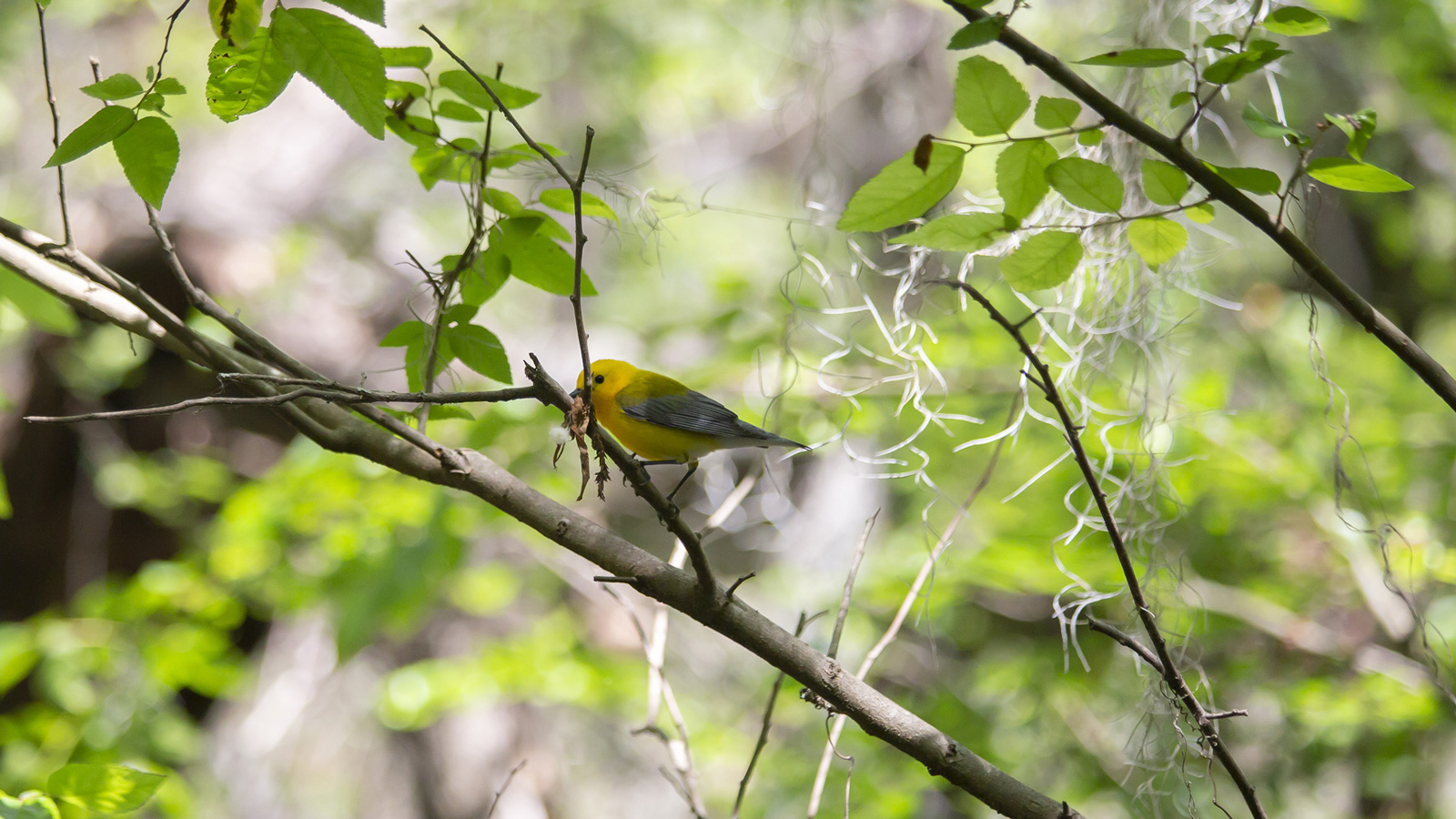
Prothonotary Warbler (Protonotaria citrea) The most striking breeding warbler in North Louisiana's bottomland forest, nesting in tree cavities near water with a vivid golden-yellow head and breast that earns it the nickname "golden swamp canary" in the regional birding community. Prothonotary Warblers return to North Louisiana in early April and immediately begin the cavity-nesting process, competing with other cavity-dependent species for the limited supply of suitable nest holes in bottomland timber. The song, a loud, ringing "sweet-sweet-sweet" delivered repeatedly from perches near water, carries across bottomland forest clearings and locates these birds efficiently once the song pattern locks in.
Common Yellowthroat (Geothlypis trichas) A breeding species in North Louisiana's wetland edges, shrubby marsh margins, and dense riparian thickets, the Common Yellowthroat represents one of the most abundant and widely distributed warblers in the region. The male's black mask across the face against a yellow throat identifies the species immediately in breeding plumage, and the song, a rolling "witchety-witchety-witchety" delivered emphatically from inside dense vegetation, establishes territory at volume from before dawn. Common Yellowthroats breed in North Louisiana and also appear as migrants in larger numbers, which means this species turns up across more habitat types and more months than most other warblers in the region.
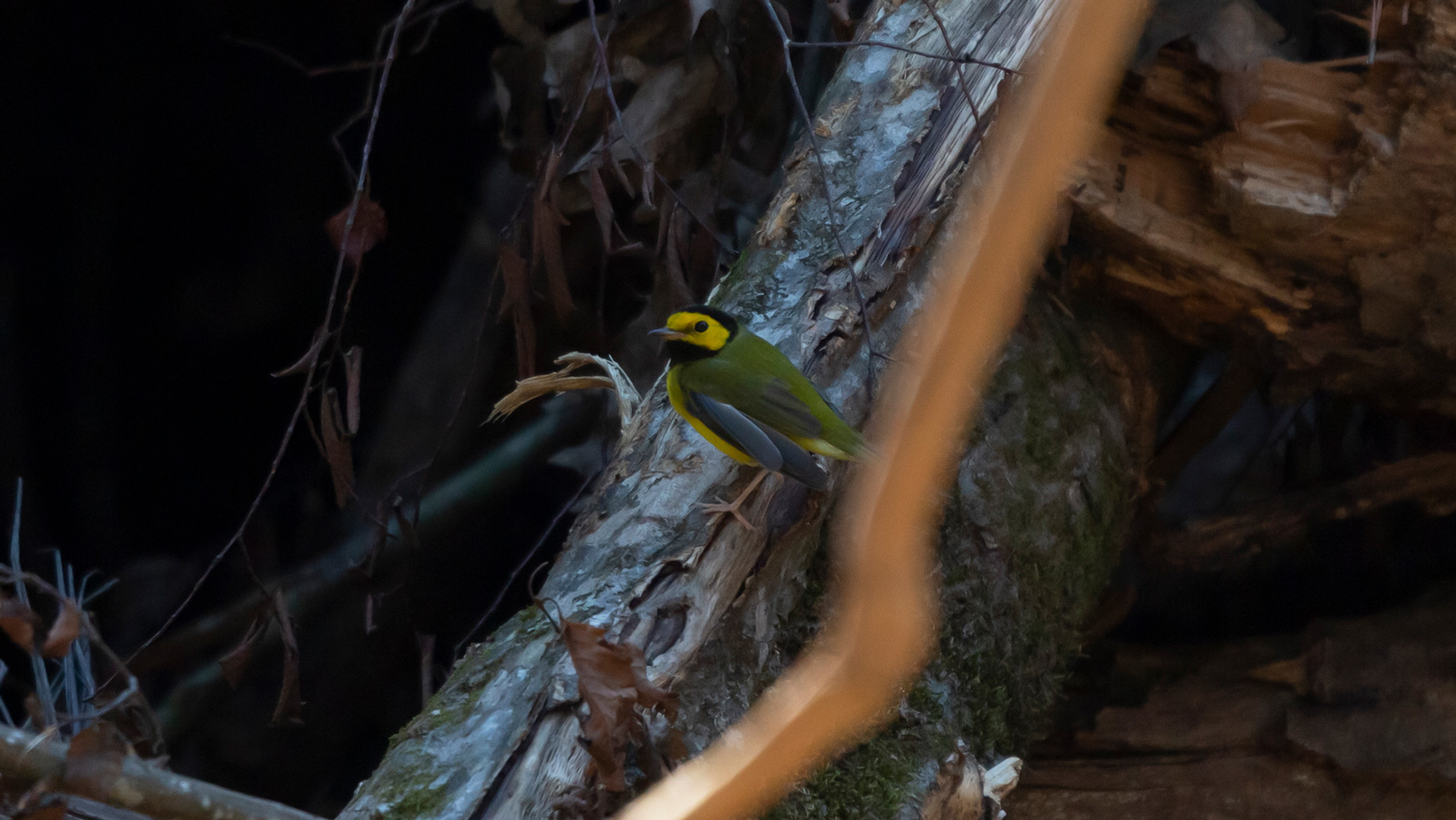
Hooded Warbler (Setophaga citrina) A breeding species in North Louisiana's mature bottomland and upland hardwood forest, the male Hooded Warbler carrying a black hood surrounding a bright yellow face represents one of the more dramatic breeding plumage combinations in the regional warbler community. Hooded Warblers occupy the forest understory, foraging in the dark interior of mature woods where the hood and yellow face create a signal that reads clearly even in low light. The tail-fanning behavior, frequent and distinctive, flashes the white outer tail feathers as the bird moves through the understory, a field mark visible before the face pattern registers.
Yellow-breasted Chat (Icteria virens) Technically removed from Parulidae in recent taxonomic revisions and placed in its own family, but included here because every birder in North Louisiana still calls it a warbler and nobody wants that conversation in the field. The largest "warbler" in North America, nearly twice the size of most true warblers, with a yellow breast, white spectacles, and a song repertoire of whistles, cackles, and mechanical sounds that sounds nothing like any other bird in the region. Yellow-breasted Chats breed in dense shrubby thickets and forest edge habitat across North Louisiana and sing with a persistence and variety that makes them detectable at significant distance.
Louisiana Waterthrush (Parkesia motacilla) A breeding species along North Louisiana's fast-moving streams and creek margins, the Louisiana Waterthrush walks along stream banks with a distinctive teetering motion, constantly bobbing the rear of the body in a behavior visible from considerable distance. The song, loud and musical with a cascading quality, carries downstream along creek corridors and locates these birds in the riparian habitat they occupy from early spring arrival through summer. The white eyebrow stripe, brownish upperparts, and streaked underparts with a buff wash on the flanks separate Louisiana Waterthrush from the Northern Waterthrush that passes through during migration.
Pine Warbler (Setophaga pinus) The only warbler that breeds year-round in North Louisiana's pine forest, Pine Warblers occupy longleaf and loblolly pine stands across the western and central parishes with a faithfulness to pine habitat that makes them predictable residents of Kisatchie National Forest and similar pine-dominated landscapes. The male's yellow breast and two white wing bars against the olive-green back provide field marks visible in the pine canopy, and the trilling song, similar in quality to a Chipping Sparrow but slower and richer, carries through pine woodland continuously during breeding season.
Yellow-throated Warbler (Setophaga dominica) A breeding species in North Louisiana's mature bottomland forest and Spanish moss-draped cypress swamps, the Yellow-throated Warbler creeps along large branches with a nuthatch-like deliberateness that distinguishes its foraging style from most other warblers. The gray upperparts, black face mask, white eyebrow, and yellow throat create a distinctive field pattern, and the habit of foraging high in the canopy and along large horizontal branches puts this species in a consistent location once the habitat gets identified.
Winter Warblers of North Louisiana
Several warbler species stop in North Louisiana and winter instead of continuing to tropical wintering grounds, taking advantage of the region's mild winters and the berry-rich vegetation that supports them through the cold months.
Yellow-rumped Warbler (Setophaga coronata) The most abundant warbler in North Louisiana during the winter months by a margin so large it almost constitutes a different category of bird. Yellow-rumped Warblers arrive in October and stay through April in numbers that transform hedgerows, forest edges, and shrubby fields into warbler habitat for half the year. The yellow rump patch visible in flight from most angles, the yellow side patches, and the yellow crown patch create the "butter butt" field marks that identify this species from most viewing distances in most lighting conditions. Yellow-rumped Warblers eat berries in addition to insects, which allows them to winter further north than most warblers and explains their presence in North Louisiana when other species keep heading south.
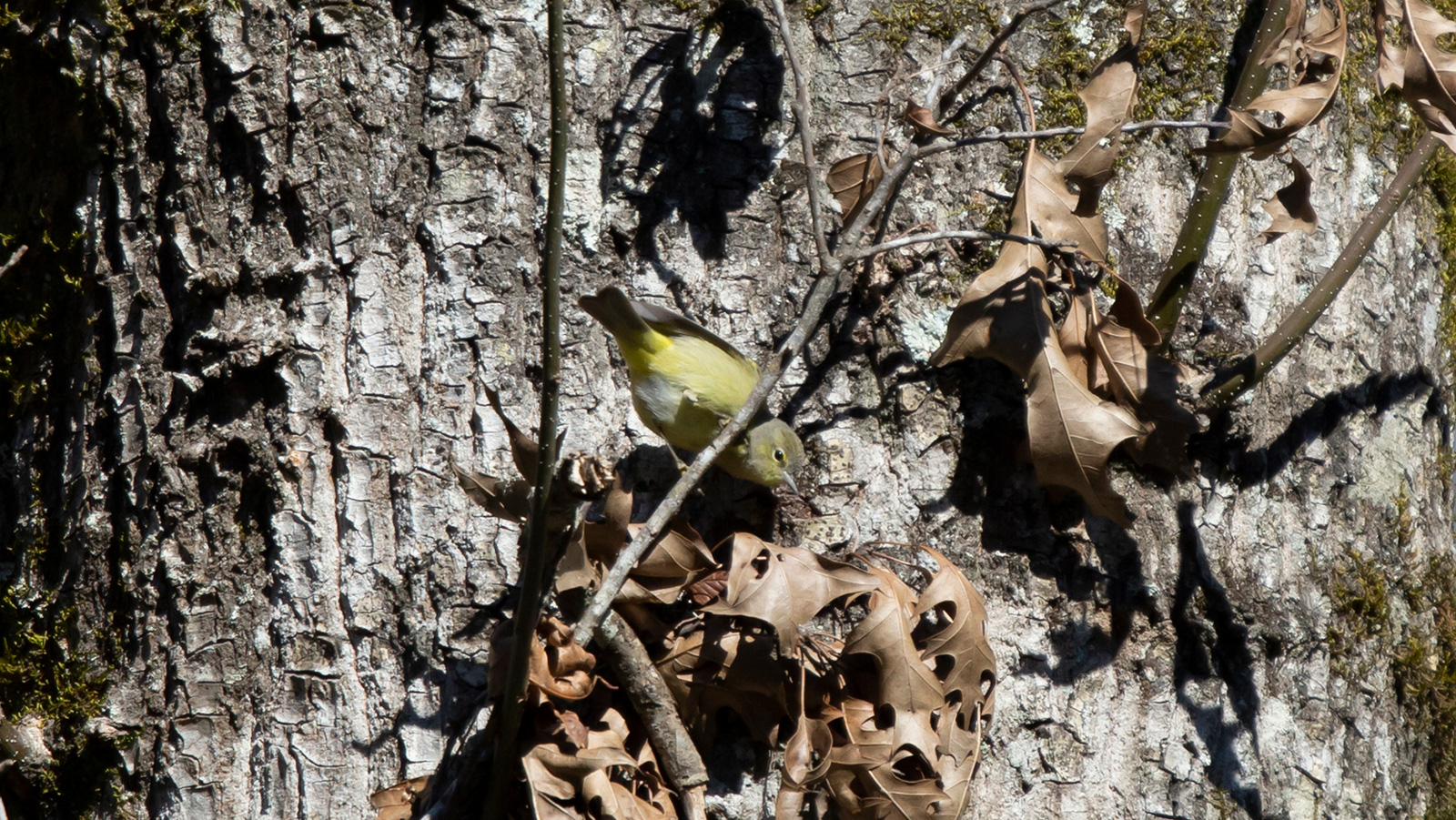
Orange-crowned Warbler (Leiothlypis celata) A drab winter resident that tests observer patience by offering essentially no field marks beyond "small, greenish, slightly yellowish underneath, moving through low vegetation." The orange crown that gives the species its name stays hidden under other feathers most of the time and rarely appears in field observations. Orange-crowned Warblers reward attention to habitat and behavior: they favor dense low shrubs and forest edge vegetation, forage lower in the vegetation than most winter warblers, and the faint blurry streaking on the breast that most field guides mention as a field mark requires better light and closer range than most field encounters provide. The song, a descending trill, identifies them when they cooperate by singing during late winter.
Pine Warbler (Setophaga pinus) Year-round resident covered in the breeding section above, but worth noting that winter Pine Warbler flocks in North Louisiana's pine forest include both resident birds and individuals that bred further north and moved south to winter, producing larger winter concentrations than the breeding season population alone would suggest.
Spring Migration: The Event
Spring warbler migration through North Louisiana runs from late March through late May, with the peak moving through the last two weeks of April and the first two weeks of May in most years. The timing reflects the birds' departure from tropical wintering grounds and their arrival on Gulf Coast staging areas before the final push north, with weather systems playing a significant role in concentrating migrants into specific dates and locations.
Cold fronts moving through the region during spring migration create the "fallout" events that North Louisiana birders plan around. A cold front arriving after a period of southerly winds grounds northbound migrants that were making progress and forces them down into whatever woodland or shrubby habitat lies below. The morning after a significant cold front during peak migration produces woodland patches with dozens of warbler species moving through simultaneously, with birds at eye level and overhead and in the understory all at once, the entire canopy apparently in motion. These events get texted between birding contacts across the region within hours of the first observer arriving at a productive site.
The geography of North Louisiana positions the region on the approach to the primary land mass after the Gulf crossing, making it one of the first substantial woodland stops for birds that made the overnight water crossing from Mexico and Central America. Birds arriving depleted from the crossing concentrate in the first good woodland they encounter, which in North Louisiana means the bottomland hardwood corridors along the Red River, Ouachita River, and their tributaries, the wooded parks and neighborhoods of Shreveport-Bossier and Monroe, and the woodland fragments of Kisatchie National Forest. The same bird that crossed four hundred miles of open water overnight lands in a Natchitoches city park and eats insects for three days before continuing north.
Fall Migration: The Hard Version
Fall warbler migration runs from late July through November, substantially longer than the spring push, with early-moving species departing breeding grounds while other species still hold summer territory. The extended timeline and the absence of breeding plumage in most species creates the identification challenge that fall warblers famously deliver.
Adult males retain enough of their breeding plumage in early fall to provide identification cues before the complete molt to winter plumage finishes. By September and October, the drab fall plumage of females and young-of-year birds dominates the migrant stream, producing the olive-and-yellow-and-white combinations that require systematic field mark examination, none of the immediate recognition that bright spring males hand you on a plate. The field guide pages for fall warblers run longer than spring pages for the same species, carrying more qualifying language and more caveats about individual variation, which accurately reflects the identification experience.
Yellow-rumped Warblers dominate the fall migration numbers as they do the winter resident population, with large flocks moving through in October and November that dwarf the numbers of any other warbler species. Mixed flocks containing Yellow-rumped Warblers often carry other warbler species moving with the flock, and scanning through a Yellow-rumped Warbler flock in fall migration regularly produces less common species mixed into the group.
Notable Migrants
Beyond the breeders and winter residents, dozens of warbler species pass through North Louisiana in numbers ranging from abundant to genuinely rare. The most notable migrants in terms of abundance, identification interest, and seasonal impact include the following.
Magnolia Warbler (Setophaga magnolia): A spring and fall migrant with male breeding plumage combining black streaking on a yellow breast with a gray head and white wing patch that makes spring males immediately recognizable. Fall birds require attention to the necklace of black streaking across the upper breast and the distinctive tail pattern with white patches and a black terminal band.
Black-throated Green Warbler (Setophaga virens): A migrant with a yellow face and olive-green back in both male and female, and in spring males a black throat that frames the yellow face cleanly. The "zee-zee-zee-zoo-zee" song pattern identifies this species acoustically during spring migration when singing males move through.
Chestnut-sided Warbler (Setophaga pensylvanica): Spring males carry chestnut streaking on the sides against white underparts and a yellow crown, a combination that makes spring identification straightforward. Fall birds show bright lime-green upperparts and white underparts, looking different enough from spring that beginning birders sometimes treat them as separate species until the field marks assemble.
Tennessee Warbler (Leiothlypis peregrina): An abundant spring and fall migrant that passes through North Louisiana in large numbers while looking as plain as possible, with greenish upperparts and whitish to pale yellowish underparts and a white eyebrow stripe providing the primary identification features. Tennessee Warblers make up for plumage modesty with numbers, sometimes appearing in large concentrations during peak spring migration.
American Redstart (Setophaga ruticilla): A migrant with adult males showing black-and-orange plumage that qualifies as among the most striking in the warbler family, with orange patches on the wings and tail flashing during the butterfly-like foraging behavior that makes redstarts identifiable by movement before the colors register. Females and young birds show yellow where males show orange, providing a paler but structurally similar pattern.
Black-and-white Warbler (Mniotilta varia): A migrant and occasional winter resident that forages along branches and bark surfaces in the creeping manner of a nuthatch, using its slightly longer and more curved bill for probing bark crevices. The bold black-and-white streaking and the creeping foraging behavior identify this species immediately in most lighting conditions.
Mourning Warbler (Geothlypis philadelphia): One of the rarest regular warblers passing through North Louisiana, moving through in small numbers during spring and fall migration in dense low vegetation where it stays frustratingly close to the ground and equally frustratingly difficult to observe. The gray hood of spring males with the incomplete black breast band and yellow underparts provide the identification features when the bird finally cooperates with a view.
Identification Strategies
Fifty-plus warbler species create an identification challenge that rewards systematic approach more than pattern recognition alone, though pattern recognition develops over time and eventually allows rapid identification of familiar species.
Start with the parts of the bird that show most clearly from most angles: the presence or absence of wing bars, the eyebrow stripe pattern, and the underpart coloration. These three features narrow the field quickly from fifty possibilities to a manageable handful before face pattern, crown coloration, and back coloration refine the identification further.
Behavior helps as much as plumage in many cases. Ovenbirds walk on the forest floor. Louisiana Waterthrushes teeter on stream banks. Black-and-white Warblers creep along bark. American Redstarts fan their tails and wings constantly during foraging. Palm Warblers pump their tails repeatedly while perched. These movement signatures identify the species before the field marks register, particularly in the low light of dense forest understory where plumage details blur.
Song provides the most reliable identification when birds cooperate by singing, and spring migration brings singing males that announce their identity acoustically without requiring a clear visual. Investing in warbler song learning through recorded audio before the spring migration window pays dividends immediately, because the ear finds singing birds that the eye would miss entirely in the canopy.
Where to Find Warblers in North Louisiana
Bottomland hardwood forest along the Red River and Ouachita River drainages concentrate spring migrants in the woodland corridors that parallel the rivers. Bodcau Wildlife Management Area in Bossier and Red River parishes provides extensive bottomland hardwood access with breeding Prothonotary Warblers, Hooded Warblers, and Louisiana Waterthrushes during the summer season and migrant diversity during spring and fall. Kisatchie National Forest units in Natchitoches, Winn, and Vernon parishes support breeding Pine Warblers and Yellow-throated Warblers in pine and mixed pine-hardwood habitat.
City parks and residential neighborhoods with mature trees produce surprising warbler diversity during migration peaks, particularly in the Shreveport-Bossier metropolitan area, Monroe, and Ruston. Migrants that crossed the Gulf overnight don't wait for wilderness to land , they land in whatever trees they find, which sometimes means a city park running double-digit warbler species on the morning after a cold front.
Accessibility
Warbler presence registers acoustically before visual confirmation becomes possible in most North Louisiana woodland settings. The high-pitched songs of breeding warblers carry through forest vegetation and identify species by ear before any sightline opens to the singing bird. Prothonotary Warbler song rings across bottomland clearings at real volume. Common Yellowthroat song pushes through marsh edge vegetation with surprising carrying power. Hooded Warbler song cuts through forest understory and locates the bird directionally before any movement registers in the foliage.
Fall migration warbler flocks produce a collective sound distinct from the singing of spring migrants: soft chip notes from multiple individuals moving through vegetation simultaneously, each chip note slightly different between species in ways that experienced birders use for identification. Yellow-rumped Warblers produce a distinctive check note. American Redstarts produce a sharp "chink." Black-and-white Warblers produce a high, thin "tsip." Learning the chip notes alongside the songs doubles the acoustic identification vocabulary available during migration.
Most productive warbler observation across North Louisiana happens in the first two hours after sunrise during peak migration weeks in late April and early May, when birds feed actively after overnight travel and the light angle supports color perception in the forest canopy. A trail through bottomland hardwood forest, a section of Kisatchie pine mixed with hardwood edge, or a city park with mature trees all produce warbler encounters during migration if the timing falls during peak movement.
More Information
Louisiana Ornithological Society — losbird.org Cornell Lab of Ornithology Warbler Guide — allaboutbirds.org Louisiana Bird Records Committee — labrc.org iNaturalist North Louisiana Parulidae Observations — inaturalist.org
Species Profiles
Individual articles cover each North Louisiana warbler species in depth.
Breeding Species
Prothonotary Warbler
Common Yellowthroat
Hooded Warbler
Yellow-breasted Chat
Louisiana Waterthrush
Pine Warbler
Yellow-throated Warbler
Winter Residents
Yellow-rumped Warbler
Orange-crowned Warbler
Notable Migrants
Magnolia Warbler
Black-throated Green Warbler
Chestnut-sided Warbler
Tennessee Warbler
American Redstart
Black-and-white Warbler
Mourning Warbler
Nashville Warbler
Wilson's Warbler
MacGillivray's Warbler
Palm Warbler
Yellow Warbler
Yellow-rumped Warbler
Northern Parula
Ovenbird
Northern Waterthrush
Kentucky Warbler
Canada Warbler
Blackpoll Warbler
Bay-breasted Warbler
Blackburnian Warbler
Frequently Asked Questions
How many warbler species pass through North Louisiana? More than fifty species appear on the North Louisiana list across all seasons combined, ranging from abundant breeders and winter residents to rare migrants documented in small numbers. The spring migration window concentrates the highest species diversity into the shortest time period, with peak days during late April and early May sometimes producing thirty or more warbler species across the region.
When does spring warbler migration peak in North Louisiana? The last two weeks of April and first two weeks of May cover the peak for most species, with the specific timing shifting a few days based on weather patterns each year. Cold fronts during this window ground northbound migrants and create the fallout events that produce the highest single-day species counts. Monitoring weather forecasts during late April and planning woodland visits for the morning after a cold front during southerly winds produces the most concentrated warbler observation opportunities.
Why do fall warblers look so different from spring warblers? Most warblers molt out of breeding plumage after the breeding season, replacing the vivid male breeding colors with a duller, more cryptic plumage better suited to migration and winter survival. The same species blazing through in vivid colors in May moves through in September in plumage that shares the general color scheme but lacks the contrast and saturation of spring. First-year birds in fall migration add additional plumage variation because they never developed full adult breeding plumage to begin with.
What's the best way to learn warbler songs? Audio recordings paired with deliberate listening sessions before the migration season builds the song library faster than field learning alone. The Cornell Lab's Macaulay Library and the Merlin Bird ID app both provide high-quality recordings organized by species. Focusing on the five to ten most abundant spring migrants before branching into rarer species builds confidence faster than attempting to learn all fifty simultaneously.
Do warblers visit feeders? Most warblers eat insects, skip seeds entirely, and don't use seed feeders. Yellow-rumped Warblers eat suet and occasionally visit feeders offering mealworms. Orange-crowned Warblers sometimes use suet feeders during winter. Offering a water source through a dripper or small water feature attracts more warbler species to a yard during migration than any food offering, because migrating warblers need water for drinking and bathing regardless of food source preferences.
What's a warbler fallout and how do I find one? A fallout occurs when a cold front grounds northbound migrants during spring migration, concentrating birds into the first available woodland. The ingredients: a period of southerly winds helping birds north, followed by a cold front with north winds that stops their progress. The morning after the front arrives during peak migration produces the highest concentrations. Following North Louisiana birding listservs and eBird alerts during late April and early May surfaces fallout reports within hours of the first observers arriving at productive sites.