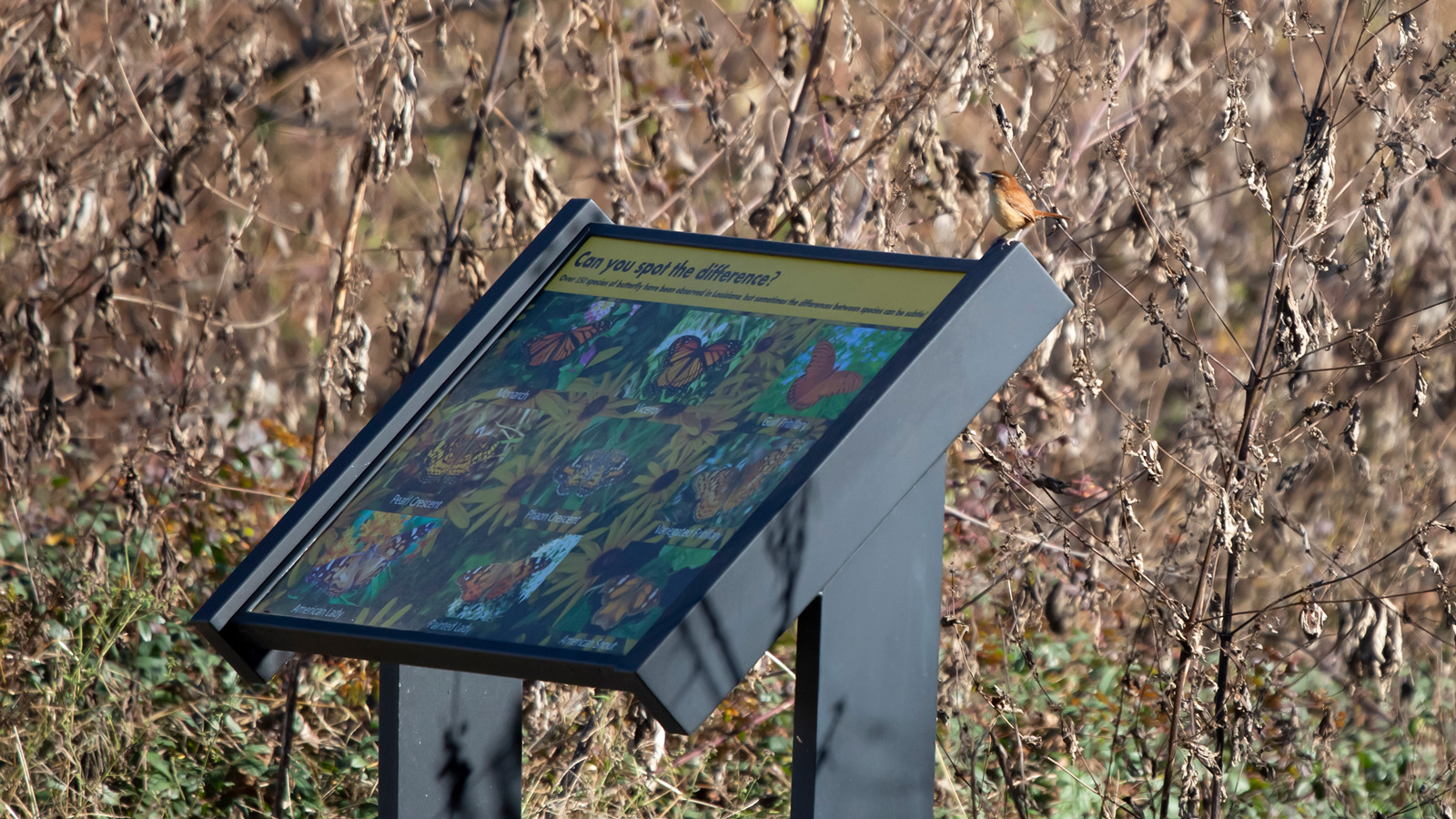
About Wrens
If you've ever been walking through a North Louisiana forest and heard a sound so loud, so aggressive, and so relentlessly cheerful that you expected to find a bird the size of a robin, only to discover the noise was coming from a brown bird the size of your thumb — congratulations, you've met a wren. Wrens are the birds that prove volume has nothing to do with body size. They are tiny, hyperactive, absurdly loud, and convinced that every square foot of habitat they occupy belongs to them personally. They sing like they're trying to be heard in the next parish, and given their lung capacity relative to their body mass, they might actually succeed.
North Louisiana hosts two regular wren species, and while they share the family name and a general commitment to being brown, noisy, and irritable, they occupy very different niches and show up at very different times of year. Carolina wrens are the year-round residents — the ones you hear singing from your porch railing in July, nesting in your garage, and scolding your cat from the azalea bush. Winter wrens are the seasonal visitors — small, secretive, mouse-like birds that creep through dense underbrush during the colder months and produce a song so complex it sounds like it was written by a committee of composers who couldn't agree on a key.
The Wren Family
Wrens belong to the family Troglodytidae — a name derived from the Greek word troglodytes, meaning "cave dweller." The name refers to the family's general habit of creeping into dark holes, crevices, and dense tangles rather than perching in the open. Wrens are skulkers. They live in the understory, in brush piles, in fallen logs, in the gap between your house and the air conditioning unit. They are built for tight spaces and dark corners, and their compact bodies, short tails (often cocked upward at a jaunty angle), and strong legs reflect that lifestyle.
The family is primarily a New World group — most wren species are found in the Americas, with only one species (the Eurasian wren) occurring naturally in the Old World. North America hosts about 11 wren species depending on taxonomy, and North Louisiana's two regulars — Carolina and winter — represent the most common eastern species. Other wrens pass through occasionally during migration, but Carolinas and winters are the two you'll encounter with any regularity.
Both species are insectivores, though Carolina wrens supplement their diet with seeds and berries during winter. Both are cavity or crevice nesters to varying degrees. And both share the wren family's signature behavioral trait: they are much, much louder than any bird their size has any business being.
A Carolina wren's "teakettle-teakettle-teakettle" can be heard a quarter mile away. A winter wren's song can contain over 30 notes per second. These are not quiet birds. They are small birds with enormous opinions.
When and Where
Carolina wrens are year-round residents across all 26 parishes in our coverage area. They're non-migratory, which means the bird singing outside your window in January is the same bird that was singing there in July. They're habitat generalists within their preferred niche — wooded areas, brushy edges, suburban yards, barns, garages, sheds, and pretty much any structure that provides crevices for nesting and cover for foraging. If you have a house in North Louisiana, you have Carolina wrens. They were there before you moved in and they'll be there after you leave.
Winter wrens are migrants that arrive in October and November and depart by March or April. They breed in the boreal and montane forests of the northern United States and Canada — dense, mossy, old-growth coniferous forests that couldn't be more different from a North Louisiana bottomland hardwood swamp. But during winter, they descend into our dense understory habitats, where they skulk through brush piles, root tangles, and downed timber with the stealth of a mouse wearing feathers. Finding a winter wren requires patience, sharp ears, and a willingness to stare at a brush pile for longer than most people consider reasonable.
Accessibility
Wren watching presents different accessibility profiles depending on the species. Carolina wrens are among the most accessible birds in North Louisiana — they live in yards, parks, and developed areas, sing loudly, and perch in the open frequently enough to provide easy viewing. For birders with mobility limitations, Carolina wrens come to you. They forage on porches, deck railings, window ledges, and the sides of buildings. Any residential area in the 26 parishes provides Carolina wren habitat. For birders with vision impairment, the Carolina wren's loud, repetitive "teakettle" song is one of the most recognizable and locatable bird sounds in the region.
Winter wrens are harder. They stay low, they stay hidden, and their winter call is a sharp, doubled "chimp-chimp" that's quieter and less carrying than the Carolina wren's song. For birders with mobility limitations, boardwalk trails through dense bottomland forest — Black Bayou Lake NWR, D'Arbonne NWR — offer the best chance of encountering a winter wren without navigating uneven terrain. For birders with vision impairment, the winter wren's call note is distinctive once learned but requires closer proximity to detect than the Carolina wren's song.