About Turtles
Turtles in Louisiana are engineered for chaos, and North Louisiana gives them plenty of it. Rivers rise, banks collapse, sandbars disappear, summer turns water into bath soup, winter drops temperatures hard enough to make everything else reconsider its life choices, and the turtles persist. They don't panic when the Ouachita floods. They don't melt when August decides to weaponize humidity. They absorb it, adjust to it, and keep moving like they've seen worse before.
Floodwater rearranges the Red River every year, carving new channels and swallowing old ones, yet shells still appear on the next stable log as if nothing changed. A cold snap will silence the frogs and slow the fish, but turtles bury into mud, lower their metabolism, and wait it out without theatrics. Heat waves drive most sensible creatures into shade, yet you'll still see turtles stacked in direct sun because that sun is the engine that runs their body. They are not reckless; they are adapted to a system that punishes hesitation.
Stand long enough along any North Louisiana waterway and something simple becomes clear. These animals do not survive because conditions are gentle. They survive because conditions are unstable. The entire design, bone-fused shell, temperature dependence, slow growth, long lifespan, reads like a blueprint for endurance in a place that never stays the same for long.
What Makes a Turtle Different From Everything Else Moving in the Water
A turtle is not just another reptile with a shield strapped on. The shell is bone integrated into the skeleton, ribs widened and fused into the carapace, spine locked into the structure, plastron sealing the underside. When a turtle pulls inside, it is not ducking into a backpack. It is retracting into its own framework. That matters because it explains why these animals absorb impacts that would cripple something built lighter.
River species in Louisiana carry flatter shells because current punishes unnecessary bulk. Forest species carry high domes because teeth and claws punish exposed surfaces. Softshell turtles discard rigid plating in favor of speed and flexibility, betting on reaction time and not armor thickness. Each design choice reflects habitat pressure, not aesthetic difference.
Temperature drives everything they do. These reptiles do not manufacture body heat internally. The sun is not optional. Morning basking sessions along the Black River are not social calls; they are metabolic resets. Digestion slows without warmth. Movement weakens. Immune response drops. A turtle unable to heat up becomes vulnerable, and vulnerability in a river full of opportunists does not last long.
Because they rely on environmental heat, their rhythm follows seasonal swings. Spring sunlight triggers visible movement. Summer heat forces calculated retreat into deeper channels. Winter sends many species into brumation, where they bury into mud and reduce activity to a minimum that still sustains life. They are not gone in winter; they are conserving energy while everything loud above them freezes or complains.
The Water Shapes the Behavior
North Louisiana waterways are not stable straight lines. The Ouachita curves and doubles back. The Red River shifts sediment and reshapes banks. The Black River flows dark beneath cypress branches that shed limbs into the channel every storm season. Those fallen limbs become platforms. Platforms become basking stations. Basking stations become predictable territory.
Map turtles prefer current and depth, choosing stronger channels where mussels and snails thrive. Sliders show less loyalty to flow and will settle in ponds, lakes, and urban retention basins as long as sun and food exist. River cooters lean into vegetation-heavy stretches where aquatic plants support steady grazing. Snapping turtles favor depth and concealment, staying submerged or partially hidden until something edible wanders too close.
Softshell turtles claim sandy bottoms where burial offers camouflage. Only eyes and nostrils show above the substrate, turning a harmless-looking sand patch into a spring-loaded predator. Box turtles remove themselves from the water conversation entirely, occupying forest floor and grassy clearings, walking with slow insistence through pine straw and leaf litter.
Flood events shift logs and drown old sandbars, yet turtles relocate within the system and don't abandon it. They adjust their basking platforms. They test new banks for nesting. They adapt because the alternative ended for less flexible designs millions of years ago.
Species You'll Actually Encounter
North Louisiana does not run on one or two turtle types. The diversity here stretches across rivers, ponds, swamps, and forests, and each species occupies a slightly different lane.
The Red-eared Slider is the most frequently seen freshwater turtle in Louisiana. That red streak behind the eye makes identification easy, especially in younger individuals with brighter green shells and crisp patterning. As they age, the shell darkens and the red marking can fade, leaving older sliders looking almost charcoal with faint striping. They tolerate a wide range of habitat conditions, stack heavily on logs, and thrive in environments ranging from quiet oxbows to suburban retention ponds.
The Yellow-bellied Slider also occurs in parts of Louisiana and is frequently confused with the Red-eared Slider. Instead of the red ear patch, it carries a yellow marking behind the eye and a yellow plastron with darker blotches. In mixed basking groups, careful attention to head markings separates them quickly.
River Cooters grow larger than sliders and carry elongated, oval shells patterned with yellow striping that sometimes forms intricate swirling designs. They favor flowing systems and spend significant time basking alongside sliders. Larger individuals occupying prominent log positions in rivers often turn out to be cooters, not sliders.
Map turtles anchor themselves to rivers with consistent current. In North Louisiana, the Mississippi Map Turtle and Ouachita Map Turtle dominate larger drainages, while the Sabine Map Turtle appears within its more limited range. These turtles display fine, map-like lines across their shells and pronounced keels, especially in males. Females grow dramatically larger and develop broader heads designed to crush mussels and snails. That sexual size difference can be so extreme that the two sexes appear unrelated at first glance.
Snapping turtles represent a different approach entirely. The Common Snapping Turtle is widespread and adaptable, favoring deeper water and heavy cover. Open basking is rare for this species; snapping turtles stay submerged or partially concealed and surface without announcement. The Alligator Snapping Turtle, heavier and more prehistoric in appearance, carries a ridged shell and massive head that sets it apart immediately. This species prefers large river systems and deep channels, using a worm-like appendage inside its mouth to lure fish within striking range.
Softshell turtles replace rigid armor with speed and concealment. The Spiny Softshell appears more frequently in many Louisiana rivers, while the Smooth Softshell also occurs within the state. Both species favor sandy bottoms where they can bury themselves almost completely, leaving only eyes and nostrils exposed. Their flattened bodies and extended necks allow quick bursts of movement that contradict most assumptions about turtle speed. The flattened appearance is not damage. It is exactly what a softshell turtle is supposed to look like.
Musk turtles add smaller-bodied diversity to the mix. The Eastern Musk Turtle and the Razor-backed Musk Turtle both occur in Louisiana waters, preferring quieter habitats with structure. These turtles stay relatively small, release strong odor from scent glands when handled, and persist steadily in the same systems despite being less visible than basking species.
Chicken Turtles occur in Louisiana as well, favoring still or slow-moving water with abundant vegetation. They carry elongated necks and smoother shells compared to sliders and cooters. Their seasonal movement patterns differ from more commonly observed basking turtles, which leads to fewer casual sightings despite stable populations in suitable habitat.
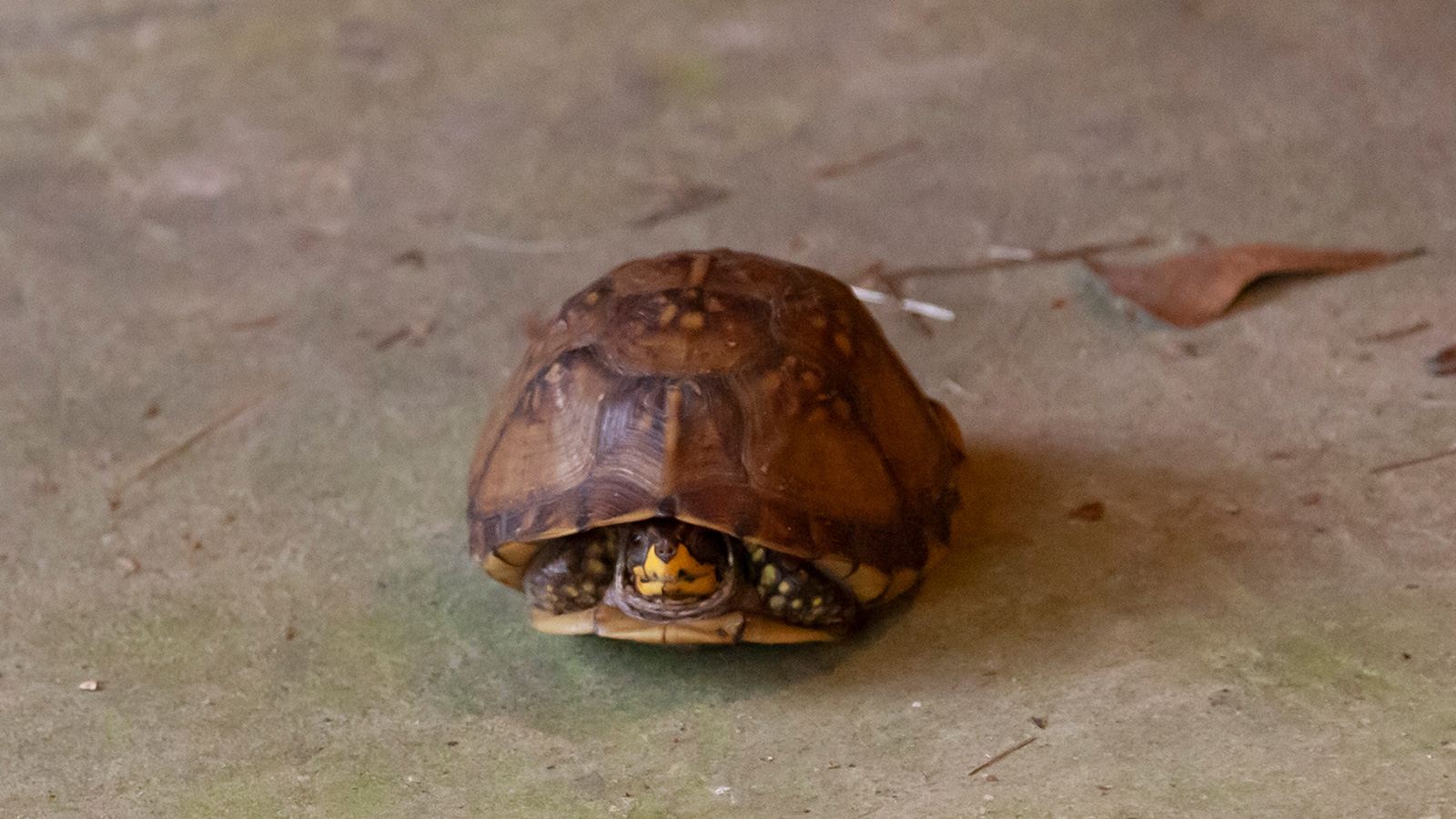
Eastern Box Turtles and Three-toed Box Turtles represent the terrestrial branch of Louisiana turtle species. High-domed shells, hinged plastrons, and bright orange or yellow markings distinguish them from aquatic species immediately. They occupy forests, grassy fields, and woodland edges, feeding on insects, fruit, fungi, and carrion. Their loyalty to small home ranges makes displacement especially harmful, because a box turtle moved even a mile from its established range faces survival challenges that aquatic species with larger movement patterns don't encounter in the same way.
Louisiana supports one of the most diverse turtle communities in the southeastern United States. From log-stacking sliders to deep-channel snappers to forest-roaming box turtles, each species occupies a specific ecological niche shaped by water, temperature, structure, and food availability.
When You're Most Likely to Notice Them
Spring sunlight reveals them first. As water temperatures climb, basking becomes frequent and visible. Logs fill with shells. Sandbanks show nesting tracks. Movement increases because metabolism finally catches up with winter dormancy.
Early morning offers the best basking observation before boat traffic and shoreline activity trigger mass dives. By midday in peak summer, activity shifts into deeper water where heat stress becomes manageable. Late afternoon sometimes produces a second round of basking if cloud cover or breeze moderates temperature.
Autumn cools the surface but does not erase activity immediately. Turtles feed steadily in preparation for colder months. Winter reduces visibility significantly as many freshwater species bury into mud and enter brumation. Activity slows and does not stop; they survive underwater in low-oxygen conditions through physiological adaptations that border on stubbornness.
Rain events influence terrestrial species most visibly. Box turtles move more during wet conditions when soil softens and prey emerges. Increased movement increases road crossing risk.
Identification Without Guessing
Habitat gives the first clue. Fast current and deep river channels suggest map turtles or cooters. Stagnant pond environments suggest sliders. Forest floor far from permanent water suggests box turtle. Sandy river bottom with quick movement suggests softshell. Muddy, deeper water with minimal visible basking suggests snapping turtle.
Shell shape refines the guess. Flattened equals aquatic. Domed equals terrestrial. Flexible equals softshell. Head markings confirm details. Red patch behind the eye signals slider. Thin yellow bars behind the eye signal map turtle. Massive head and hooked beak signal snapper.
Behavior seals the deal. Large social basking clusters often mix sliders and cooters. Smaller, deeper-channel groups lean map turtle. Solitary, submerged presence leans snapping turtle. Sand-buried eyes above substrate lean softshell. Watching longer almost always clarifies what first glance cannot.
From Buried Eggs to Old River Kings
Every turtle you see stacked on a log started as a buried risk. No nursery, no guard duty, no sentimental woodland parent hovering nearby. Just a female hauling herself out of water sometime between late spring and early summer, dragging mud and river smell onto a sandy bank like she owns the place. She tests the ground with her back feet, digs a flask-shaped chamber with mechanical precision, drops a clutch of soft-shelled eggs into it, and covers the whole operation. Then she turns around and goes back to the river. That is the entire parental investment.
Nesting in North Louisiana isn't tidy. Sandbars shift. Levees harden. Road shoulders look suspiciously like suitable nesting substrate, which is unfortunate because pavement does not negotiate with biology. Sliders might lay a dozen eggs. Cooters can push that number higher. Snapping turtles can lay twenty, thirty, sometimes more. Box turtles keep it smaller and slower, consistent with a life history built around longevity over volume. Temperature does the rest. Warm sand accelerates development. Cooler ground drags it out. The sun, not instinct, often decides the sex of the hatchlings, because in many turtle species temperature influences whether eggs become male or female. A string of hotter-than-usual seasons can quietly tip the demographic balance without anyone noticing until it's too late.
Hatching isn't cinematic. It's violent and fast. Tiny turtles crack through shells with a temporary egg tooth, shove through packed soil, and surface into a world that has been waiting to eat them. Fire ants will swarm a fresh nest if given half a chance. Raccoons can smell disturbance and dig like professionals. Crows watch open sand like it's a buffet. The distance between nest and water may be twenty feet, but those twenty feet are a statistical bloodbath. Most of them won't make it to the shallows. That's not pessimism; it's math, and the math is built into the species' entire reproductive approach.
Growth takes time. Sliders and cooters might need several years before they're large enough to reproduce. Map turtle females take even longer because they grow larger and invest more energy into reaching a body size that can crush mussels. Snapping turtles may spend close to a decade reaching sexual maturity. Adults that survive can reproduce for decades. Longevity in turtles is not myth; it's design. Some individuals live well past forty or fifty years in stable habitat. That means a snapping turtle you see today might have been cruising the same stretch of river when people were still arguing about dial-up internet.
Everything That Wants to Eat Them
Eggs sit at the bottom of the food chain with no defense except camouflage and luck. Raccoons treat nesting season like a scheduled event. They memorize sandbars and return repeatedly. Skunks, foxes, opossums, and feral hogs dig opportunistically. Fire ants don't need a plan; they need scent and numbers. In heavily trafficked nesting areas, it is entirely possible for nearly every unprotected clutch to disappear before hatching.
Hatchlings face a second wave immediately. Herons stab quickly and swallow whole. Egrets patrol shallows. Bass wait under the surface. Even bullfrogs will attempt to swallow small turtles if size allows. Cottonmouths take advantage of anything slow or exposed. The river does not pause for innocence.
Adult turtles earn relative security through size and bone. Still, nothing is absolute. Alligators can crush large turtles if opportunity lines up with hunger. Vehicle strikes kill nesting females with alarming frequency because they must cross open ground to reach suitable soil. Remove a breeding female from a population that matures slowly, and the impact echoes for decades.
Hooks and fishing line create silent casualties. A swallowed hook can mean infection and slow death. Line wrapped around a limb tightens as the turtle grows, cutting into flesh. Boat propellers crack shells in high-traffic waterways. Habitat modification removes sandy banks and replaces them with hard armoring that looks tidy but functions like a biological dead end.
Despite all of that, turtles persist because their approach anticipates loss. They are built around high early mortality balanced by long adult survival. When adult mortality spikes beyond that balance, decline follows quietly and without spectacle.
Humans: Problem and Occasionally Solution
People in Louisiana have a complicated relationship with turtles. Historically, some species were harvested for meat. That pressure reduced numbers in certain systems, particularly for large snapping turtles. Regulations now protect vulnerable species, but the memory of harvest lingers in population structure.
Modern threats look less dramatic and more constant. Roads slice through nesting corridors. Shoreline development replaces soft banks with bulkheads. Well-meaning individuals relocate turtles to "safer" areas, not realizing that most turtles operate within defined home ranges and may not survive displacement. Box turtles found crossing roads are often carried far from their home territory by well-intentioned drivers, which disrupts established patterns and increases mortality risk.
Conservation now focuses on habitat protection and monitoring long-lived species like the Alligator Snapping Turtle. That species relies on deep river channels and stable systems. Recovery is slow because maturity takes years and reproductive output depends heavily on adult survival. Protecting one adult female can matter more than protecting a dozen hatchlings.
Education is one of the simplest interventions available. Recognizing species reduces unnecessary fear. Leaving turtles in place instead of relocating them protects survival odds. Preserving natural sandbars and minimizing disturbance during nesting season maintains recruitment. Small changes compound over time, which the long-term structure of turtle populations makes legible in ways that fast-breeding species obscure.
The Identification Mistakes Everyone Makes
The most common confusion involves sliders. Red-eared Sliders and Yellow-bellied Sliders overlap in range and behavior. The red patch behind the eye separates the former from the latter, but older individuals darken and lose clarity. Plastron color and head striping patterns provide better confirmation than a quick glance at shell shape.
Map turtles and river cooters share basking logs in flowing systems. Map turtles carry sharper keels and more intricate shell lines. Cooters present smoother shells and broader bodies. Males in map turtle species stay much smaller than females, a detail that helps sort mixed groups.
Common Snapping Turtles are frequently mislabeled as Alligator Snapping Turtles. The latter possess more pronounced ridges and a heavier, blockier head. They also prefer larger, deeper river systems. Softshell turtles are sometimes assumed to be injured hard-shelled turtles because of their flexible carapace. The flattened appearance is not damage and is not injury. It is exactly the design a softshell turtle is supposed to have.
What They Actually Do for the System
Turtles occupy middle positions in food webs that rarely get attention. Sliders and cooters consume aquatic vegetation, influencing plant density and nutrient cycling. Map turtles reduce mussel and snail populations, affecting filtration rates and invertebrate balance. Snapping turtles remove carrion and prevent buildup of decaying material. Softshell turtles regulate fish and invertebrate populations in sandy-bottom stretches.
Nesting transfers nutrients from aquatic systems to terrestrial banks. Eggs deposit energy in soil. Predators consuming eggs redistribute nutrients again. Hatchlings moving back toward water return energy to the river. Even failed nests feed mammals and insects. Nothing in the cycle is wasted.
Because turtles depend on stable water, adequate basking structure, and suitable nesting banks, their consistent presence signals functional habitat. A log that fills with shells every spring suggests that enough pieces of the ecosystem hold together. When those logs sit empty year after year, something upstream has shifted.
The Math That Keeps Them Here
Freshwater turtles in Louisiana aren't built around speed or high reproductive turnover. They're built around durability. Lose ninety percent of your hatchlings? That's expected. Live long enough to reproduce for thirty or forty years? That's the counterbalance. That approach only works if adult survival stays high. When road mortality spikes during nesting season, the math starts to wobble. When sandbars vanish under development, recruitment drops. The effects aren't immediate. You don't see collapse overnight. You see fewer large females a decade later.
Healthy freshwater turtle populations in North Louisiana look like repetition. You see sliders on the same log year after year. You notice map turtles holding steady in a stretch of current that hasn't been straightened or armored. You encounter box turtles in the same patch of mixed hardwood and pine across multiple seasons. Water clarity, adequate basking structure, sandy nesting banks, and connectivity between backwaters and main channels all carry weight. When flood pulses can still move through a system without being trapped behind excessive barriers, turtles adjust naturally.
North Louisiana still holds functioning systems. The Ouachita River, segments of the Red River backwaters, refuge lands, and unmanaged oxbows continue to support layered turtle communities. They aren't untouched. They are simply intact enough. And intact enough is sometimes the difference between persistence and disappearance.
Floods don't destabilize them. They absorb the flood and wait it out. Heat doesn't catch them unprepared. They regulate around it and retreat when the calculations change. The bad decisions in this story belong mostly to people. Turtles evolved alongside unstable river systems. What they did not evolve alongside is shoreline hardening, high-speed traffic slicing through nesting corridors, and water chemistry changes from upstream runoff. They adjust when they can. When the adjustments run out, they endure. They are still here: layered across driftwood, buried in sand, crossing forest trails after rain, moving through systems that have been altered repeatedly and holding their place regardless. The entire design points toward one outcome, persistence, and it has been working for longer than anything else moving in these rivers.
Where to Watch Without Getting in the Way
The Ouachita River offers reliable sightings where fallen timber collects near bends with moderate current. Early morning light hits exposed logs first, drawing basking turtles out before boat traffic disrupts them. Black Bayou Lake provides quieter observation opportunities, especially along stretches with limited shoreline disturbance.
Red River backwaters and oxbow lakes often hold mixed species groups during warm months. Cypress-tupelo swamps reveal musk turtles and juveniles in shaded shallows if you move slowly and avoid splashing. Farm ponds with minimal activity can produce surprisingly dense basking clusters, though distance and patience are necessary.
Rain increases box turtle movement along forest edges. Softshell turtles reveal themselves in sandy shallows if you watch for eye ridges just above the surface. Snapping turtles rarely announce themselves but occasionally surface briefly before sinking back into shadow.
Stillness outperforms movement every time on a turtle outing. Noise empties logs faster than any predator, and the turtle that slipped into the water when you walked up will be back on the same log twenty minutes after you stop moving.
Accessibility
Before any visual search starts, the water tells you where the turtles are. The acoustic signature of a basking site is distinctive and consistent: a sequence of splashes that begins with one larger entry sound and resolves into two or three shorter ones as the group follows the first animal off the log. That pattern, one heavy splash followed by a cluster of smaller ones, identifies a basking site from the bank and distinguishes it from the single-splash entry of a fish or frog. On still mornings before boat traffic begins, this sequence carries from logs that aren't visible yet, locating turtles before binoculars are raised.
Large snapping turtles surfacing briefly in deeper water produce a sound unlike smaller species: a heavier disturbance that generates a wider ring and displaces more water on the surface draw. Softshell turtles moving across sandy shallows create a sustained substrate disturbance audible in very quiet conditions at close range. Turtles moving through leaf litter on forest paths generate a deliberate, low-to-ground shuffling that reads as larger-bodied and slower than squirrel or bird movement. The shell contact with fallen leaves is specific enough to narrow the source before any visual confirmation arrives.
For visitors who are blind or have low vision, the Ouachita River road corridors and Black Bayou Lake NWR paths deliver turtle acoustic signatures reliably in spring and early summer. A companion familiar with turtle behavior can narrate basking dynamics, species identification, and predator-avoidance dives from any accessible position along the bank. The splash sequence of a disturbed basking group provides a complete behavioral story in sound alone, identifying the log's position, the number of animals, and the direction each turtle took into the water.
For visitors using wheelchairs or with limited mobility, vehicle-based observation along river road corridors produces reliable sightings at dawn without any terrain navigation. Turtles habituate to slow-moving vehicles more readily than to approaching pedestrians, so a slow road drive at first light often delivers closer sustained views than trail access on foot. Black Bayou Lake NWR near Monroe provides paved accessible paths adjacent to turtle habitat. A spotting scope or binoculars allow log observation from comfortable distance without triggering the mass dive that ends most close approaches.
The basking behavior that makes turtles so observable concentrates animals at specific, predictable locations at predictable times each morning through spring and summer. An accessible vehicle position within view of an active log at first light, with windows down, delivers the full turtle experience: the acoustic signature of the site before the light is fully up, the visual confirmation as the sun hits the log, and the behavioral sequence of a basking group managing temperature through the morning.
More Information
Louisiana Department of Wildlife and Fisheries, Reptile and Amphibian Information: https://www.wlf.louisiana.gov/page/reptiles-and-amphibians
Louisiana Herp Atlas, Turtle Occurrence Records: https://www.lsuagcenter.com/topics/animals/wildlife/reptiles
iNaturalist, Louisiana Turtle Observations: https://www.inaturalist.org/taxa/35122-Testudines/browse_photos?place_id=46
USGS Nonindigenous Aquatic Species, Louisiana Turtle Distribution: https://nas.er.usgs.gov
Black Bayou Lake National Wildlife Refuge: https://www.fws.gov/refuge/black-bayou-lake
Frequently Asked Questions
What is the most common turtle in North Louisiana? The Red-eared Slider is the most frequently encountered freshwater turtle across all 26 parishes, present in ponds, oxbow lakes, rivers, and urban retention basins wherever sun and food exist. The red streak behind the eye identifies adults and juveniles clearly in good light. Older individuals may lose some color clarity, but the head striping and shell shape continue to identify the species.
What should I do if I find a turtle crossing the road? Leaving aquatic turtles and box turtles in place wherever possible avoids the displacement risk that affects both species. If a turtle is directly in a road, moving it to the nearest safe edge in the direction it was already heading works better than carrying it across to an unfamiliar area. Box turtles in particular operate within small, established home ranges and may not survive being relocated far from the territory they know. Snapping turtles on roads are best guided with a shovel or stick and not handled directly because of the reach of their necks.
How do I tell a snapping turtle from an alligator snapping turtle? The Alligator Snapping Turtle carries three pronounced ridges running the length of the shell, giving it a spiked, prehistoric silhouette that Common Snapping Turtles lack. The head is also blockier and heavier in proportion to the body, and the hooked beak is more pronounced. Alligator Snapping Turtles favor deeper, larger river systems and are far less commonly encountered than Common Snapping Turtles. An apparent snapper in a pond or small waterway is almost certainly a Common Snapping Turtle.
Are any Louisiana turtles endangered? The Alligator Snapping Turtle is listed as a species of conservation concern across much of its range and is protected under Louisiana law. Its slow maturation rate, which can reach a decade or more, means that adult mortality, particularly from vehicle strikes during nesting season and historical commercial harvest, has lasting population effects. Several map turtle species also carry conservation significance due to their specific habitat requirements and limited ranges.
Is it legal to keep wild-caught turtles in Louisiana? Louisiana regulations restrict the collection of many native turtle species from the wild, and commercial harvest of several species is prohibited or heavily regulated. LDWF maintains current possession and collection regulations. Taking turtles from the wild for personal pets, even common species like sliders, sits in a legal gray area that varies by species and quantity, and checking current LDWF regulations before collecting any native turtle avoids violations that carry significant penalties.
Why do turtles bask in groups on the same log? Communal basking is primarily thermoregulatory. Multiple turtles sharing a log may access warmth from contact with neighbors in addition to direct sun, and the presence of other basking animals may reduce individual predator vigilance requirements since more animals scanning for threats reduces the per-animal cost of watching. Sliders, cooters, and map turtles are all communal baskers. Snapping turtles are not, preferring solitary positions or concealment.
Why do turtles cross roads? Nesting females in late spring and early summer move from aquatic habitat to suitable nesting substrate, which may involve crossing roads between water and sandy or soft-soil banks. Male turtles move in search of mates during breeding season. Box turtles cross roads as part of their regular home range use, since their terrestrial habitat often straddles road edges. Spring and early summer represent the peak road mortality period for turtles across North Louisiana, and morning turtle crossings on rural roads are common from May through July.