About Blackbirds
Somewhere in North Louisiana right now, there is a flock of blackbirds. There are probably several. There might be one on your power line, a dozen in your backyard, a few thousand in a field off the highway, and a roost somewhere in a stand of trees that contains so many birds the sound hits you in the chest before you see them.
Blackbirds are not rare in North Louisiana. They are not subtle. They are not going anywhere. They are, by several measures, winning.
What blackbirds actually are tends to get lost behind the fact that they're also everywhere and occasionally inconvenient. The icterid family, the New World blackbirds, grackles, meadowlarks, orioles, and cowbirds, is an ecologically and behaviorally diverse family. In North Louisiana alone, you can find species that migrate here from the Canadian boreal forest, species that crossed deserts to colonize new territory, species that have turned child abandonment into an evolutionary success story, and species so iridescent that afternoon sun will make you question why you ever looked at anything else. Also, some of them are enormous and loud and will absolutely steal your fast food if you leave your car window down. This is not theoretical.
This is the North Louisiana guide to all of them.
What Makes a "Blackbird"
Not everything black is a blackbird, and not every blackbird is actually black, which sounds like a riddle but is just ornithology being itself. When birders and biologists say "blackbirds," they mean the family Icteridae, the New World blackbirds. This family includes the classic blackbirds (Red-winged, Rusty, Brewer's, Yellow-headed), the three grackle species, Brown-headed Cowbirds, Bobolinks, Eastern and Western Meadowlarks (which are yellow, confusingly), and a handful of other species spread across the Americas. It's a large family with an enormous range of appearances, habitats, and behaviors, united by shared skeletal features, a characteristic "gaping" behavior used to pry open soil and plant material, and an evolutionary history entirely separate from the Old World blackbirds, which are thrushes and not related at all. Two completely different animals who arrived at "black bird" independently. Evolution does this.
In North Louisiana, we regularly encounter nine icterid species: Red-winged Blackbird, Brewer's Blackbird, Rusty Blackbird, Yellow-headed Blackbird, Brown-headed Cowbird, Common Grackle, Boat-tailed Grackle, Great-tailed Grackle, and Bobolink. Their seasons range from year-round residents to winter visitors to spring and fall migrants passing through on their way somewhere with different weather and presumably different opinions about the accommodations.
Red-Winged Blackbirds
The Red-winged Blackbird is the one you already know. The male is glossy black with a scarlet shoulder patch bordered in yellow, and he spends spring singing from the tops of cattails and fence posts like he personally owns every marsh in North America. He does not actually own anything, he's defending a territory through advertising, which is a strategy with a long track record in the animal kingdom and several corners of social media. The female is cryptically streaked brown and looks so completely different from the male that beginning birders see her at the feeder and spend twenty minutes with a field guide in genuine confusion. This happens to everyone. It is not a reflection on you.
Red-winged Blackbirds (Agelaius phoeniceus) are year-round residents in North Louisiana, breeding across our region in wetland and marsh habitats. In winter, they form massive mixed-species flocks that roam agricultural areas with the efficient restlessness of a seasonal workforce. A winter flock of "blackbirds" in a Louisiana cornfield is usually mostly Red-winged Blackbirds, with Common Grackles and Brown-headed Cowbirds filling out the numbers.
[Full article: Red-Winged Blackbirds →]
Brewer's Blackbirds
The Brewer's Blackbird is the winter visitor that most people don't recognize as separate from the Common Grackle, and in a mixed flock in bad light, the distinction requires attention. Male Brewer's Blackbirds (Euphagus cyanocephalus) are glossy with iridescent purple-green sheen, purple on the head, green on the body, with bright yellow eyes. Females are plain gray-brown with dark eyes. They're smaller than grackles, with shorter tails and a more compact shape, and they tend to walk rather than strut, which is a character difference as much as a physical one.
Brewer's Blackbirds arrive in North Louisiana in fall and winter, often mixing with other blackbird species in agricultural areas and open country. They're not rare, but they don't always get the attention they deserve from birders who are too busy sorting through the flock for Rusty Blackbirds. Sort through anyway. Rusty Blackbirds are in those flocks.
[Full article: Brewer's Blackbirds →]
Rusty Blackbirds
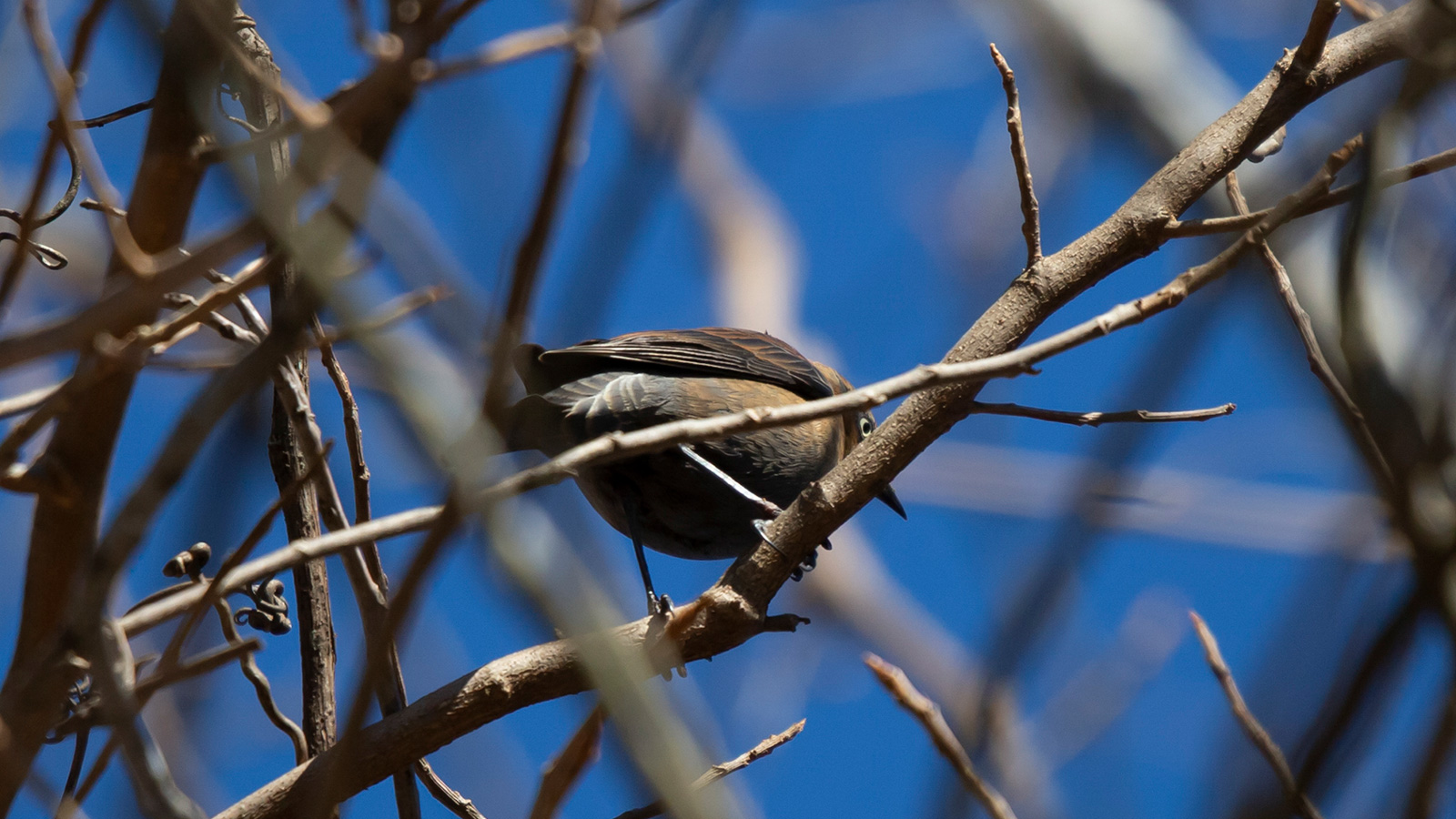
The Rusty Blackbird is the one that makes serious birders sort carefully through every mixed flock in winter, because it's declining rapidly and every record matters to the people tracking what's happening to it. Winter-plumage Rusty Blackbirds (Euphagus carolinus) have rusty-brown feather edges that give them their name, a scaly, worn appearance quite different from the crisp gloss of a grackle. Their eyes are pale yellow. They strongly favor wooded wetlands and flooded forests rather than the open agricultural fields where most blackbirds congregate, which separates them ecologically from most of the mixed-flock species. A flooded bottomland forest with standing water, dead timber, and leaf litter is prime Rusty Blackbird habitat, the kind of place that looks inhospitable until you know what it's holding.
North Louisiana has documented wintering Rusty Blackbirds, and the flooded bottomlands along the Ouachita, Red, and other river systems in our region are worth checking carefully in winter. If you're birding a flooded forest and a grackle-sized bird with pale eyes and rusty scaling pops out of the leaf litter, stop and look hard. This is why you brought binoculars.
[Full article: Rusty Blackbirds →]
Yellow-Headed Blackbirds
The Yellow-headed Blackbird is blackbird that makes everyone do a double take and then immediately look around to see if anyone else is seeing this. A male Yellow-headed Blackbird (Xanthocephalus xanthocephalus) is a large, stocky, black bird with a blazing gold-yellow head and breast and a white wing patch, a bird so boldly patterned he looks like he was designed by committee with no one willing to compromise. He is spectacular. He also sounds terrible. The Yellow-headed Blackbird's song is an extended mechanical grinding noise that sounds like a rusty gate being slowly torn from its hinges, possibly the single greatest mismatch between visual impression and acoustic reality in North American ornithology.
In North Louisiana, Yellow-headed Blackbirds are irregular visitors, primarily in fall and winter, with scattered records concentrated in mixed blackbird flocks in agricultural areas. They breed in western marshes and some winter in the Gulf Coast states, which puts North Louisiana on the plausible path. Finding one in a big blackbird roost is a genuine target for North Louisiana birders, worth the time it takes to sort through a few thousand Red-winged Blackbirds.
[Full article: Yellow-Headed Blackbirds →]
Brown-Headed Cowbirds
People vilify the Brown-headed Cowbird, and while the condemnation is understandable, the biology is extraordinary. Cowbirds (Molothrus ater) are obligate brood parasites, they do not build nests, incubate eggs, or raise young. The female deposits her eggs in other birds' nests, one at a time, spread across as many hosts as she can locate. The host species raises the cowbird chick, often at the expense of their own eggs and nestlings. One female cowbird can parasitize dozens of nests in a single breeding season, which is either impressive or horrifying depending on your relationship with the concept of parenting.
This strategy evolved alongside nomadic bison herds on the Great Plains, following the herd meant the cowbird never stayed in one place long enough to raise young, so outsourcing was the solution. The problem is that European land use spread cowbirds into habitats and regions where host species had no evolutionary experience with brood parasitism and no defenses against it. This is why cowbirds are bad news for certain forest-interior species and why cowbird control is part of some targeted recovery programs. None of this changes the fact that the Brown-headed Cowbird himself is not evil. He's just doing biology in a way that doesn't photograph sympathetically.
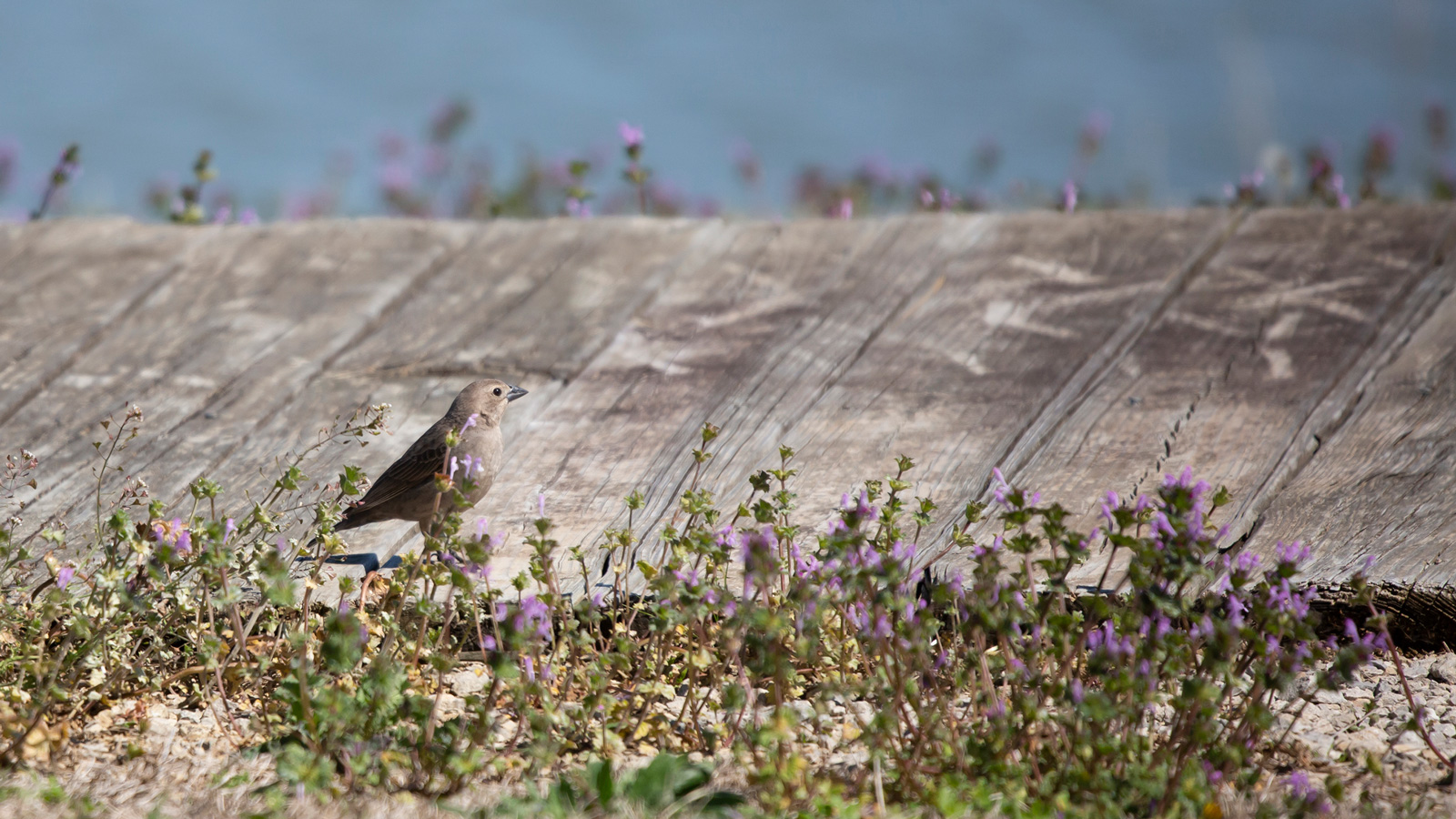
Male cowbirds are glossy black with a brown head. Females are plain gray-brown. Both are year-round in North Louisiana, where they have opinions about everyone else's nests.
[Full article: Brown-Headed Cowbirds →]
Common Grackles
The Common Grackle is your yard bird, your parking lot bird, your bird-that-will-absolutely-chase-smaller-birds-from-the-feeder bird. Males (Quiscalus quiscula) are iridescent bronze or purple depending on subspecies, with a long keel-shaped tail, bright yellow eyes, and an expression that can only be described as smug. Females are similar but duller. They walk with a strutting, proprietary gait that communicates they've assessed the situation and found it satisfactory, mostly because they're the biggest thing at the feeder.
Common Grackles are year-round residents across North Louisiana. They nest in loose colonies, often in evergreen trees, and in winter they join enormous mixed flocks that roost communally, the big winter roosts in our region can number in the hundreds of thousands of birds and generate enough noise to be a legitimate quality-of-life issue for anyone living underneath one. If your neighborhood suddenly develops a loud, persistent, aromatic presence in the trees every December, you've been chosen.
[Full article: Common Grackles →]
Boat-Tailed Grackles
The Boat-tailed Grackle is the grackle of the wetland and the lake edge, a bigger and more dramatically built species than the Common Grackle, with a tail so absurdly long on adult males that it kinks and folds in the wind in ways that seem structurally optimistic. Males (Quiscalus major) are iridescent blue-black. Females are warm brown with a pale eyebrow, so different from the males that beginning birders sometimes don't connect them as the same species, which is a reasonable mistake given that the size difference alone is substantial.
In North Louisiana, Boat-tailed Grackles occur primarily near lakes, rivers, and wetland edges. This is not the parking-lot grackle, he prefers shorelines, cattail margins, and cypress edges where wetland habitat provides both nesting cover and foraging opportunity. Present and worth your time, especially around major water bodies in our region.
[Full article: Boat-Tailed Grackles →]
Great-Tailed Grackles
The Great-tailed Grackle has staged one of the more aggressive range expansions in North American bird history, and he did it without anyone's permission. A hundred years ago, he barely touched the US border. Today he's colonized from coastal California to Louisiana and continues spreading east and north. The male (Quiscalus mexicanus) is a truly massive bird, nearly eighteen inches long with a tail that's a third of his total length, iridescent purple-black with yellow eyes. The female is much smaller and brown. Their calls include an astonishing range of electronic-sounding shrieks, mechanical clucks, and sustained rattles that can make a grocery store parking lot sound like the opening sequence of a science fiction film.
Great-tailed Grackles have established a firm presence in North Louisiana, particularly in urban and suburban areas, and continue expanding. Seeing one at a gas station or big-box parking lot is now a completely normal North Louisiana experience. He knows he's big. He's fine with you knowing too.
[Full article: Great-Tailed Grackles →]
Bobolinks
The Bobolink is the blackbird that looks like he lost a specific bet. Breeding male Bobolinks (Dolichonyx oryzivorus) are black below and white above, literally reversed from most birds' countershading, with a buffy-yellow nape that blazes like a hard hat. It's a look that has no parallel anywhere in the family. His song sounds like R2-D2 having a great day. Females and fall birds are streaky buff-brown and look nothing like the breeding male, which trips up birders who see them in August and spend quality time in the sparrow section of their field guide before giving up.
Bobolinks are long-distance migrants, wintering in South America and breeding in northern grasslands, and they pass through Louisiana in spring and fall. In North Louisiana, Bobolink migration happens in April-May (spring) and August-September (fall). Open agricultural areas and weedy grasslands can hold good numbers during peak passage, stop and look at those "large sparrows" in the field. It might be the upside-down tuxedo bird himself.
[Full article: Bobolinks →]
Finding Blackbirds in North Louisiana
The general advice is simple: look in open country. Agricultural fields, pastures, roadsides, and wetland edges are where the action is for most species. In winter, the big mixed flocks in corn and soybean stubble can be extraordinarily productive, patient sorting is how you find Rusty Blackbirds and Yellow-headed Blackbirds mixed in among the thousands of Red-wingeds and grackles. This is not glamorous work, but it is good work.
For specific areas: the farmland of Lincoln, Union, Claiborne, and Bossier Parishes holds winter blackbird flocks reliably. The Ouachita River bottomlands hold Rusty Blackbirds specifically. Grain storage facilities, feedlots, and crop fields throughout the region draw mixed flocks from fall through early spring. The Red River corridor in Red River, Natchitoches, and Rapides Parishes has species with a western bias, including Great-tailed Grackle and Yellow-headed Blackbird.
The blackbirds of North Louisiana are loud, numerous, and frequently misidentified. Know them by name. Start sorting the flocks. They will test your patience and reward your attention in roughly equal measure.
The Roost: North Louisiana's Most Underrated Wildlife Event
The winter roost is where the blackbird story in North Louisiana reaches its most dramatic expression, and most people sleep through it, literally. Communal roosts form in stands of trees or dense shrub corridors across the agricultural parishes, with birds streaming in at dusk from all directions and filling the vegetation until the weight of them bends branches and the noise is physical. These roosts are mixed-species affairs, with Red-winged Blackbirds, Common Grackles, Brown-headed Cowbirds, European Starlings, and Brewer's Blackbirds all participating, with the less common species, Rusty Blackbirds, Yellow-headed Blackbirds, occasionally present in the flock.
Roost sizes in North Louisiana can reach the hundreds of thousands. Documented locations in the agricultural parishes show winter roosts numbering over a million birds across multiple adjacent sites. This is not an exaggeration and it is not ancient history, this is a current, active, annual event that happens in fields and woodlots within driving distance of most North Louisiana residents every winter, with zero marketing budget and almost no public awareness.
To find a winter roost: drive rural roads in the agricultural parishes of Claiborne, Union, Lincoln, Bossier, or Morehouse in January and February an hour before sunset. Watch for the directional movement of blackbird flocks, birds flying in from multiple directions toward a common point. Follow the flow. When you find the concentration site, the noise will confirm your arrival before the birds are fully visible. Park somewhere safe, point your binoculars at the mass, and work through the flock. This is where the interesting species show up.
A Word on Nuisance Roosts
If you live under one of these roosts, and some North Louisiana neighborhoods do, with birds roosting in residential tree rows, the experience is less poetic than it sounds from the outside. Noise, mess, and the unmistakable odor of a large bird concentration are real quality-of-life issues, and state wildlife agencies have dealt with nuisance roost complaints for decades. Dispersal methods (pyrotechnics, distress call broadcasts, tree thinning) have varying success, and the birds typically relocate rather than disperse entirely. This is not a condemnation of the birds; it's just acknowledgment that a hundred thousand grackles descending on your neighborhood every evening for four months is an experience with genuine downsides that the bird's ecological interest doesn't fully offset. Both things are true simultaneously.
Accessibility Notes
Winter blackbird flocks in North Louisiana are among the most accessible wildlife viewing experiences in the region. Birds concentrate in open agricultural fields and roadside areas that can be observed from vehicles without leaving paved roads. This is legitimate birding, scan from the car window, sort through the flock with binoculars, and move when you need a better angle. For visitors with mobility limitations, the large agricultural parishes (Lincoln, Claiborne, Union, Bossier, Morehouse) offer the most productive roadside blackbird watching from November through March.
For visitors with low vision, the most useful tool is audio: the calls of the dominant species in any mixed flock, Red-winged Blackbirds, Common Grackles, Brown-headed Cowbirds, are distinctive and learnable. Large roost sites produce enough noise that the general direction is unmistakable from a significant distance.
The Mixed Flock Problem (and Why It's Actually a Gift)
If you've ever stood at the edge of a field in December watching what looks like a single enormous black mass shift and swirl and settle, you've experienced the mixed blackbird flock, and if you just clocked it as "a bunch of blackbirds" and drove on, you left significant birds behind. Mixed flocks in North Louisiana's agricultural country are rewarding if you do the work of sorting through them. The trick is patience and a search image for the outliers.
Most winter blackbird flocks in our region break down roughly like this: the majority are Red-winged Blackbirds, with Common Grackles making up a large second tier, Brown-headed Cowbirds filling in throughout, and Brewer's Blackbirds appearing in the mix with less fanfare than they deserve. That's your baseline. Once you've locked in what "baseline" looks like, Red-winged males, grackle-sized birds with long tails, plain brown females of multiple species, you start scanning for the exceptions.
The exceptions are where the birding happens. A slightly larger bird with a longer tail and different gait deserves a second look. It might be a Boat-tailed or Great-tailed Grackle. A blackbird in a flooded forest margin with rusty edging on the feathers and a pale eye is a Rusty Blackbird and a real find. A big bird with a yellow head blazing at the front of the flock is a Yellow-headed Blackbird and that's a legitimate field day. Bobolinks in their streaky fall colors will move through open fields in August and September and are easy to miss unless you're checking every sparrow-sized bird carefully.
The large black flock filed away as "common species, no action needed" is where the interesting birds hide. Sort the flock. Count the sections. Look for the bird that doesn't fit. North Louisiana's winter blackbird flocks offer that opportunity from September through March.
The Roost Situation
The winter roosts deserve their own entry, because if you've stumbled into one without knowing what you were walking into, you already understand why people have opinions about them. Winter blackbird roosts in North Louisiana can be enormous. "Enormous" in the sense of hundreds of thousands to millions of birds occupying a stand of trees at dusk and producing a sound that is less birdlike and more geological in character. The noise carries for miles. The visual of that many birds streaming into a roost from multiple directions across the sky is one of the more arresting wildlife spectacles North Louisiana offers, and it happens in suburban neighborhoods and city parks as readily as it does in remote bottomlands.
The species composition of these roosts includes primarily Common Grackles, Red-winged Blackbirds, Brown-headed Cowbirds, and Brewer's Blackbirds in varying ratios. European Starlings sometimes join. The roosts serve thermoregulation and possibly information-sharing functions, birds in large roosts may use each other to locate productive food sources. What they also do is produce an extraordinary amount of waste under the trees, which is why the relationship between large blackbird roosts and the humans who live beneath them is sometimes complicated.
If you've been chosen, you know. If you haven't been chosen yet, find a roost-watch vantage point and go at dusk. Bring a hat.