About Cormorants & Anhingas
North Louisiana's cormorants and anhingas share a lifestyle that most other birds avoid: swimming underwater to catch fish, surfacing with the meal, and then standing on a log or a dock with the wings spread wide to dry because the feathers soaked through during the dive. The wing-spreading behavior gave both bird families their most recognizable pose, and a large dark bird perched on a snag over a North Louisiana lake or bayou with its wings spread to the sun belonged to either a cormorant or an anhinga before any other field mark got checked. The pose settled the family. The bill settled the species.
These birds hunt fish below the surface, swallow the fish whole (or in the anhinga's case, spear the fish first and then swallow), and spend more time in the water than any other non-waterfowl bird in the 26 parishes. The cormorant swam after the fish. The anhinga speared the fish. Both birds caught the fish. Both birds dried the feathers afterward. The fishing technique differed. The laundry routine matched.
Cormorants in North Louisiana
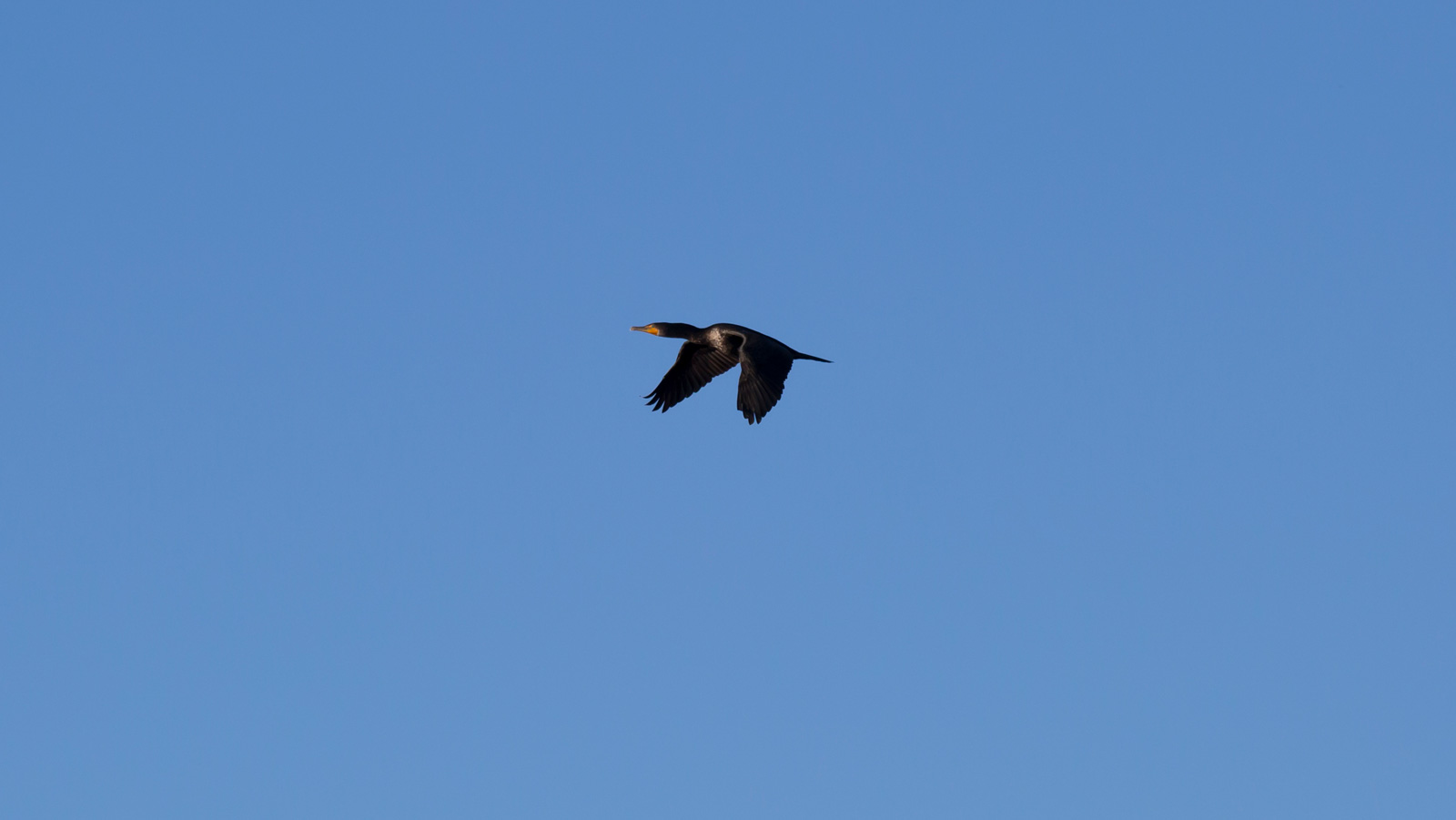
The double-crested cormorant (Phalacrocorax auritus) winters across North Louisiana in large numbers on lakes, reservoirs, rivers, and any body of water deep enough to hold the fish the cormorant chased. The bird breeds primarily north of Louisiana but winters here from October through April in flocks that range from a few individuals on a farm pond to hundreds on a large reservoir. A flock of double-crested cormorants flying in a V-formation over a North Louisiana lake in December looked like a dark, low-flying version of the Canada goose formations that flew at higher altitudes, and the cormorant V sat close enough to the water that the individual birds resolved into the long-necked, hook-billed silhouettes that no goose matched.
Black plumage, orange-yellow throat pouch, hooked bill, and a long neck that the bird held at a slight upward angle during swimming combined to create a profile that reads "dark waterbird with a hook" at binocular distance. A cormorant swimming in a lake with only the head and neck above water looked like a snake with a beak, and the "snake bird" nickname that more properly belonged to the anhinga got applied to the cormorant by every non-birder who saw the swimming profile and reached for the closest descriptive word.
Cormorant fishing involved diving from the surface, chasing fish underwater with powerful foot-propelled swimming, catching the fish in the hooked bill, surfacing, and swallowing. The diving depth reached thirty feet or more, and the cormorant's underwater speed exceeded most fish species' escape speed over short distances. A cormorant that dove near a dock and surfaced sixty feet away with a fish traveled the underwater distance in under ten seconds, and the fish that entered the bill did not exit.
The catfish-farm controversy earned the double-crested cormorant more negative press in the Mississippi Delta region than any other bird in the Southeast. Cormorant flocks descending on commercial catfish ponds ate enough fish to create measurable economic losses for catfish producers, and the conflict between aquaculture and cormorant management played out across the lower Mississippi River valley for decades.
North Louisiana's catfish operations faced the same cormorant pressure that operations in the Delta faced, and the cormorant's legal protection under the Migratory Bird Treaty Act limited the management options to depredation permits and harassment rather than unrestricted killing. The cormorant ate the fish the farmer raised. The farmer wanted the cormorant gone. The law wanted the cormorant protected. Nobody consulted the catfish.
Anhingas in North Louisiana
The anhinga (Anhinga anhinga) breeds in North Louisiana's swamps, bottomland forests, and wooded waterways from April through September and winters in the region during mild years, retreating south during cold winters that dropped water temperatures below the anhinga's comfort threshold. A breeding anhinga on a dead snag over a Bayou Bartholomew backwater in June spread the wings to dry after a fishing dive with the same pose the cormorant used on the same bayou, but the anhinga's longer tail, thinner neck, and dagger-straight bill distinguished the silhouette from the cormorant's heavier, shorter-tailed, hook-billed profile.
Male anhingas wore black plumage with silvery-white streaking on the upper wings and back that caught sunlight during the drying pose and gave the bird a more ornate appearance than the uniformly dark cormorant. Female anhingas wore a tan-brown head, neck, and breast that contrasted against the darker body, creating a two-toned bird the cormorant's uniform dark plumage did not produce. A brown-headed anhinga on a snag wore the female plumage. A black-headed anhinga on the same snag wore the male plumage. Both birds spread the wings the same way.
The anhinga's fishing technique differed from the cormorant's pursuit diving. The anhinga swam slowly underwater with the neck coiled in an S-shape, stalking fish at close range rather than chasing fish at speed. When a fish came within range, the anhinga struck with the neck, driving the dagger bill through the fish's body with a speed that earned the bird its "snake bird" nickname. The speared fish got brought to the surface, flipped off the bill, caught in the air, and swallowed headfirst. The entire sequence from spear to swallow took under ten seconds, and the anhinga performed the sequence with a practiced efficiency that suggested the bird rehearsed the move ten thousand times and perfected it nine thousand times ago.
Telling Them Apart
Cormorant versus anhinga: the bill settled everything. Hooked bill (curved tip) equals cormorant. Straight, dagger bill (pointed tip) equals anhinga. A dark waterbird drying wings on a snag over a North Louisiana bayou: check the bill. Hook equals cormorant. Dagger equals anhinga. Every other field mark (tail length, neck thickness, plumage pattern) confirmed what the bill already determined.
Swimming profile also sorted the two. A cormorant swimming showed the head, neck, and part of the back above water. An anhinga swimming showed only the head and the thin neck above water, with the body submerged, creating the "swimming snake" profile that earned the anhinga nickname. A long, thin neck sticking out of the water with no visible body belonged to the anhinga. A thicker neck with a visible back above the waterline belonged to the cormorant.
Flight silhouette: the anhinga flew with a longer tail and a thinner neck than the cormorant, and the anhinga soared on thermals with the wings held flat while the cormorant rarely soared and flew with steady wingbeats. A dark waterbird soaring high on a thermal with a long tail and a thin neck belonged to the anhinga. A dark waterbird flying low over the water with steady wingbeats and a shorter tail belonged to the cormorant. Altitude told the story. Soaring told the species.
Where to Look
Any North Louisiana lake, reservoir, river, or bayou with fish. Black Bayou Lake NWR, Poverty Point Reservoir State Park, Lake Claiborne State Park, Caney Lakes, the Ouachita River, the Red River, and every farm pond and municipal reservoir in the 26 parishes support cormorants during winter and anhingas during the breeding season. Look for the drying pose on any dead snag or dock post over water. The spread wings caught the eye before the binoculars confirmed the bird.
Accessibility Notes
Both cormorants and anhingas perch on exposed snags and dock structures over open water, and the drying pose (wings spread, body exposed) creates a large, visible target at distances most waterbirds do not offer. A cormorant or an anhinga drying wings on a dock post at a North Louisiana boat ramp sat within binocular range of the parking area without requiring foot travel to the water's edge. Fishing piers, boat docks, and lake overlooks at state parks and NWR facilities put both species within observation range from accessible surfaces. The bird chose the most exposed perch available for drying. The exposed perch sat visible from the most accessible vantage point. The bird's need to dry and the observer's need to see met at the same snag.