About Grasshoppers
Thirteen Species, One Good Jump, and the Insect That Ate Your Garden and Didn't Apologize
Walk through any North Louisiana field between June and October and something launches from the grass ahead of every step. Sometimes it goes straight up and lands two feet away. Sometimes it catches air and crosses twenty feet before dropping back into the vegetation. Sometimes it flashes colored underwings during the flight that disappear the moment it lands, and then you spend three minutes trying to find it in the grass before it launches again from a completely different direction. That's a grasshopper, and North Louisiana hosts enough species across its 26 parishes that a morning in a good field produces half a dozen without working very hard.
Grasshoppers don't get the same cultural traction as butterflies or dragonflies, which misses a genuinely interesting group. A grasshopper that flashes bright yellow hindwings mid-flight and then vanishes into brown grass that matches it perfectly, a grasshopper the size of a man's thumb that can't fly more than waist height and knows it, a grasshopper that makes the clicking sound during territorial flights that sounds like someone flicking a fingernail against a comb: these animals carry specific and often dramatic field identities once the observer knows what to look for and where.
Most North Louisiana grasshoppers go unidentified because most people looking at a grasshopper see "grasshopper" and move on. This guide gives that grasshopper a name.
What Makes a Grasshopper
Grasshoppers belong to the order Orthoptera and the suborder Caelifera, separating them from the crickets and katydids that share the order but occupy a different suborder. The physical features that define grasshoppers as a group include short antennae, stout hind legs built for jumping, and forewings that fold over the body to protect the hindwings during rest. The hind legs that make grasshoppers famous for jumping contain femur muscles that store elastic energy during flexion and release it in the rapid extension that produces the jump, a mechanism generating acceleration forces that scale to hundreds of times body weight at peak thrust.
The stridulation that many grasshoppers produce, the sound associated with grasshoppers in fields and roadsides, comes from rubbing a row of small pegs on the inner face of the hind femur against a ridge on the forewing, a mechanism called femoro-alary stridulation. The sound carries species-specific frequency and pattern characteristics that other grasshoppers detect and that observers learn to associate with specific species in the field. Some species produce crepitation, the crackling sound made by hindwing snapping during flight, which differs from stridulation and also carries identification information.
Most North Louisiana grasshopper species show some degree of sexual dimorphism, with females running larger than males in most species and sometimes showing different coloration. The size difference between male and female of the same species sometimes causes initial confusion in the field, with small males and large females of the same species looking like two different animals before the field marks resolve the identification.
The North Louisiana Grasshoppers
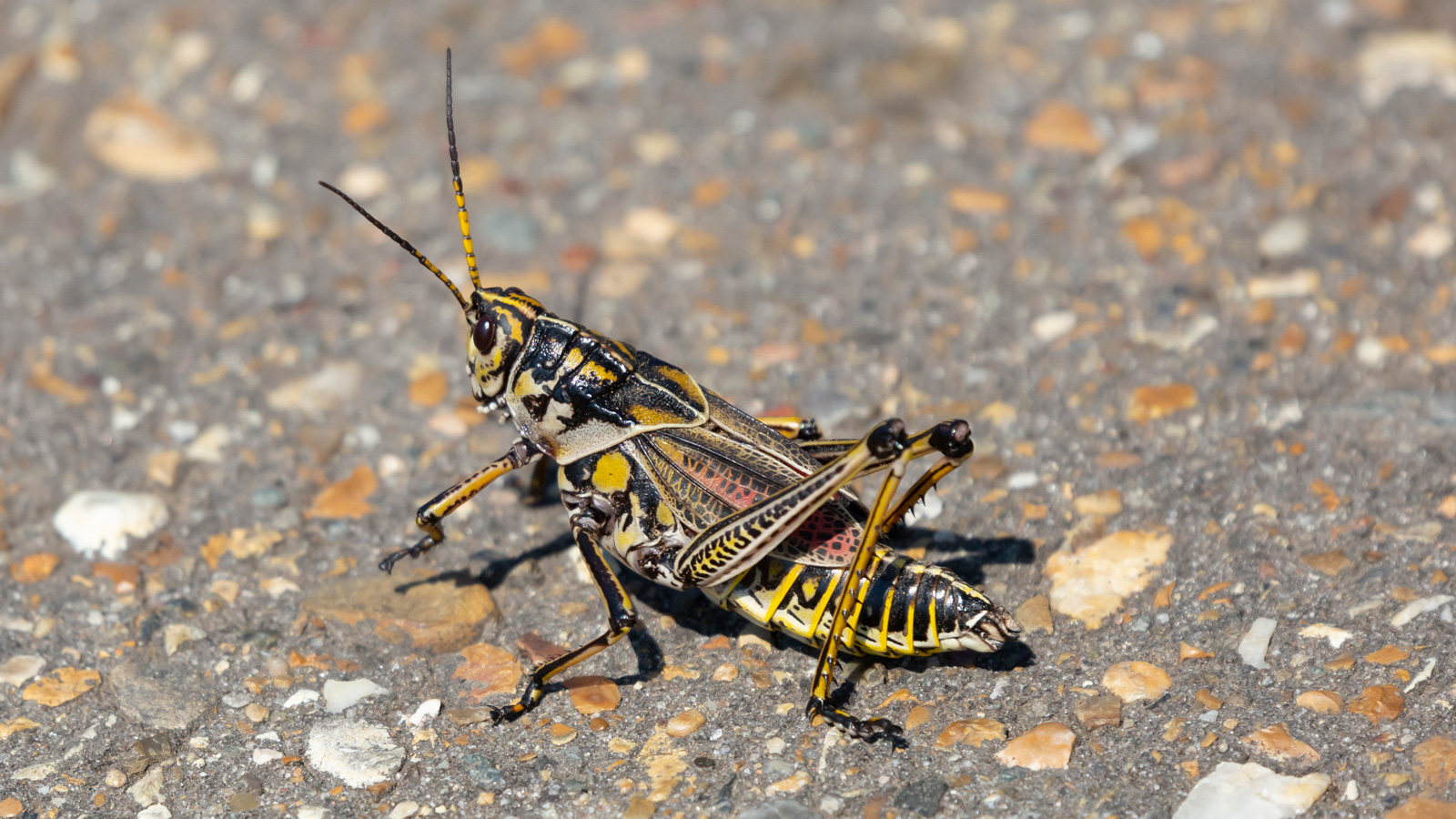
Eastern Lubber Grasshopper (Romalea microptera) The unmistakable one. Eastern Lubber Grasshoppers reach three inches or more in length, walk instead of hop, wings too small for effective flight, and carry a yellow-and-black coloration that signals the toxic chemical cocktail they secrete from the thorax when threatened. Nothing else in North Louisiana looks like a Lubber, and nothing in North Louisiana eats Lubbers willingly after the first experience with the defensive secretion. Juveniles show an entirely different color pattern from adults, jet black with red and yellow striping, creating the temporary impression that two different insects occupy the same habitat at different times of year. Both phases show up in North Louisiana's weedy fields, roadsides, and garden edges from late spring through fall.
American Bird Grasshopper (Schistocerca americana) One of the largest flying grasshoppers in North Louisiana, the American Bird Grasshopper reaches two and a half inches in good years and flies strongly enough that flushing one from roadside vegetation produces a flight arc that clears twenty feet before the landing. The name comes from the bird-like quality of the flight, not any relationship to birds, and the comparison holds: watching a large Schistocerca clear a fence and continue across a field creates a double-take about what exactly just flew past. The brown-and-yellow dorsal striping and the large size separate this species from most other North Louisiana grasshoppers without requiring close examination.
Migratory Grasshopper (Melanoplus sanguinipes) The species most likely to build to crop-damaging population densities in North Louisiana agricultural areas, the Migratory Grasshopper occupies open grassland and agricultural habitats and periodically undergoes population explosions that produce the locust-like outbreaks historically associated with grasshopper damage. In non-outbreak years, Migratory Grasshoppers function as ordinary components of the field grasshopper community without the drama. During outbreak years, the combination of defoliation of host plants and movement toward new food sources produces the crop damage events that earned grasshoppers their agricultural reputation. The medium size, brownish coloration, and preference for open grassland habitats identify this species in the context of its habitat and range.
Differential Grasshopper (Melanoplus differentialis) Named for the herringbone chevron pattern on the hind femur that distinguishes it from related Melanoplus species, the Differential Grasshopper occupies agricultural edges and weedy habitats across North Louisiana with a preference for the broader-leaved vegetation that its diet favors over pure grass. The yellow color and the distinct chevron markings on the hind leg femur identify Differential Grasshoppers at close range, and the size, medium-to-large by North Louisiana standards, separates them from the smaller Melanoplus species in the same habitat.
Red-legged Grasshopper (Melanoplus femurrubrum) The most common small-to-medium grasshopper in North Louisiana's grasslands and weedy areas, the Red-legged Grasshopper contributes more to the background launch-from-underfoot grasshopper experience than any other species in the region. The red coloration on the inner hind leg surface, visible when the grasshopper holds its legs out during flight or lifts them while perching, gives the species its name and delivers a field mark visible at close range. In grasshopper communities where multiple Melanoplus species coexist, the red hind leg separates femurrubrum from its relatives without requiring measurement of the chevron markings or other fine features.
Spur-throated Grasshoppers (Melanoplus spp.) The genus Melanoplus contains numerous North Louisiana species beyond the three named above, united by a small spine or spur on the underside of the thorax between the front legs that gives the genus its common name. Separating Melanoplus species requires examination of hind leg pattern, body size, forewing length, and sometimes genitalic features that field identification without collection doesn't support. Many North Louisiana field records legitimately end at "Melanoplus species" without claiming more precision than the conditions allowed.
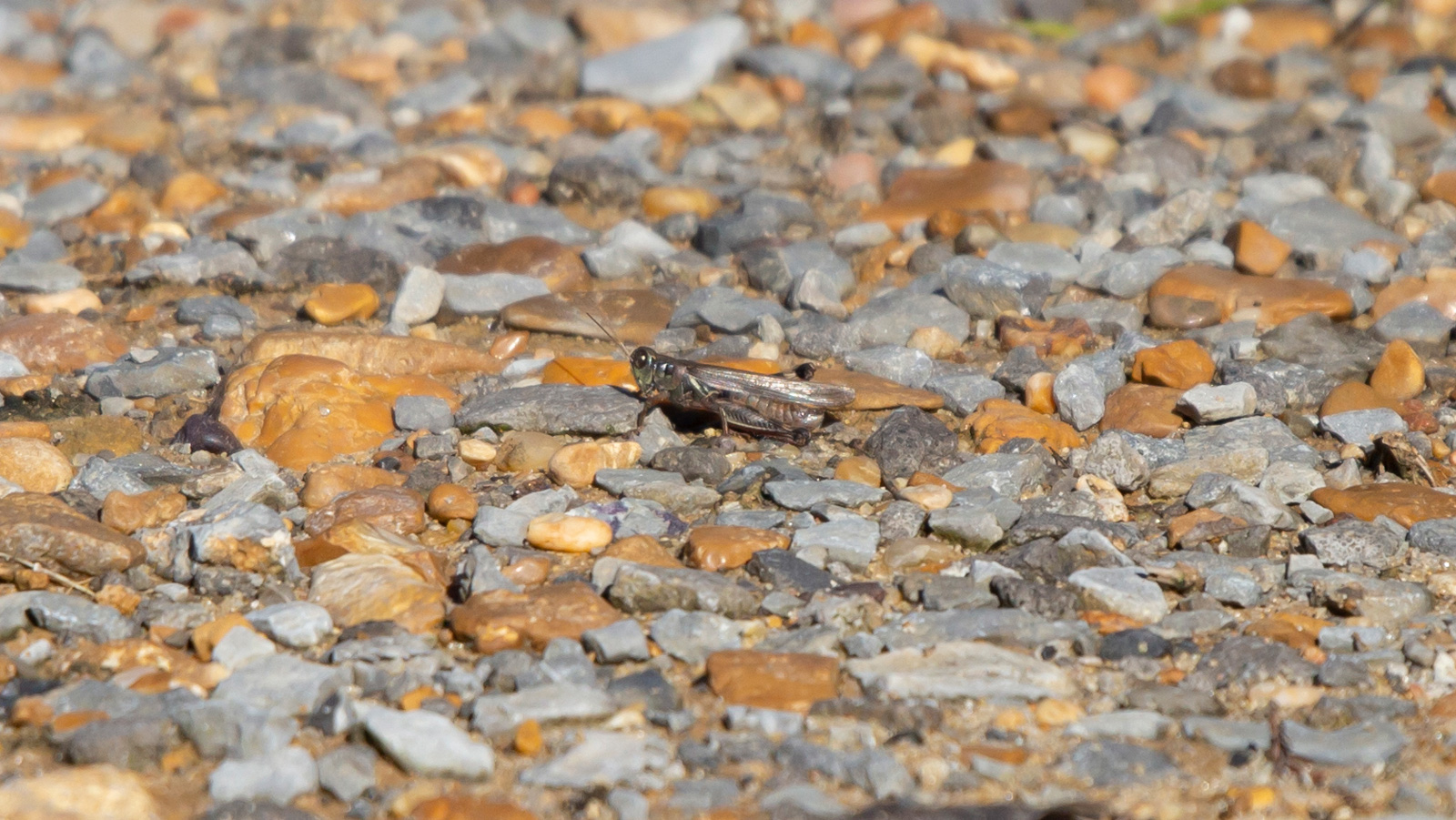
Carolina Grasshopper (Dissosteira carolina) The grasshopper most likely to produce startled double-takes on North Louisiana sidewalks, parking lots, and bare ground habitats, the Carolina Grasshopper sits motionless on bare surfaces in a perfect cryptic match to the substrate and then launches into a flight showing black hindwings with a pale yellow border that looks nothing like the brown-gray insect that was just sitting on the gravel. The flight usually ends with the grasshopper landing back on bare ground within twenty feet and immediately disappearing into the substrate again. The black hindwings with the pale border visible during flight identify this species before it lands, and the preference for bare and gravelly surfaces separates it from the vegetation-dwelling species sharing the same general area.
Sulphur-winged Grasshopper (Arphia sulphurea) A spring-flying grasshopper in North Louisiana, on the wing before most other species emerge, with bright yellow hindwings that flash during flight and provide an immediate field mark before the grasshopper lands and closes the hindwings. The early spring flight season, the yellow hindwings, and the tendency to produce loud crepitation during flight, a crackling rattling sound as the hindwings snap during the flight stroke, all combine to make this one of the more memorable early-season grasshopper encounters in North Louisiana. The adult population dies back in summer heat while the eggs laid in spring carry the next generation through to the following spring.
Green-striped Grasshopper (Chortophaga viridifasciata) Another spring-flying species with considerable color variation across individuals, ranging from green to brown with a consistent dorsal stripe that gives the species its name. Green-striped Grasshoppers occupy the same early spring window as Sulphur-winged Grasshoppers in wet meadow and grassy habitats, with the stripe pattern visible at close range separating the two species. The green color morph individuals in wet grassy habitat present a striking contrast to the brown field grasshoppers that appear later in the season.
Short-winged Green Grasshopper (Dichromorpha viridis) A small, slender grasshopper with short wings that limit flight capacity, the Short-winged Green Grasshopper occupies wet grassy areas and marsh edges where the green coloration matches the living grass stems and the short wings encourage the low-to-the-ground movement pattern that keeps this species below the observation threshold of most casual observers. The green color, small size, and short wings visible when the grasshopper perches in grass all identify this species without requiring close examination of finer features.
Admirable Grasshopper (Syrbula admirabilis) A grasshopper with a striking sexual dimorphism: males show vivid yellow-green coloration with black markings, females show brown with striping, and the two sexes look different enough that first-time observers sometimes record them as two separate species. The male coloration in particular stands out in the grasshopper community, the yellow-green reading clearly against the brown field vegetation that most grasshoppers match. Admirable Grasshoppers occupy open grassy habitats and produce stridulation that adds to the field soundscape.
Mischievous Bird Grasshopper (Schistocerca damnifica) The smallest of the bird grasshoppers in North Louisiana, with a name that suggests someone named it while irritated, and the best Latin name in the order: damnifica. Mischievous Bird Grasshoppers occupy the same general habitat as American Bird Grasshoppers but run considerably smaller, and the size difference provides the most immediate field separation when both species occupy the same field. The brown dorsal striping pattern matches other Schistocerca species, and the size remains the primary identification character for field purposes.
Olive-green Grasshopper (Schistocerca obscura) A large bird grasshopper with an olive-green coloration that provides better camouflage against the mixed green-and-brown vegetation of shrubby habitat than the browner Schistocerca species show. Olive-green Grasshoppers occupy the shrubby edges and woodland margins where the coloration suits the background, and the large size combined with the olive-green dorsal color separates this species from the smaller brown grasshoppers sharing adjacent open habitat.
Identification Strategy
Grasshopper identification in North Louisiana rewards a sequential approach that starts with size and hindwing color before moving to body pattern and habitat.
Size separates the grasshopper community into three functional groups immediately. Large, over two inches: Lubber, American Bird Grasshopper, Olive-green Grasshopper, Differential Grasshopper. Medium, one to two inches: Red-legged Grasshopper, Migratory Grasshopper, Carolina Grasshopper, Admirable Grasshopper. Small, under an inch: Short-winged Green Grasshopper, Mischievous Bird Grasshopper.
Hindwing color during flight eliminates several species before landing. Black with pale border: Carolina Grasshopper. Yellow or yellow-orange: Sulphur-winged Grasshopper, Green-striped Grasshopper. Plain: most other species. The hindwing flash visible during a flight of three seconds carries enough information to name several species without the grasshopper ever sitting still for a look.
After landing, the hind femur color and pattern closes most identifications. Red inner surface: Red-legged Grasshopper. Yellow with herringbone chevrons: Differential Grasshopper. Yellow-green with black markings (male): Admirable Grasshopper. Black and yellow whole body, very large, doesn't fly well: Lubber.
Seasonal Timing
North Louisiana's grasshopper season runs from the first warm days of February or March through the first hard freezes of November, with different species peaking at different times.
Spring, February through May, belongs primarily to the overwintering adult species and the early-emerging species: Sulphur-winged Grasshoppers and Green-striped Grasshoppers fly in late winter and early spring before most other species appear. These spring fliers lay eggs in spring that carry the next generation through summer in the egg stage, with adults dying back as temperatures climb.
Summer, June through August, produces the peak grasshopper diversity and abundance in North Louisiana, with the majority of species present simultaneously. American Bird Grasshoppers, Differential Grasshoppers, Red-legged Grasshoppers, Migratory Grasshoppers, Admirable Grasshoppers, and Short-winged Green Grasshoppers all fly through the summer, with population peaks varying by species. Eastern Lubbers reach maximum adult size in summer and become most visible as they feed on garden vegetation in July and August.
Fall, September through October, extends the season for several species while the spring-flying species remain absent. Carolina Grasshoppers stay active on warm fall days on their preferred bare ground habitats and continue into October in most North Louisiana years. The first hard freeze of late fall ends the season for most above-ground grasshopper activity, with most species overwintering as eggs in the soil, not as adults.
Ecological Role
Grasshoppers move energy through North Louisiana's grassland and field food webs at a scale proportional to their abundance, and in productive years that scale reaches significant. As primary consumers, grasshoppers convert plant material, including agricultural crops in outbreak years, into grasshopper biomass that feeds everything above them in the food web.
The predator list for North Louisiana grasshoppers covers most of the region's vertebrate and invertebrate predators that operate at the right scale. Red-tailed Hawks and Kestrels hunt grasshoppers in open field habitats. Loggerhead Shrikes impale grasshoppers on thorns and barbed wire for later consumption. Scissor-tailed Flycatchers catch them in aerial pursuit. Painted Buntings eat them. Raccoons flip and eat them in field margins at night. Bullfrogs eat any grasshopper that lands near water. The food web connections radiating from a productive grasshopper population in a North Louisiana field touch almost every vertebrate species using that habitat.
Parasitoid wasps, ground beetles, and robber flies account for significant grasshopper mortality at the larval and adult stages respectively, with robber flies in particular hunting adult grasshoppers in flight with enough efficiency to affect local population densities at productive robber fly sites. The grasshopper that launches from underfoot and clears the field margin faces a predator community that knows that specific trajectory and hunts accordingly.
Habitat
North Louisiana's grasshopper species divide between habitat specialists and habitat generalists in ways that narrow the identification list before any body features enter the picture.
The Eastern Lubber Grasshopper occupies a wide range of weedy, open, and semi-open habitats including roadsides, gardens, and field margins but avoids dense forest interior. American Bird Grasshoppers and Olive-green Grasshoppers favor the shrubby ecotone between open field and woodland edge. Red-legged Grasshoppers and Migratory Grasshoppers use open grassland and agricultural fields without strong edge dependence. Sulphur-winged Grasshoppers and Green-striped Grasshoppers appear in wet meadows and grassy wetland margins earlier in the season than the open-field species. Short-winged Green Grasshoppers stay close to wet grassy areas and marsh edges through the season. Carolina Grasshoppers occupy the bare ground and gravel habitats that no other North Louisiana grasshopper uses consistently.
The Bodcau Wildlife Management Area's field and grassland habitats support grasshopper diversity that reflects the managed habitat variety, with open fields, woodland edges, and moist low areas all contributing species to the community. State highway rights-of-way with unmowed margins in late summer and fall hold grasshopper populations visible from the vehicle before any walking enters the equation. Rural agricultural field margins in Claiborne, Union, Morehouse, and Lincoln parishes support grasshopper populations that rarely get surveyed, with the iNaturalist records from these areas running thin relative to the actual populations present.
Predators
The predator list for North Louisiana grasshoppers spans vertebrates and invertebrates in ways that reflect the grasshopper's position as a mid-sized, highly mobile prey item in open habitat.
Red-tailed Hawks, American Kestrels, and Loggerhead Shrikes hunt grasshoppers in open field habitat with hunting strategies tuned to the grasshopper's launch behavior. Kestrels hover over fields and drop on grasshoppers from above. Shrikes pursue from exposed perches and impale the catch on available thorns or wire for later consumption. Scissor-tailed Flycatchers catch grasshoppers in aerial pursuit with the agility their long tails contribute to directional changes. The sheer abundance of grasshoppers in productive North Louisiana field habitat during summer makes grasshopper hunting a reliable foraging strategy for every open-country bird in the region.
Robber flies rank as the most significant invertebrate predator on adult grasshoppers in North Louisiana open habitats. These large, fast flies launch from perches in vegetation and pursue grasshoppers in flight, catching them in mid-air and injecting paralytic saliva before carrying the prey back to the perch. A robber fly on a fence post or weed stem in a grasshopper-rich field poses a real threat to grasshoppers of most sizes, and the pursuit speed of large robber fly species competes with the escape speed of all but the largest grasshoppers.
Ground-nesting parasitoid wasps in several families attack grasshopper egg pods in soil during the egg stage, with females locating egg masses through chemical signals and laying their own eggs to develop at the expense of grasshopper embryos. Blister beetles in the family Meloidae parasitize grasshopper egg pods in a different way, with first-instar larvae locating egg masses and consuming the eggs as development food. Both parasitoid wasps and blister beetles represent mortality sources that operate entirely below the soil surface and below the observation threshold of anyone watching adult grasshoppers without awareness of the underground dynamics running simultaneously.
Accessibility
Grasshoppers communicate presence through sound and movement in ways that carry real observation information in North Louisiana field habitats. The stridulation of male grasshoppers carries species-specific frequency and pattern characteristics audible from several feet in quiet conditions: the steady buzzing of Red-legged Grasshopper stridulation, the longer bursts of American Bird Grasshopper song, and the crepitation of Sulphur-winged Grasshoppers during spring flights all identify species acoustically before any visual contact.
The launch sound of a large grasshopper, particularly the American Bird Grasshopper or Eastern Lubber launching from dense vegetation, carries a distinctive rustle-and-snap that announces the departure before the flight arc registers visually. Carolina Grasshopper crepitation during the arcing flight over bare ground produces a rattling sound audible from thirty to forty feet, enough to identify the species acoustically before the black hindwings register visually.
Morning visits to grasshopper habitat before temperatures climb into the mid-afternoon peak produce the most accessible observation conditions. Grasshoppers basking in early morning sun on vegetation surfaces and warm bare ground hold longer before flushing than mid-afternoon individuals operating at peak activity temperature, allowing closer approach and extended observation. The grasshopper sitting motionless on a warm fence post at 8 a.m. stays considerably longer than the same species at noon, which matters for the close examination that field mark confirmation requires.
More Information
Orthoptera Species File — orthoptera.speciesfile.org iNaturalist North Louisiana Acrididae Observations — inaturalist.org University of Florida Featured Creatures Grasshoppers — entnemdept.ufl.edu BugGuide Acrididae — bugguide.net
Species Profiles
Individual articles cover each North Louisiana grasshopper species in depth.
Eastern Lubber Grasshopper
American Bird Grasshopper
Mischievous Bird Grasshopper
Olive-green Grasshopper
Migratory Grasshopper
Differential Grasshopper
Red-legged Grasshopper
Spur-throated Grasshoppers (Melanoplus spp.)
Carolina Grasshopper
Sulphur-winged Grasshopper
Green-striped Grasshopper
Short-winged Green Grasshopper
Admirable Grasshopper
Frequently Asked Questions
How many grasshopper species live in North Louisiana? Around thirty species occur across the 26 parishes with enough regularity to appear on regional invertebrate checklists, though the thirteen species covered in individual articles represent the ones most likely to appear in typical field observation. The Melanoplus genus alone contributes a dozen or more species to the regional list, most of them requiring collection and close examination for species-level identification.
Why do grasshoppers flash colored wings during flight and then disappear when they land? The colored hindwings fold under the brown or gray forewings when the grasshopper lands, hiding the color completely. The contrast between the flash of color during flight and the sudden disappearance on landing serves as a predator confusion strategy: a predator tracking a yellow-winged insect in flight searches for a yellow insect after landing and finds nothing obvious while the actual grasshopper sits camouflaged on a brown-matching substrate a few feet away. The strategy works well enough that it evolved independently in multiple grasshopper lineages.
Are grasshoppers harmful to gardens? Some species eat garden vegetables and can cause real damage in high population years. Eastern Lubber Grasshoppers eat a wide range of garden plants and reach large enough size to consume substantial leaf area per individual. Differential Grasshoppers and Migratory Grasshoppers build to outbreak population densities in some years and defoliate host plants across wide areas. Most years and most species, North Louisiana grasshopper populations in residential garden settings cause aesthetic damage without reaching economically significant levels. The Lubber gets the most complaints simply because of its size and the brazenness of its approach to garden consumption.
What's the difference between a grasshopper and a cricket? Short antennae versus long antennae provides the fastest field separation. Grasshoppers carry short antennae, shorter than the body length. Crickets and katydids carry antennae as long as or longer than the body. The body shape also differs: grasshoppers show a compact, stout build with the large hind femurs clearly visible. Crickets show a flatter, more elongated body. Both groups belong to Orthoptera but occupy different suborders and use different stridulation mechanisms.
Why do Eastern Lubbers come in two completely different color patterns? Juveniles and adults show entirely different coloration because the juvenile pattern and adult pattern serve different functions. Juvenile Lubbers in the black-with-red-and-yellow pattern display the aposematic coloration that signals toxicity to predators that learned it through previous Lubber encounters. Adult Lubbers in the yellow-and-black pattern signal the same toxicity with an adult-specific visual pattern. Both patterns advertise the same chemical defense, just with different aesthetics depending on life stage.
When do grasshoppers peak in North Louisiana? Late summer, July through September, produces peak grasshopper abundance and diversity for most species. The spring-flying species, Sulphur-winged and Green-striped Grasshoppers, peak in February through April and decline as summer approaches. Eastern Lubbers reach maximum visibility in July and August when adults approach full size and move into garden areas. The grasshopper density that makes a late-summer North Louisiana field feel constantly alive underfoot reflects the late-summer peak of most species simultaneously.