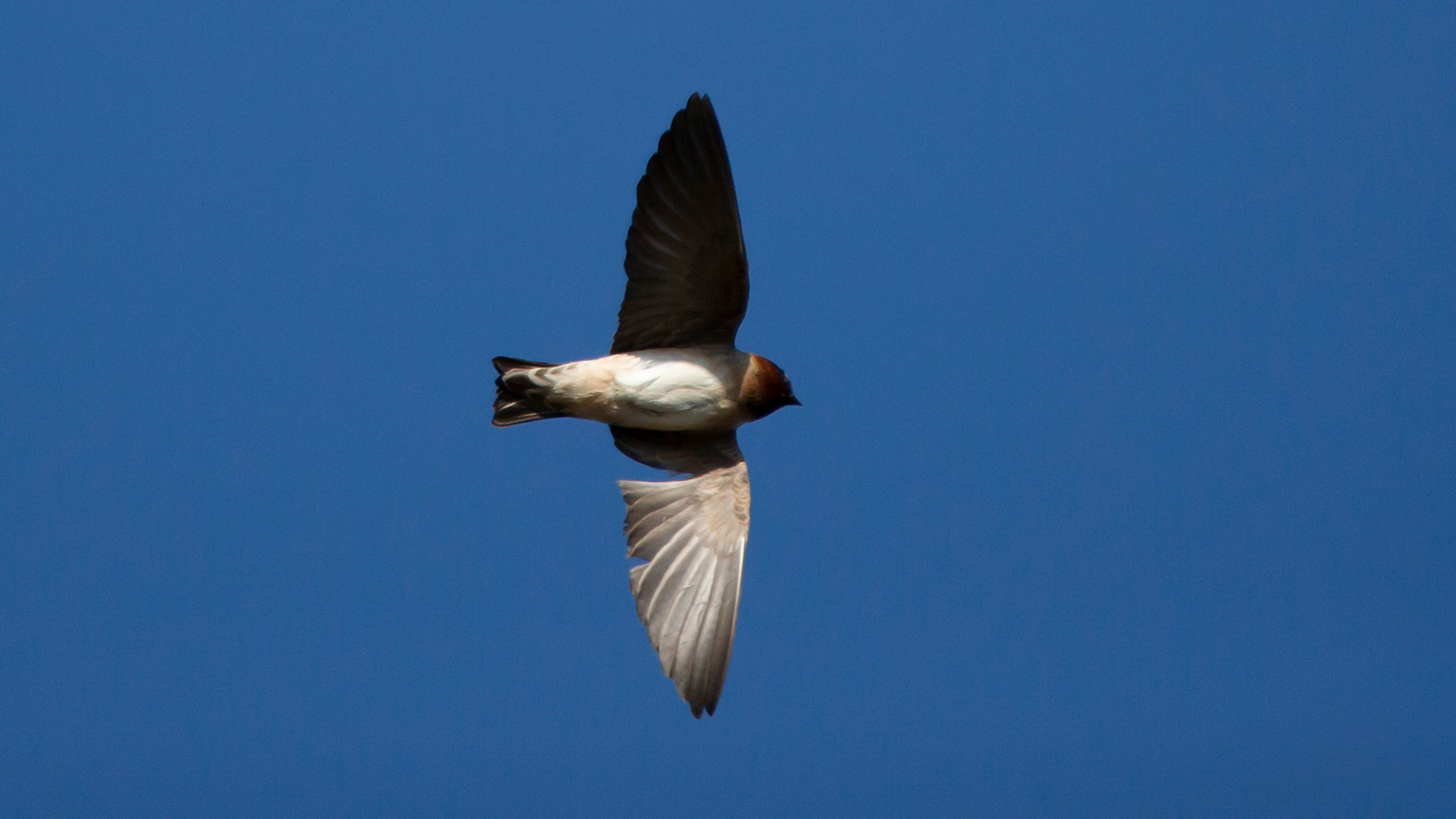
About Martins and Swallows
Every swallow in North Louisiana eats flying insects caught in midair. That's the job. That's the entire job. The six swallow species in the coverage area have taken that single job description and split it six different ways, each bird carving out a niche defined not by what it eats but by where it nests, how it flies, and how many neighbors it tolerates. The purple martin moved into a human-provided aluminum apartment complex. The barn swallow built a mud nest under your carport. The cliff swallow built a mud apartment complex under a highway bridge. The bank swallow dug a tunnel into a dirt wall. The northern rough-winged swallow found a hole somebody else made and moved in.
The tree swallow grabbed a tree cavity, ate some berries, and stayed through winter while everybody else left for South America.
Six species. Six completely different approaches to the question of where to put the babies. One shared answer to the question of what to feed them: whatever flies past.
What They Eat
Flying insects. All six species catch their food on the wing, in the air, at speed. Flies, beetles, moths, mosquitoes, dragonflies, flying ants, and whatever else occupies the air column between ground level and the upper atmosphere. No swallow in the coverage area picks insects off leaves. No swallow in the coverage area feeds on the ground. Every meal involves an aerial intercept. A barn swallow sweeping a freshly mowed field takes flies at a rate that turns the bird into an assembly line with feathers. A purple martin intercepting a dragonfly over a lake covers the distance between perch and prey in about two seconds.
A cliff swallow feeding in a flock over a field darts, dips, and recirculates through the insect column in patterns that look choreographed and function as math.
The tree swallow cheats. When cold weather grounds the insect supply, the tree swallow switches to wax myrtle berries and bayberries, a dietary trick that no other North American swallow has copied. The berry backup keeps the tree swallow alive through North Louisiana winters. Every other swallow has left for Central or South America by the time the tree swallow starts eating fruit off a shrub in November. The loophole has worked for millions of years.
Who Nests Where
The six species divide the coverage area's nesting habitat with almost no overlap:
Purple Martin. Human-provided housing. Aluminum multi-compartment houses, gourd racks, and plastic gourds on poles in backyards, at churches, at fire stations, and on commercial properties. The purple martin breeds nowhere in eastern North America without human participation. The bird outsourced real estate centuries ago and has not looked back.
Barn Swallow. Any structure with an overhang. Barns, bridges, culverts, carports, gas station canopies, church breezeways, and the eaves of your house. The barn swallow builds an open mud cup on any vertical surface with a roof above it. The bird has not submitted a permit for any of these locations.
Cliff Swallow. Highway bridges, concrete overpasses, and dam faces. The cliff swallow builds enclosed gourd-shaped mud nests in colonies that can number in the hundreds, clustered on concrete surfaces that the Department of Transportation built for cars and the cliff swallow repurposed for babies. The Department of Transportation was not consulted.
Bank Swallow. Eroded riverbanks and quarry faces. The bank swallow digs her own tunnel into a vertical wall of soft soil, two to three feet deep, using feet the size of pencil erasers and a bill that weighs less than a paper clip. The bird has standards about dirt and will not compromise.
Northern Rough-Winged Swallow. Any existing hole in any bank, bridge, wall, or structure near open water. Drain pipes, crevices, old kingfisher burrows, gaps in riprap. The rough-winged swallow builds nothing and digs nothing. The bird finds a hole and moves in. The real estate strategy of someone who only rents furnished apartments.
Tree Swallow. Tree cavities, old woodpecker holes, and nest boxes during breeding season farther north. In North Louisiana, the tree swallow shows up primarily as a winter visitor, gathering in flocks of dozens to thousands at wax myrtle thickets and marsh edges from October through March. The only swallow in the coverage area between November and February.
Telling Them Apart
The six species sort into three visual categories that handle most field identification:
Dark and glossy. Purple martin (large, all dark, purple sheen) and barn swallow (smaller, dark blue above, orange throat, deeply forked tail). The martin dwarfs the barn swallow. The barn swallow's forked tail and orange face separate it from everything else in the air.
Dark above, pale rump. Cliff swallow. The pale buffy rump patch flashes in flight and settles the ID from a hundred yards. No other North Louisiana swallow wears a pale rump. Squared tail, dark throat, pale forehead. The rump does all the sorting.
Brown. Bank swallow (clean brown breast band on white chest) and northern rough-winged swallow (smudgy brownish throat wash, no clean edge). The band versus the smudge separates the two species. One clean line across the chest: bank. One gradient wash down the throat: rough-winged. One good look at the chest settles it.
Blue-green above, white below. Tree swallow. Adult males flash iridescent blue-green that shifts with the light. Clean white belly, no breast band, no throat color. In winter, the only swallow in the coverage area, which makes the calendar do the identification before any field mark gets checked.
What Eats Them
Cooper's hawks, sharp-shinned hawks, American kestrels, and merlins all hunt swallows. The hawks learn colony locations and time their attacks to intercept birds during departure and return flights. A Cooper's hawk perched near a purple martin house at dawn has done this before. The hawk knows the schedule. The martins know the hawk knows the schedule.
Colonial species defend through numbers. A hundred cliff swallows boiling off a bridge at once overwhelm a hawk's ability to target a single bird. A purple martin colony puts twenty birds in the air dive-bombing a hawk and screaming alarm calls until the hawk leaves. The solitary nesting species, the rough-winged swallow and sometimes the bank swallow, face hawks alone and rely on speed and cover.
Rat snakes raid every nesting type. Snakes climb martin house poles (unless a predator guard blocks them), enter barn swallow nests in barns, crawl into bank swallow tunnels, and reach cliff swallow colonies on bridges. The snake fits wherever the bird nests. House sparrows and European starlings compete for purple martin compartments and cliff swallow nests, and the sparrow problem at martin houses has created an entire management industry.
The Shared Vulnerability
The aerial insectivore decline across North America has hit every swallow species in the coverage area. Barn swallows have dropped. Bank swallows have dropped. The causes stack up: reduced insect biomass, habitat loss at nesting sites, and the general thinning of the flying insect supply that nobody fully understands and nobody has reversed. When flying insects disappear, swallows starve. The barn swallow eats flying insects or the barn swallow does not eat. The bank swallow eats flying insects or the bank swallow does not eat. No backup plan exists for five of the six species. The tree swallow's berry trick buffers it through winter, but the breeding season still depends on bugs in the air.
The swallows that adapted to human structures, the barn swallow and the cliff swallow especially, have partially cushioned themselves through nest site flexibility. The swallows that depend on natural features, the bank swallow especially, have taken the hit harder. The bank swallow needs eroding riverbanks. Humans stabilize riverbanks. The conflict between swallow habitat and flood control has no obvious resolution, and nobody has brokered a deal.
When to See Them
Purple martins arrive first, mid-March, and the males start claiming apartments in the martin houses before the females show up. Barn swallows, cliff swallows, bank swallows, and rough-winged swallows arrive through April. All five breeding species nest from April through July, with some barn swallows pushing into August for a third brood.
The purple martin heads south first, July and August, earlier than most people expect. Premigration roosts in late summer draw thousands to tens of thousands of birds to traditional staging sites along waterways, and the roost assemblies draw crowds. The other breeding swallows clear out through September and October. By November, one swallow species remains in the coverage area: the tree swallow, eating berries, wearing chrome, and roosting in marsh vegetation until March.
Tree swallow flocks fill the winter gap. They arrive in October and stay through March, roosting in pre-roost assemblies at dusk that swirl thousands of birds above the marsh in coordinated flight patterns before the whole mass drops into the vegetation at dark. The show plays nightly. The show has never charged admission. The show ends in March when the tree swallows head north and the breeding swallows start arriving from the south to replace them.
The overlap window, late March through mid-April, can put all six species in the coverage area at once. A birder at the right lake, bridge, or marsh during that window can see every North Louisiana swallow in a single morning. The window lasts about three weeks. The window does not send reminders.
Where to Start
Any bridge over any waterway in the coverage area between April and July will probably have barn swallows, cliff swallows, or both nesting on the structure. Driving slowly and checking the undersides of bridges along the Red River, Ouachita River, and their tributaries picks up colony after colony.
Any backyard with a properly managed purple martin house has purple martins. Any eroded riverbank along a major waterway may have bank swallows. Any bridge drain hole, retaining wall gap, or bank crevice near open water may contain a rough-winged swallow nest that nobody has noticed because the bird has never once tried to draw attention.
Winter swallow birding means tree swallows. Find the wax myrtle thickets along marsh edges in the coverage area between October and March. The pre-roost assemblies at dusk happen on a schedule tied to sunset, and they bring thousands of birds swirling above the roost site for ten to twenty minutes before the mass descent at dark. The flock can be spotted from a moving vehicle. The flock has not been designed for subtlety.
More Information
The Cornell Lab of Ornithology's All About Birds covers all six North Louisiana swallow species with range maps, song and call recordings, and nesting ecology. The Sibley Guide to Birds covers all six alongside each other with flight profile and plumage comparisons that sort the aerial identification challenge. The Purple Martin Conservation Association (PMCA) covers colony management, house selection, and the sparrow problem with detail that reflects decades of landlord experience. For the aerial insectivore decline, published research on swallow population trends across North America documents the trajectory and the suspected causes.
Experiencing Martins and Swallows: Accessibility Notes
Swallows announce their colonies and feeding areas through sound. Each species carries a different vocal signature: the purple martin gurgles richly from the colony house at dawn. The barn swallow twitters rapidly from near the nest. The cliff swallow colony hums with a continuous low chatter amplified by the bridge overhead. The bank swallow buzzes dryly from the riverbank. The rough-winged swallow buzzes quietly from a single hole. The tree swallow flock calls "chi-veet" by the thousands during the winter pre-roost assembly.
From a car or accessible viewpoint, every species can be experienced without leaving the vehicle. Purple martin colonies sit on poles in open yards. Barn swallow and cliff swallow colonies occupy bridges and structures along public roads. Bank swallow colonies line riverbanks visible from river road bridges. Tree swallow pre-roost assemblies swirl above marsh edges near public roads and refuge dikes. The birds feed in open airspace within easy viewing range from ground level, and the flight profiles, deeply forked tail on the barn swallow, pale rump on the cliff swallow, tiny and brown on the bank swallow, all separate at the distances and angles available from a parked vehicle.
The pre-roost assembly of wintering tree swallows, October through March at dusk, puts on the loudest, most visually overwhelming swallow show in the coverage area. The collective "chi-veet" chorus from thousands of birds builds for ten to twenty minutes before the descent into the roost. The sound carries across open marsh and reaches any position within several hundred feet of the roost site.