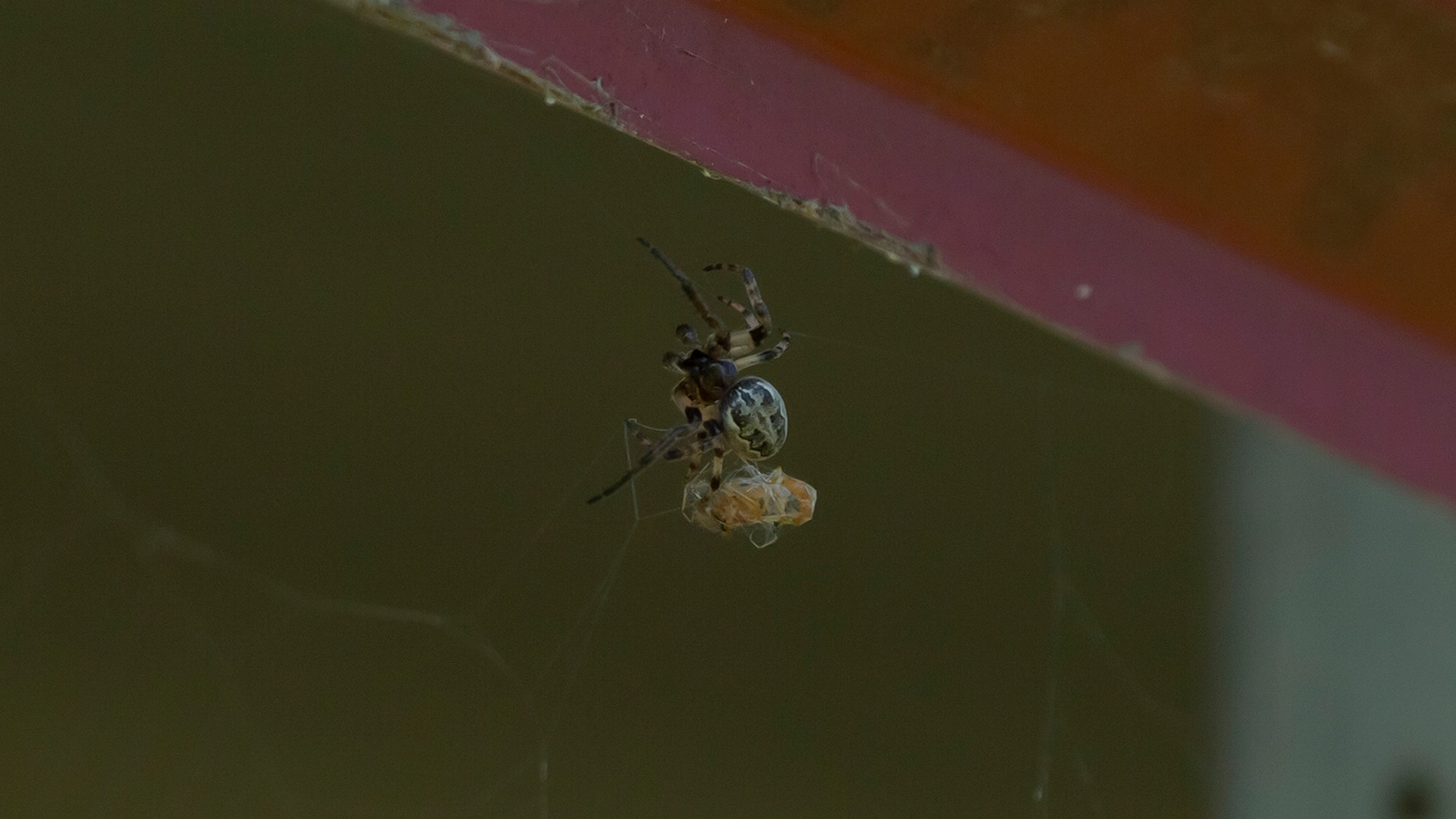
About Orb Weavers
Seven Species, One Architectural Masterpiece, and the Spider You Walked Into at 6 a.m.
The web appears in the gap between the azalea bush and the porch post sometime overnight, a perfect spiral of dry silk attached at four anchor points with engineering precision that a first-year architecture student would fail to replicate. By 6 a.m. the dew catches on every strand and the whole structure glows. By 6:01 a.m. somebody walks through it on the way to the car and ruins three hours of work that the spider will rebuild tonight without apparent frustration.
That spider almost certainly qualifies as an orb weaver, and North Louisiana hosts at least seven species across its 26 parishes with enough regularity to appear on any regional spider checklist. Orb weavers belong to the family Araneidae, a worldwide spider family defined by the distinctive flat, spiral-web architecture that gives the group its name. They build the webs people picture when they picture a spider web, the radial spokes and sticky spiral threads hanging in the open between vegetation and structures, and they build them with a consistency of form that makes the web as useful for identification as the spider sitting at its center.
Most North Louisiana orb weavers spend the day hidden in retreats at the web margin, moving to the hub only at night or when prey vibrations demand attention. The large colorful spider most people notice at the web center during the day often turns out to be a species that happens to sit in the open, while the more numerous species around it hide in rolled leaves or bark crevices attached to the web by a signal thread and wait for vibrations. Both strategies work. The web does the catching regardless of where the spider sits.
What Makes an Orb Weaver
Orb weavers belong to the family Araneidae within the order Araneae. The family name and the common name both reference the orb, the circular or near-circular flat web with radial spoke threads and a sticky spiral that defines the group's construction strategy. Not all Araneidae build classic orbs, and some spiders outside Araneidae build orb-like webs, but the combination of family membership and orb architecture covers the vast majority of the large web-building spiders North Louisiana observers encounter.
The web construction sequence that orb weavers follow each night begins with the frame threads that anchor the web to surrounding vegetation or structures, continues with the spoke threads radiating from the hub, and finishes with the sticky spiral laid from the hub outward in progressively wider circles. The spider lays a non-sticky temporary spiral outward first to maintain spacing, then lays the sticky capture spiral inward while removing the temporary threads. The completed web contains two types of silk: the dry, high-strength radial spokes and frame threads that provide structural support, and the sticky, elastic capture spiral threads that retain prey. A single web may contain several hundred feet of silk laid in a single construction session.
The hub, the center of the web where the spider waits or where signal threads converge, often shows a stabilimentum in some species, a zigzag or band of extra silk that was historically theorized to stabilize the web or attract prey and now understood to serve multiple possible functions including camouflage for the spider at the hub. Some species build their stabilimenta as distinctive patterns that help identify the spider without examining the animal directly.
Orb weavers locate and orient to prey through vibration detection transmitted through the web threads. When prey contacts the sticky capture spiral, the vibration pattern transmitted to the waiting spider carries information about prey size, location, and activity level that the spider uses to decide whether to approach immediately or wait. The spider approaches along the dry radial spokes, not the sticky capture spiral, moving to the prey and immobilizing it with a bite before wrapping it in silk for later consumption.
The North Louisiana Seven
Banana Spider / Golden Silk Orb Weaver (Trichonephila clavipes) The largest and most visually dramatic orb weaver in North Louisiana, with large females reaching body lengths of an inch or more and building webs that sometimes span several feet between anchor points. The yellow and brown banded legs, the silver cephalothorax, and the elongated abdomen with yellow spots on a dark background combine to make banana spiders immediately identifiable without close examination. Males run dramatically smaller than females, sometimes sitting at the web margin barely visible beside females several times their body length. The web of banana spiders differs from most orb weaver webs in using golden-yellow silk visible to the naked eye, a color that reflects the protein composition of the silk and gives the species its "golden silk" alternative common name. Banana spiders build webs in forest edge, woodland gaps, and along trail margins in North Louisiana's bottomland and mixed forest habitats from late summer through fall, timing their peak abundance to coincide with the maximum prey availability of late summer.
Arrow-shaped Orb Weaver (Micrathena sagittata) A small orb weaver with a dramatically spined abdomen that looks less like a spider and more like something that got lost on the way to a different taxonomic neighborhood entirely. The red-and-yellow abdomen of females carries two large forward-pointing lateral spines and a single posterior spine that create the arrow-head shape that names the species. The spines, while visually alarming, carry no venom and function as a predator deterrence mechanism through visual warning or by making the spider harder to swallow. Arrow-shaped Orb Weavers build small, precise webs in forest understory habitats across North Louisiana's woodland areas, at eye level or below in the shaded interior of bottomland hardwood and mixed forest.
Star-bellied Orb Weaver (Acanthepeira stellata) Another spined orb weaver in the North Louisiana lineup, the Star-bellied Orb Weaver carries a more complex array of abdominal spines than the Arrow-shaped Orb Weaver, creating a star or crown-like profile when viewed from above or behind. The brown-and-white mottled coloration blends into dried vegetation and bark surfaces in a way the brighter Arrow-shaped Orb Weaver's pattern doesn't, giving this species better daytime concealment when it sits at the web hub. Star-bellied Orb Weavers build webs in open and semi-open habitats, forest edge and shrubby field margins, across North Louisiana from summer through fall.
Spined Micrathena (Micrathena gracilis) A close relative of the Arrow-shaped Orb Weaver with a different abdominal spine arrangement, the Spined Micrathena carries multiple paired spines along the abdomen sides, not the terminal arrow-head arrangement of its relative. The black-and-white coloration and the multiple spine pairs distinguish this species from the Arrow-shaped Orb Weaver at close examination. Both Micrathena species occupy forest understory habitats and build small webs in similar locations, sometimes found within a few feet of each other in North Louisiana bottomland forest.
Mabel's Orchard Spider (Leucauge venusta) A distinctive small orb weaver with metallic green and silver coloration on the abdomen, orange or yellow spots, and an abdomen held horizontally in the web, not the vertical hanging posture of most orb weavers. Mabel's Orchard Spiders build horizontal or near-horizontal webs in moist vegetation and forest edge habitats, the web orientation and the spider's posture in it both differing from the vertical orb weaver webs that most other North Louisiana Araneidae build. The metallic coloration and the horizontal web posture identify this species quickly once the observer encounters it, which usually happens when the green shimmer of the abdomen catches light in shaded moist vegetation.
Venusta Orchard Spider (Leucauge venusta variant) The two Leucauge species in North Louisiana show enough similarity that field separation sometimes requires close examination of the abdominal coloration and web orientation, with the Venusta Orchard Spider showing slightly different color patterning in the orange or red abdominal spots compared to Mabel's Orchard Spider. Both build horizontal webs in similar moist vegetation habitats and share the metallic green coloration that distinguishes the Leucauge genus from the other North Louisiana orb weavers.
Furrowed Orb Weaver (Larinioides cornutus) A medium-sized orb weaver with highly variable coloration ranging from pale gray to dark brown, united by a distinctive foliate or leaf-shaped pattern on the abdomen that gives the species a recognizable pattern across its color variation range. Furrowed Orb Weavers show a strong association with structures near water, building webs on bridges, dock pilings, building eaves near water, and waterfront structures across North Louisiana's river and lake systems. The structural association and the water proximity narrow the habitat identification before the spider's pattern enters the picture.
Red-femured Orb Weaver (Mecynogea lemniscata) A slender orb weaver with distinctive red or orange coloration on the femur segments of the legs, creating a leg color pattern visible at close range that distinguishes this species from other North Louisiana orb weavers with similarly cryptic body coloration. Red-femured Orb Weavers build elongated webs in vegetation and show a more grass and low-shrub habitat association than the forest-interior Micrathena species or the forest-edge banana spiders.
Identification
Orb weaver identification in North Louisiana rewards attention to three features in sequence: web architecture, spider size and coloration, and body shape including spines or other distinctive structures.
Web architecture narrows the field before the spider gets examined. A horizontal or near-horizontal web in moist vegetation: Leucauge species. A large yellow-silk web spanning several feet in forest edge or woodland gap: banana spider. A small precise web in forest understory at eye level or below: Micrathena species. A web on a bridge or waterfront structure: Furrowed Orb Weaver. Standard vertical orb web in open or semi-open habitat: several possibilities.
Size eliminates most alternatives once the web architecture narrows the field. Banana spider females at an inch or more in body length occupy a different category from the small Micrathena species at a quarter inch. The medium-sized Furrowed Orb Weaver and Star-bellied Orb Weaver fall between those extremes.
Body shape provides definitive identification for the spined species. Abdomen with two lateral spines and one posterior spine creating an arrowhead: Arrow-shaped Orb Weaver. Abdomen with multiple paired spines creating a star profile: Star-bellied Orb Weaver or Spined Micrathena. Abdomen with no distinctive spines: Leucauge species, Furrowed Orb Weaver, banana spider, or Red-femured Orb Weaver, separated by size, coloration, and leg color.
Web Architecture and Construction
The webs of North Louisiana's orb weavers show enough species-specific variation in size, orientation, and silk type to function as identification aids alongside the spider.
Banana spider webs reach the largest size of any North Louisiana orb weaver and use the golden silk that distinguishes the genus Trichonephila from all other North American web-building spiders. The web's large span, sometimes four to six feet across the capture zone, and the barrier webs of non-sticky thread above and below the main orb provide a distinctive architecture visible at a distance before the spider's coloration registers.
Micrathena webs stay small and precise, often ten to fifteen inches across, built with careful geometry that reflects the small spider's construction capacity. The webs appear in forest understory at eye level or below, suspended between understory plant stems and often nearly invisible until caught in a light angle that reveals the silk. Walking through Micrathena webs in North Louisiana bottomland forest during late summer and fall happens regularly to anyone moving through the understory without attention to the silk at face level, which covers most people most of the time.
Leucauge webs tilt at angles between horizontal and vertical, sometimes nearly flat and sometimes at 45-degree angles, with the spider hanging beneath the web and the metallic abdomen facing upward toward potential prey approaching from above. The tilted orientation, the spider's position below the web instead of at center, and the moist low vegetation habitat all differ from the typical orb weaver presentation and make Leucauge webs distinctive once the pattern registers.
Furrowed Orb Weaver webs on structural surfaces often incorporate the irregular geometry that fixed anchor points impose, with the web adjusted to fit the available span between bridge beam, piling, or building eave and nearby vegetation. The structural association narrows the identification before any web geometry enters the picture.
Seasonal Timing
North Louisiana's orb weaver community shows a pronounced late-summer and fall peak in adult abundance, with most species reaching full size and maximum web size from August through October before adult populations die with the first cold temperatures.
Banana spiders build their largest webs in August through October, with the webs reaching maximum size and the females reaching peak body size during this period. The late-summer visibility of banana spiders in forest edge and trail margin habitats makes this species the most commonly encountered large spider in many North Louisiana outdoor recreation contexts during fall.
Micrathena species peak in midsummer through early fall, with adults building webs in forest understory from July through September in most years. The small webs become most conspicuous in late summer when the population density in productive forest understory reaches its seasonal maximum.
Furrowed Orb Weavers extend activity later into fall than most other North Louisiana orb weavers, with adults on bridges and waterfront structures sometimes remaining active into November in mild years. The structural microclimate provided by bridge surfaces and building eaves moderates temperature enough to extend the active season beyond what open-habitat species manage.
Leucauge species build webs in moist vegetation through summer and into fall, with the metallic green coloration remaining distinctive throughout the season. Early morning dew on Leucauge webs in the horizontal orientation that characterizes the genus catches light in a way that makes these webs visible from several feet in good morning light, providing a detection opportunity that most other spider webs don't offer until much closer approach.
Predators and the Web as a Liability
Orb weaver webs, despite their sophistication as prey capture structures, also create vulnerabilities that hunting spiders without webs don't face.
Kleptoparasitic spiders, primarily species in the genus Argyrodes and related genera, invade orb weaver webs and steal prey before the host spider reaches it. These tiny spiders live at the margins of large webs and move inward when prey contacts the capture spiral, cutting the prey free and carrying it away before the larger host spider arrives. Banana spider webs attract kleptoparasites consistently, with multiple Argyrodes individuals sometimes living in a single large banana spider web simultaneously.
Parasitoid wasps in the family Pompilidae locate orb weavers at their webs and at retreat sites, stinging them into paralysis and provisioning burrows with living spiders as larval food. The orb weaver at the hub of a web presents a more exposed target than a wolf spider moving through leaf litter, and the web structure that makes prey capture efficient also makes the spider's location predictable to parasitoid wasps that learned to search specific web locations.
Web-invading vertebrates include a range of North Louisiana wildlife. Tree frogs sometimes position themselves at web margins and ambush prey drawn to the web without directly entering the silk. Birds occasionally take orb weavers directly from webs during foraging passes through vegetation. Mud dauber wasps, particularly the blue mud dauber Chalybion californicum, hunt and paralyze orb weavers for nest provisioning, specifically targeting web-building spiders and carrying paralyzed individuals back to mud cells where the wasp larva develops at the spider's expense.
Orb Weavers and Humans
Orb weavers interact with North Louisiana human activity primarily through the web-in-the-face encounters that define late-summer outdoor activity and through the visual impact of large colorful spiders in prominent web locations around homes and gardens.
All North Louisiana orb weavers carry venom and deliver it through biting, with the venom potency and bite significance varying between species. Banana spiders, the most commonly encountered large orb weaver in the region, produce a bite that causes local pain and redness in most healthy adults, uncomfortable but not medically significant. The smaller Micrathena and Leucauge species rarely bite humans under any circumstances and lack the body size to deliver more than minimal venom even when contact occurs. None of the North Louisiana orb weavers belong in the same medical significance category as brown recluse or black widow spiders.
The ecological function orb weavers fill in North Louisiana gardens and natural areas involves catching flying insects in numbers proportional to web size and location. A large banana spider web spanning a forest gap catches every flying insect that crosses the gap at that height, which during peak late-summer insect activity adds up to a substantial volume of prey per night. Orb weaver webs in garden settings catch flying pest insects alongside beneficial species, without distinguishing between the two, which makes orb weavers a net ecological positive in most garden contexts without qualifying as pest management in any targeted sense.
Accessibility
Orb weaver webs generate sound in ways that most observers don't notice because the sound stays subtle and requires proximity to detect. Prey struggling in the sticky capture spiral creates a vibration that the spider detects through the web threads, and large prey items, June bugs and grasshoppers caught in banana spider webs, create audible struggling sounds at close range as they attempt to break free of the silk. The sound of a large insect thrashing in an orb weaver web carries a few feet in quiet conditions and sometimes locates active webs in forest edge habitat before visual detection confirms the web's position.
The early morning dew that makes orb weaver webs visible from a distance also creates sound. Dew droplets falling from web threads onto vegetation below produce soft intermittent sounds audible from close range in calm morning conditions. This sound distinguishes active web locations from web-free vegetation in dense shrubby habitat where visual detection of small webs stays difficult.
Most productive orb weaver observation in North Louisiana happens in the morning hours when dew on web silk creates maximum visibility, and the spiders that rest at retreats during the day sometimes move to the web hub at dawn before retreating again as temperatures climb. The banana spider that hid in a folded leaf at the web margin all afternoon often moves to the web center at dusk or dawn, providing the extended viewing time that the daytime retreat behavior denies. Forest edge and trail margin habitats in bottomland hardwood areas, the Bodcau Wildlife Management Area bottomlands and the riparian corridors along North Louisiana's major rivers, hold banana spider populations at densities that make late summer trail walks a multi-encounter experience regardless of how much attention the observer pays to the vegetation ahead.
More Information
BugGuide: Araneidae — bugguide.net iNaturalist North Louisiana Araneidae Observations — inaturalist.org American Arachnological Society — americanarachnology.org University of Florida Featured Creatures: Orb Weavers — entnemdept.ufl.edu
Species Profiles
Individual articles cover each North Louisiana orb weaver species in depth.
Banana Spider / Golden Silk Orb Weaver (Trichonephila clavipes)
Arrow-shaped Orb Weaver (Micrathena sagittata)
Star-bellied Orb Weaver (Acanthepeira stellata)
Spined Micrathena (Micrathena gracilis)
Mabel's Orchard Spider (Leucauge mabelae)
Venusta Orchard Spider (Leucauge venusta)
Furrowed Orb Weaver (Larinioides cornutus)
Red-femured Orb Weaver (Mecynogea lemniscata)
Frequently Asked Questions
Are banana spiders dangerous? Banana spider bites cause local pain and redness in most healthy adults, uncomfortable but not medically significant in the same category as brown recluse or black widow bites. Banana spiders bite when directly handled or when pressed against skin, not through web contact. The web carries no venom. The large size and prominent position in webs at trail level makes banana spiders visually alarming in proportion to their actual medical significance.
Why do orb weavers rebuild their webs every night? The sticky capture spiral loses effectiveness as prey, dust, and pollen contaminate the threads through the day. Rebuilding nightly maintains the web's prey capture capacity at full efficiency. The spider often eats the old web silk before rebuilding, recycling the protein investment in the silk instead of losing it. Reconstruction takes one to two hours depending on species and web size.
What are those tiny spiders living in the banana spider's web? Kleptoparasitic spiders, primarily in genus Argyrodes, that steal prey before the host spider reaches it. These small spiders, sometimes only a few millimeters in body length, live at the web margin and move inward when prey contacts the capture spiral. Multiple individuals sometimes coexist in a single large banana spider web. The host spider generally ignores them unless direct competition for a specific prey item occurs.
Why do orb weavers have spines? The spines on Arrow-shaped Orb Weavers, Star-bellied Orb Weavers, and Spined Micrathena likely deter predators by making the spider physically harder to swallow and visually conspicuous in a way that predators associate with difficulty or unpalatability. The spines carry no venom and serve a passive defensive function through their physical structure and visual presentation. Some evidence suggests spines also reduce predation by birds specifically, which tend to avoid prey items with physical irregularities that make them difficult to process.
Do orb weavers bite humans? Orb weavers bite when directly handled, pressed against skin, or perceived as immediately threatened. Contact with a web alone produces no bite because the spider can't detect the contact as a threat through the web vibration pattern. Most orb weaver bites in North Louisiana result from handling the spider directly, putting on clothing or gloves containing a spider, or reaching into vegetation where a spider sits at its retreat. The bite causes local reactions ranging from minimal to a few hours of pain and swelling depending on species and individual sensitivity.
When do banana spiders build their largest webs? Late August through October produces the largest banana spider webs in North Louisiana, coinciding with the females reaching maximum body size and building the largest webs of their lives before the season ends. The webs visible in September and October in bottomland forest edge and along trail margins often span four to six feet across the capture zone, substantially larger than the smaller webs the same individuals built earlier in the season when body size limited construction capacity.