About Woodpeckers
Eight Species, One Percussion Section, and the Bird That Refused to Go Extinct
The sound arrives before the bird does. A rapid drumming from somewhere in the pine canopy, too fast and too consistent for a branch knocking in the wind, carrying a mechanical quality that belongs only to one group of birds. Then a burst of movement, a flash of black and white and red against the bark, and a woodpecker lands on a snag and immediately starts doing exactly what woodpeckers do, which involves making considerably more noise than anything that small should be able to generate.
North Louisiana hosts eight woodpecker species across its 26 parishes, from the Downy Woodpecker working a backyard suet feeder to the Pileated Woodpecker leaving rectangular excavations in bottomland hardwoods that look like something much larger than a bird made them. The group covers every forested habitat in the region: longleaf pine savanna, bottomland hardwood, mixed pine-hardwood, and suburban oak woodland all hold woodpecker species year-round. A winter morning walk through almost any North Louisiana forest produces woodpecker encounters within the first fifteen minutes, usually before anything else shows up.
One species on the list, the Ivory-billed Woodpecker, carries a story unlike anything else in North American ornithology and warrants its own treatment alongside the seven species with confirmed current populations. Eight species total. All of them loud. None of them subtle.
What Makes a Woodpecker
Woodpeckers belong to the family Picidae, a worldwide family of birds that evolved a suite of physical adaptations for extracting insects and other food from wood. The North American woodpeckers share these adaptations in ways that make the family immediately identifiable as a group even before species identification begins.
The bill of a woodpecker does structural work that no other North American bird bill attempts. The chisel-shaped tip delivers the rapid, precise blows that excavate nest cavities, expose wood-boring beetles, and strip bark from dead trees. The skull absorbs the impact through a combination of dense bone structure and a hyoid bone apparatus that wraps around the skull to cushion the brain against the deceleration force of each blow. The tongue, in some species, extends several inches past the bill tip and carries backward-facing barbs or a sticky coating that impales or adheres to insects deep in excavated galleries. The whole system works as an integrated insect-extraction tool that no other bird evolved.
The feet of woodpeckers show a zygodactyl arrangement, two toes pointing forward and two backward, that grips bark surfaces from a vertical position with enough stability to support the body during excavation. The stiff tail feathers brace against the bark surface as a third point of contact, forming a tripod with the feet that allows the bird to work a vertical surface with both feet free for gripping. A woodpecker clinging to a vertical trunk and hammering presents a body posture impossible for most birds and unremarkable for every woodpecker species.
Drumming, the rapid bill-striking against resonant surfaces that carries through forests as a territorial and communication signal, differs from excavation in speed and purpose. Woodpeckers drum on surfaces specifically chosen for resonant quality: dead branches, metal roofing, aluminum gutters, and wooden utility poles all get used because they amplify the signal further than live wood. The drum rate varies between species enough to function as an identification tool, with some species drumming faster and others incorporating breaks in ways that produce recognizable species-specific patterns.
The North Louisiana Eight
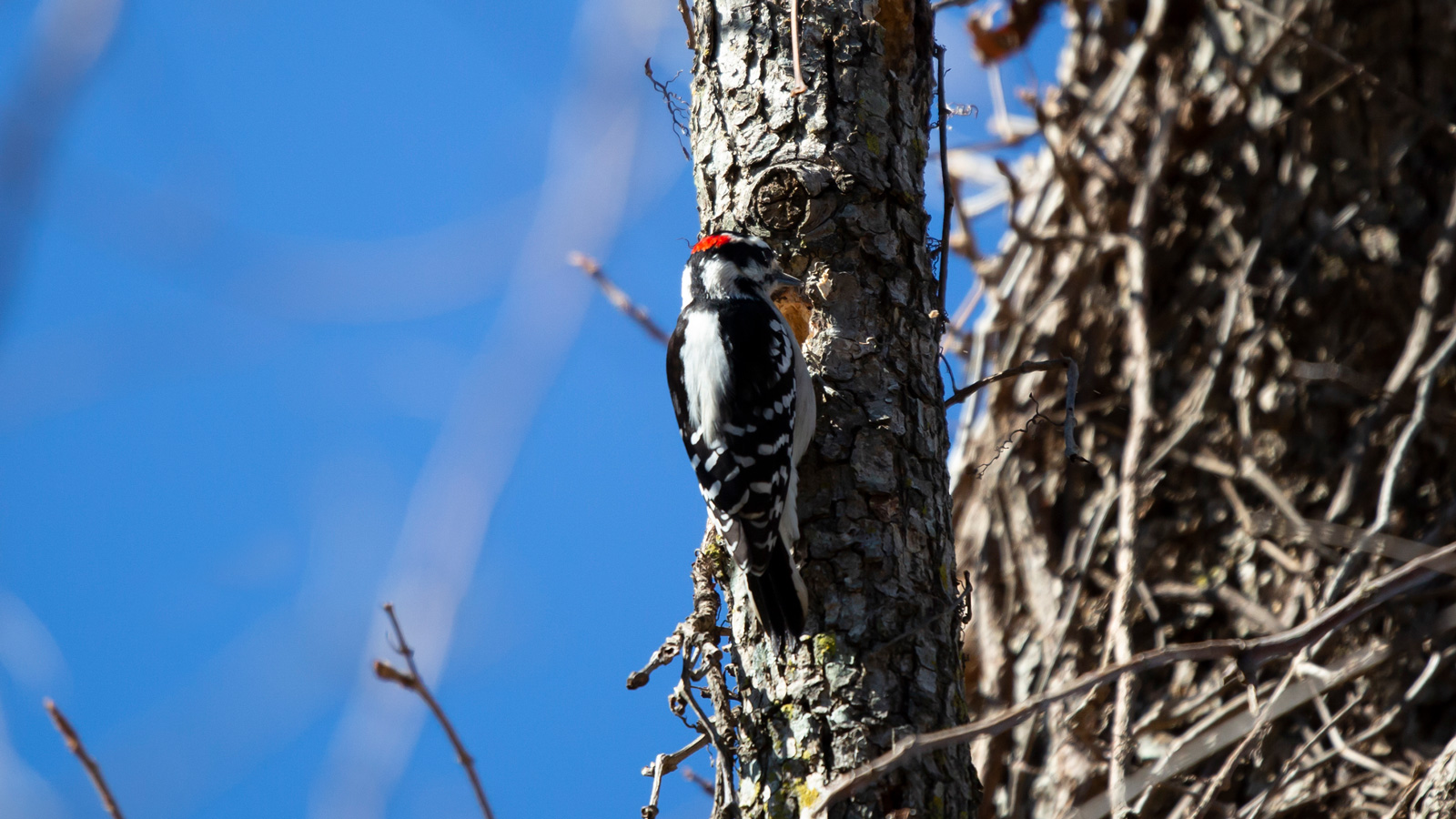
Downy Woodpecker (Dryobates pubescens) The smallest woodpecker in North America and the one most likely to appear at a backyard suet feeder across all 26 parishes. Downy Woodpeckers work small-diameter branches and weed stems that larger woodpeckers ignore, occupying a foraging niche at the fine-textured end of the dead wood spectrum. The small bill relative to head size separates Downy Woodpeckers from the similar Hairy Woodpecker at a glance, and the outer tail feathers carry black spots that Hairy Woodpeckers lack. Males show a red patch on the back of the head that females don't carry.
Hairy Woodpecker (Dryobates villosus) A larger, less common version of the Downy Woodpecker that occupies mature forest with larger-diameter dead wood, not the suburban and woodland edge habitat Downy Woodpeckers use freely. The proportionally large bill, roughly as long as the head from front to back, separates Hairy from Downy at any distance where the bird shows clearly. Hairy Woodpeckers excavate deeper into dead wood and work larger snags than Downy Woodpeckers, giving the two species enough habitat separation that they coexist in the same forest without direct competition at the same foraging sites.
Red-bellied Woodpecker (Melanerpes carolinus) The most abundant large woodpecker in North Louisiana's residential and forest habitats, the Red-bellied Woodpecker occupies every wooded habitat in the region year-round and shows up at feeders, in city parks, along forest roads, and deep in bottomland hardwood with equal frequency. The red cap extending from bill to nape on males, and the red restricted to the nape on females, combined with the black-and-white barring on the back, identify this species immediately. The red belly that gives the species its name stays hidden against the branch and rarely visible in the field, which makes the name both accurate and misleading simultaneously.
Red-headed Woodpecker (Melanerpes erythrocephalus) A striking species with an entirely red head on adults, no partial cap or nape patch but a full hood of deep crimson covering the entire head from throat to crown, creating one of the most visually dramatic woodpecker plumages in North America. Red-headed Woodpeckers occupy open woodland and forest edge habitats, particularly areas with large dead snags and open understory that support the aerial insect catching and food caching behavior that distinguishes this species from other North Louisiana woodpeckers. Populations declined across much of the eastern range during the 20th century, and finding Red-headed Woodpeckers in North Louisiana now requires targeting the specific open woodland and dead snag habitat they depend on.
Yellow-bellied Sapsucker (Sphyrapicus varius) Yellow-bellied Sapsuckers arrive as winter visitors, not year-round residents. The sapsucker arrives in North Louisiana in October and departs in April, spending the winter drilling the orderly rows of small wells in tree bark that identify sapsucker activity immediately. The sap that wells up in these holes attracts hummingbirds, warblers, and other species that use the sapsucker's excavations as food sources throughout the winter. The red cap, red throat on males, and the bold white wing stripe visible in flight and at rest all contribute to identification, and the quiet methodical drilling of sap wells produces a slower, more evenly spaced sound than the excavation or drumming of other woodpeckers.
Northern Flicker (Colaptes auratus) The woodpecker most likely to confuse observers who expect woodpeckers to be on trees, because Northern Flickers spend substantial time on the ground foraging for ants, their primary food during the warmer months. A large, brown-barred woodpecker flushing from a lawn and showing a white rump patch and yellow underwings in the flash of departure closes the identification immediately, the yellow wing lining visible at distances where the facial field marks stay invisible. Flickers drum loudly on resonant surfaces during the breeding season, and their loud "wick-wick-wick" call carries through neighborhoods in spring.
Pileated Woodpecker (Dryocopus pileatus) The largest woodpecker in North America with confirmed current populations, crow-sized and unmistakable, with a flaming red crest, largely black body, and white facial stripes that create a pattern nothing else in the region matches. Pileated Woodpeckers excavate large rectangular or oblong holes in dead and dying hardwood trees while hunting carpenter ant colonies, leaving excavations that persist in standing snags for years and provide nest cavities for Wood Ducks, owls, and other cavity-nesting species long after the Pileated moved on. The call, a loud laughing series of notes with a prehistoric quality, carries through bottomland forest at significant distance.
Ivory-billed Woodpecker (Campephilus principalis) The Ivory-billed Woodpecker refused to accept extinction quietly. Formerly the largest woodpecker in North America, lost its primary old-growth bottomland forest habitat across the South through logging operations in the late 19th and early 20th century, with the last universally accepted confirmed records coming from Louisiana's Singer Tract in 1944. What followed became one of the most contested narratives in North American ornithology: reported sightings continued across subsequent decades, a 2004-2005 Arkansas sighting produced footage that divided the ornithological community, and Louisiana bottomland forests including areas of the Atchafalaya Basin and the Pearl River drainage generated periodic reports that never produced consensus confirmation. The U.S. Fish and Wildlife Service moved toward declaring the species extinct in 2023, a determination that generated significant scientific objection on its own. The Ivory-billed Woodpecker occupies a category North American ornithology rarely encounters: a species simultaneously listed as extinct and reported alive, the question of its existence unresolved and perhaps unresolvable without evidence that searches spanning decades haven't produced.
Drumming and Calling
Woodpecker drumming serves the same territorial and communication functions as bird song, carrying species-specific patterns that experienced listeners separate by ear in the field. Learning drum patterns alongside calls doubles the identification tools available in forest habitat where a woodpecker heard before it's seen may drum without calling, or call without drumming.
Downy Woodpeckers drum in short bursts with even spacing between strikes. Hairy Woodpeckers drum faster and longer than Downies, with the larger bill producing a deeper, more resonant sound against the same substrate. Red-bellied Woodpeckers drum at moderate speed with occasional hesitations. Pileated Woodpeckers drum slowly and powerfully, each strike distinct and the interval between strikes longer than smaller woodpeckers manage, creating a tempo that sounds different from any other North Louisiana woodpecker.
Calls carry identification information independently. The Pileated's wild, laughing call carries further than any other woodpecker in the region and identifies the species instantly once learned. The Red-bellied Woodpecker's rolling "churr" call, repeated frequently through the day, locates this species in forest canopy before visual contact. Northern Flicker calls carry the "wick" series and the "flicker" call that name-checks the species and carry through suburban neighborhoods and open woodland. Yellow-bellied Sapsuckers call with a cat-like mewing note that differs from other woodpecker calls and sometimes causes observers to look around for the cat before the sapsucker appears.
Habitat
The eight North Louisiana woodpecker species split across habitat types in ways that narrow the identification list before the binoculars come up.
Mature bottomland hardwood, particularly the large-diameter dead wood that accumulates in protected forest, supports Pileated Woodpeckers, Red-bellied Woodpeckers, and Hairy Woodpeckers in North Louisiana's Ouachita and Red River drainages, the Bodcau Wildlife Management Area, and the bottomland timber in Bienville, Jackson, and Winn parishes. Ivory-billed Woodpeckers, if present anywhere, would occupy this same large-diameter bottomland hardwood habitat.
Pine forest and mixed pine-hardwood supports Red-cockaded Woodpeckers in longleaf pine restoration areas in Kisatchie National Forest, where active cavity tree clusters occur in the longleaf pine units of Vernon, Sabine, and Natchitoches parishes. Northern Flickers use open pine savanna during breeding season and range into suburban and agricultural habitat during migration and winter.
Suburban and residential habitat with mature trees supports Red-bellied Woodpeckers, Downy Woodpeckers, and Northern Flickers year-round, with Yellow-bellied Sapsuckers adding to the winter mix. A mature oak or pecan tree in a residential yard in Ruston, Natchitoches, or Monroe holds more woodpecker activity through the year than most observers notice until they start paying attention.
Cavity Nesting and Ecological Role
Woodpeckers excavate the primary cavities that define the cavity-dependent bird community in North Louisiana's forests. Without woodpecker excavation, Wood Ducks, owls, several duck species, Eastern Bluebirds, Carolina Chickadees, Tufted Titmice, and multiple other species lose nest sites they cannot create themselves. The secondary cavity users, which in North Louisiana include more than thirty species, depend entirely on woodpecker excavation activity to create the holes they occupy for nesting and roosting.
Pileated Woodpecker excavations, the largest cavities created by any common North Louisiana woodpecker, provide nest and roost sites for Wood Ducks, Barred Owls, and other large cavity users that smaller woodpecker species can't accommodate. A Pileated excavation in a large bottomland hardwood snag may get used by multiple species over decades as it weathers and enlarges, the Pileated long gone from that particular tree and the cavity still supporting nesting birds years later.
The relationship between woodpecker populations and forest health runs in both directions. Woodpeckers extract wood-boring beetle larvae that kill trees in large numbers when beetle populations explode during drought or forest stress. A forest with functional woodpecker populations keeps beetle populations in check in ways that alter tree mortality rates. Remove the woodpeckers and the beetles reorganize the forest on a different timeline, one of the less obvious reasons woodpecker populations matter beyond their immediate ecological role.
Red-cockaded Woodpecker: The Conservation Story
The Red-cockaded Woodpecker (Dryobates borealis) warrants specific attention within a North Louisiana woodpecker discussion because its recovery story runs directly through the Kisatchie National Forest and ranks among the more significant conservation successes in the region's recent history.
Red-cockaded Woodpeckers nest exclusively in living longleaf pine trees, excavating cavities in trees with red heart fungal infection that softens the heartwood enough for excavation. The dependence on living longleaf pine made this species a direct casualty of the longleaf pine loss that replaced most of the South's native pine savanna with loblolly pine plantations and agricultural land through the 20th century. By the 1970s, the species qualified as endangered across its entire range.
Kisatchie National Forest's longleaf pine restoration program created the habitat recovery that Red-cockaded Woodpecker populations needed, and the forest now supports active Red-cockaded Woodpecker clusters in the longleaf pine units. The active cavity trees get marked with white paint bands visible to observers walking the forest, and the clusters of cavity trees in suitable longleaf pine stands represent the most reliable Red-cockaded Woodpecker observation locations in North Louisiana. Early morning visits to active clusters during breeding season produce the most consistent encounters.
Confused With
Most woodpecker species in North Louisiana separate cleanly from each other and from non-woodpecker species once the general woodpecker body plan registers. A few specific confusion pairs create identification challenges worth addressing.
Downy Woodpecker and Hairy Woodpecker create the most consistent confusion in the family because the two species share the same black-and-white plumage pattern and frequently occupy the same woodland habitat. Bill length relative to head size settles every identification: Downy bills look short and stubby relative to the head, and Hairy bills look as long as the head from front to back. When both species appear at the same feeder or on the same snag, the size difference reinforces the bill difference and eliminates ambiguity. When only one species appears, the bill proportion alone closes the identification without needing the size reference.
Pileated Woodpecker and Ivory-billed Woodpecker share enough structural similarity that distinguishing them drives the ongoing debate about recent Ivory-billed sightings. Ivory-billed Woodpeckers ran larger than Pileateds, with a white ivory bill where Pileateds carry a dark bill, extensive white on the trailing edge of the wing visible at rest, and a different white facial stripe arrangement from the Pileated's single stripe. In flight, Ivory-billeds showed white on the rear of the wing, while Pileateds show white on the front of the wing in flight. The distinctions require close observation or clear photographs, and the habitat conditions where potential Ivory-billed sightings would occur, dense bottomland forest with limited sight lines, present exactly the conditions where close observation proves most difficult.
Northern Flicker on the ground sometimes gets identified as a thrush or other ground-feeding bird by observers who don't expect woodpeckers on lawns. The brown barring on the back, the spotted breast, and the black bib create a pattern that doesn't immediately register as woodpecker until the bird flushes and shows the white rump patch and yellow wing lining. Once the flight pattern registers, the identification closes immediately and the ground-feeding behavior makes sense as the ant-foraging strategy it always was.
Accessibility
Woodpecker activity in North Louisiana forests and suburban habitats carries significant sound before any visual contact occurs. Drumming on resonant wood, the most diagnostic woodpecker sound, travels through forest at distances that allow location of the bird well before a sightline opens. Pileated Woodpecker drumming, slower and more powerful than smaller woodpeckers, carries the furthest and often identifies the species before anything else registers. The excavation sound of a Pileated working a dead tree, louder and more irregular than drumming, resembles someone working wood with a hand tool and carries clearly through bottomland forest.
Red-bellied Woodpecker calls, the rolling "churr" repeated through the day, locate this species in forest canopy where the black-and-white barring on the back stays hidden against bark from below. Northern Flicker calls carry through suburban neighborhoods in spring before the bird appears on a utility pole or fence post. Yellow-bellied Sapsucker excavation of sap wells creates a slow, rhythmic tapping distinctly different from the faster drumming or excavation of resident woodpeckers, audible from close range at active sap well trees.
Suet feeders in residential yards across North Louisiana attract Downy Woodpeckers, Red-bellied Woodpeckers, and in winter Yellow-bellied Sapsuckers, making backyard feeding the most accessible woodpecker observation opportunity for observers without ready access to forest habitat. A suet feeder on a mature tree in a residential yard produces woodpecker activity within days of installation in most North Louisiana neighborhoods with mature trees, and the close observation distance a feeder allows produces field mark views unavailable in the forest canopy.
More Information
Louisiana Department of Wildlife and Fisheries — wlf.louisiana.gov Kisatchie National Forest Red-cockaded Woodpecker Program — fs.usda.gov/kisatchie Cornell Lab of Ornithology Woodpecker Identification — allaboutbirds.org iNaturalist North Louisiana Picidae Observations — inaturalist.org
Species Profiles
Individual articles cover each North Louisiana woodpecker species in depth.
Downy Woodpecker
Hairy Woodpecker
Red-bellied Woodpecker
Red-headed Woodpecker
Yellow-bellied Sapsucker
Northern Flicker
Pileated Woodpecker
Red-cockaded Woodpecker
Ivory-billed Woodpecker
Frequently Asked Questions
How many woodpecker species live in North Louisiana year-round? Seven species qualify as year-round residents or near-residents: Downy, Hairy, Red-bellied, Red-headed, Northern Flicker, Pileated, and Red-cockaded Woodpeckers. Yellow-bellied Sapsuckers arrive in October and depart in April, winter visitors and nothing more. Ivory-billed Woodpecker status remains unresolved.
What's the difference between a Downy and a Hairy Woodpecker? Bill length relative to head size settles the identification. Downy bills look short and stubby, clearly shorter than the head. Hairy bills look as long as the head from front to back. Size reinforces the bill difference when both species appear together, with Hairy Woodpeckers running noticeably larger. Downy outer tail feathers also show black spots that Hairy outer tail feathers lack.
Why do woodpeckers drum on my house? Woodpeckers drum on resonant surfaces for territorial communication, and metal gutters, aluminum flashing, and cedar siding all provide better resonance than most natural wood. A woodpecker drumming on a house in spring almost always drums for territorial reasons, not foraging ones, choosing the most resonant surface available, not the most likely to hold insects. Excavation damage, not drumming, usually indicates an insect infestation in the wood worth investigating.
Where can I find Red-cockaded Woodpeckers in North Louisiana? Kisatchie National Forest's longleaf pine units in Vernon, Sabine, and Natchitoches parishes support active Red-cockaded Woodpecker clusters. The cavity trees in active clusters get marked with white paint bands, and forest roads through the longleaf pine units provide access to cluster areas. Early morning visits during the breeding season, when birds leave and return to cavity trees, produce the most reliable encounters.
What created those large rectangular holes in the dead tree? Pileated Woodpeckers. The rectangular or oblong excavation shape, sometimes a foot or more in length, identifies Pileated Woodpecker foraging activity immediately. The bird excavates these cavities while hunting carpenter ant colonies in the heartwood of dead and dying trees, leaving cavities that later get used as nest and roost sites by Wood Ducks, owls, and other cavity-dependent species.
Could Ivory-billed Woodpeckers still exist in North Louisiana? Possibly. Louisiana bottomland forest habitat, particularly in the Atchafalaya Basin and portions of the Red River and Ouachita drainages, falls within the historical range and holds the closest existing analog to the old-growth habitat the species occupied. Periodic sightings continue to generate investigation without producing consensus confirmation. The species occupies a genuinely uncertain status in North American ornithology, and North Louisiana's bottomland forest gives that uncertainty a specific address.