About Kinglets and Nuthatches
Five species split the bark, the branches, and the needle tips of North Louisiana's forests into feeding zones defined by angle, speed, body size, and which direction the bird walks on a trunk. The kinglets hover at branch tips and pick insect eggs off pine needles. The nuthatches hitch headfirst down trunks and probe bark crevices that upward-climbing birds never see.
Every species weighs between six and twenty-eight grams. Every species moves through the forest at speeds that make binoculars feel adversarial. One of them uses tools. One of them booby-traps its own front door with pine resin. One of them sings louder than birds three times its size. One of them survives January through controlled hypothermia. One of them was walking down the oak in your yard longer than you've owned the house. None of them have received adequate credit.
What's on the Menu
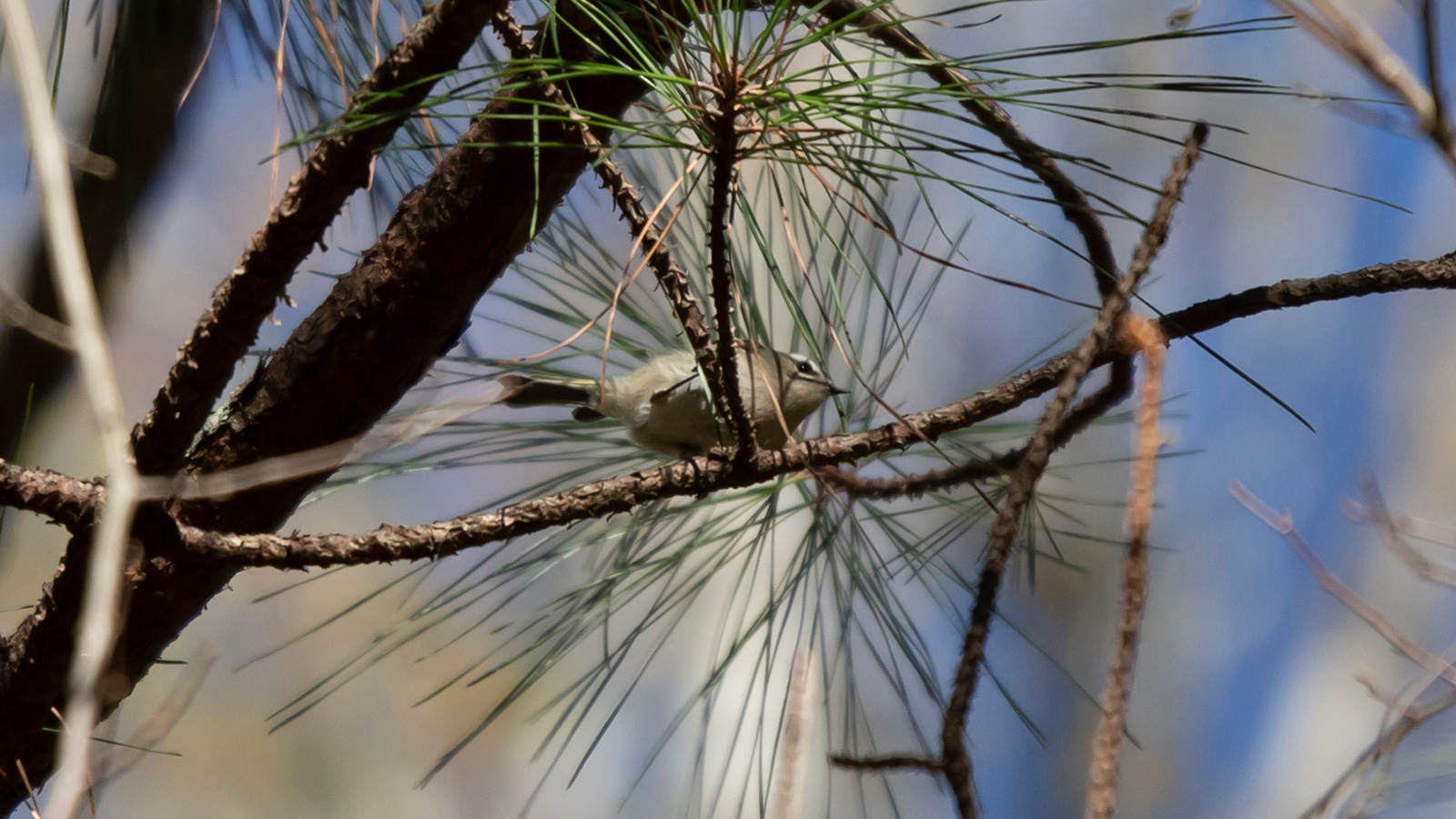
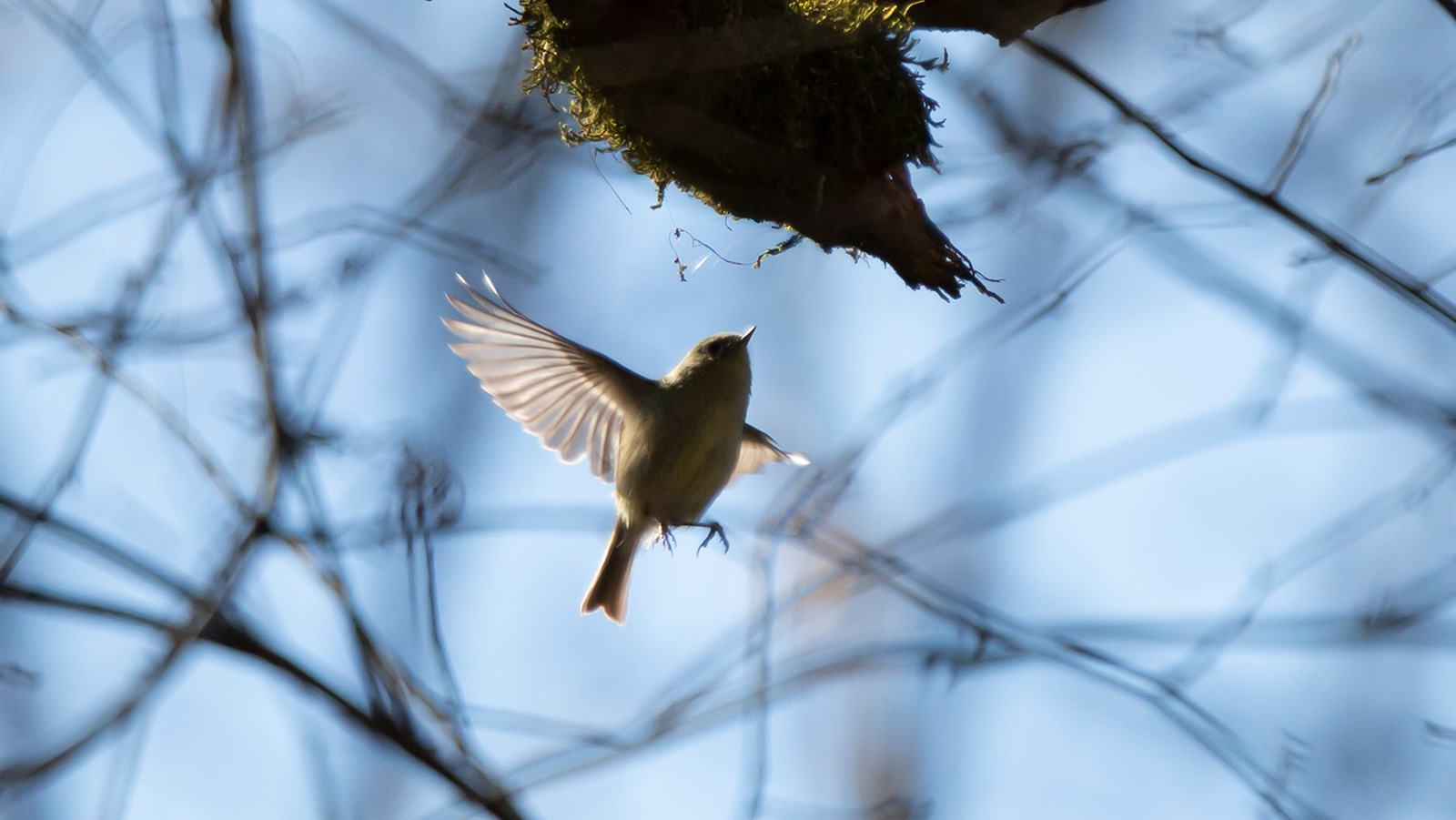
Insects, insect eggs, spiders, spider eggs, seeds, and whatever tiny arthropod clings to the bark surface or needle cluster that the bird's bill can reach. The kinglets specialize in the outer branch tips that no other bird checks: hovering at pine needle clusters, hanging upside down from twig ends, picking off insect eggs smaller than the period at the end of a sentence. The nuthatches specialize in the trunk and main branches, hitching along bark in any direction, probing crevices from the headfirst-downward angle that gives them a viewing perspective no upward-climbing bird can match.
The brown-headed nuthatch adds tool use. The bird picks up loose bark flakes and uses them as levers to pry up adjacent bark, exposing the insects underneath. The white-breasted nuthatch adds power hammering: wedging acorns and seeds into bark cracks and pounding them open with the bill. The red-breasted nuthatch adds suet-feeder aggression during irruption winters, defending a feeder territory against birds that outweigh it and losing none of the confrontations. The golden-crowned kinglet eats approximately its own body weight in insects and eggs every day because the alternative to eating its own body weight every day involves dying overnight.
The ruby-crowned kinglet eats all of the above plus sap from sapsucker wells and berries, because the ruby-crowned kinglet never turned down a food source in its history.
The Lineup
Golden-crowned kinglet. Pine and mixed forest, October through March. Travels with mixed-species flocks. Calls at a frequency that slowly disappears from human hearing with age. Survives freezing nights through controlled hypothermia. Weighs six grams.
Ruby-crowned kinglet. Everywhere with trees or brush, October through April. Hides the ruby crown so effectively that most birders have never seen it. Flicks its wings with a nervous tic that no other bird in North Louisiana matches. Sings with a volume that the body cannot physically explain.
Brown-headed nuthatch. Mature pine forest, year-round. Pine specialist, tool user, and the squeakiest bird in the forest. Kisatchie National Forest carries the strongest populations in North Louisiana. Depends entirely on mature, fire-maintained pine stands.
Red-breasted nuthatch. Pine and mixed forest, irruption winters only. Shows up when the Canadian boreal cone crop fails and vanishes when it doesn't. Smears pine resin around the nest entrance. Chases chickadees off feeders without regard for the size difference.
White-breasted nuthatch. Mature hardwood forest, year-round. The nuthatch that was walking headfirst down the same oak for longer than you've been watching it. Caches sunflower seeds in every bark crack within fifty feet of the feeder. Calls with a low, nasal "ank-ank-ank" that carries year-round.
How to Tell Them Apart (Faster Than You Think)
The five species sort by size, habitat, and face pattern.
Kinglets (tiny, hyperactive, olive-green): the golden-crowned wears a gold-and-black crown stripe. The ruby-crowned wears a bold broken white eye ring. Crown stripe versus eye ring sorts them at a glance. The golden-crowned's thin, high "tsee" call sits near the ceiling of human hearing. The ruby-crowned's husky "ji-dit" sits lower and louder.
Nuthatches (small to medium, headfirst-down-trunk, nasal calls): brown-headed wears a brown cap, feeds in pine, squeaks. Red-breasted wears a black cap with a bold white eyebrow and orange breast, shows up only during irruption winters. White-breasted wears a black cap with a clean white face and white breast, feeds in hardwood, year-round. Cap pattern, breast color, and call pitch sort all three at close range. At distance, habitat alone narrows the ID: pine nuthatch or hardwood nuthatch eliminates one or two species before the binoculars go up.
No other bird in North Louisiana hitches headfirst down tree trunks. Any bird going headfirst down bark belongs to one of the three nuthatch species, and the cap color identifies which one.
What Eats Them (And What the Weather Does)
Sharp-shinned hawks and Cooper's hawks hunt every species in this group. Both hawks specialize in small forest birds and hunt through the same stands where kinglets and nuthatches feed. The nuthatch defense: freeze flat against the bark with the camouflaged back facing outward. The kinglet defense: constant motion that makes targeting difficult. Both defenses work until they don't. Both defenses work often enough to sustain the population.
Rat snakes and corn snakes raid nuthatch nest cavities. A climbing snake that finds the cavity entrance can eat every egg and nestling inside. The brown-headed nuthatch's small cavity entrance excludes cowbirds and larger birds but not snakes. The red-breasted nuthatch's resin barrier deters climbing mammals but not snakes. Cavity defense works against everything except the predator shaped to pass through any opening larger than its own head.
Cold weather kills more kinglets than predators do. A six-gram bird that burns its entire fat reserve every night has roughly one missed feeding day between survival and starvation. Consecutive freezing days that prevent feeding can eliminate local wintering kinglet populations faster than any hawk.
When They Show Up
The year-round residents, the white-breasted nuthatch and the brown-headed nuthatch, show up in every month. The brown-headed stays in the pines. The white-breasted stays in the hardwoods. Both call year-round.
Both kinglets arrive in October and depart by April or early May. The golden-crowned travels with mixed-species flocks in pine forest. The ruby-crowned spreads across every habitat with trees or brush. Both species travel with chickadees and titmice, and the easiest way to find a kinglet in winter starts with finding a chickadee flock and listening for the additional voices that travel with it.
Red-breasted nuthatches show up only during irruption winters, October through March, and may not appear in North Louisiana for years at a stretch. An irruption year puts the bird at feeders and in pine stands. A non-irruption year produces nothing.
Where to Start
Kisatchie National Forest for the brown-headed nuthatch. Mature pine stands with standing dead snags hold the bird year-round. The squeaky call gives away the bird's location within minutes.
Any mature hardwood forest for the white-breasted nuthatch. D'Arbonne NWR, Chemin-a-Haut State Park, Poverty Point Reservoir State Park, and every city park with old oaks carry the bird. The nasal "ank-ank-ank" shows up within minutes.
Mixed-species flocks in any forest between October and April for the kinglets. Find the chickadees. Listen above the chickadee calls for the thin "tsee" of the golden-crowned or the husky "ji-dit" of the ruby-crowned.
Suet and sunflower feeders for the nuthatches, especially during irruption winters when the red-breasted nuthatch appears.
Where to Learn More
The Cornell Lab of Ornithology's All About Birds covers all five species with range maps, call recordings, and feeding ecology. The Sibley Guide to Birds provides the side-by-side nuthatch comparison by cap pattern and the kinglet comparison by crown pattern and eye ring.
Published behavioral ecology research covers the brown-headed nuthatch's tool use, the red-breasted nuthatch's resin defense, and the golden-crowned kinglet's hypothermic survival in peer-reviewed detail. All three topics read better than most fiction.
Experiencing These Birds: Accessibility Notes
Each bird carries a distinct sound, and four of the five sit in a pitch range that most people hear without trouble.
The white-breasted nuthatch's low "ank-ank-ank" sounds like a small horn blown with a stuffy nose. Comes through clearly for almost everyone, including people who've lost the high frequencies. You'll hear it in any hardwood stand, any month of the year.
Brown-headed nuthatches squeak a rapid "yank-yank" that sounds like a rubber duck being squeezed rapidly. Higher pitched but still well within normal hearing range. The rubber-toy quality sets it apart from every other sound in the pine forest.
Ruby-crowned kinglets call with a husky "ji-dit" that carries at a mid-range pitch and sounds vaguely irritated. The sound shows up at every wooded location in North Louisiana between October and April.
Red-breasted nuthatches call with a nasal "ank-ank-ank" pitched between the other two nuthatches, pitched between the other two nuthatches. Shows up only during irruption winters.
Golden-crowned kinglets call at an extremely thin, high "tsee-tsee-tsee" near the ceiling of human hearing. If you've lost some high-frequency range with age, you may not hear the call at all, even standing right under the bird. The chickadee flock traveling with the kinglet works as a lower-pitched stand-in for where the flock went.
All five feed on tree trunks and branches, and the nuthatches come within ten feet of the ground regularly during normal feeding. From a car or any accessible spot along a forest road, you can find every bird in this group by ear and confirm by eye without leaving the vehicle or the path.