About Raptors
North Louisiana has more than two dozen hawk, owl, falcon, eagle, and vulture species living in or passing through the region. Yes, vultures count. They don’t hunt. They scavenge. But they have the hooked beak and the attitude, so they’re in the club. The raptor you’re most likely to see is the turkey vulture — or more accurately, a committee of turkey vultures, since they travel in groups and the collective noun is genuinely “committee.” They circle above highways looking for roadkill. They roost in dead trees. They stand in the middle of roads eating things you’d rather not think about. The turkey vulture is North Louisiana’s most visible raptor and also the least threatening, because it only eats things that are already dead and cannot object to being eaten. The raptor you’re most likely to hear is the red-tailed hawk, whose long, descending, raspy scream is so authoritative that Hollywood has been dubbing it over bald eagle footage for decades. Every time an eagle screams in a movie, you’re hearing a red-tailed hawk. Bald eagles sound like squeaky toys. The red-tailed hawk has been providing vocal performance for the national bird since the beginning of cinema and has never received a credit.
What Makes a Raptor a Raptor
Hooked beak. Powerful talons. Exceptional eyesight. Most raptors kill their own food; vultures prefer it pre-killed by someone else, ideally several days ago when the meat has had time to ripen. The hunting strategies divide roughly into four approaches: hawks and eagles ambush from above or from perches; falcons pursue prey in high-speed aerial combat; owls use silent flight and exceptional hearing to hunt in darkness; vultures locate carrion by smell and circle in until the situation resolves. North Louisiana has active representatives of all four.
Eagles
Bald eagles are fish specialists that hunt by swooping down and grabbing fish from the water’s surface — though they also eat carrion, steal food from ospreys with cheerful regularity, and occasionally take waterfowl or small mammals. Adults have white heads and tails. Immatures are mottled brown and can look like other large raptors until you register the size. North Louisiana’s population has recovered dramatically from DDT-era lows; Black Bayou Lake NWR near Monroe, Poverty Point Reservoir, and Tensas River NWR in Madison Parish are reliable winter eagle locations. Golden eagles are uncommon winter visitors, usually immature birds wandering south from northern breeding ranges. Sightings are documented but rare enough to generate excitement in local birding groups. They’re mammal specialists built for open country and appear most often near forest edges and agricultural land.
Falcons
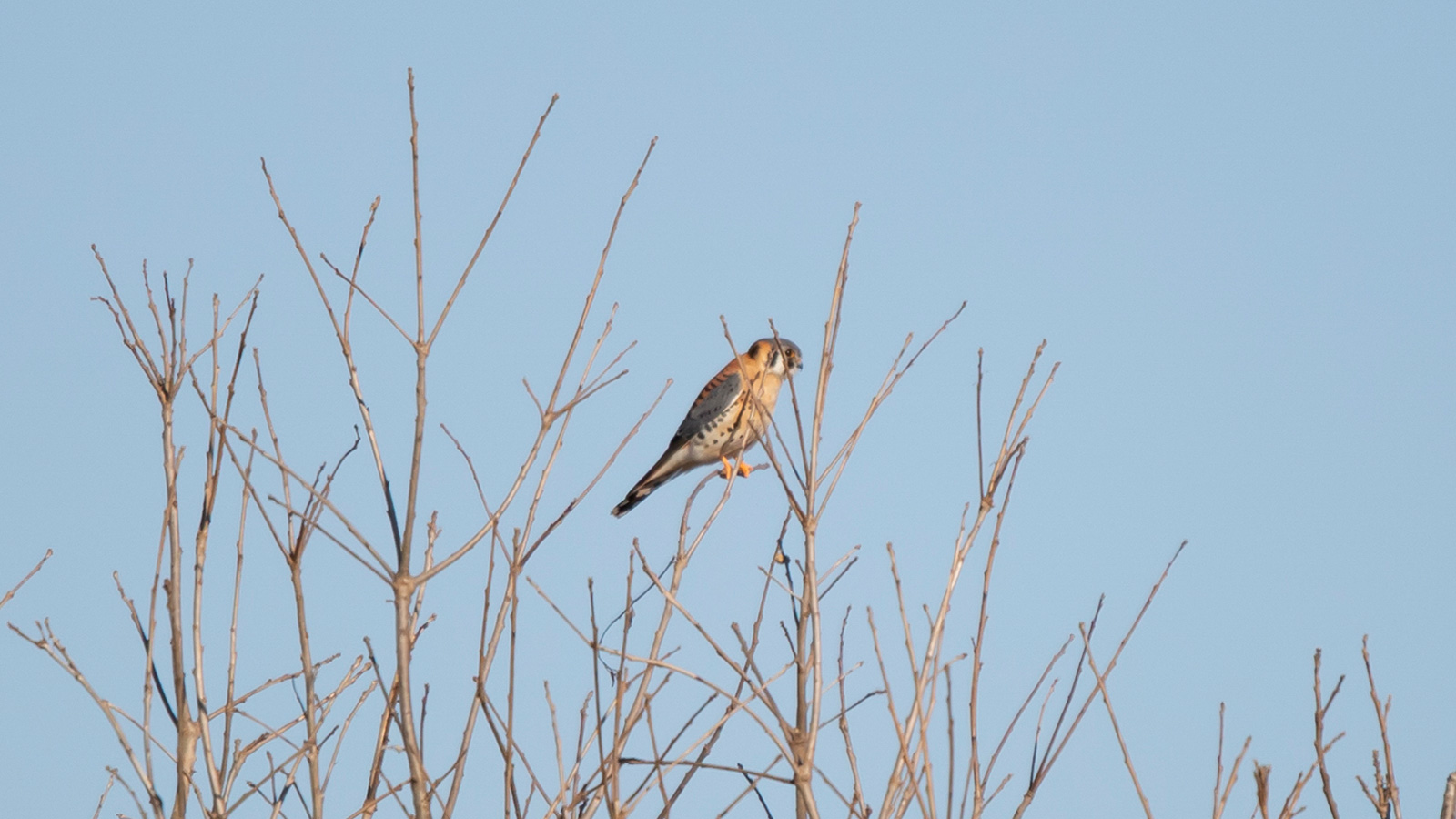
American kestrels are the falcons you’ll actually see — robin-sized, colorful, and common along roadsides where they perch on wires scanning for insects and small mammals. Males are rusty red and blue-gray with distinctive facial markings that look like war paint. Females are rusty red and brown. Merlins are larger, more aggressive, and appear during migration and winter. They hunt small birds in flight by blasting through flocks with explosive speed and mid-flight course corrections that seem to violate reasonable expectations about bird physics. Peregrine falcons are the fastest animals on Earth, capable of exceeding 240 mph during hunting stoops. They appear during migration and occasionally winter near large water bodies where waterfowl and shorebirds concentrate. Seeing a peregrine stoop on a duck is watching something that costs the duck everything and costs the falcon nothing.
Hawks
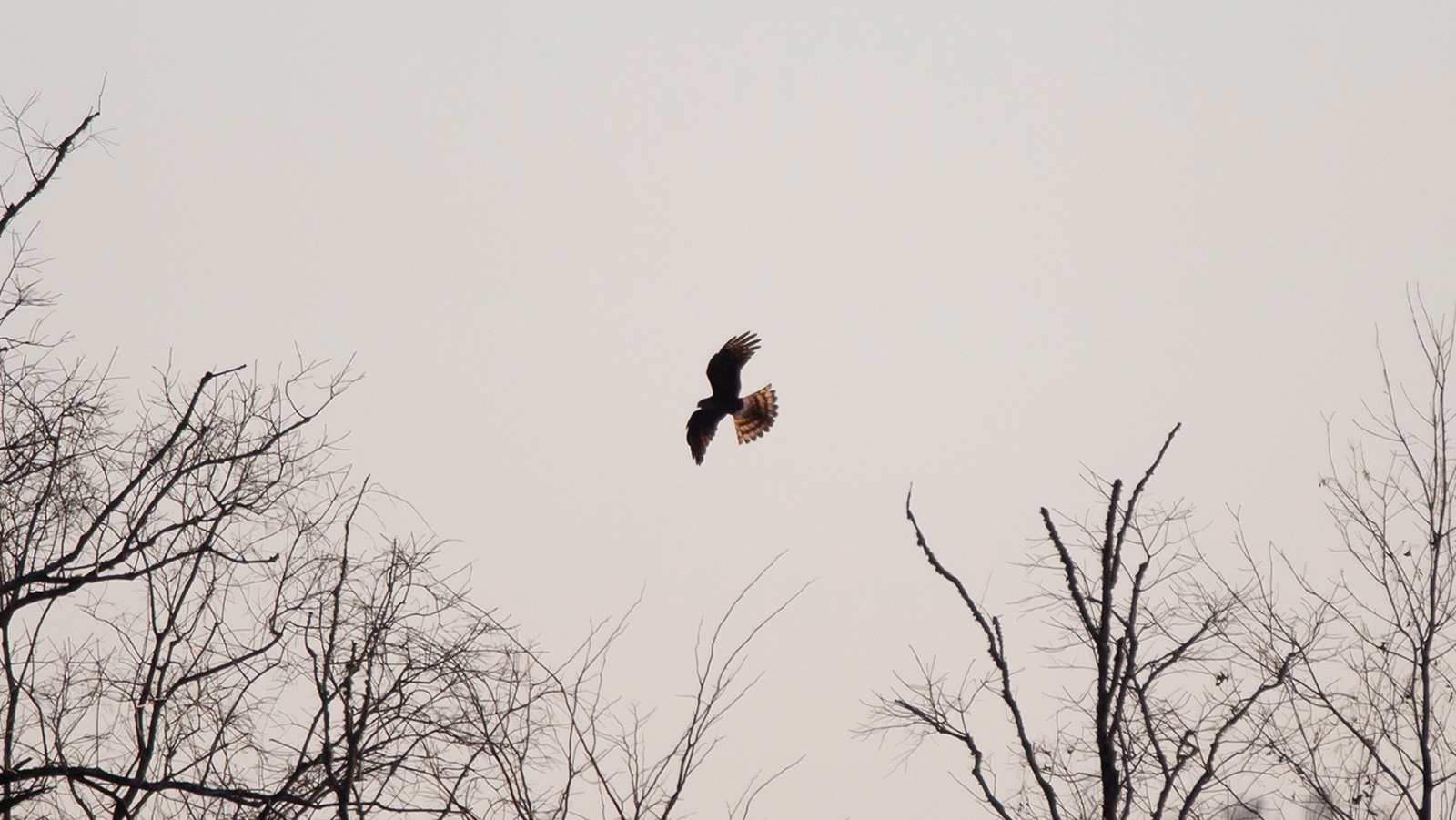
Red-tailed hawks are the hawk you’ve seen your entire life without necessarily knowing what you were looking at — large, chunky, on every other utility pole along every rural highway in North Louisiana, scanning the adjacent field with the focused patience of something that has nowhere to be and several acres of mouse habitat in front of it. Year-round residents, common in every habitat, and the source of every “eagle scream” you’ve heard in a film. Red-shouldered hawks are forest and wetland specialists, vocal and territorial, identifiable by their distinctive “kee-aah” call that echoes through bottomland hardwoods. They eat frogs, snakes, small mammals, and CRAWFISH. The translucent crescent-shaped windows near the wingtips in flight are the most reliable field mark. Cooper’s hawks are bird specialists that hunt by ambush, flying fast and low through vegetation to intercept prey before it processes what’s happening. They’ve adapted enthusiastically to suburban life and have figured out that bird feeders are hunting blinds built and maintained by helpful humans. The songbirds at your feeder know this. They flush simultaneously when a Cooper’s hawk enters the yard, before you’ve seen it, because they’ve been under this selection pressure longer than you’ve been paying attention. Sharp-shinned hawks are smaller Cooper’s hawks running the same hunting strategy on smaller prey. Telling them apart in the field involves subtle differences in head size, tail shape, and overall proportions that are considerably easier to see in a field guide than in a rapidly moving bird trying to catch a sparrow. Broad-winged hawks migrate in kettles — swirling groups of hundreds or thousands of birds riding thermals south in September and early October. A kettle of broad-wings visible from a North Louisiana highway is one of the region’s genuinely spectacular wildlife events. Northern harriers are open-country specialists that hunt by flying low over marshes and fields, using a facial disc like an owl’s to locate prey by sound. The white rump patch is visible at any distance in any light and is the fastest field identification in North American raptor watching.
Vultures
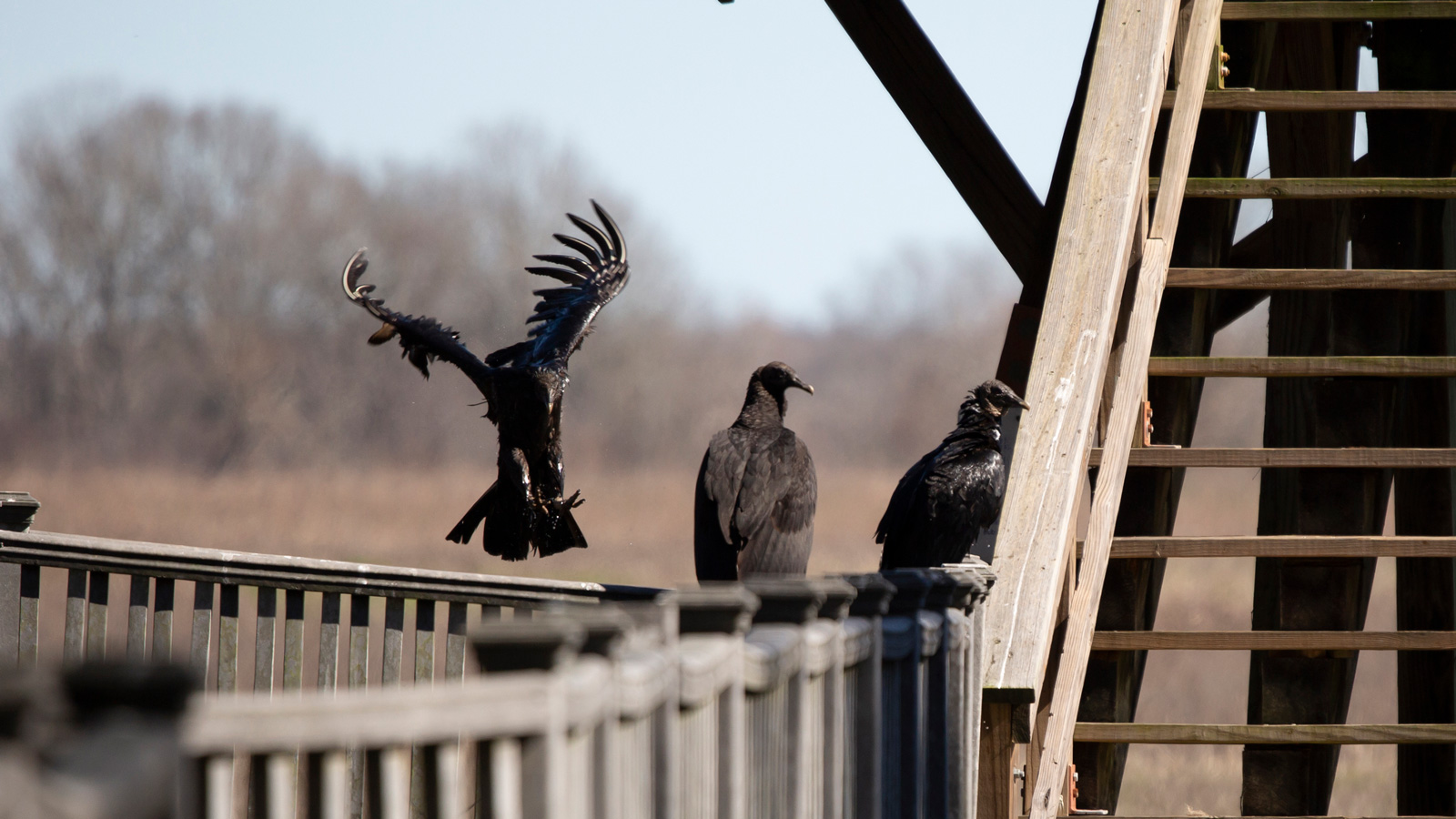
Turkey vultures are everywhere: forests, swamps, lakesides, highways, your yard, the middle of the road eating a deer that got hit three days ago. Large, dark, naked red head, two-toned underwing pattern, wings held in a shallow V with a distinctive rocking motion in soaring flight. They locate carrion primarily by smell, which is unusual among birds and is the reason they can find a dead animal hidden under dense vegetation that a black vulture standing ten feet away cannot find. Black vultures have naked black heads, white patches near the wingtips, and a more direct flight style without the rocking. Slightly smaller and more aggressive than turkey vultures, they often dominate carcasses through persistence rather than size. More common in forested areas and meadows. Both species have stomach acid strong enough to neutralize anthrax and botulism. They can safely eat things that would kill most other animals. This is either impressive or deeply unsettling depending on how you think about acid, and either way it represents a genuine ecosystem service that goes almost entirely unappreciated.
Owls
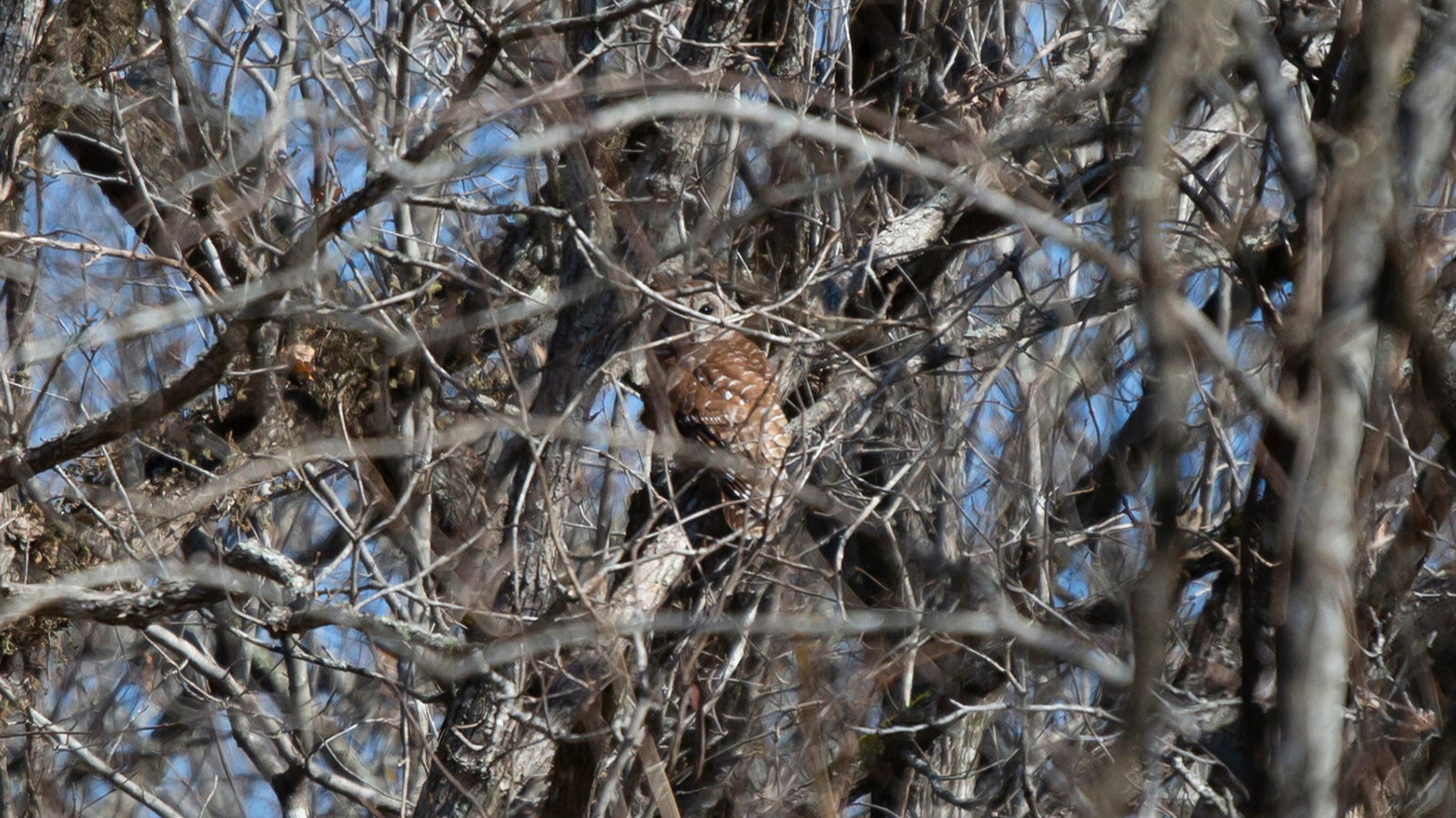
Great horned owls are the apex predators of the night — five-foot wingspan, yellow eyes, ear tufts, a deep hooting call that carries for miles. They hunt everything from mice to skunks to other owls, including barred owls, which is one reason barred owls are loud and agitated when they detect a great horned owl in their territory. Barred owls are the owls you’re most likely to encounter in North Louisiana — medium-sized, brown and white, dark eyes, no ear tufts, and a call that maps perfectly onto “who cooks for you, who cooks for you-all.” They are heard during the day and night, are comfortable wading through shallow water hunting CRAWFISH and frogs, and respond to imitations readily enough that anyone willing to cup their hands and make a reasonable attempt will often get an answer from the dark within minutes. Eastern screech-owls are small, nocturnal, and present in suburban areas, parks, and forests throughout the region. They don’t screech — they produce a descending whinny that sounds like a small horse. Learn that sound and you’ll hear them constantly in habitat where you previously heard nothing. Barn owls are pale, heart-faced, and uncommon but present, hunting rodents in agricultural areas and nesting in barns and abandoned buildings. Seeing one at night is memorable because they look like ghosts and fly like them — absolutely silent, pale, drifting through darkness with no apparent effort.
Where and When to Find Raptors
Black Bayou Lake NWR near Monroe, D’Arbonne NWR near Bastrop, Tensas River NWR in Madison Parish, Catahoula NWR, Bodcau WMA, and Kisatchie National Forest all produce consistent raptor sightings across species. Any lake, river, or agricultural area in North Louisiana has at least a few species, and roads through open country are reliable for perched hawks. Migration — March through May and September through November — is when resident species are joined by migrants and diversity peaks. Winter brings rough-legged hawks, occasional golden eagles, and concentrated bald eagle numbers around large water bodies. Fall migration is the dramatic season: broad-winged hawk kettles, sharp-shinned and Cooper’s hawk flights, American kestrel and merlin concentrations along the coast, and peregrine falcons moving through wetland corridors. Most hawks and eagles are diurnal and most visible in morning and late afternoon when thermals and prey activity align. Owls are primarily nocturnal except in winter when shortened days and increased energy demands force some species to hunt during daylight. Winter is the best season for seeing owls, and any time of year is good for hearing them if you go out after dark in appropriate habitat and listen.
Learn More
Individual species pages cover bald eagles, red-tailed hawks, Cooper’s hawks, northern harriers, barred owls, and the rest of North Louisiana’s raptor lineup in detail — identification, behavior, hunting strategy, and which ones are currently watching you from the utility pole across the street.
Accessibility
Raptors are one of the more accessible wildlife groups in North Louisiana because many species are large, vocal, and visible from roads, lake edges, and open fields. Visitors with limited mobility can scan for vultures, hawks, eagles, and falcons from vehicle pullouts, refuge drives, fishing piers, and observation decks. Visitors who are blind or have low vision can learn several distinctive sounds: barred owl hoots, red-shouldered hawk calls, red-tailed hawk screams, and the wingbeats or calls of vultures and owls at roosts.
Frequently Asked Questions
What is the most common raptor in North Louisiana?
Turkey vultures are the most visible large soaring raptors, while red-tailed hawks are among the most commonly seen perched hunting hawks.
Do vultures count as raptors?
Yes. They are scavengers rather than active hunters, but they have hooked beaks and are traditionally included with birds of prey.
When is the best time to see migrating raptors?
Fall migration, especially September through November, is the best window for broad-winged hawks, accipiters, falcons, and other migrants.
Where should beginners look for raptors?
Open roadsides, lake edges, agricultural fields, Black Bayou Lake NWR, Tensas River NWR, D’Arbonne NWR, and Kisatchie National Forest are all productive.