About Lizards
North Louisiana has lizards. Not a staggering diversity of them — this is not the desert Southwest, where you can find fifteen species on a single hillside — but the species we have are abundant, widespread, and routinely confused with each other by everyone who is not actively studying them. A small brown lizard on a porch railing in Ouachita Parish could be a prairie lizard, a five-lined skink, a broadhead skink, a little brown skink, a green anole having a bad day, or a brown anole that hitchhiked in with a shipment of landscaping plants. Telling them apart requires patience, practice, or a willingness to grab the animal and count scales, which is not recommended for anyone who values their dignity more than their accuracy.
The lizard fauna of North Louisiana breaks into a few broad groups, and understanding those groups is the fastest way to narrow down what you are looking at. Skinks have smooth, shiny scales and elongated bodies. Prairie lizards have rough, keeled scales and blue belly patches. Anoles have color-changing ability and throat fans. Geckos — yes, we have one — have soft skin and vertical pupils. Once you know which group you are dealing with, the species-level identification gets easier.
The Skinks
Three skink species dominate North Louisiana: the broadhead skink (Plestiodon laticeps), the common five-lined skink (Plestiodon fasciatus), and the little brown skink (Scincella lateralis). A fourth species, the southeastern five-lined skink (Plestiodon inexpectatus), occurs in the Florida parishes and the eastern edge of the state but does not range into North Louisiana's core parishes.
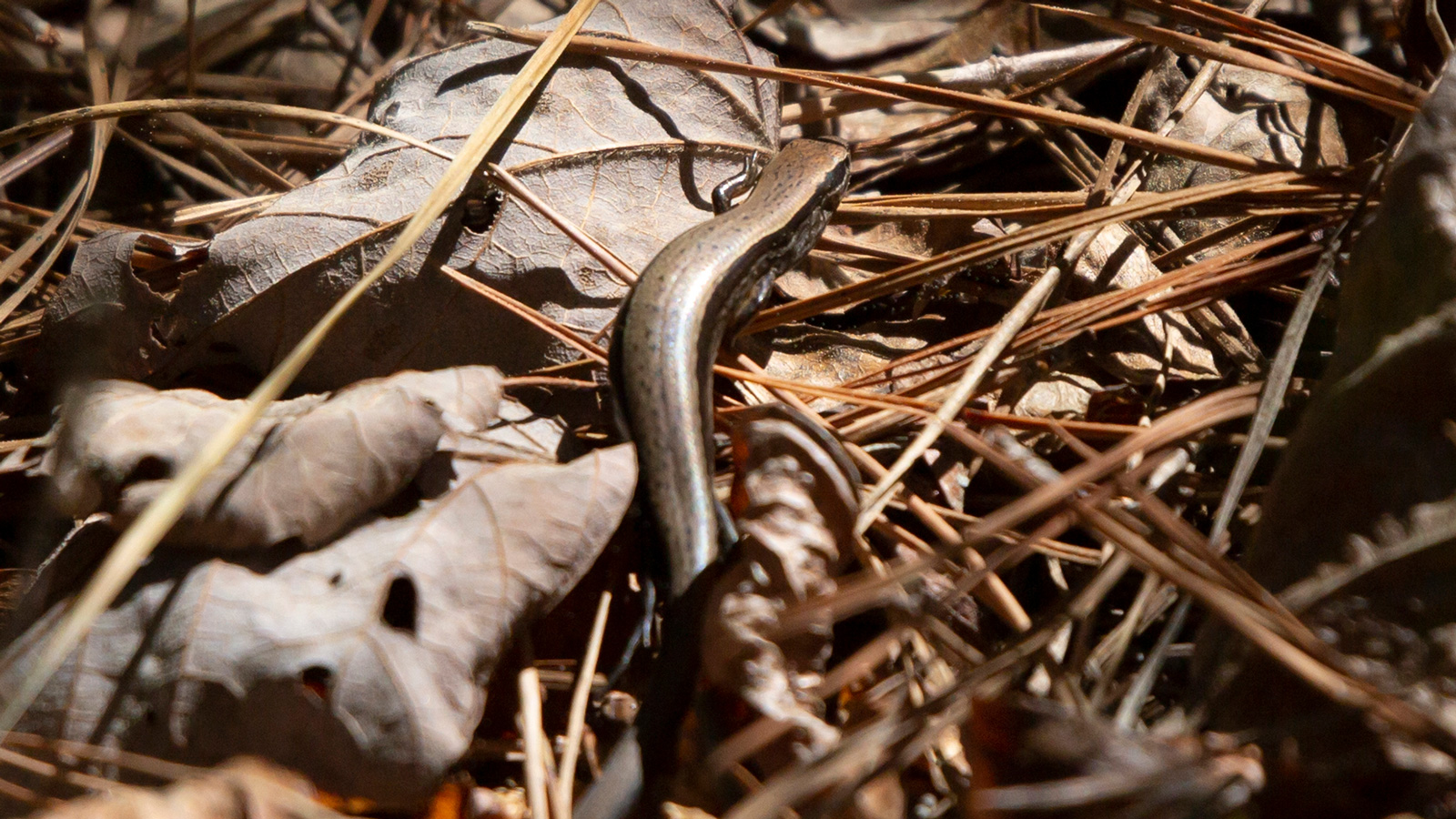
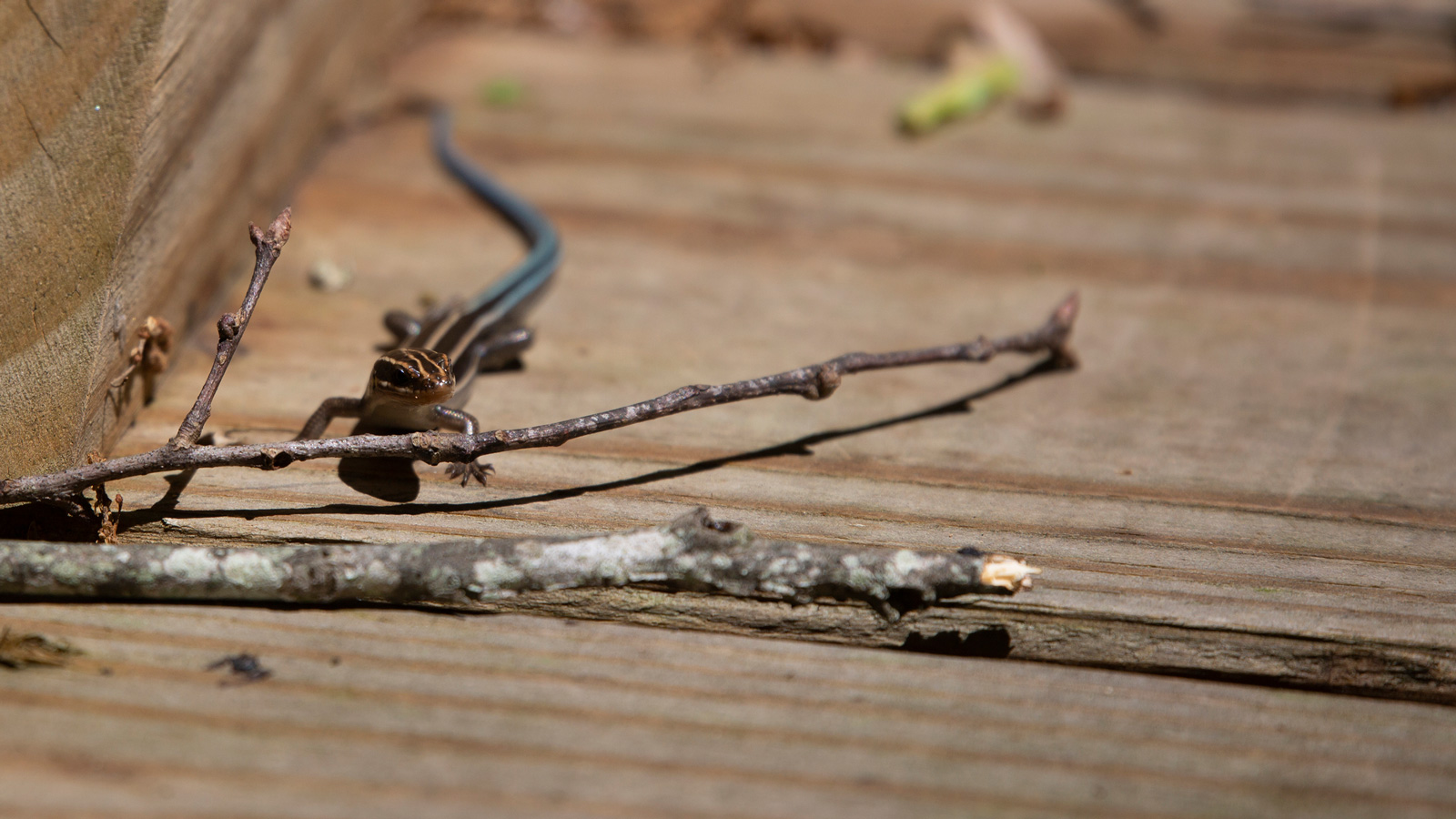
Broadheads are the big ones — up to 13 inches, with adult males sporting bright orange heads during breeding season that get them killed by people who think they are venomous. Five-lined skinks are the common ones — found under every log, rock, and board in the state, with juveniles wearing brilliant blue tails and adults fading to brown. Little brown skinks are the tiny ones — three inches of pure leaf-litter camouflage with transparent eyelids that let them see with their eyes closed.
All three look similar as juveniles, which is where most of the confusion starts. A dark-bodied, striped juvenile skink with a blue tail could be a five-lined or a broadhead. Without checking labial scale counts (four for five-lined, five for broadhead), the identification at the juvenile stage requires experience and luck. Adult males sort themselves out — only broadheads develop that unmistakable orange head.
No skink in North Louisiana is venomous. Not one. The "scorpion" label that gets attached to broadhead skinks in folk taxonomy reflects the appearance of the animal, not its actual capability. A broadhead skink can bite — and a large male can deliver a surprisingly firm pinch — but the bite is mechanical force, not venom delivery. Putting a shovel through a broadhead skink on your porch is solving a problem that does not exist.
The Spiny Lizard
North Louisiana has one spiny lizard: the prairie lizard (Sceloporus consobrinus), formerly classified as a subspecies of the Eastern Fence Lizard and still called a fence lizard by virtually everyone who encounters one. Rough, keeled scales distinguish prairie lizards from every skink in the region — if the lizard feels like sandpaper, prairie lizard. If it feels smooth and polished, skink.
Prairie lizards are the push-up artists of North Louisiana's fence posts and pine trunks. Males defend territory with rapid body pumping that flashes their bright blue belly patches. They are arboreal, fast, sun-loving, and found in every dry, open pine forest and rural fence line in the region. Genetic studies split them from the Eastern Fence Lizard as a full species, and Glorioso's Louisiana herps site lists them under the new name, though the lizard on your fence post does not know it has been reclassified.
The Anoles
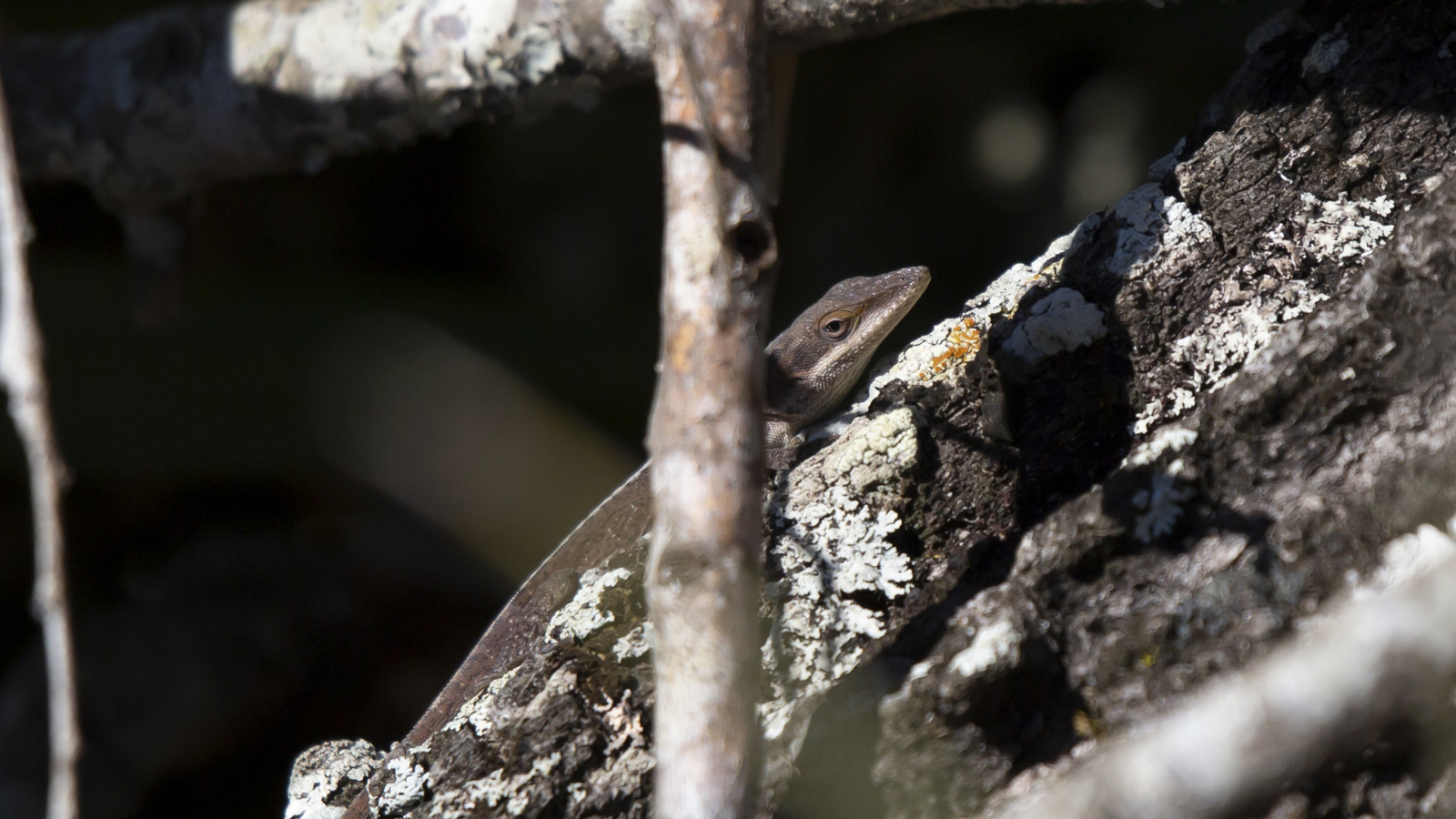
Two anole species live in North Louisiana: the native green anole (Anolis carolinensis) and the invasive brown anole (Anolis sagrei). Green anoles are the familiar color-changing lizards — green when warm and relaxed, brown when stressed or cold — with pink throat fans (dewlaps) that males flash during territorial displays. Brown anoles are the invasive newcomers from the Caribbean, spreading northward through Louisiana and outcompeting green anoles in some areas by occupying ground-level habitats and pushing green anoles higher into the canopy.
Both species climb. Both display with throat fans. Green anoles are typically found on shrubs, trees, and fences at eye level or above. Brown anoles prefer lower perches and ground-level positions. A lizard on a fence post doing push-ups with a red throat fan is a green anole. A stocky, patterned brown lizard on a porch step with an orange-red dewlap is probably a brown anole.
The Gecko
The Mediterranean house gecko (Hemidactylus turcicus) — an introduced species now established across the South — lives on and around buildings in North Louisiana. Pale, translucent skin, large eyes with vertical pupils, and toe pads that allow them to walk on glass and smooth walls. Nocturnal, which is why most people see them at night clustered around porch lights eating insects attracted to the bulbs. They chirp — a soft, clicking vocalization that is the only sound any North Louisiana lizard regularly produces.
House geckos are not native, but they have been in Louisiana long enough that their presence around buildings is unremarkable. They do not compete significantly with native lizards because they occupy a niche — nocturnal, wall-climbing, light-attracted insectivore — that no native species fills.
Telling Them Apart: The Quick Guide
Rough, spiny scales + push-ups + blue belly = prairie lizard. Smooth, shiny scales + stripes + blue tail (juvenile) = five-lined or broadhead skink. Smooth scales + orange head + large size = broadhead skink (adult male). Smooth scales + tiny + brown + no stripes + lives in leaf litter = little brown skink. Color changes green to brown + throat fan + climbing = green anole. Stocky brown + patterned back + orange dewlap + low perch = brown anole. Pale, translucent + vertical pupils + on your wall at night + chirping = house gecko.
None of them are venomous. All of them eat insects. All of them are faster than you. And all of them would prefer that you watch from a distance rather than pick them up, though they will not get the chance to express that preference because they will be gone before your hand gets close.
Where to See Them
Every habitat in North Louisiana holds lizards. Dry pine forests and fence lines hold prairie lizards. Hardwood bottoms and suburban woodpiles hold five-lined skinks. Mature forests with big trees and deadwood hold broadheads. Leaf litter everywhere holds little brown skinks. Shrubs and fences hold green anoles. Buildings and porches hold house geckos and, increasingly, brown anoles.
Spring and early summer — March through June — offer the best lizard watching in North Louisiana. Males of every species are at peak display during breeding season: prairie lizards doing push-ups, anoles flashing dewlaps, broadhead skinks glowing orange. By midsummer, activity shifts to cooler parts of the day. By November, most species are dormant until spring.
Accessibility
Lizards are visual animals. No North Louisiana lizard produces sounds loud enough to hear at a distance except the Mediterranean house gecko, whose soft clicking chirp is audible within a few feet. For visitors who are blind or have low vision, lizards are essentially undetectable. The scratch of claws on bark, the rustle of leaves as a skink flees, and the gecko's chirp are the only non-visual cues, and all are faint, brief, and easily missed.
Species Quick Reference
Prairie Lizard (Sceloporus consobrinus) — 4-7.5 in. Rough, keeled scales. Blue belly on males. Fence posts, pine trunks, dry forests.
Broadhead Skink (Plestiodon laticeps) — 6-13 in. Smooth scales. Orange head on adult males. Most arboreal skink. Mature forests.
Common Five-lined Skink (Plestiodon fasciatus) — 5-8.5 in. Smooth scales. Blue tail as juvenile. Under logs, rocks, boards. Female guards eggs.
Little Brown Skink (Scincella lateralis) — 3-5.5 in. Smooth scales. Plain brown, no stripes. Leaf litter only. Transparent eyelids.
Green Anole (Anolis carolinensis) — 5-8 in. Color-changing (green/brown). Pink dewlap. Shrubs, fences, trees. Native.
Brown Anole (Anolis sagrei) — 5-8 in. Brown, patterned. Orange-red dewlap. Ground level, low perches. Invasive.
Mediterranean House Gecko (Hemidactylus turcicus) — 4-5 in. Pale, translucent. Vertical pupils. Nocturnal, on buildings. Introduced. Chirps.