About Thrushes
Thrushes are the birds that make the forest sound like a cathedral. If you've ever stood in a North Louisiana bottomland hardwood forest at dusk and heard a song so clear, so flute-like, and so hauntingly beautiful that it stopped you mid-step, you were probably hearing a thrush. The family Turdidae delivers some of the finest vocalists in the bird world, and even the species that don't have show-stopping songs carry themselves with a gravity and presence that sets them apart from the hyperactive warblers and chattering sparrows sharing the same habitat.
North Louisiana hosts five regular thrush species, and they span a remarkable range of familiarity. Two of them, Eastern bluebirds and American robins, are among the most recognized birds in North America, the kind of species that non-birders can identify on sight and associate with specific seasons. The other three, gray-cheeked thrushes, hermit thrushes, and Swainson's thrushes, are brown, secretive, forest-dwelling migrants that most people have never heard of, let alone seen. The gap between "America's favorite backyard bird" and "brown thing in the understory that nobody notices" is the thrush family in North Louisiana.
The Thrush Blueprint
Thrushes share a general body plan: medium-sized songbirds with relatively large eyes, sturdy legs, upright posture, and a tendency toward ground-level or low-canopy foraging. Most species are built for hopping across forest floors, flipping leaf litter, and extracting insects and berries from the understory, the unglamorous but essential work of processing the forest's ground-level food web.
The family divides neatly into two groups in North Louisiana. The spotted thrushes, gray-cheeked, hermit, and Swainson's, are brown above, pale below, and covered in dark breast spots that create an identification puzzle birders have been arguing about for generations. They're secretive, migratory, and associated with mature forest. The open-country thrushes, bluebirds and robins, are colorful, conspicuous, and comfortable in yards, parks, and agricultural edges. Same family, completely different lifestyles.
What unites them is song. Thrush songs are widely regarded as some of the most beautiful in the bird world. The hermit thrush's ethereal, spiraling song has been called the finest sound any North American bird makes. Even the American robin's cheerful caroling, so common that most people tune it out, is a genuinely complex and musical performance that deserves more attention than it gets. If the warblers are the jazz musicians of the forest, thrushes are the classical soloists.
Eastern Bluebird
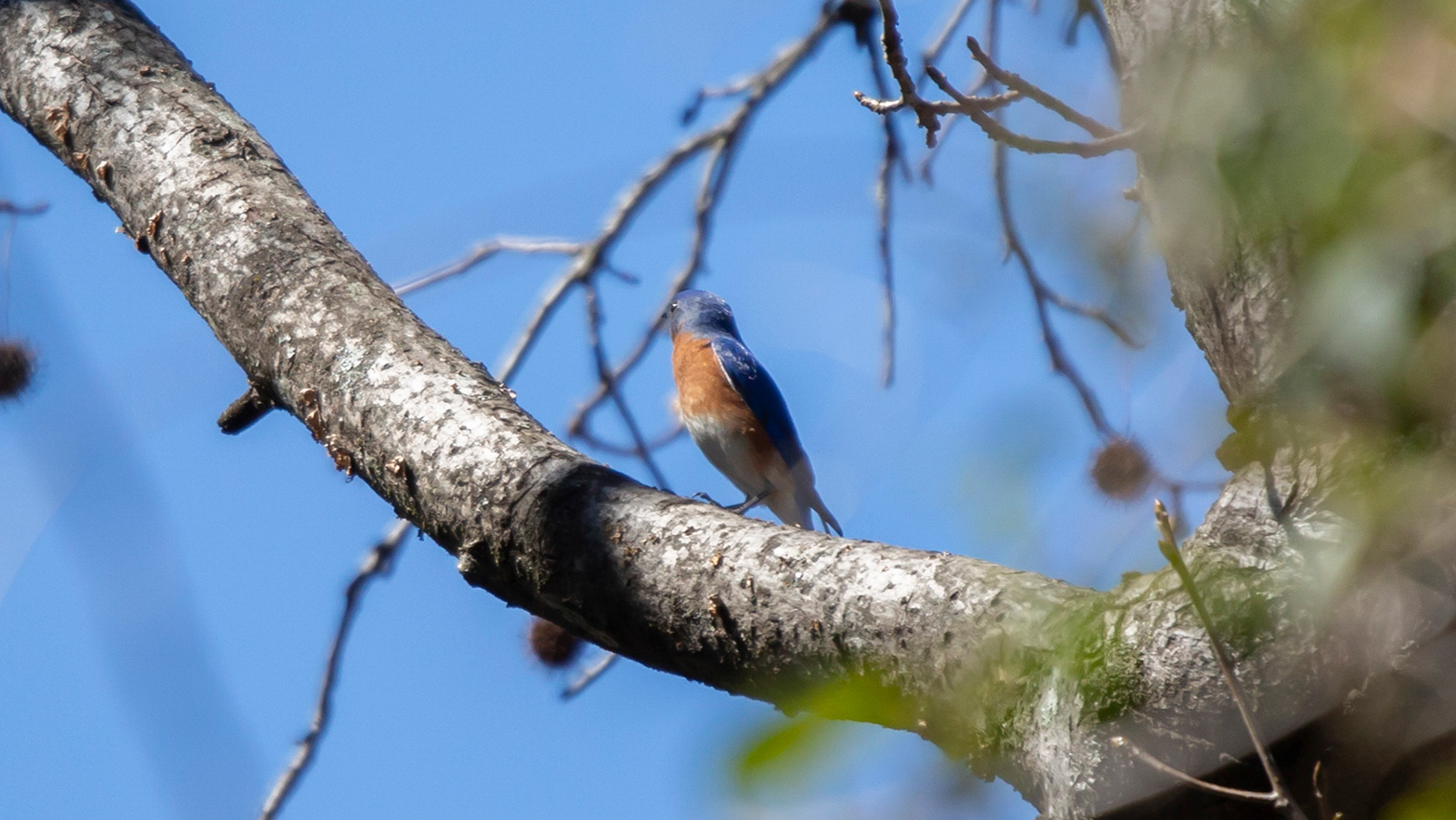
Eastern bluebirds, Sialia sialis, are the thrush that convinced a generation of Americans that small birds could be beautiful without being exotic. The male's vivid combination of sky-blue upperparts, rusty-orange breast, and white belly is one of the most immediately recognizable color patterns in North American birds, and seeing a male bluebird on a fence post in a North Louisiana pasture on a January morning is the kind of visual that makes people understand why birding exists.
Males are brilliant blue above, with the blue extending from the crown through the tail. The throat, breast, and flanks are warm rusty-orange, fading to white on the belly. Females are similar in pattern but muted, with gray-blue upperparts and not the vivid blue of males, and a duller orange on the breast. Both sexes are about 6 to 8 inches long, slightly larger than a house sparrow.
The song is a soft, rolling warble, often described as "chur-lee, chur-lee," delivered from fence posts, wire lines, and the tops of nest boxes during the breeding season from February through July. The song is genuinely musical and more complex than its familiar status suggests. Most people stop hearing it consciously because it's always there in spring, which is approximately the opposite of a good reason to stop paying attention. The call is a mellow, rising "tru-lee" that carries across open country and identifies bluebirds acoustically before the color registers. Bluebirds are not loud, but their calls are distinctive enough to pick out from background noise in any open-country setting.
Eastern bluebirds are year-round residents in North Louisiana, present in all 26 parishes in every month. They prefer open habitats with scattered trees, including pastures, golf courses, orchards, roadsides, and rural residential areas. They nest in cavities, either natural tree holes or nest boxes, and the nest box programs maintained by landowners and conservation organizations across North Louisiana have contributed to stable bluebird populations in the region. A nest box on a fencepost in open country with views of short grass in all directions is precisely what a bluebird pair is looking for, and they will find it within days of installation during the breeding season.
Diet is primarily insects during the warmer months, captured by dropping from a perch onto ground-level prey in a hunting approach called perch-and-pounce. The bird watches from a low fence wire or nest box top, spots movement below, and drops to the ground to grab the prey, returning to the perch to consume it. During winter, fruit becomes increasingly important, and bluebirds flock to American holly, eastern red cedar, and various berry-bearing shrubs. Winter flocks of 20 to 30 bluebirds working a cedar thicket in January are one of North Louisiana's more reliable cold-weather wildlife experiences.
American Robin
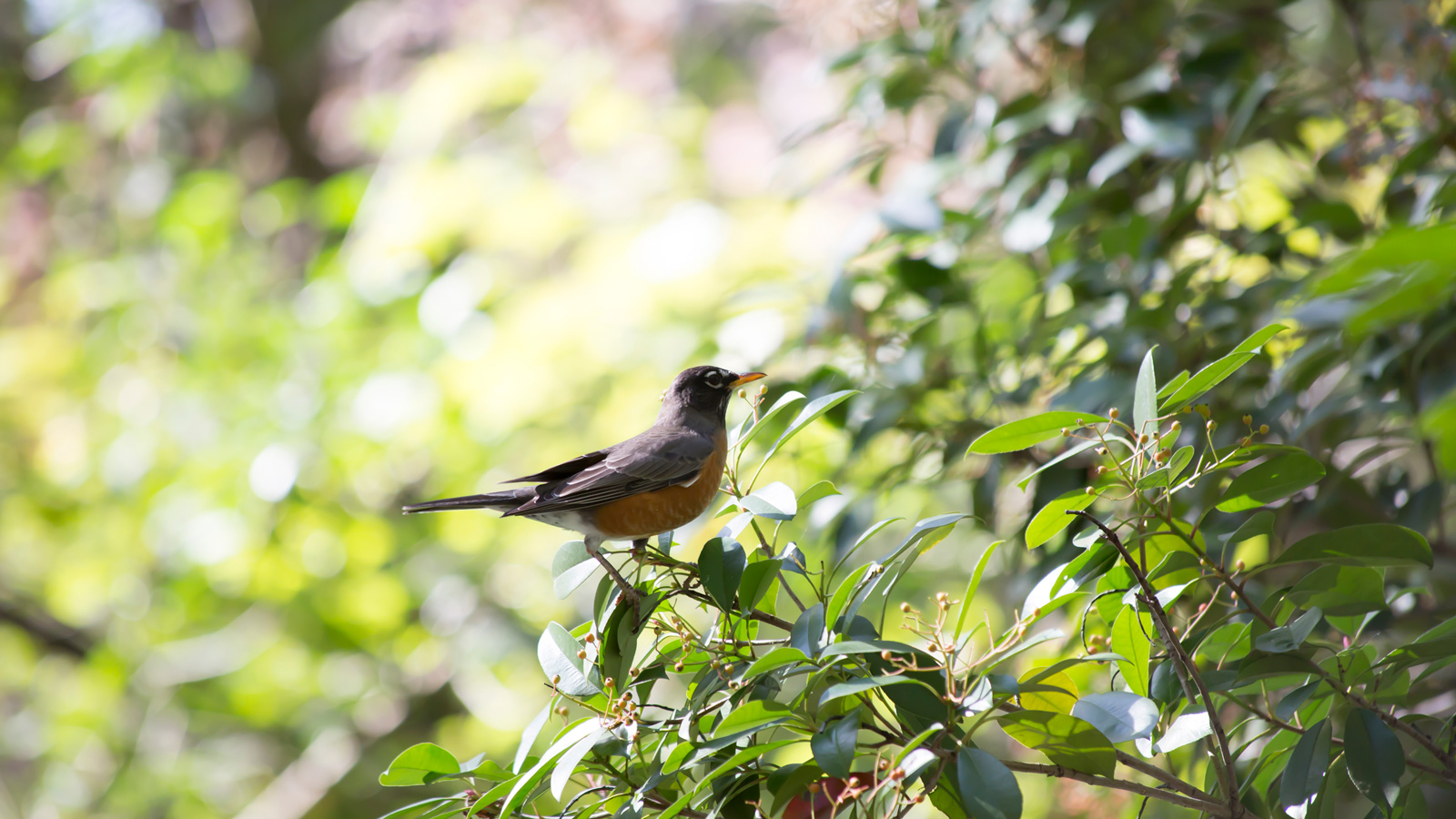
American robins, Turdus migratorius, are the thrush everyone knows by name and almost nobody thinks of as a thrush. They're large, familiar, and ubiquitous across North Louisiana's suburban and agricultural landscapes, and their association with spring, worms, and lawns has made them a cultural icon that sometimes obscures their status as genuinely interesting birds.
Adult males carry a deep, warm orange breast that shades into darker coloration on the belly. The back and wings are gray-brown. The head is dark, nearly black in fresh plumage, with bold white arcs above and below the eye that give the face an alert expression. Females are similar but with a paler orange breast and a grayer, less contrasty head. Both sexes are about 10 inches long, making the robin the largest thrush in North Louisiana by a significant margin.
The song is one of the most familiar bird sounds in North America: a rolling, cheerful series of phrases, often described as "cheerily, cheerio, cheery-up," delivered from rooftops, tree tops, and exposed perches throughout the breeding season. The song is complex, continuous, and musical, and a robin singing from a suburban oak in April is performing a genuinely sophisticated vocal display that sounds simple only because we've heard it so many times. The call note is a sharp "tut-tut-tut" or "peek," given in alarm and also in flight.
In North Louisiana, robins are year-round residents, but the population composition shifts dramatically by season. Resident breeding robins are present in spring and summer, raising 2 to 3 broods from March through July. Starting in October, enormous flocks of wintering robins arrive from the northern breeding range, and winter numbers can be ten to twenty times the summer population. A large cedar stand or a berry-bearing thicket in November may hold hundreds of robins, their collective wing noise and "tut-tut" calls filling the air as they move through the trees.
The foraging image everyone knows, a robin cocking its head on a lawn and pulling an earthworm, is real. Robins locate earthworms by sight and by detecting soil vibration, and short-grass areas after rain draw concentrated foraging activity. The diet shifts heavily toward fruit in fall and winter, and robins are among the most important seed dispersers for native berry-bearing plants across the region.
Hermit Thrush
Hermit thrushes, Catharus guttatus, are the spotted thrush of North Louisiana's winters, the only member of the Catharus genus that overwinters in the region and one of the most acoustically celebrated birds in North America. Their presence in North Louisiana runs from October through April, and while they're mostly quiet during the winter months, the occasional pre-migratory song from a late-winter bird in February or March is a genuinely remarkable experience.
The key field mark is the tail. Hermit thrushes carry a distinctly rufous, reddish-brown tail that contrasts sharply with the olive-brown back and wings. No other spotted thrush in North Louisiana shows this contrast. The face carries a thin, complete white eye ring. The breast spots are round, dark, and set against a pale whitish-buff background. The bird's defining quirk is a slow, deliberate tail-pumping movement, raising and lowering the rufous tail rhythmically while perched, which no other Catharus thrush performs. See the tail-pumping, see the rufous tail, and the identification is settled.
The hermit thrush has a dedicated article in this library covering field marks, foraging, song, seasonal patterns, and where to find the species across the 26 parishes in full detail. The short version: winter forest with dense understory, ground-level foraging on invertebrates and berries, and the call note "whee" followed by a low "chuk" as the primary detection cue from October through March. The tail-pumping movement, that slow rhythmic raising and lowering of the rufous tail while the bird perches, is unique to the species and visible at close range before the face or breast marks are clear. A spotted thrush pumping its tail in a North Louisiana bottomland forest in December is a hermit thrush.
The full song, when it arrives in late winter, is one of the most remarkable sounds in any North Louisiana forest. Spiraling, flute-like, harmonic phrases that ornithologists, writers, and composers have been trying to describe for two centuries without fully succeeding. Walt Whitman wrote about it. Music theorists have analyzed its intervals. Stand near a North Louisiana bottomland hardwood forest on a warm February morning and listen. It's worth every early alarm.
Swainson's Thrush
Swainson's thrushes, Catharus ustulatus, are the spotted thrush most likely to be standing between you and a positive identification, because they're the common one during spring and fall migration and the one most often confused with the other Catharus species passing through at the same time.
The key mark is the face. Swainson's thrushes carry bold buffy spectacles, a warm buffy eye ring that extends forward toward the bill in a way that creates a bespectacled, wide-eyed expression that no other regular spotted thrush in North Louisiana shows. The overall plumage is uniformly olive-brown from crown to tail, with no rufous contrast on the tail that would suggest hermit thrush. The breast spots sit against a warm, buffy background and not the cooler, paler background of hermit thrushes.
Swainson's thrushes pass through North Louisiana during spring migration, April through May, and fall migration, late August through October. They breed in boreal and montane forests of the North and winter in South America, so their North Louisiana presence is entirely as migrants. Spring birds are in better condition and often sing during stopovers, delivering a distinctive spiraling, upward-spiraling series of flute-like phrases that ascend in pitch with each successive phrase, as if the song is climbing an invisible staircase toward some higher register. The fall migration is quieter, with birds moving at night and appearing in forest understory at dawn without announcement.
During migration stopovers, Swainson's thrushes forage in the understory and mid-canopy of deciduous and mixed forest, eating insects and berries with equal enthusiasm depending on availability. They're less tied to the ground than hermit thrushes, working through the shrub layer and lower tree branches as readily as the forest floor. Migration windows of 1 to 3 days are common, with birds arriving overnight and departing the following evening, which makes them genuinely transient visitors and means checking the same forest on consecutive days during peak migration windows.
The fall migration call, a soft "peep" or "whit," is given frequently in nocturnal migration and occasionally during day stopovers. Learning this call is useful for detecting Swainson's thrushes at dawn when the birds are freshly arrived and moving through the canopy before settling to feed.
Gray-Cheeked Thrush
Gray-cheeked thrushes, Catharus minimus, are the plainest Catharus thrush and in some ways the most challenging to find in North Louisiana, not because they're particularly rare but because they're the most secretive and the least visually distinctive of the three spotted thrushes passing through.
The face is the key feature, and what's notable about it is the absence of features. Gray-cheeked thrushes carry minimal or no eye ring, giving the face an austere, unadorned expression compared to Swainson's buffy spectacles and hermit thrush's white eye ring. The overall plumage is cold gray-brown above, with the gray tones less warm than Swainson's olive-brown and without any rufous contrast on the tail. The breast spots sit against a pale, lightly washed background. The overall impression is a plain, cold-toned, expressionless brown bird that seems designed to blend into the understory and disappear.
Gray-cheeked thrushes are strictly passage migrants in North Louisiana, present during spring migration, April and May, and fall migration, September and October. They breed in arctic and subarctic tundra scrub, boreal forest, and high-elevation willows across northern Canada and Alaska, and winter in South America. Their window in North Louisiana is the same as Swainson's thrush, and during peak migration the two species may appear in the same forest patch simultaneously, which is when the face marks become critical. A forest that holds both species on the same morning is a birding experience worth planning for.
The call is a thin, descending "quee-a" or "veer," slightly downward-slurred compared to the more level calls of Swainson's thrush. Gray-cheeked thrushes are generally less vocal during migration than Swainson's thrushes and less likely to sing during stopovers. The song, when heard on the breeding grounds, is a thin, downward-spiraling series of phrases that descends in pitch, the reverse of Swainson's thrush's upward spiral.
Like Swainson's thrushes, gray-cheeked thrushes move at night during migration and appear in forest understory at dawn. They tend to forage closer to the ground than Swainson's thrushes and are more likely to be found hopping through leaf litter and dense understory cover. Any careful search of bottomland hardwood forest during April or October should turn up gray-cheeked thrushes mixed with Swainson's thrushes during peak migration, and learning to separate the two on face pattern is one of the more rewarding identification investments available during North Louisiana's spring migration.
Identification: Sorting the Spotted Thrushes
The three spotted Catharus thrushes share enough plumage similarities that sorting them out deserves specific attention. The key marks, in order of reliability, are the tail, the face, and seasonal timing.
Tail contrast: Only the hermit thrush shows a distinctly rufous, warm-toned tail that contrasts with the cooler brown of the back. If the tail is clearly warmer and redder than the back in any light condition, the bird is a hermit thrush.
Face pattern: If the tail doesn't confirm hermit thrush, check the face. Swainson's thrushes carry bold, warm buffy spectacles extending from the eye ring forward toward the bill. Gray-cheeked thrushes carry minimal or no eye ring at all, a plain face. Hermit thrushes carry a thin, complete white eye ring without the forward spectacle extension of Swainson's.
Seasonal timing: Hermit thrushes are the only spotted thrush present in November through February. Any spotted thrush during those months is a hermit. During April through May and September through October, any of the three could be present, and face and tail marks become essential. During July and August, spotted thrushes are largely absent in North Louisiana.
Tail-pumping: The hermit thrush's habit of slowly raising and lowering its tail while perched is species-specific. No other spotted thrush does this regularly. A spotted thrush pumping its tail is a hermit thrush.
Where to Find Thrushes in North Louisiana
Eastern bluebirds are present across all 26 parishes year-round in open habitats. Fence lines and utility wires along rural roads, nest boxes on pasturelands, and the edges of any open country with scattered trees all hold bluebirds. Lincoln Parish Park, Kiroli Park, and any rural area with nest box programs in the region are reliable. Drive slowly along parish roads through cattle country and watch the fences and wires.
American robins are present year-round but are most impressive during winter, from November through March, when northern birds join resident populations and create large flocks. Any large cedar stand, holly planting, or berry-bearing thicket in North Louisiana may hold hundreds of robins during midwinter. Suburban lawns after rain, park edges, and the fruiting trees around residential areas all hold robins during the warmer months.
Hermit thrushes are present October through March in forested habitats with dense understory. The national wildlife refuges with mature bottomland hardwood forest, Tensas River NWR, D'Arbonne NWR, Upper Ouachita NWR, and Black Bayou Lake NWR, all hold wintering hermit thrushes. Walk slowly along forested trails and listen for the "whee-chuk" call note. See the dedicated hermit thrush article for complete where-to-find coverage.
Swainson's thrushes appear during April through May and September through October in any mature forest with understory structure. The bottomland hardwood forests of the eastern parishes, particularly along the Tensas and Boeuf river systems, concentrate migrating thrushes during peak spring movement. D'Arbonne NWR and Kisatchie National Forest hardwood zones are reliable spring migration locations. Check forests at dawn during the second and third weeks of April for the best chance of finding singing birds. A morning fog over the bottomland forest on April 15th with thrush song coming from the understory is North Louisiana birding at its best.
Gray-cheeked thrushes share the same migration habitat and timing as Swainson's thrushes, appearing in the same forest patches during the same April through May and September through October windows. Any location that turns up Swainson's thrushes warrants careful examination for gray-cheeked thrushes alongside them. Gray-cheeked thrushes tend to be less vocal and more ground-oriented than Swainson's, so careful visual scanning of leaf litter and low understory during the same forest visits that turn up Swainson's encounters is the most efficient approach.
Accessibility
Thrushes are forest birds, and most forest trails in North Louisiana are unpaved. But the songs are the reason to go, and songs don't stay inside the woods.
The acoustic texture of the thrush family is unmatched by any other bird group in North Louisiana. Hermit thrush song, which arrives occasionally in late February and March, is the purest, most ethereal flute-work in the eastern forest, spiraling through bare winter woods like smoke. American robins sing a cheerful, rolling carol from the top of every suburban tree in spring, available from the driveway, the car, or the window. Eastern bluebird song floats across open pasture like a melody that's been there all along and you just noticed it.
For visitors who are blind or have low vision, the thrush family is defined acoustically. The hermit thrush's "whee-chuk" call is the winter forest's quietest reliable cue, while the song in late February stops conversation and thought simultaneously. The American robin's caroling is one of the most familiar and identifiable bird sounds in North America, available from any suburban or rural position with trees nearby. The Eastern bluebird's soft "tru-lee" carries across open country without directional ambiguity. The Swainson's thrush's upward-spiraling song during April stopovers is distinct enough from other thrush songs to identify in a single hearing. A companion familiar with each species can orient toward the sound source and confirm identification.
For visitors using wheelchairs or with limited mobility, the open-country thrushes, bluebirds and robins, are fully accessible by vehicle and from any paved surface near their preferred habitat. Rural roads through pasturelands, park paths, and suburban streets all deliver bluebird and robin encounters without off-road navigation. The spotted thrushes are more challenging, but the parking areas and road shoulders adjacent to major bottomland hardwood forest refuges, Tensas River NWR road access, D'Arbonne NWR parking areas, Black Bayou Lake NWR boardwalk, all put accessible positions within the acoustic range of wintering hermit thrushes during October through March and migrating Swainson's and gray-cheeked thrushes during April and October.
If you can get to the edge of a forest, a parking lot at a trailhead, a paved park path, a car parked at a NWR entrance, the thrush songs will reach you. They don't stay inside the woods. They carry out through the canopy and across the tree line. You don't have to go deep. You just have to be close enough to listen.
More Information
Cornell Lab of Ornithology, Eastern Bluebird: https://www.allaboutbirds.org/guide/Eastern_Bluebird
Cornell Lab of Ornithology, American Robin: https://www.allaboutbirds.org/guide/American_Robin
Cornell Lab of Ornithology, Hermit Thrush: https://www.allaboutbirds.org/guide/Hermit_Thrush
Cornell Lab of Ornithology, Swainson's Thrush: https://www.allaboutbirds.org/guide/Swainsons_Thrush
Cornell Lab of Ornithology, Gray-Cheeked Thrush: https://www.allaboutbirds.org/guide/Gray-cheeked_Thrush
Frequently Asked Questions
What is the best time to hear thrush song in North Louisiana? Depends on the species. American robins sing from February through July, peaking in April. Eastern bluebirds sing from February through August, peaking during early spring territory establishment. Hermit thrushes sing occasionally in late February and March before departing north. Swainson's thrushes sometimes sing during April migration stopovers, with the second and third weeks of April as the peak window. Gray-cheeked thrushes rarely sing during migration in North Louisiana.
How do I tell the three spotted thrushes apart? Start with the tail. A spotted thrush with a distinctly rufous, warm-toned tail that contrasts with the cooler brown back is a hermit thrush. If the tail matches the back, check the face: bold buffy spectacles extending forward from the eye ring toward the bill means Swainson's thrush; minimal or no eye ring means gray-cheeked thrush. Seasonal timing helps: if it's November through February, it's a hermit by default. If it's April through May or September through October, all three are possible.
When do hermit thrushes arrive and depart in North Louisiana? Hermit thrushes arrive from late September through November and depart during March and April. They're present across all 26 parishes during the winter window in appropriate forest habitat. See the dedicated hermit thrush article for complete seasonal and habitat information.
Are all five thrush species common in North Louisiana? Eastern bluebirds and American robins are common year-round. Hermit thrushes are common winter residents from October through March in forested habitats. Swainson's thrushes are fairly common during April through May and September through October migration. Gray-cheeked thrushes are uncommon during the same migration windows, present in smaller numbers than Swainson's and less likely to be found without targeted searching in appropriate forest during peak migration.
What do spotted thrushes eat during their North Louisiana stopover? Insects and fruit, with the balance depending on availability. During spring migration, insects are more available and spotted thrushes forage heavily in the canopy and understory for caterpillars, beetles, and other invertebrates. During fall migration, fruit, including pokeweed, spicebush berries, and various native drupes, makes up a larger portion of the diet and keeps stopover birds at fruit-bearing locations for multiple days. Providing berry-bearing native plantings in wooded yards can draw migrating spotted thrushes during April and October.
What's the easiest thrush to find in North Louisiana? American robins in winter, if numbers is the criteria. Large winter flocks congregate at fruiting trees and berry-bearing thickets and can be found at virtually any park, wooded neighborhood, or rural area with mature plantings. Eastern bluebirds are the easiest to identify, with their vivid color, open-country habitat, and habit of perching on fences and wires in plain view. Hermit thrushes are the easiest spotted thrush, present for six months and not just a few weeks, and findable in any substantial bottomland hardwood forest during October through March.