Advertisement
Fun Facts
Did You Know?
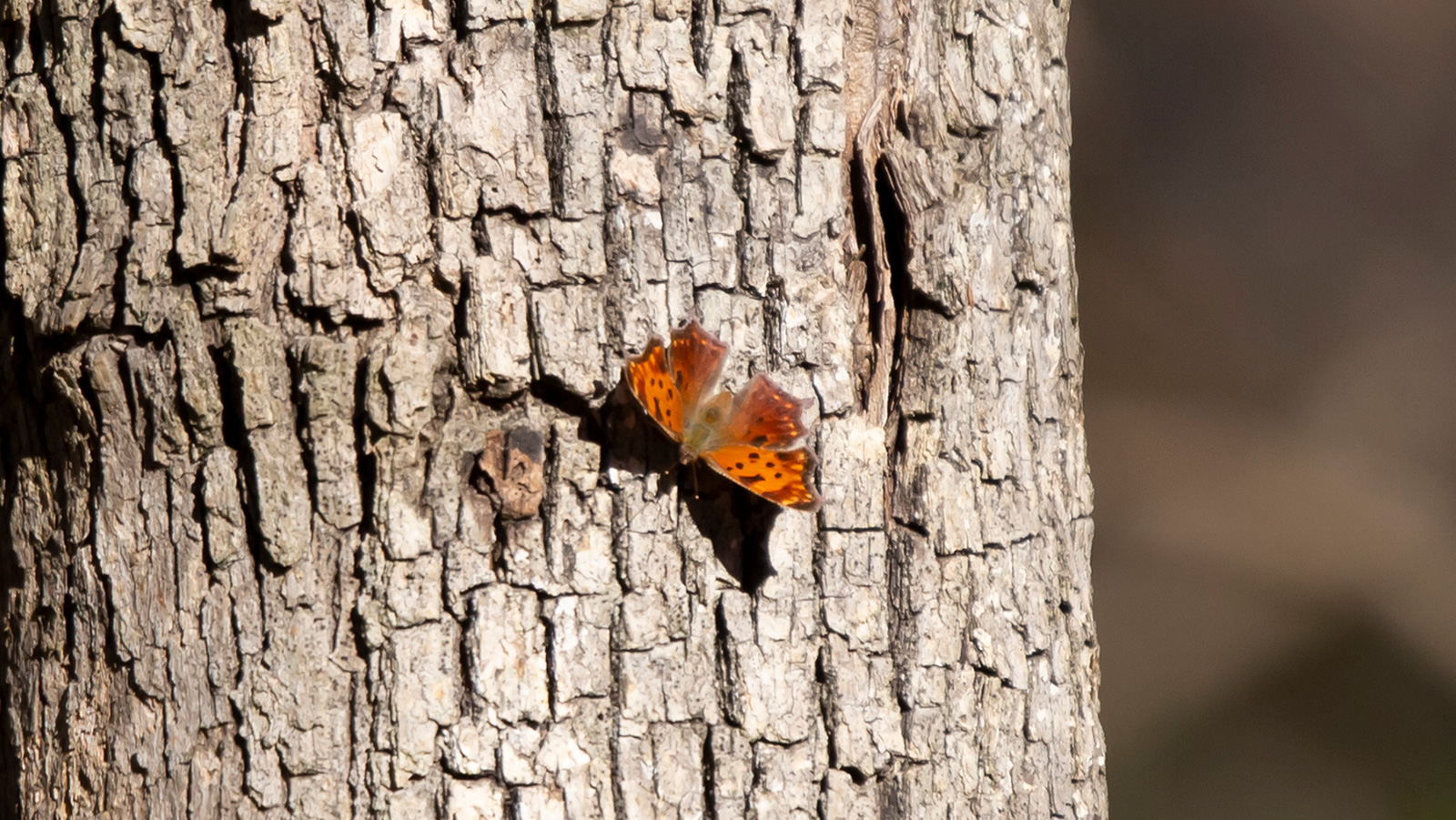
The goatweed leafwing lands on a tree trunk, closes its wings, and disappears.
If This Animal Could Talk...
"Look at my habitat, season, and behavior first. Those clues tell you what I am before you need a close-up."
The goatweed leafwing lands on a tree trunk, closes its wings, and disappears. Not metaphorically, the butterfly physically vanishes against bark, and experienced observers who watched it land still lose it. Anaea andria carries one of the more convincing dead-leaf disguises in North Louisiana's butterfly community: angular wings with a hooked forewing tip and an underside mottled in brown, tan, gray, and rust that reads as a dead or curled leaf so accurately that finding the butterfly after it closes its wings needs knowing the exact spot it landed and searching at that precise location until the wing outline resolves. Even then, it takes a moment. Anaea andria ranges across the central United States from Texas to Nebraska, east through the Gulf South, and throughout North Louisiana's 26 parishes it breeds wherever its host plant grows and perches wherever dry leaves blow against tree trunks. Adults fly from late March through November in most years, with two seasonal color forms producing adults that look somewhat different from each other. The species survives winter as an adult in sheltered locations the same way the question mark and eastern comma do, reappearing at the first warm days of late winter for one of the earliest butterfly sightings of the season at any woodland edge site in the northern parishes. What the Goatweed Leafwing Actually Looks Like Adults span two and a quarter to three inches. The upperside shows bright orange with black forewing margin, a dark spot on the forewing, and a distinctive hooked forewing tip that gives the wing outline its angular, dead-leaf quality even from the upperside. The hindwing underside shows brown to rust brown with irregular mottling in tan, gray, and darker brown that mimics a dried, curled leaf, veins, irregular blotches, uneven texture. The hooked forewing tip creates the leaf petiole impression when the wings close, which completes the illusion. Two seasonal forms differ in the color intensity on the upperside: a summer form with more extensive black on the forewing, and a fall-winter form with less black and more uniform orange. Both forms carry the dead-leaf underside that does most of the defensive work. The fall-winter form adults are the ones that survive into winter and reappear in late February, and they show the most intense rust and gray mottling on the underside of any seasonal form. Males hold territories at woodland edges and clearings, launching from perches to investigate other butterflies and returning. The investigation flights provide the best open-wing views, since perched adults spend most of their time in closed-wing cryptic posture against bark or in leaf litter. Where the Goatweed Leafwing Lives Open woodland, woodland edges, old fields with scattered trees, scrubby second growth, and any semi-open habitat where goatweed, Croton monanthogynus, or other Croton species grow in the understory or margins. The goatweed leafwing ties closely to its Croton host plants, and its distribution across North Louisiana's 26 parishes tracks the distribution of those plants in open, dry to moderately moist woodland margins, disturbed ground with partial shade, and old field edges growing up with scattered trees. Goatweed, Croton monanthogynus, grows throughout the 26 parishes as a common weedy annual in disturbed ground, agricultural margins, open woodland understory, and roadsides. The plant establishes in any disturbed soil with enough light and produces seed abundantly through late summer and fall. A goatweed leafwing breeding population appears wherever goatweed grows in sufficient density adjacent to tree cover that adults use for perching and shelter, which in North Louisiana describes a large fraction of the disturbed open habitats in every parish. Other Croton species, including Croton glandulosus and the native Croton capitatus, also serve as host plants and extend the available host plant resource into slightly different habitat types than goatweed alone covers. The Caterpillar's Year Two broods in North Louisiana, with adults present from late March through November. First adults emerge from winter-survived adults' eggs in April and May, producing summer-form adults in June and July. Those summer adults produce a second brood with fall-winter-form adults emerging in August and September. Fall-winter-form adults feed actively through October and November to build fat reserves for winter dormancy, then shelter in bark crevices and leaf litter through cold periods, reactivating at the first warm days of late winter. Caterpillars feed on Croton foliage, resting on the undersides of leaves between feeding bouts and relying on cryptic coloration for protection rather than chemical defense or aposematic warning. Early instars are greenish with dark markings. Later instars become more yellowish-green. None of the instars carry the dramatic spines or bold coloration of defended caterpillars, the goatweed leafwing caterpillar relies on looking like a leaf rather than advertising unpalatability, which matches the adult's strategy exactly. The chrysalis attaches to a stem or leaf of the host plant and shows angular, brown-green coloration consistent with the species' overall investment in visual concealment at every life stage. What the Goatweed Leafwing Eats Adults prefer rotting fruit, tree sap, and mud over flower nectar, consistent with other brushfoot species that evolved primarily as non-nectar feeders. Fallen fruit, fermenting sap at bark wounds, and mineral-rich wet soil draw adults more reliably than wildflower patches. In residential and agricultural settings adjacent to woodland, adults turn up at fallen figs, plums, and other rotting fruit through late summer and fall with the focused feeding behavior of a species that found something worth staying for. When adults do nectar, they prefer small, open-faced white and yellow flowers in open or edge habitats near host plant areas. Adults at flowers move quickly and rarely hold for more than a brief visit. The longer, more engaged feeding sessions happen at fruit and sap. Caterpillars eat Croton foliage, consuming the leaf blade while leaving the petiole intact, a feeding pattern reminiscent of other leafwing caterpillars that use partially eaten leaves as visual camouflage while resting between feeding bouts. What Eats the Goatweed Leafwing The dead-leaf underside camouflage represents the species' primary adult defense, and its effectiveness against visual predators explains why the butterfly invests so completely in the illusion rather than in chemical defense or mimicry. A goatweed leafwing at rest against bark or in dry leaf litter with wings closed presents no visual profile that registers as butterfly. Eastern kingbirds, which hunt large butterflies by visual detection in open flight, take adults in active flight when the orange upperside becomes visible. At rest, the bird must stumble onto the precise location to find it. Robber flies intercept adults in open-country flight between perch sites. Spiders ambush adults at fruit and sap sources where extended feeding reduces vigilance. Caterpillar predation proceeds through parasitoid wasps and tachinid flies, neither of which the caterpillar's cryptic coloration deters. Direct avian predation of caterpillars on Croton foliage stays lower than for many exposed caterpillars because the goatweed caterpillar rests on leaf undersides and remains stationary for extended periods. Telling the Goatweed Leafwing from Similar Species The hooked forewing tip distinguishes the goatweed leafwing from all other orange butterflies in North Louisiana in open-wing view. No fritillary, comma, question mark, or monarch carries that angular hook at the forewing apex. Once seen, the feature identifies the genus immediately without any other mark needed. Dead-leaf underside in closed-wing view also distinguishes it from Polygonia species at rest, the question mark and eastern comma show a brown cryptic underside but lack the hooked forewing tip and carry the distinctive silver punctuation mark that the goatweed leafwing does not have. From the tropical leafwing, Anaea troglodyta, a species that occasionally strays into the Gulf South: the goatweed leafwing shows a more orange upperside and smaller average size. Tropical leafwing strays in Louisiana represent genuinely unusual records and would require documentation to distinguish from the resident goatweed leafwing. The Leafwing's Year in North Louisiana The goatweed leafwing's seasonal arc in North Louisiana follows the same adult-winter-dormant pattern as the question mark and eastern comma, which means the species provides some of the earliest butterfly sightings of late winter in the upland parishes. An adult goatweed leafwing at a patch of early-season native plum bloom in late February in Bienville or Union Parish represents an adult that survived winter in a bark crevice or leaf pile, reactivated at the first warm day above fifty degrees, and found the first flower resource of the season within its territory. That late-winter adult carries the rust-and-gray underside mottling of the fall-winter form at its most developed, having spent months in the cold developing the depth of pattern that makes the fall-winter form adults the most convincing dead-leaf mimics in the species. Finding one at a redbud or native plum in late February in the northern parishes and then comparing it to a summer-form adult at the same site in July shows the full seasonal range of a butterfly that looks somewhat different in different seasons but always looks exactly like a dead leaf when it lands. The Dead-Leaf Illusion in Practice The goatweed leafwing's dead-leaf disguise works by exploiting how visual predators search for prey. Birds and lizards hunting butterflies develop a search image for butterfly shape, butterfly color, and butterfly movement. A stationary object with no butterfly-shaped outline, no butterfly-colored upperside visible, and no butterfly movement does not trigger the search image. The goatweed leafwing at rest against bark eliminates all three triggers simultaneously and becomes, functionally, invisible to a predator that learned to hunt butterflies specifically. Limitation: the approach flight and the open-wing phases during territorial activity and thermoregulation expose the butterfly completely. Those are the moments when predation risk peaks and when observers get their best views. A goatweed leafwing that closes its wings after landing has solved the predation problem for as long as it stays still. One that needs to warm up, defend territory, or investigate another butterfly has to accept the exposure that comes with opening those wings. That rhythm, open and conspicuous while active, invisible while resting, plays out at every woodland edge where the species occurs in North Louisiana. The observer who watches long enough at a goatweed leafwing perch site sees both modes: the flash of orange when the male launches from the trunk, and the vanishing act when it lands again in the same spot. Finding Goatweed Leafwings in North Louisiana Disturbed woodland margins with goatweed in the understory throughout the upland and transitional parishes produce the most consistent goatweed leafwing encounters. The species turns up at any open woodland edge with the right host plant, but populations concentrate where goatweed grows densely in partial shade adjacent to tree cover with rough-barked trunks available for perching and concealment. For the camouflage demonstration: find a territorial male's perch site on a rough-barked oak or hickory at a woodland edge clearing. Watch from a distance until the male returns to the perch and closes its wings. Then try to find it without moving closer. The exercise calibrates the observer to the search image for a closed-wing goatweed leafwing against bark, which makes subsequent encounters, which involve already-perched, already-closed individuals at the same and other sites, much more productive. Fermenting fallen fruit in late summer and fall draws adults to ground level, where the closed-wing dead-leaf posture against fallen leaves rather than bark produces an even more convincing concealment. An adult goatweed leafwing in October in dry leaf litter under a persimmon tree in a woodland edge setting needs searching the leaves specifically rather than scanning for butterfly shapes. Croton: The Host Plant Nobody Notices Goatweed, Croton monanthogynus, grows everywhere in North Louisiana that the soil gets disturbed and the sun gets through. Roadsides, field margins, disturbed woodland openings, fence rows, agricultural edges, old pastures going back to scrub, goatweed colonizes all of it, grows ankle-to-knee high, produces small pale flowers through summer, sets seed abundantly, and dies back in late fall. Most people who walk through North Louisiana in July and August step around it constantly without registering it at all. Small, grayish-green, a small, grayish-green annual weed. It smells faintly aromatic when crushed. Nobody plants it on purpose. Female goatweed leafwings know exactly what they want. They find goatweed colonies from the air by odor and visual search, inspect individual plants before landing, and deposit eggs singly on leaves near the top of the plant where fresh foliage develops. A Croton colony in a disturbed opening at a woodland edge in Lincoln or Claiborne Parish in June has goatweed leafwing eggs on it whether anyone checked or not. The butterfly found it before any naturalist thought to look. That reliance on a common, widespread, heavily distributed annual weed explains the goatweed leafwing's presence throughout all 26 North Louisiana parishes in open and semi-open habitats. The host plant imposes no distribution constraint. Wherever the landscape gets disturbed enough to create bare ground with sun, goatweed follows, and the butterfly follows the goatweed. Seasonal Forms and the Winter Gamble The goatweed leafwing's decision to survive North Louisiana winters as an adult rather than as a chrysalis involves the same trade-offs as the question mark and eastern comma's strategy: early spring activity at the cost of winter predation exposure. Adults that survive winter emerge weeks before chrysalis-stage species produce their first adults, reaching early-blooming flowers and mate-finding opportunities in late February and March before most of the butterfly community has stirred. In North Louisiana's mild winters, the gamble pays off more often than it would in colder climates. Winters with extended hard freezes, multiple nights below twenty-five degrees, kill dormant adults that would have survived as chrysalises without difficulty. Mild winters with only brief cold periods allow adults to survive in bark crevices and leaf litter with minimal energy cost, producing a February emergence at early resources before any competition from chrysalis-stage species. The fall-winter form adults that enter winter dormancy in October and November show the richest dead-leaf mottling of any seasonal form, which may reflect developmental responses to shorter days and cooler temperatures that produce a more cryptic underside at the time of year when the adult spends the most time stationary and exposed to searching predators. Whether that deeper mottling actually improves survival through winter relative to summer-form underside coloration has not been examined specifically in this species, but the pattern holds in other adult-wintering brushfoots as well. Why the Vanishing Act Matters North Louisiana's woodland edges hold enough roosting birds, foraging lizards, and active robber flies that any orange butterfly sitting still in the open would face constant predation pressure from above and the sides. The goatweed leafwing's camouflage eliminates most of that pressure by removing the butterfly from the predators' visual search model rather than by being unpalatable or toxic or too fast to catch. That strategy differs fundamentally from the monarch's chemical defense, the red-spotted purple's mimicry, and the viceroy's dual defense. The goatweed leafwing tastes fine. It moves at normal butterfly speeds. It has no warning pattern on the upperside beyond the orange that many edible butterflies also show. What it has: an underside pattern so accurate that a bird standing one foot from a perched, closed-wing goatweed leafwing against bark will look at the wrong place in the bark and fly away without finding the butterfly. Not a small advantage. The whole defense, and it works well enough that the species maintains populations throughout North Louisiana's woodland edge habitats without any chemical investment, any mimicry relationship with a protected species, or any particular speed advantage over its predators. It just looks like something nobody wants to eat, at a scale nobody expects. The Frosted Elfin and Other Croton Visitors Goatweed patches in North Louisiana attract other butterfly species beyond the leafwing, and a systematic examination of flowering Croton in open woodland in July and August produces observations beyond the host-plant relationship. Native bees, wasps, and small flies visit the Croton flowers for pollen and nectar. Gray hairstreaks, which use a wide variety of host plants including Croton species, sometimes oviposit on the same plants. The various moth species that use Croton as larval host add caterpillar diversity to any goatweed patch examined systematically. A Croton colony in a disturbed woodland opening in July, examined plant by plant for caterpillars, eggs, feeding damage, and adult activity, delivers multiple insect species per hour of careful searching that casual observation of the same patch would miss entirely. The goatweed leafwing brings observers to Croton who might never have examined those plants otherwise, and the examination almost always rewards attention beyond the primary target. The Search Image Problem Finding a goatweed leafwing at rest needs a deliberate shift in search image from "butterfly on bark" to "leaf fragment wedged against bark." Those are different searches. The butterfly search involves looking for rounded shapes, symmetric outlines, and the slight three-dimensionality of a perched insect against a flat surface. The leaf search involves looking for irregular, asymmetric, flat shapes in the same color range as the bark and dry leaf litter. Most casual observers have not practiced the leaf search because they have never needed it. A productive approach: go to a known goatweed leafwing perch site on a warm morning in June or July in the northern or central parishes. Watch from ten feet for a territorial male to launch, note the exact perch location when it lands, then close in slowly before it moves again. From three feet, the butterfly against bark resolves into its component shapes, the hooked forewing tip, the irregular wing margin, the mottled underside surface. Practice that resolution at three feet, then step back to ten feet and try to see the same individual. That exercise, repeated a few times, builds the search image that makes subsequent encounters productive rather than frustrating. Maddening part: even observers who have done this exercise many times lose perched goatweed leafwings regularly. The camouflage does not degrade with observer experience the way many wildlife camouflage strategies do. A well-camouflaged frog in a pond looks less convincing on the tenth viewing than on the first because the brain builds a search image that detects the frog specifically. The goatweed leafwing's pattern varies enough between individuals and perch surfaces that no single search image captures all encounters. Each new bark surface needs a new calibration. Goatweed Leafwings and Disturbed Ground Presence throughout North Louisiana reflects an opportunistic relationship with disturbed ground that predates human modification of the landscape but benefits from it. Goatweed in North Louisiana grows most densely in road margins, agricultural edges, and any ground where soil gets broken and sunlight gets through the canopy. The expansion of roads, agricultural margins, and disturbed ground across the 26 parishes over the past two centuries expanded the available goatweed habitat substantially and probably increased goatweed leafwing abundance relative to pre-settlement conditions. No pristine woodland or specialized rare habitat. It needs goatweed adjacent to trees with rough bark. That combination describes most of North Louisiana's rural landscape throughout the upland and transitional parishes, from the piney woods of Bienville and Winn south through the mixed terrain of Natchitoches and Grant and into the bottomland transition zone in the central parishes. The agricultural bottomland parishes of the east hold less suitable habitat where row crop agriculture eliminated the woodland edge structure, but the species persists wherever fragments of woodland edge with goatweed remain. A Species Worth Knowing Specifically Goatweed leafwings appear in North Louisiana butterfly lists as a peripheral species, present and noted but not often sought specifically or observed at length. That reflects the difficulty of the closed-wing search rather than any scarcity of the butterfly itself. Active territories at woodland clearings in June and July hold males that investigate every observer who enters the clearing and return to the same perch reliably. The closed-wing camouflage that makes the species elusive at rest becomes an asset to the observer who learns to exploit the territory: know the perch location, wait for the male to return, approach when it lands, get within a few feet before it moves again. Full observation of the goatweed leafwing, orange flash in flight, angular silhouette in the air, instantaneous disappearance on landing, gradual resolution of wing outline against bark at close range, and finally the hooked forewing tip and the intricate mottled underside up close, delivers more per encounter than most North Louisiana butterfly species that sit openly on flowers and wait to be found. The difficulty earns the reward. Accessibility At perch sites on rough-barked tree trunks, territorial males launch with an audible wing-snap in still conditions, a dry, brief sound that locates the departure before the orange flash becomes visible. At fermenting fruit on the ground, the wing adjustments of feeding adults make soft sounds detectable at very close range in quiet woodland settings. A hooked forewing tip and orange upperside on an active male in territory at a woodland clearing produce a visual profile different enough from other orange butterflies that the shape identifies the species from a moderate distance once it becomes familiar. Any rough-barked tree at a sunny woodland edge clearing in the 26 parishes from April through October holds potential as a goatweed leafwing perch site where the vanishing act plays out on a schedule set entirely by the butterfly. More Information Resources: the North American Butterfly Association at naba.org maintains Louisiana identification resources. iNaturalist accepts goatweed leafwing observations from all 26 North Louisiana parishes with expert Lepidoptera review. Butterflies and Moths of North America at butterfliesandmoths.org carries Louisiana range data and seasonal form documentation. Anaea andria does not need help being hard to find. It has that covered completely. What it needs: an observer who knows where to look and what search image to use, and who, after watching the vanishing act happen twice, accepts that the butterfly sitting on that oak trunk closed its wings and became a leaf, and starts looking for the leaf instead of the butterfly. The difficulty earns the reward. North Louisiana's woodland edges and disturbed openings hold goatweed leafwings in every parish from April through October. The search image takes practice. The butterfly rewards the practice every time it opens its wings against the bark, which it does eventually, for whatever reason it has at that moment, thermoregulation, territory defense, investigating an approaching naturalist who got within five feet of something that looked like a leaf and then moved. Anaea andria asks nothing of the observer except attention and willingness to look for a leaf that breathes. North Louisiana's 26 parishes provide the goatweed, the bark, and the butterfly in every parish with a woodland edge. The rest comes with showing up and practicing the search until the leaf resolves into wings. Seven months of flight season, all 26 parishes, a host plant that grows in every disturbed margin in North Louisiana without any help from anyone. The butterfly was always here. The search image just needs calibrating. Once it locks in, the goatweed leafwing stops being the butterfly that disappears and becomes the butterfly that appears on bark, resolved out of texture by an observer who knows what to look for. That shift happens once, at close range, at a territorial perch site in June. After that, every woodland edge in North Louisiana looks a little different. The bark contains butterflies that were always there. The bark has always contained butterflies. In every parish. On every woodland edge with a rough-barked tree and a patch of goatweed in the margin. From April through October. The butterfly made that case for a long time. Nobody needed to notice for that to be true. Still true now. And will continue to be, on every woodland edge in North Louisiana with a patch of goatweed and a rough-barked tree to land on, for as long as both of those things exist here, which currently means all 26 parishes. All 26. Every single one. Without exception. The search just needed calibrating. Always did. Still does.
Advertisement
Seasonal Activity Pattern
When you're most likely to spot Goatweed Leafwing in North Louisiana, broken down by season. Activity shifts with temperature and daylight — what's nocturnal in a Louisiana summer may be out at midday in January.
Spring
Mar – May
Dawn
Morning
Midday
Evening
Night
Active when weather and habitat conditions fit the species profile.
Summer
Jun – Aug
Dawn
Morning
Midday
Evening
Night
Often most visible around food, cover, flowers, water, or breeding habitat described on the page.
Fall
Sep – Nov
Dawn
Morning
Midday
Evening
Night
Fall activity depends on migration, temperature, food supply, and habitat conditions.
Winter
Dec – Feb
Dawn
Morning
Midday
Evening
Night
Winter visibility is reduced unless the source profile describes winter residency or mild-weather activity.
Advertisement
Accessibility
At perch sites on rough-barked tree trunks, territorial males launch with an audible wing-snap in still conditions, a dry, brief sound that locates the departure before the orange flash becomes visible. At fermenting fruit on the ground, the wing adjustments of feeding adults make soft sounds detectable at very close range in quiet woodland settings.
A hooked forewing tip and orange upperside on an active male in territory at a woodland clearing produce a visual profile different enough from other orange butterflies that the shape identifies the species from a moderate distance once it becomes familiar. Any rough-barked tree at a sunny woodland edge clearing in the 26 parishes from April through October holds potential as a goatweed leafwing perch site where the vanishing act plays out on a schedule set entirely by the butterfly.
Advertisement