Advertisement
Fun Facts
Did You Know?
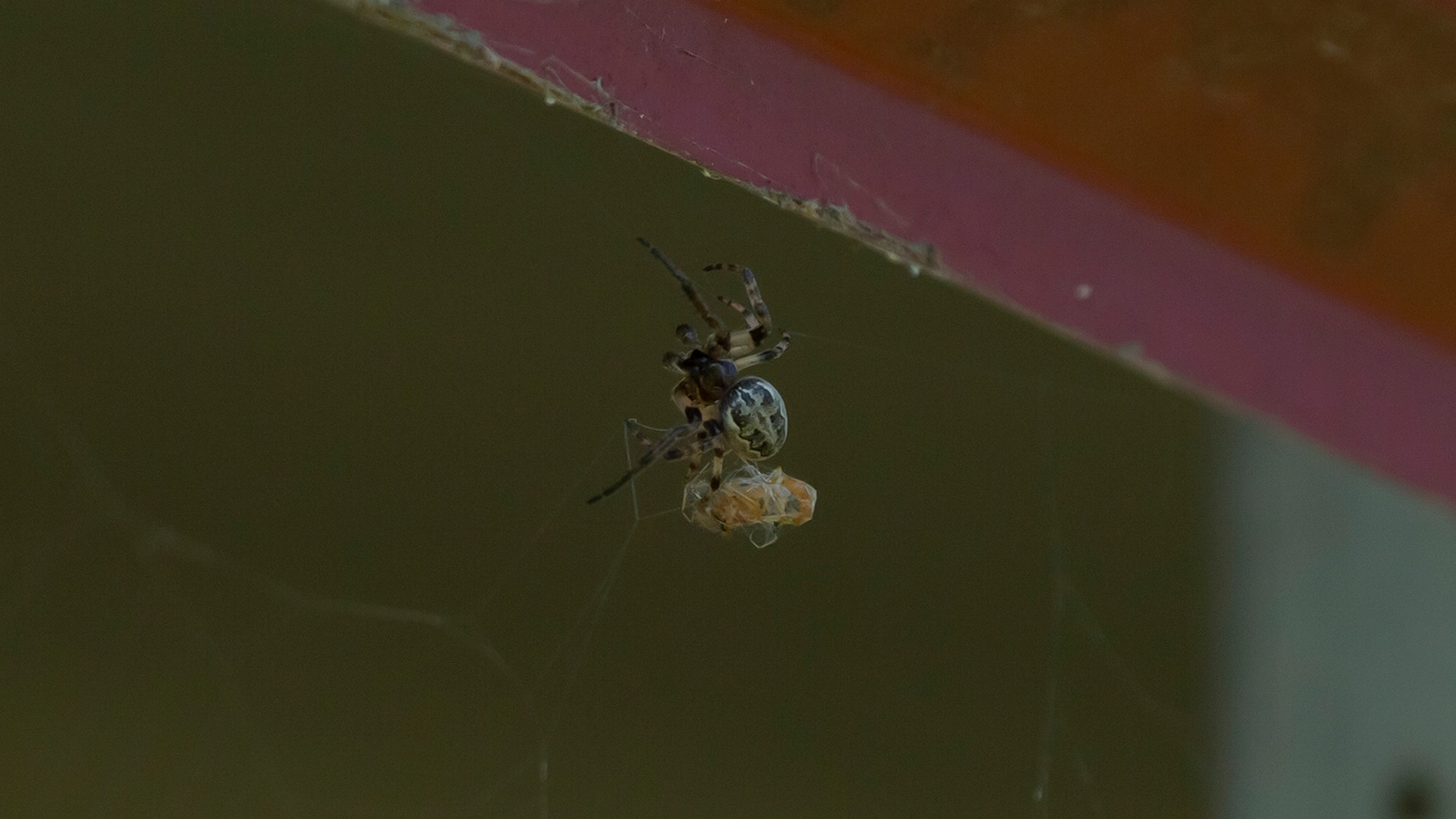
The yellow-legged mud dauber's prey is orb-weaving spiders and crab spiders, primarily. The female hunts systematically through vegetation, under leaf surfaces, at web margins, and across any surface where spiders of the right size might be found. The paralysis sting is delivered to the spider's nerve ganglia, producing immediate immobilization without killing the spider. That wasp carries the paralyzed spider in flight, gripping it by the legs or abdomen, and brings it to the cell under construction. Multiple spiders are packed into each cell before the egg is laid and the cell sealed. The…
If This Animal Could Talk...
"Watch closely, respect my space, and let my habitat explain the rest of the story."
The yellow-legged mud dauber, Sceliphron caementarium, is the mud dauber most North Louisiana residents watched their entire lives without knowing its name. The irregular cluster of gray-brown clay cells on the porch ceiling, the barn wall, the bridge underside: the point is the yellow-legged mud dauber's work. That clay tubes of the pipe organ mud dauber are more architecturally distinctive, but the yellow-legged mud dauber's irregular clusters are more common and more widely distributed throughout the 26 parishes. Every structure in North Louisiana with a sheltered ceiling carries yellow-legged mud dauber nests on it. Every single one. Sceliphron caementarium is a widespread and abundant solitary wasp with a North American distribution covering the continent east of the Rockies. In North Louisiana it is present throughout the year in warm months, active from April through September, and visible in built environments from Avoyelles Parish north through every parish in the coverage. Yellow-legged mud daubers do not form colonies, does not defend its nest aggressively, and does not sting people who are not handling it directly. This makes it the most reasonable wasp on the porch ceiling. That is a low bar. It still clears it. The nest it builds is a spider storage and brood-rearing system, and the spider populations inside North Louisiana's structures are lower because of it.
Photo Gallery

Advertisement
Accessibility
Accessibility
Yellow-legged mud daubers at mud-gathering sites produce an audible, rapid wing buzz as they work clay loose from wet soil margins, distinct from flight buzz, sustained while the wasp is working. At pond edges and muddy drainage margins throughout the 26 parishes, that working sound carries several feet in still conditions. Near active porch or barn construction, the faint rasping of wet clay being applied is audible in quiet interior spaces before the bright yellow legs catch the light. Nest sites sit at standing height on covered surfaces throughout all 26 parishes.
Mud-gathering activity at pond and bayou margins reads clearly from road shoulders and boat launch aprons throughout the bottomland parishes.
Advertisement
Frequently Asked Questions
Does Yellow-Legged Mud Dauber live in North Louisiana?
Yes. The yellow-legged mud dauber, Sceliphron caementarium, is the mud dauber most North Louisiana residents watched their entire lives without knowing its name. That clay tubes of the pipe organ mud dauber are more architecturally distinctive, but the yellow-legged mud dauber's irregular clusters are more common and more widely distributed throughout the 26 parishes. Every structure in North Louisiana with a sheltered ceiling carries yellow-legged mud dauber nests on it.
How do you identify Yellow-Legged Mud Dauber?
That common name describes the most visible field mark: the legs are bright yellow, conspicuous against the dark body in flight and at rest. The body is black and yellow with a pattern that produces a black and yellow striped appearance at a glance, but the pattern is different from the bold banding of yellowjackets, less regular, with more black, and lacking the yellowjacket's robust waist-free body plan. This thread waist of the yellow-legged mud dauber is visible and distinctive, a long petiole that connects the thorax to the more globular abdomen. Body length runs three-quarters of an inch to an inch in females, slightly smaller in males. The yellow legs in flight catch light in a way that makes the species visible from ten feet at the right angle. On a dark barn ceiling, the bright legs moving against the clay nest surface are the first thing that registers. The body appears to be mostly legs and thread waist until the eye resolves the full animal. The yellow legs are the primary field mark. No other common mud dauber in North Louisiana shows that bright yellow on the legs. The blue mud dauber is metallic blue-black. The pipe organ mud dauber is dark with subtle pale markings. A mud dauber in flight or at rest with conspicuous yellow legs is the yellow-legged mud dauber. Each nest architecture confirms the identification. The irregular cell cluster of the yellow-legged mud dauber versus the parallel tubes of the pipe organ mud dauber versus the renovated cells of the blue mud dauber are distinct enough that finding an adult at a specific nest type provides the identification. Paper wasps and yellowjackets are sometimes confused with the yellow-legged mud dauber by observers who see the yellow and black pattern without resolving the body shape. The mud dauber's long petiole, elongated abdomen, and lack of wing-folding behavior when at rest separate it from paper wasps, which fold their wings longitudinally at rest. At the nest, the architecture is the separator: an irregular clay cell cluster is not a paper nest.
What does Yellow-Legged Mud Dauber eat?
Adult Foraging
Adult yellow-legged mud daubers feed on nectar from accessible flowers while provisioning nests. The species visits goldenrod, native clovers, Queen Anne's lace, and other open-faced flowers within foraging range of active nest sites. The nectar visit is a quick refueling stop, not a prolonged foraging bout. The female is spending most of her active time either at the mud source, at the nest, or hunting spiders. Nectar-foraging yellow-legged mud daubers make an incidental pollination contribution is minor relative to the contribution of dedicated pollinators, but it is not zero.
A species visiting flowers regularly across a long season in large numbers throughout the 26 parishes transfers pollen as a side effect. The pollination is a by-product of an animal fueling an entirely different primary activity.
Is Yellow-Legged Mud Dauber dangerous to people?
No. This species is not dangerous to people when it is observed without handling or disturbance