Advertisement
Fun Facts
Did You Know?
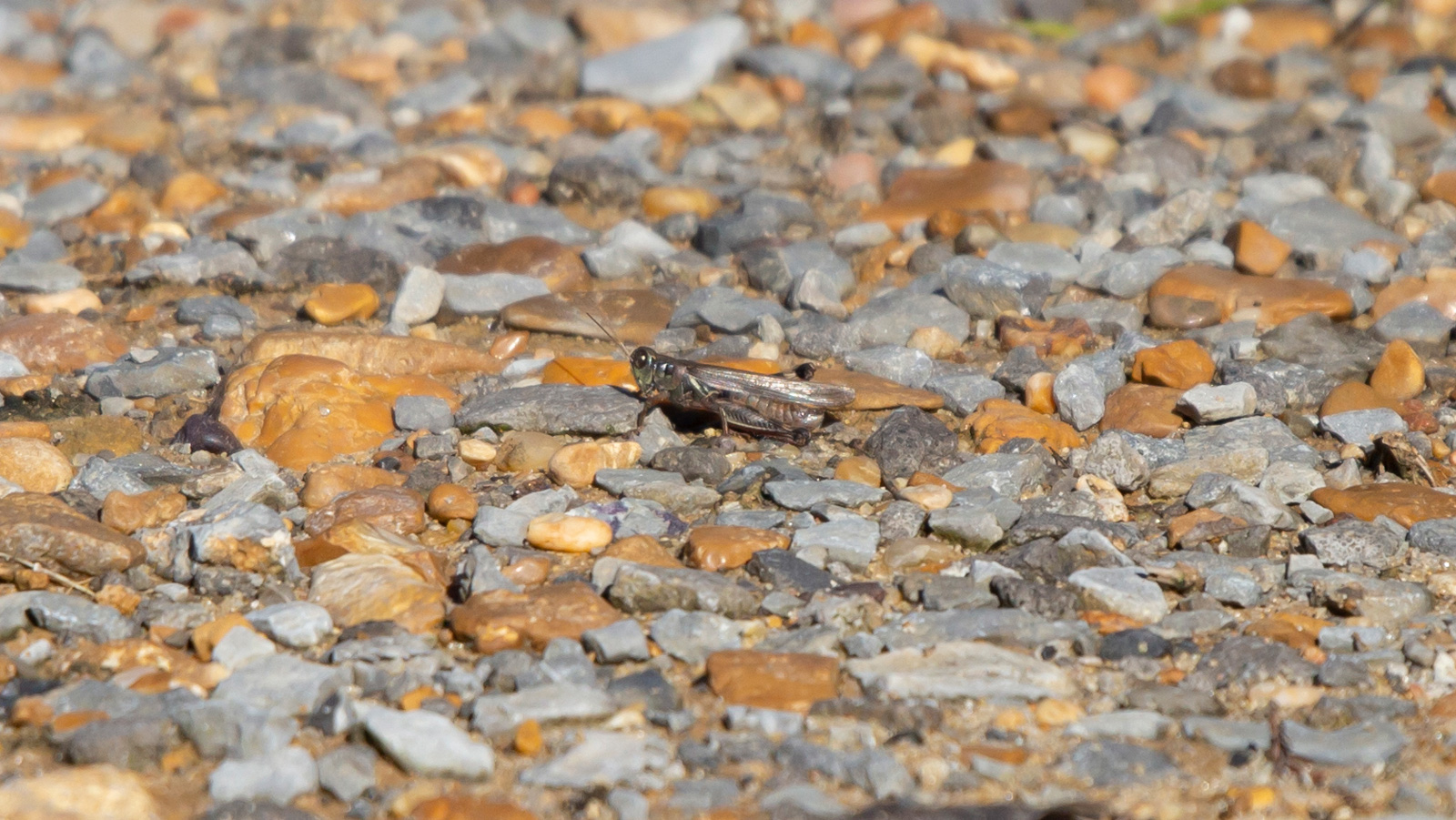
The Sulphur-Winged Grasshopper's resting camouflage matches the Carolina Grasshopper's vanishing act in quality. The body runs gray, dark brown, or nearly black, matching the bare soil, gravel, or rock surface underneath. Dark mottling on the forewings breaks up the body outline against the irregular texture of the ground. A Sulphur-Winged Grasshopper sitting on dark clay on a Rapides Parish field road disappears at three feet. You can stare directly at the spot where the grasshopper landed and see only dirt. The only reliable way to find one at rest involves already knowing the exact…
If This Animal Could Talk...
"Watch closely, respect my space, and let my habitat explain the rest of the story."
The Sulphur-Winged Grasshopper belongs to the same band-winged subfamily (Oedipodinae) as the Carolina Grasshopper, and the two species share the same basic playbook: camouflage at rest, flash display in flight, crepitation during courtship. But where the Carolina Grasshopper flashes black hindwings, the Sulphur-Winged Grasshopper flashes bright yellow. A drab, gray-brown grasshopper launches from bare ground, opens a pair of vivid sulphur-yellow hindwings bordered by a dark band, kicks out a soft crackling sound, and lands on the next patch of bare earth where the entire display folds away and the insect vanishes against the background. The yellow flash in a grasshopper's flight over a North Louisiana field in April or May, months earlier than most band-winged species reach adulthood, identifies Sulphur-Winged Grasshopper with near certainty.
Adults measure 22 to 35 millimeters, placing them in the medium-size range. The body coloring ranges from gray to dark brown to almost black, matching the bare-ground and dry-grass backgrounds where the species rests. The darker body coloring, averaging darker than the Carolina Grasshopper's gray-to-brown range, may reflect adaptation to the darker spring substrates the species occupies. Spring ground in North Louisiana carries more moisture, more recently decayed organic matter, and less sun-bleaching than the same ground in August, resulting in a generally darker surface color that the Sulphur-Winged Grasshopper's dark body matches.
Advertisement
Accessibility
Accessibility
The crepitation, a soft, rhythmic crackling during display flights, carries 15 to 20 feet. The crackling frequency falls well within the human hearing range regardless of age, remaining fully audible to listeners with high-frequency hearing loss that masks katydid songs. The sound arrives before the visual, the crackling draws the ear before the eye finds the grasshopper.
Sulphur-Winged Grasshoppers occupy flat, bare ground surfaces, gravel roads, packed soil, parking lot margins, maintained bare areas. The primary habitat runs entirely on firm, level surfaces compatible with any mobility level. No uneven terrain, no dense vegetation, and no off-trail movement required. More Information
iNaturalist: inaturalist.org, observation records for Sulphur-Winged Grasshopper BugGuide: bugguide.net, identification resources for Oedipodinae Orthoptera Species File: orthoptera.speciesfile.org, taxonomy and distribution data
Advertisement
Frequently Asked Questions
Does Sulphur-Winged Grasshopper live in North Louisiana?
Yes. The yellow flash in a grasshopper's flight over a North Louisiana field in April or May, months earlier than most band-winged species reach adulthood, identifies Sulphur-Winged Grasshopper with near certainty. Spring ground in North Louisiana carries more moisture, more recently decayed organic matter, and less sun-bleaching than the same ground in August, resulting in a generally darker surface color that the Sulphur-Winged Grasshopper's dark body matches.
The species maintains a lower profile in the North Louisiana grasshopper lineup than the Carolina Grasshopper because the activity window falls during the spring months when fewer people spend time outdoors looking at bare ground.
How do you identify Sulphur-Winged Grasshopper?
The Sulphur-Winged Grasshopper's yellow hindwings create a clean separation from the Carolina Grasshopper's black hindwings, but other band-winged species in North Louisiana carry hindwing colors that overlap the yellow range. The Autumn Yellow-Winged Grasshopper (Arphia xanthoptera), a close relative that occurs across much of the eastern United States, shows similar yellow hindwings but follows a fall rather than spring activity schedule. If Arphia xanthoptera occurs in North Louisiana (the species' range includes neighboring states), a yellow-winged display flight in September would belong to xanthoptera rather than sulphurea. The seasonal window provides the separation: spring = sulphurea, fall = xanthoptera. The two species fill the same niche, bare-ground band-winged with yellow hindwings and crepitation, at opposite ends of the season. The Coral-Winged Grasshopper (Pardalophora apiculata), another spring-active band-winged species, sometimes carries pinkish-orange hindwings that could be confused with the yellow of the Sulphur-Winged in flight. The color difference (yellow versus orange-pink) shows clearly in photographs but may blur during the brief glimpse of a display flight at 15 feet above ground. The habitat gives a secondary separation cue: Pardalophora associates more with grassy habitats and woodland openings, while the Sulphur-Winged prefers the barren, exposed substrates with minimal vegetation.
What does Sulphur-Winged Grasshopper eat?
Diet and Ecological Role
Sulphur-Winged Grasshoppers eat grass and the occasional broadleaf weed seedling, nothing else. They chew whatever grows within walking distance of the bare ground where they spend most of their time: scattered grass tufts between bare patches, weed seedlings pushing through gravel, and the low vegetation at the margins of roads and paths. The population never builds high enough to cause crop damage anybody would notice.
The spring timing means the Sulphur-Winged Grasshopper gets first crack at the freshest grass of the year, the first green blades pushing through the brown dormant thatch in March and April. That early growth runs richer than midsummer grass: higher protein, lower fiber, more nutritional bang per bite. The species eats the equivalent of the salad bar's opening day while the summer grasshoppers wait underground for the buffet to fully restock. The quality advantage may partially compensate for the smaller body and lower egg output that the Sulphur-Winged carries compared to the larger midsummer species.
The feeding damage on spring grass stays invisible to anyone not specifically looking for grasshopper chewing marks on grass blades in March. The combined feeding of the entire Sulphur-Winged Grasshopper population across a 100-acre pasture during the spring window removes a fraction of a percent of the total grass production, undetectable by any measurement short of controlled exclusion experiments.
The species eats grass the way a hummingbird eats nectar: constantly, at a metabolically significant rate for the individual, but at a scale so far below the landscape's total growth that the ecosystem doesn't register the loss.
The predator lineup mirrors the Green-Striped Grasshopper's spring enemies. Eastern Phoebes, Eastern Bluebirds, and American Robins passing through on spring migration all eat Sulphur-Winged Grasshoppers, and during March and April the pickings run slim enough that a grasshopper on bare ground ranks as one of the best arthropod meals available.
Killdeer and other ground-foraging shorebirds patrol the same exposed surfaces where the Sulphur-Winged Grasshopper performs display flights, which creates the awkward situation of a grasshopper advertising its location through clicking and wing-flashing to an audience that includes both potential mates and potential predators. The display attracts both. The grasshopper bets that the mate arrives before the killdeer does.
Loggerhead Shrikes, active year-round across the 26 parishes, eat Sulphur-Winged Grasshoppers during the spring months from perches above the bare-ground habitats. The spring shrike-grasshopper interaction provides the shrike with protein during the pre-nesting period, when the adult shrikes begin building the energy reserves needed for egg production and incubation.
A shrike pair establishing a territory in a Grant Parish pasture during March feeds on the Sulphur-Winged Grasshoppers flushing from the gravel turn rows and bare field margins that double as the shrike's hunting territory and the grasshopper's display ground.
The Sulphur-Winged Grasshopper and the Green-Striped Grasshopper together run the spring food web's grasshopper department. The Sulphur-Winged covers bare ground. The Green-Striped covers short grass. Between them, the two species provide early-season arthropod biomass to a predator lineup coming out of winter with empty stomachs and limited options.
Neither species alone puts enough grasshopper protein on the landscape to sustain the spring predator lineup through the pre-summer gap, but the combined contribution across two habitat types, two body sizes, and two overlapping activity patterns keeps the Eastern Phoebes, the bluebirds, the killdeer, and the early-returning shrikes fed until the summer grasshopper generation reaches adulthood in July and the real buffet opens.
Is Sulphur-Winged Grasshopper dangerous to people?
No. This species is not dangerous to people when it is observed without handling or disturbance