
Advertisement
Fun Facts
Did You Know?
The bronze frog is the southern subspecies of the green frog, Lithobates clamitans. The northern subspecies — the northern green frog (L. c. melanota) — lives across the northern and central United States. The bronze frog (L. c. clamitans) lives in the southeastern United States, and the two subspecies overlap in several states where they interbreed and produce frogs with intermediate characteristics that make field identification unnecessarily complicated
If This Animal Could Talk...
"Watch closely, respect my space, and let my habitat explain the rest of the story."
Bronze frogs are the Minoans of frogs — only instead of being Bronze Age rock stars, they're bronze-colored country frogs named for their ancient fashion style. These brownish-bronze frogs are the southeastern subspecies of the green frog, Lithobates clamitans clamitans, and their scientific name translates roughly to "a loud stone," which anybody who's ever met one of these frogs will likely agree with. They're the loudest rocks in North Louisiana.
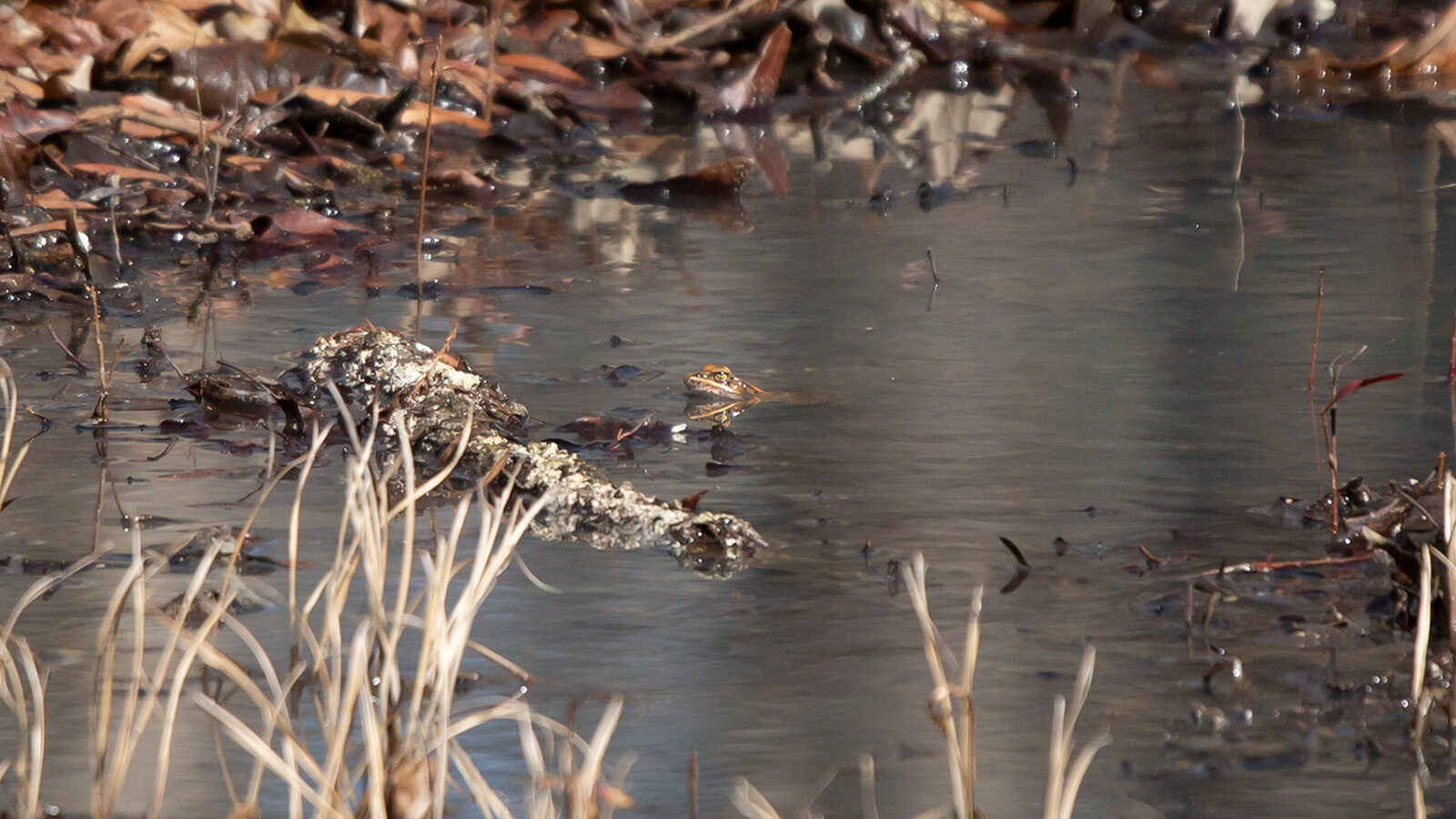
Not that green frog. These little guys and gals are related to Kermit the same way leopard frogs are related to that loveable conquistador of Manhattan. Green frog subspecies — bronze and northern green frogs — are ground dwellers, not arboreal green tree frogs. The bronze frog lives in shallow water at swamp edges, under rotten logs, on vegetation in the water, and basically anywhere that is wet, muddy, and contains bugs worth eating. They are also excellent at blending into their environments, which makes them surprisingly hard to spot despite their willingness to announce themselves acoustically.
What Is the Bronze Frog Often Confused With?
Contrary to the name, bronze frogs are not always brown. They are gray, green, brown, or a combination of the three. It's not uncommon to find a bronze frog with a green or gray head and a brownish body. The belly is white covered in dark, irregular blotches. They have bright green upper lips and noses. Males are often greener than females, and some males have yellowish throats that become more vibrant during breeding season. Adults range from two to four inches in length, which makes them smaller than bullfrogs and southern leopard frogs, and larger than cricket frogs. This is the sweet spot where "medium-sized frog" applies, which is not a helpful field mark but is accurate.
Drag the handle left and right to compare Bronze Frog side by side with the species it gets mistaken for most.
1 of 3
Advertisement
Accessibility
Accessibility
Bronze frogs offer one of the more accessible nighttime wildlife observation opportunities in North Louisiana because the calling males locate themselves for you. A flashlight, a pond edge, and a warm evening from May through July is the complete kit. No hiking required — park at the edge of any wooded pond or bayou with a solid shoulder, roll the window down, and listen.
Black Bayou Lake NWR near Monroe has paved and gravel paths adjacent to wetland habitat where bronze frogs call reliably in spring and early summer. The paths allow approach from a stable surface without wading through mud or vegetation. For visitors with limited mobility, vehicle observation works well — frogs calling from bank vegetation are audible from a parked car with windows down, and the flashlight scan can be done from the driver's seat along roadsides with direct sight lines to water.
For visitors who are blind or have low vision: the bronze frog's single-note banjo call is one of the most acoustically distinctive frog calls in North Louisiana — one deep pluck, pause, another pluck — and it locates the animal precisely. Once you hear the call and identify the direction, the frog is within a few feet of the water's edge in that direction, within ten to twenty feet of your position in most cases. The alert splash when a frog enters water is audible and locates animals that aren't calling.
On a still night at a productive pond in May or June, the combined calling of multiple males creates a soundscape that is genuinely worth seeking out whether or not you can see the frogs producing it.
Advertisement
Frequently Asked Questions
Does Bronze Frog live in North Louisiana?
Yes. They're the loudest rocks in North Louisiana. But because North Louisiana winters are mild, bronze frogs don't stay in brumation all season. This strategic resting rather than continuous hibernation is common among North Louisiana amphibians — all of whom have learned that Louisiana winter is more of a suggestion than an actual season
How do you identify Bronze Frog?
Contrary to the name, bronze frogs are not always brown. They are gray, green, brown, or a combination of the three. It's not uncommon to find a bronze frog with a green or gray head and a brownish body. The belly is white covered in dark, irregular blotches. They have bright green upper lips and noses. Males are often greener than females, and some males have yellowish throats that become more vibrant during breeding season. Adults range from two to four inches in length, which makes them smaller than bullfrogs and southern leopard frogs, and larger than cricket frogs. This is the sweet spot where "medium-sized frog" applies, which is not a helpful field mark but is accurate.
What does Bronze Frog eat?
Bronze frogs are carnivores who eat mostly bugs. The main course generally includes beetles, butterflies, caterpillars, crawfish, flies, snails, spiders, and worms. Large bronze frogs will supplement their diets with smaller frogs and small snakes when the opportunity presents itself. If it moves and fits in the mouth, attempt to eat it
Is Bronze Frog dangerous to people?
Bronze Frogs and Humans
Bronze frogs are beneficial to humans in that they eat bugs that bug people — spiders, flies, mosquitoes, beetles. A healthy population in and around a pond or wetland provides meaningful insect control during the warmer months when flying insects are abundant and annoying. The frogs don't eliminate insects, but they reduce them, which is appreciated by anyone spending time outdoors in Louisiana during mosquito season.
Bronze frogs also serve an essential role in their ecosystems as food for larger birds, reptiles, and mammals. They are mid-level predators and mid-level prey, connecting insects and other small invertebrates to larger carnivores in the food web. Remove the frogs and the ecosystem has a gap that affects both what the frogs ate and what ate the frogs.
Bronze frogs even show up in Louisiana kitchens occasionally, though less commonly than bullfrogs. Frog legs aren't as standard a meal as they used to be, but frog hunters still collect bronze frogs for their legs when they encounter them. The legs are smaller than bullfrog legs but still considered good eating.
Amphibians have permeable skin that makes them vulnerable to pollution, and habitat destruction, invasive species, disease outbreaks, and climate change all affect amphibian populations globally. Bronze frogs are not currently threatened in Louisiana, but they are part of a larger pattern of amphibian decline that concerns conservation biologists worldwide.