Advertisement
Fun Facts
Did You Know?
Armadillos tear through North Louisiana soil with mechanical focus and zero concern for landscaping plans. A stretch of quiet pine straw at dusk turns into a grid of shallow pits by morning, and the culprit leaves nothing behind but overturned dirt and the faint memory of armor glinting under porch lights. That sound in the leaves after dark doesn't belong to a monster. It belongs to one of the most efficient insect hunters in the southern United States
If This Animal Could Talk...
"Watch closely, respect my space, and let my habitat explain the rest of the story."
The Pest That's Good for Your Yard Armadillos tear through North Louisiana soil with mechanical focus and zero concern for landscaping plans. A stretch of quiet pine straw at dusk turns into a grid of shallow pits by morning, and the culprit leaves nothing behind but overturned dirt and the faint memory of armor glinting under porch lights.
Does the Armadillo Live in North Louisiana?
Yes. Armadillos tear through North Louisiana soil with mechanical focus and zero concern for landscaping plans. North Louisiana hosts one armadillo species, though the scientific name recently changed. No other mammal in North Louisiana wears external armor like this.
Where Does the Armadillo Live Worldwide?
It belongs to one of the most efficient insect hunters in the southern United States. The armadillos ranging from Mexico into the southern United States now fall under Dasypus mexicanus, commonly called the Mexican long-nosed armadillo. Around eleven thousand years ago, climate shifts pushed them out of the southeastern United States.
Where Does the Armadillo Live in North Louisiana?
When and Where to See Armadillos in North Louisiana
If you're out at noon looking for one, you're wasting your time and sweating for no reason. Armadillos move when the ground cools enough for their bodies to function without cooking from underneath. That means dusk, night, and the hours before sunrise do the heavy lifting. In summer, real activity doesn't settle in until well after dark because August dirt holds heat like it's angry about it.
Spring and fall stretch the window. Temperatures stay moderate longer, and insect activity stays steady, so armadillos spend more time above ground. March through May and October through November produce the highest odds of actually watching one instead of just reading the evidence it left behind. Winter doesn't shut them down, but hard freezes slow everything. When the soil locks up, digging stops. When digging stops, they stay underground until the dirt softens again.
Habitat matters more than timing. Bottomland hardwood forests along the Ouachita River, Tensas River, and Bayou Macon hold steady populations because the soil stays workable and insect-rich. Pine uplands with thick leaf litter also work well, especially near drainage corridors. Black Bayou Lake National Wildlife Refuge, Tensas River National Wildlife Refuge, and Russell Sage Wildlife Management Area all support visible activity if you move quietly after sunset.
Suburban edges outperform pristine wilderness in many parishes. Irrigated lawns grow grubs. Mulched beds trap beetle larvae. Compost piles turn into buffet lines. Armadillos follow insect density, not aesthetics. If a subdivision backs up to woods and the ground stays soft, that edge becomes prime territory.
Creek banks, culvert slopes, and the shaded side of levees often hide burrow entrances. They favor slight elevation changes that allow drainage while keeping soil loose. Walk slowly along those transition zones at dusk and listen for steady leaf movement that doesn't stop when you pause. That rhythm isn't wind.
North Louisiana isn't lacking armadillos. It's lacking daylight armadillos. Adjust the clock, follow the edges where woods meet open ground, and watch the soil instead of the skyline. The animal won't announce itself, but it won't hide its work either.
Advertisement
Where Are You Most Likely to See Armadillo in North Louisiana?
Use the habitat and field-note details below to choose suitable North Louisiana viewing locations and seasons.
Can the Armadillo Survive North Louisiana Winters?
Louisiana provided workable soil, tolerable winters, and abundant insect prey. Cold snaps slow activity but don’t trigger true hibernation. Winter doesn’t shut them down, but hard freezes slow everything.
How Big Does the North Louisiana Armadillo Get?
Measure roughly 24 to 30 inches
What Sounds Does the Armadillo Make?
That sound in the leaves after dark doesn’t belong to a monster. The armadillos ranging from Mexico into the southern United States now fall under Dasypus mexicanus, commonly called the Mexican long-nosed armadillo. You’ll hear it before you see it, and the sound won’t match what your brain expects.
Does the Armadillo Use Burrows or Dens in Louisiana?
How to Identify an Armadillo in North Louisiana
You'll hear it before you see it, and the sound won't match what your brain expects. It isn't a growl or a hiss. It's a steady, deliberate rustling, like someone dragging a rake through dry leaves at 10:47 p.m. The noise moves in short bursts, pauses, then starts again. Nose down. No hesitation. Moving like it has an appointment underground.
Adult armadillos in North Louisiana measure roughly 24 to 30 inches from nose to tail tip. The body itself runs about 15 to 20 inches, with the tail adding another 9 to 15 inches depending on the individual. Most weigh between 8 and 17 pounds. They sit low to the ground on short legs, which gives them a rolling, mechanical gait instead of the bounding motion people expect from mammals this size.
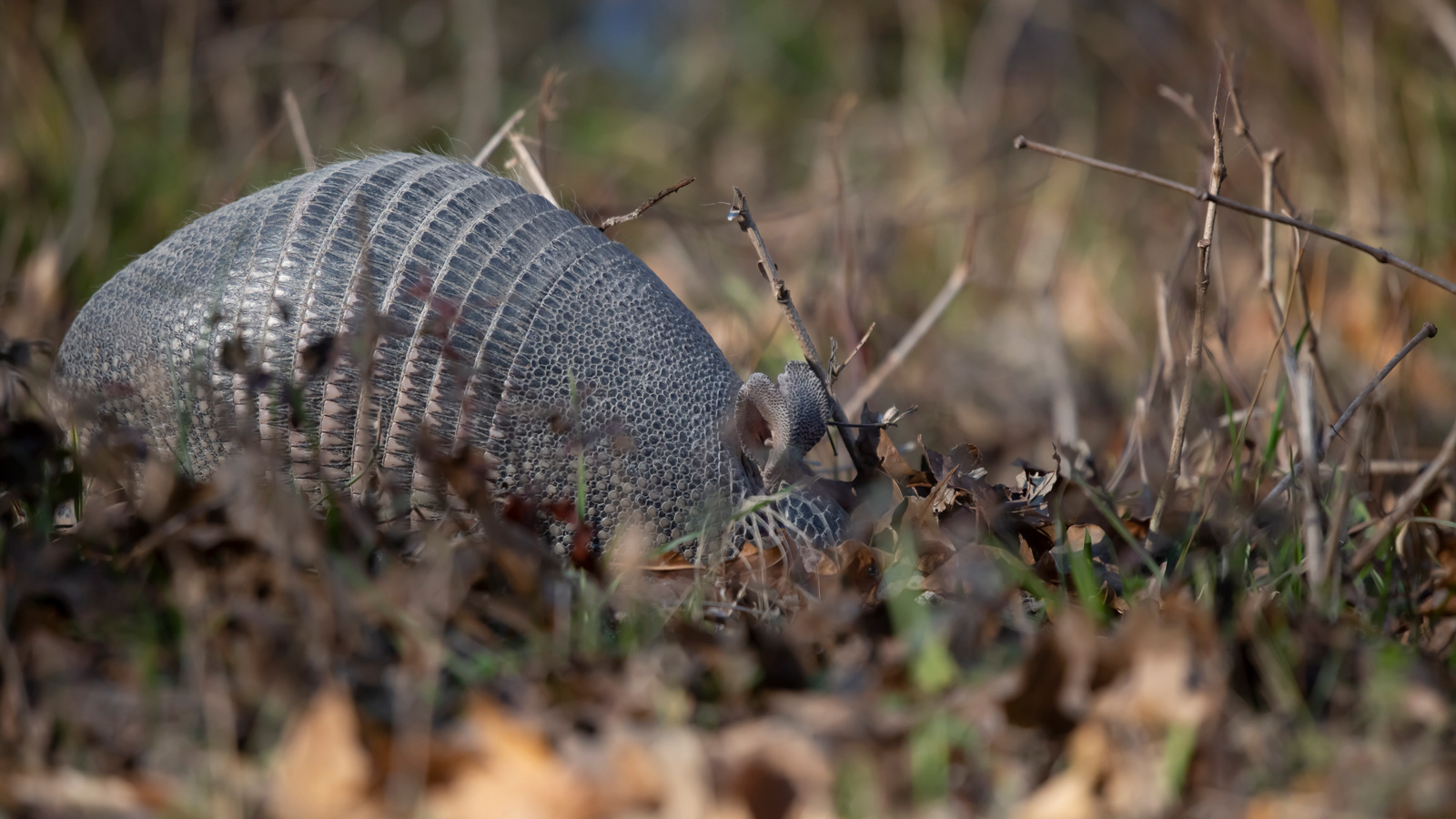
The armor is the feature nobody misses once the brain catches up. Thick bony plates cover the back and sides, divided into flexible bands across the middle of the body. Most Louisiana individuals show eight to eleven visible bands, even though "nine-banded" became the common name decades ago. The tail carries ringed armor as well, tapering toward the end in ridged segments that look built for durability instead of decoration.
The face won't impress you at first glance, but the design works exactly as intended. Small eyes sit on either side of a long, narrow snout that stays close to the ground. Vision ranks low in priority. Smell drives every decision. When that nose locks onto insect scent, the foreclaws deploy with surgical efficiency.
Tracks confirm what your ears suspected. The front feet leave four toe impressions with long claw marks extending forward. The hind feet show five toes. In soft mud, those claw marks look exaggerated, almost cartoonish. Nearby, you'll find shallow cone-shaped holes roughly three to five inches wide where the animal extracted grubs or beetle larvae. The pattern looks intentional because it is.
Burrow entrances measure roughly seven to eight inches across and angle into slopes, creek banks, drainage edges, or the base of tree roots. Soil fans outward from the opening in a clean arc, not scattered randomly. In suburban yards, burrows hide beneath sheds, brush piles, thick hedges, or along fence lines where cover feels safer. The hole isn't decorative. It's a temperature-controlled refuge and a place to raise four identical offspring without interruption.
Behavior seals the identification. When startled, the animal freezes first. If pressure escalates, it launches vertically in a reflexive jump that looks more electrical than graceful. No deer in North Louisiana reacts that way. No raccoon does either. That straight-up blast gives you your final confirmation.
Four Identical Babies, Because Nature Chose Chaos
Every summer in North Louisiana, armadillos lock into breeding season with mechanical precision. Mating happens in June and July, but the real twist begins afterward. Fertilization happens quickly, yet development does not follow that same pace. The fertilized egg pauses in suspended delay for months before implanting in late fall, essentially waiting out the calendar so birth aligns with spring insect surges and better survival odds.
March hits and the burrow turns into a production floor. Inside a chamber lined with leaves and grass, the female delivers four pups — never three, never "up to four," always four. One fertilized egg splits into four embryos, producing genetically identical offspring of the same sex. Four clones sharing the same DNA blueprint, tucked under pine straw like a biological experiment that forgot subtlety.
No other common North Louisiana mammal operates like that. Deer produce fawns with genetic variation. Raccoons roll the dice on mixed litters. Armadillos run a copy machine once a year and send four identical units into the field.
The newborns enter the world with soft shells that feel more like reinforced cartilage than armor. Plates harden over several weeks, during which the mother keeps them underground and manages the entire operation alone. She nurses, guards, and relocates if necessary, all without assistance.
By late spring, the young begin following her above ground, noses down and claws engaged. They shadow her movements through leaf litter, digging where she digs and learning by repetition. By mid to late summer, the clones disperse and carve out their own territories defined by soil softness and insect density. Each one carries the same genetic playbook but must execute it alone. One litter. One synchronized genetic gamble. Spring insects rise. The burrow opens. The armored maintenance crew expands by four.
Advertisement
What Does the North Louisiana Armadillo Eat?
It belongs to one of the most efficient insect hunters in the southern United States. The armored digger rooting through Ouachita Parish leaf litter remains the same insect-focused mammal that expanded into Louisiana more than a century ago. The snout extends forward like a soil probe built for one purpose: locating insects.
How they hunt and forage: It belongs to one of the most efficient insect hunters in the southern United States. The armored digger rooting through Ouachita Parish leaf litter remains the same insect-focused mammal that expanded into Louisiana more than a century ago. The snout extends forward like a soil probe built for one purpose: locating insects.
What Is Family Life Like for the Armadillo?
Nearby, you’ll find shallow cone-shaped holes roughly three to five inches wide where the animal extracted grubs or beetle larvae. They don’t comb dry lawns for beetle larvae. Mulched flower beds trap beetle larvae.
Live birth or eggs? yes
When young are born: See the detailed species sections below.
What Predators Hunt Armadillo?
What Actually Tries to Kill an Armored Trash Can
Coyotes test everything that moves along a tree line. Bobcats calculate angles and wait for hesitation. Free-roaming dogs abandon calculation entirely and replace it with volume. None of them see a metal tank. They see calories wrapped in bone. Young armadillos carry softer armor and less experience, which makes them easier targets during the first months of life.
Adults rely on stillness first. The body locks down. If ground vibration spikes or breath hits the back of the neck, the jump fires. That vertical blast scrambles timing and buys seconds. Armor discourages many natural predators because biting through osteoderms costs energy and risks broken teeth. Coyotes often flip an armadillo onto its softer underside if they commit fully. Bobcats prefer cleaner kills and may abandon the attempt if resistance outweighs reward. The shell doesn't create invincibility. It creates hesitation. In the wild, hesitation keeps you alive.
Roads ignore hesitation. Limited eyesight, nighttime foraging, and the reflex jump collide with headlights in ways evolution never rehearsed. A startled armadillo leaps at the exact moment a vehicle passes, which turns a defensive reflex into catastrophic timing. Rural highways across North Louisiana collect the evidence by morning. Armor defeats claws. Armor does not defeat steel.
Is the Armadillo Dangerous to People in North Louisiana?
No. This species is not dangerous to people when it is observed without handling or disturbance.
North Louisiana Armadillo Safety Rules
- Observe without handling or disturbing the animal.
- Keep a respectful distance from nests, webs, burrows, colonies, or feeding sites.
- Photograph from stable public access areas and leave habitat as you found it.
More Information
Photo Gallery
Advertisement
Accessibility
Accessibility
Armadillos offer reliable nighttime observation at forest-lawn edges across North Louisiana without any special habitat access. The best approach is the easiest: park a vehicle at the edge of a wooded area adjacent to open ground at dusk or after dark, roll the window down, and listen. That steady rustling in dry leaf litter — the rake-through-leaves sound — locates the animal before you see it.
Black Bayou Lake NWR near Monroe has paved and gravel paths along wooded edges where armadillos forage regularly. Vehicle observation from pull-offs works well throughout the refuge. For visitors with limited mobility, the armadillo's predictable edge-habitat behavior means vehicle observation from stable pull-off points produces consistent results without walking.
For visitors who are blind or have low vision: the foraging sound is the primary cue and it carries clearly on still evenings. The rhythmic, deliberate rustling that pauses and resumes — different from wind through leaves, different from a bird scratching — is specific enough to locate once you've heard it once. On nights with no wind, the digging and soil-turning sounds carry from several feet away. The sudden absence of rustling followed by silence often means the animal froze and is assessing, which is a useful cue that it's close.
Advertisement
Frequently Asked Questions
Does Armadillo live in North Louisiana?
Yes. Armadillos tear through North Louisiana soil with mechanical focus and zero concern for landscaping plans. North Louisiana hosts one armadillo species, though the scientific name recently changed. No other mammal in North Louisiana wears external armor like this
What does Armadillo eat?
It belongs to one of the most efficient insect hunters in the southern United States. The armored digger rooting through Ouachita Parish leaf litter remains the same insect-focused mammal that expanded into Louisiana more than a century ago. The snout extends forward like a soil probe built for one purpose: locating insects
Is Armadillo dangerous to people?
No. This species is not dangerous to people when it is observed without handling or disturbance