
Advertisement
Fun Facts
Did You Know?
The zebra swallowtail's dramatically elongated hindwing tails are the feature that most captures attention, and the leading hypothesis about their function: predator deflection: bird attacks aimed at the tails, which flutter visually like a second head or body, miss the actual butterfly body and remove or damage only the tail. A bird that misses the body gets nothing nutritionally useful from the encounter, and the butterfly escapes with reduced but not fatal wing damage. Tail loss in zebra swallowtails turns up common enough to observe regularly in North Louisiana populations. Adults with…
If This Animal Could Talk...
"Watch closely, respect my space, and let my habitat explain the rest of the story."
The zebra swallowtail stops people cold. Not because size goes to, the giant swallowtail has that, or the most common, that's the tiger, but because its proportions are wrong in the most striking way possible. The tails are longer than any other North Louisiana swallowtail's, long enough that the butterfly looks like it trails ribbons, and the pattern runs clean enough that the identification resolves from across a yard before the butterfly lands. Black and white with red, in an arrangement that looks designed rather than evolved. Eurytides marcellus ranks among those animals that prompts a second look from people who think they already know what a butterfly looks like. The zebra swallowtail ranges through the eastern United States wherever pawpaw, Asimina triloba, grows, because the zebra swallowtail caterpillar eats pawpaw and essentially nothing else. This narrow host plant dependency shapes the butterfly's distribution in North Louisiana: it flies and breeding in every parish where native pawpaw grows in riparian and bottomland forest understory, which across the 26 parishes includes most of the major river drainages and the moist upland woodland corridors connecting them. It does not function as a backyard butterfly in most residential settings unless the yard has a pawpaw tree, but at the right forest edges and river corridors it runs reliable enough to find consistently once the host plant gets located.
Photo Gallery
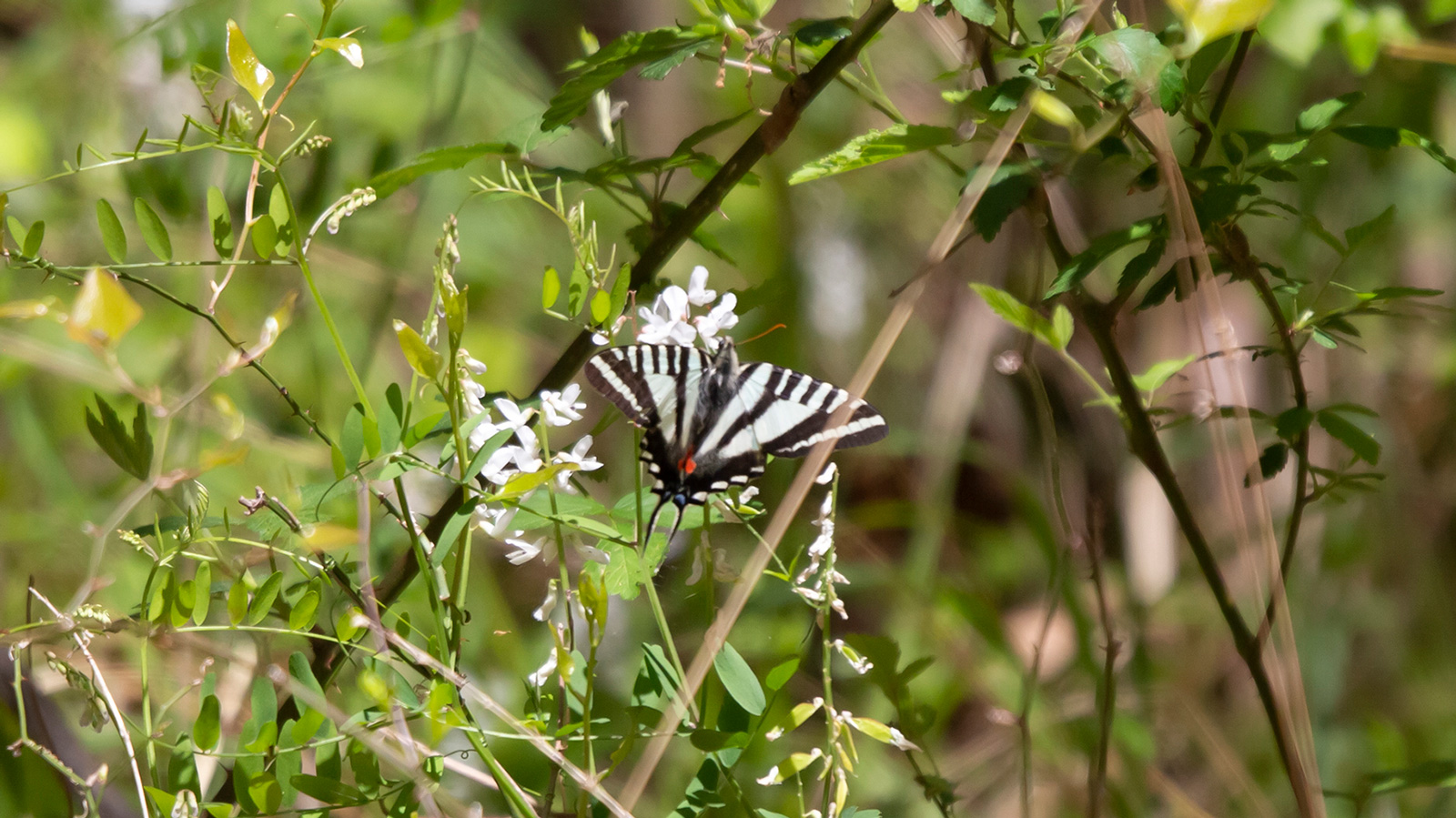
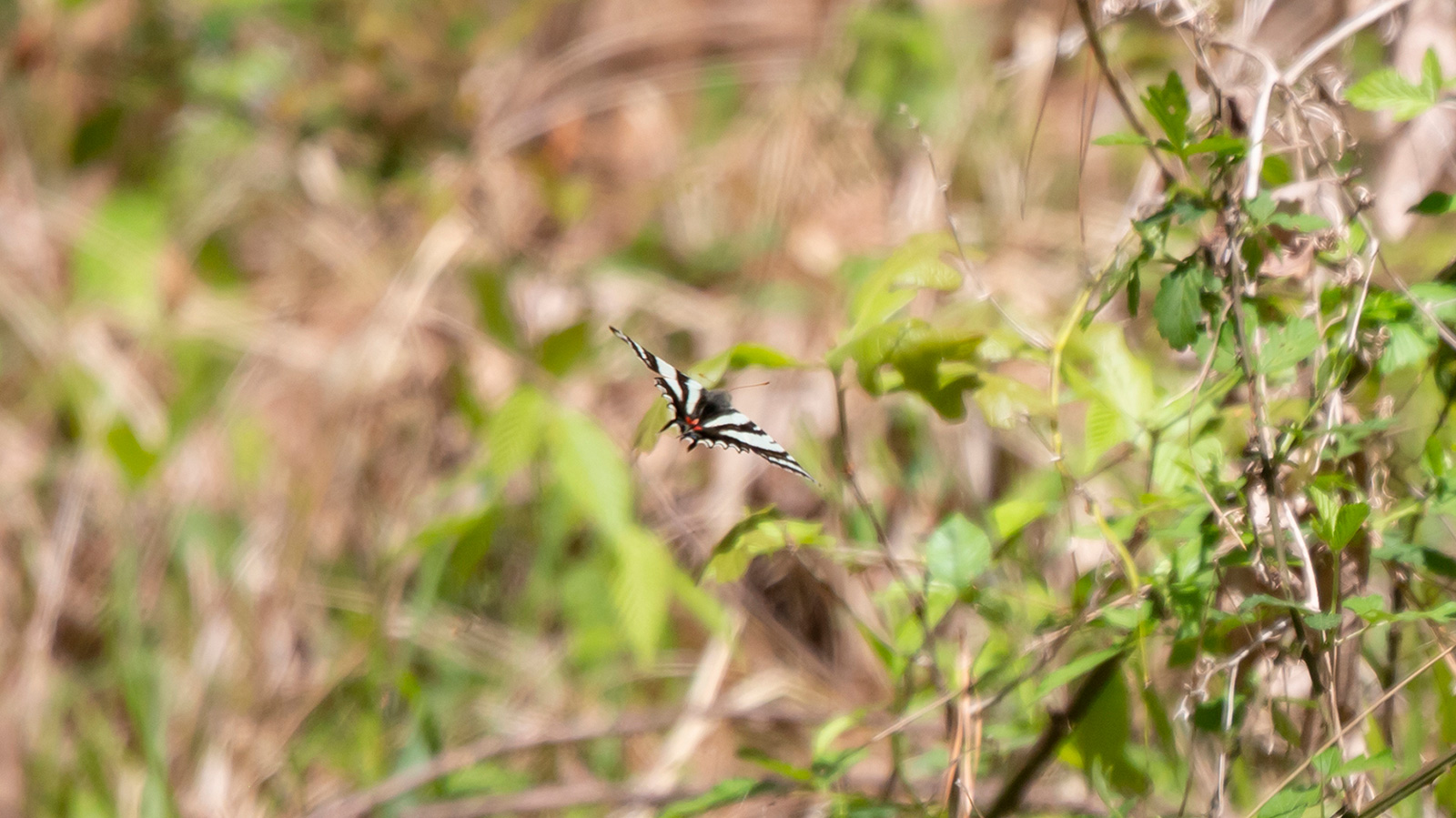
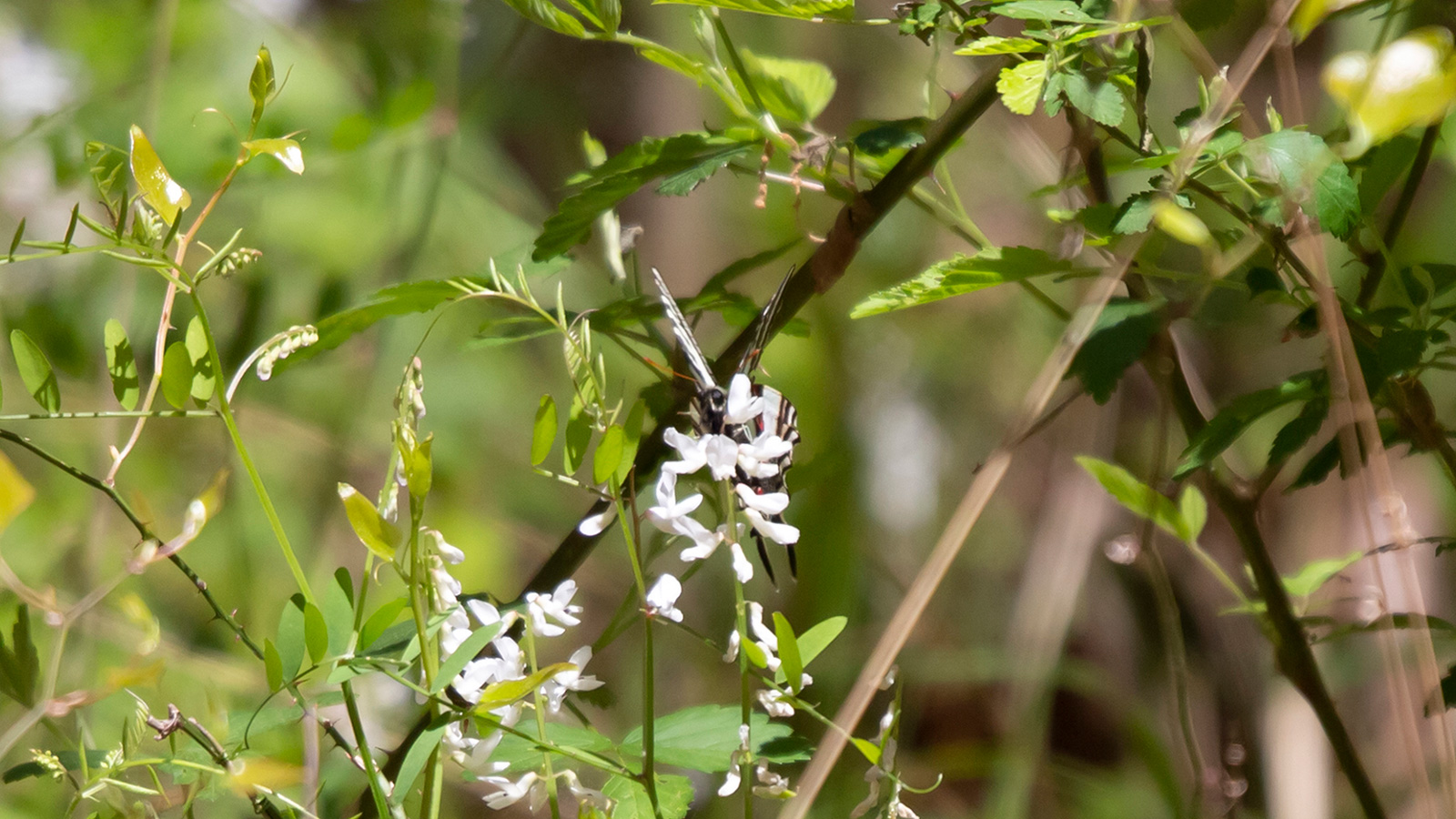
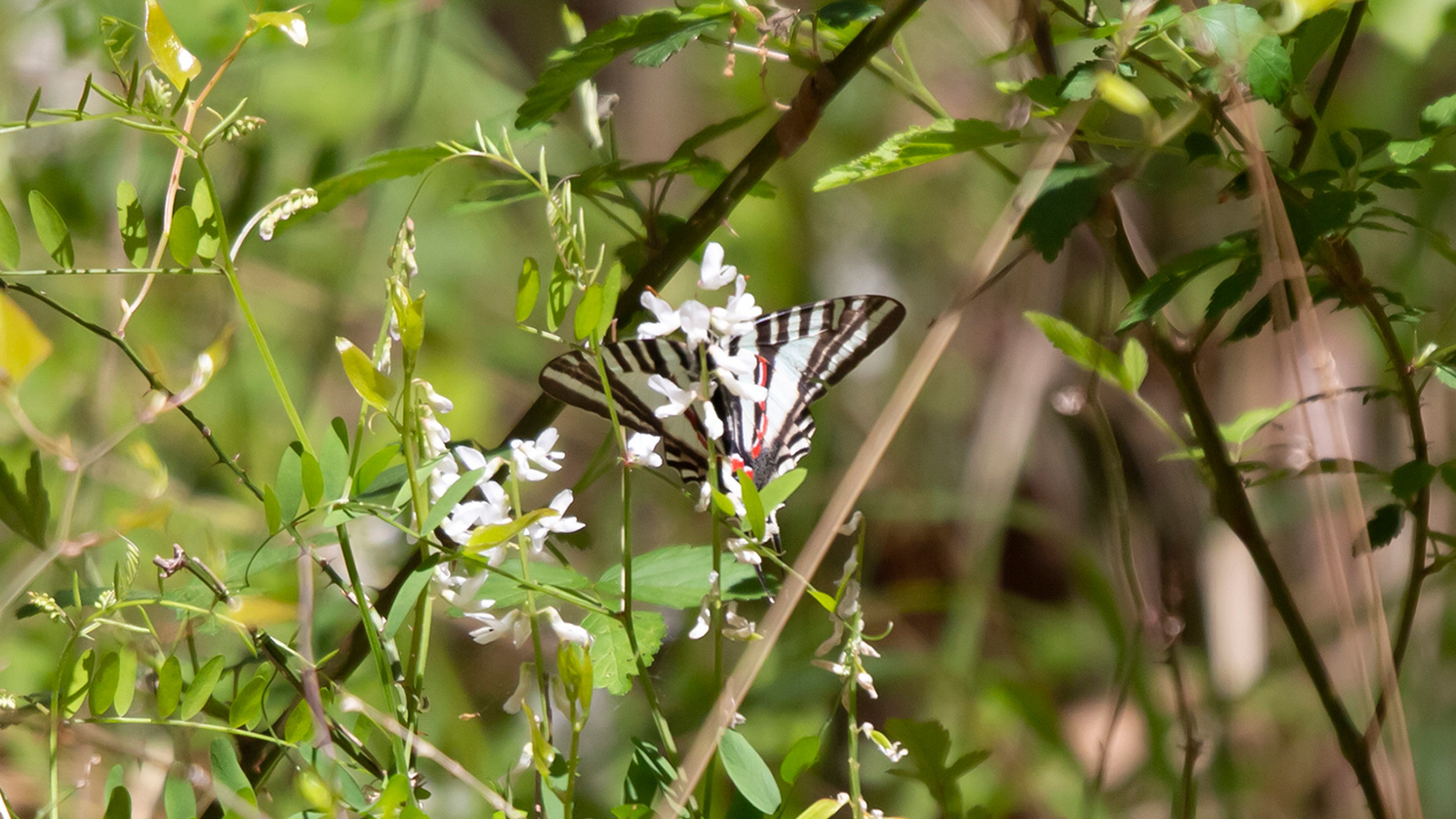
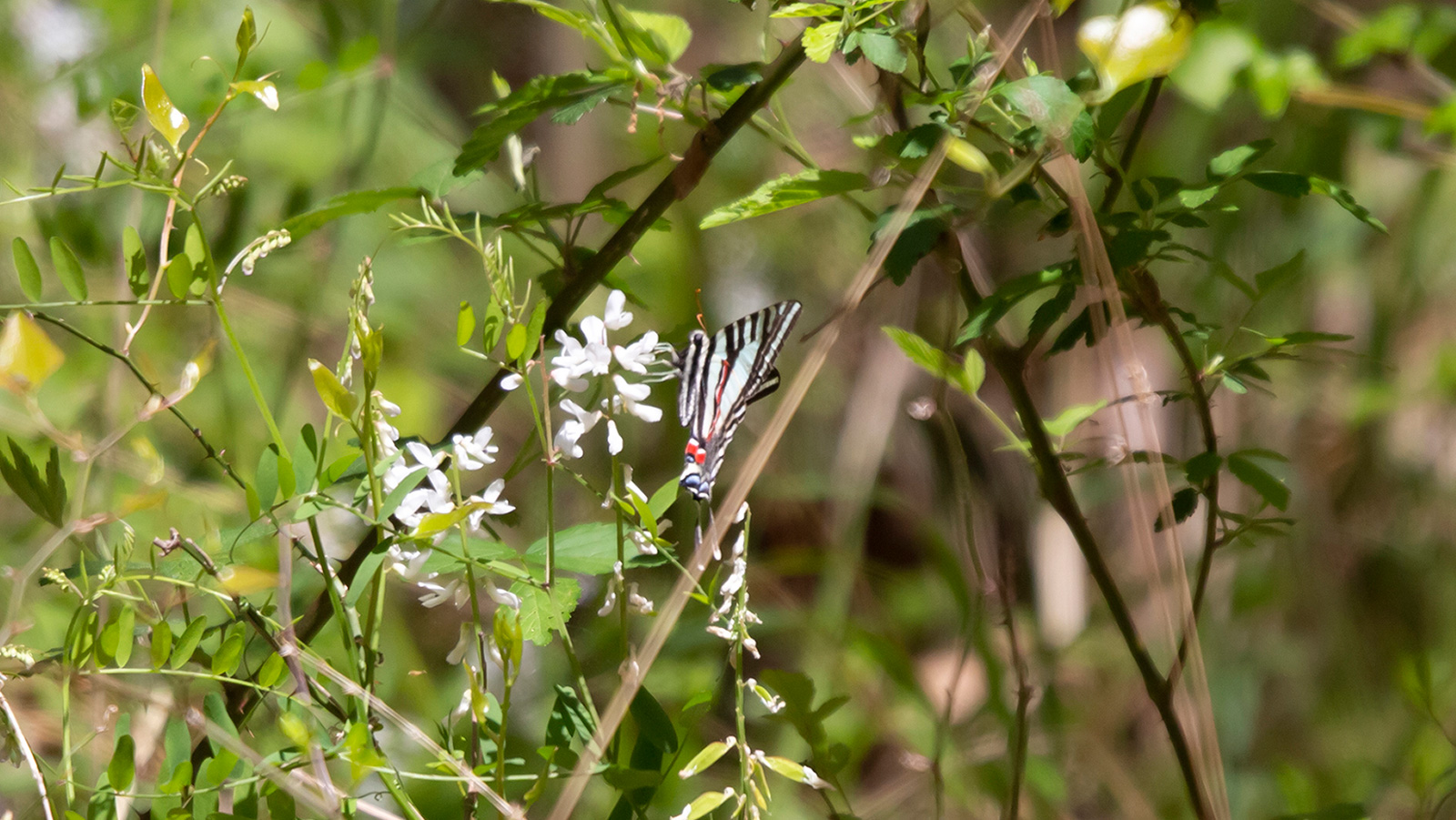
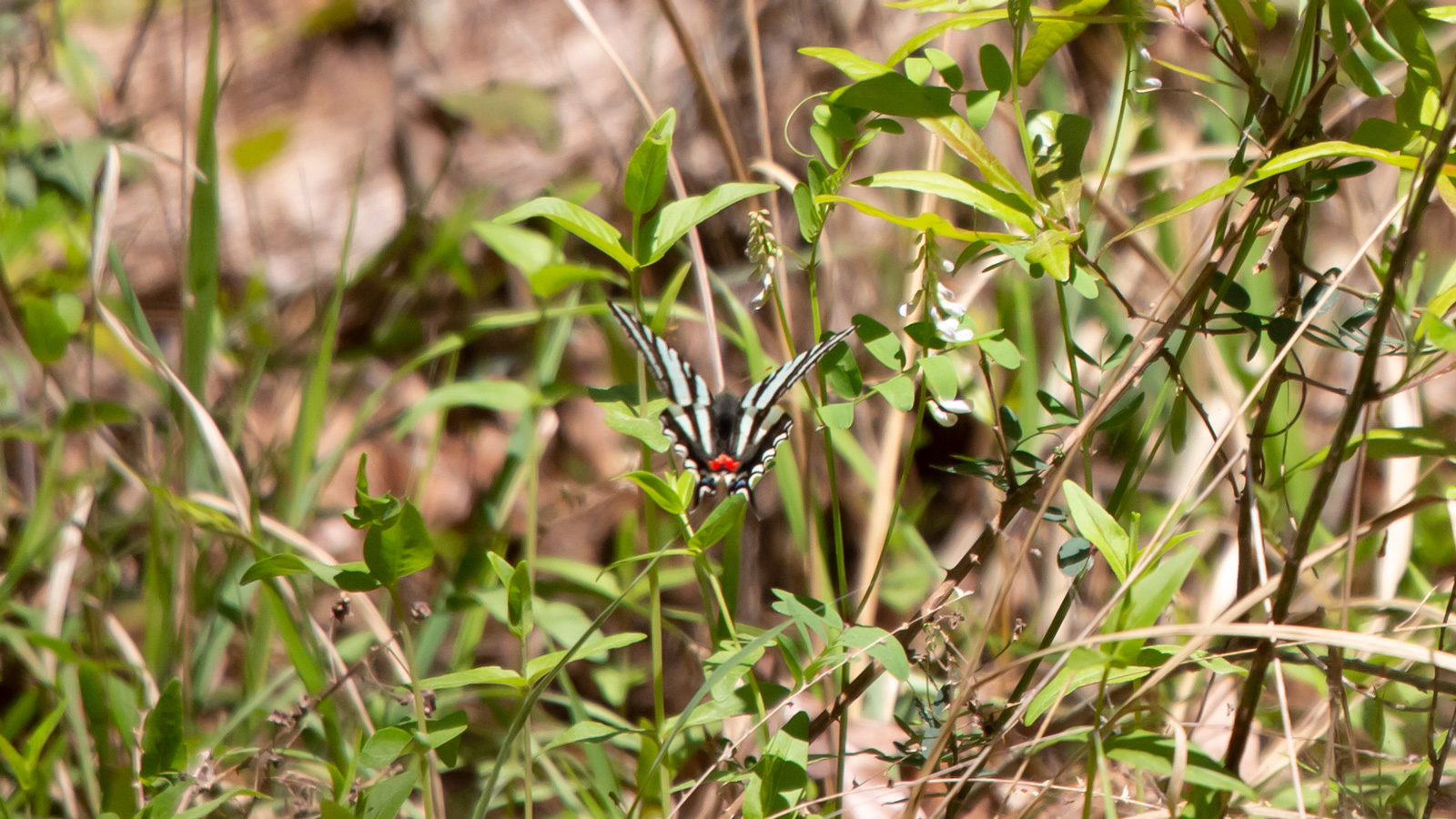
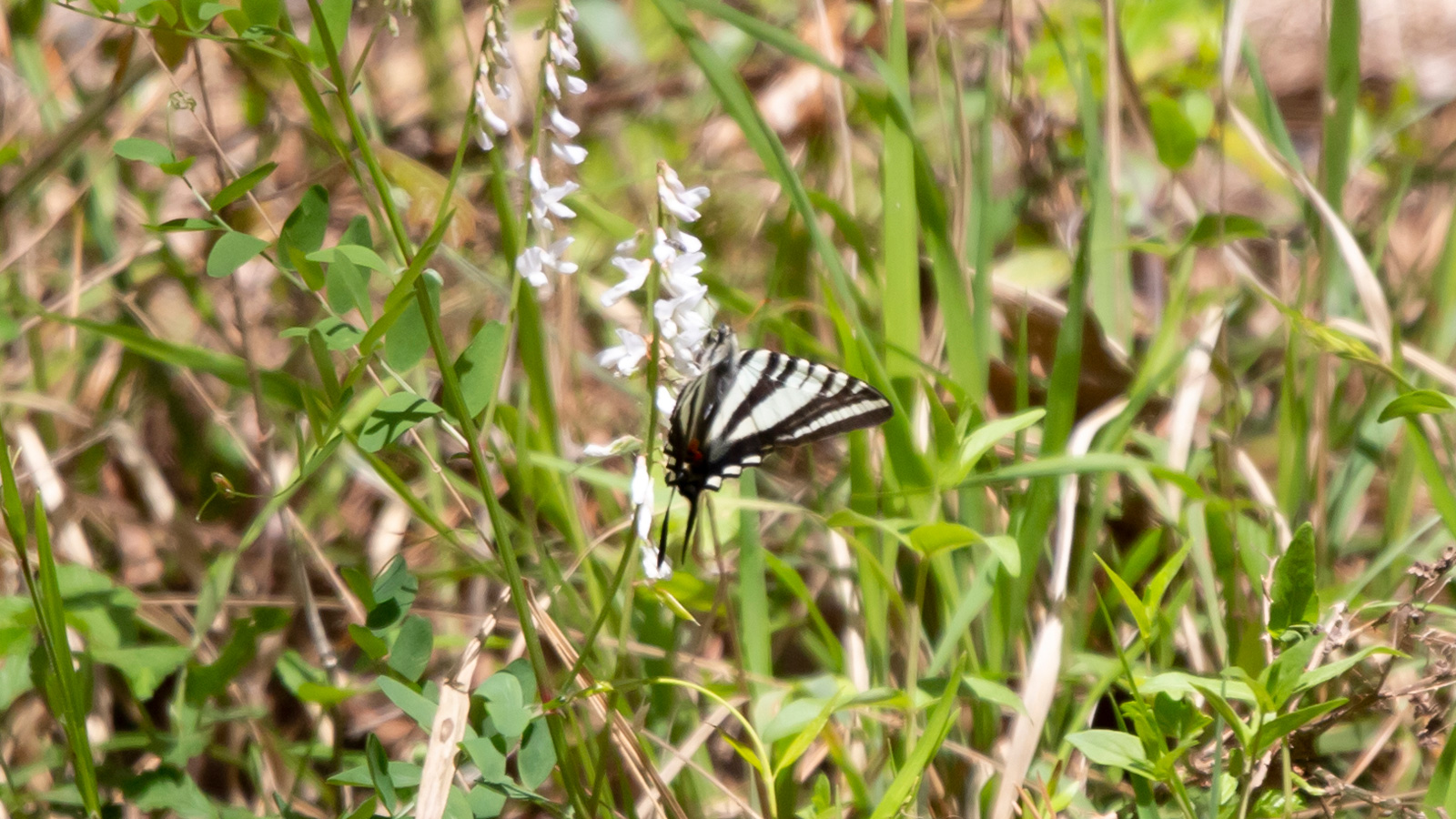
What Is the Zebra Swallowtail Often Confused With?
The adult reads immediately distinctive. Wingspan runs two and a half to three and a half inches, which runs smaller than the tiger swallowtail or giant swallowtail but large enough to register clearly from several yards. The wings are white with black zebra stripes running across the forewing and along the hindwing margin. A red stripe runs along the inner margin of each hindwing. The hindwing tails are the feature that settles identification: dramatically long, thin, and red-tipped on adults in good condition, longer relative to body size than any other North American swallowtail. Spring-form adults are smaller and paler than summer-form adults, with shorter tails and less red on the hindwing. Summer-form adults are larger, darker, and carry more extensive red coloration and longer tails. Both forms are identifiable as zebra swallowtails by pattern, but the size and color difference between generations runs large enough that first-time observers sometimes question whether they are the same species. They are. Papilio marcellus used to carry that name. Eurytides marcellus carries the current accepted name, reflecting the species' placement in a distinct genus from the Papilio swallowtails. The change does not affect identification. The underside mirrors the upperside pattern closely, with the additional red stripe on the hindwing underside more prominent than on the upperside. At rest with wings closed, the black and white striping from below still functions distinctive at close range. That caterpillar runs green with yellow and black transverse bands, stocky, and rests in the same false-eyespot posture as other swallowtail caterpillars. The markings are distinctive enough to identify from a photograph. Early instars are darker and less distinctly banded. The osmeterium runs yellow-orange. The zebra swallowtail draws no genuine confusion with any other North Louisiana butterfly at reasonable viewing distance. No other swallowtail in the region combines the black-and-white striping, the red inner hindwing stripe, and the dramatically long red-tipped tails. The identification ranks among the cleaner exercises in North Louisiana butterfly watching. At the population level, distinguishing spring-form from summer-form adults rewards noting in documentation records, as the two forms represent different brood periods and phenological documentation improves by recording form when known. Spring-form adults are smaller, paler, and shorter-tailed. Summer-form adults are larger, darker, and longer-tailed. The difference runs dramatic enough that photographs of the two forms from the same location in the same season clearly show two distinct-looking butterflies that share the same species identification.
Drag the handle left and right to compare Zebra Swallowtail side by side with the species it gets mistaken for most.
1 of 3
Advertisement
Accessibility
Accessibility
Public river access points along the Ouachita and Saline drainages, any maintained trail through bottomland hardwood forest in the central and eastern parishes, any road crossing over a bayou with moist bottomland on either side, these are the access points, and none of them require leaving pavement or prepared trail surface. Spring-form adults at early woodland wildflowers in April sit at eye level on native azalea and wild plum at forest margins along those same corridors. The trail through the bottomland serves as the access point. The pawpaw waits in the understory. The butterfly already lives there.
The zebra swallowtail rewards the naturalist who knows what the pawpaw looks like and where the bottomland forest begins. Both of those things are learnable in an afternoon. The butterfly waits at the end of the lesson.
Advertisement
Frequently Asked Questions
Does Zebra Swallowtail live in North Louisiana?
Yes. The tails are longer than any other North Louisiana swallowtail's, long enough that the butterfly looks like it trails ribbons, and the pattern runs clean enough that the identification resolves from across a yard before the butterfly lands. This narrow host plant dependency shapes the butterfly's distribution in North Louisiana: it flies and breeding in every parish where native pawpaw grows in riparian and bottomland forest understory, which across the 26 parishes includes most of the major river drainages and the moist upland woodland corridors connecting them.
Riparian corridors, bottomland hardwood forest edges, stream margins, and moist upland woodland with pawpaw in the understory throughout North Louisiana's 26 parishes.
How do you identify Zebra Swallowtail?
The adult reads immediately distinctive. Wingspan runs two and a half to three and a half inches, which runs smaller than the tiger swallowtail or giant swallowtail but large enough to register clearly from several yards. The wings are white with black zebra stripes running across the forewing and along the hindwing margin. A red stripe runs along the inner margin of each hindwing. The hindwing tails are the feature that settles identification: dramatically long, thin, and red-tipped on adults in good condition, longer relative to body size than any other North American swallowtail. Spring-form adults are smaller and paler than summer-form adults, with shorter tails and less red on the hindwing. Summer-form adults are larger, darker, and carry more extensive red coloration and longer tails. Both forms are identifiable as zebra swallowtails by pattern, but the size and color difference between generations runs large enough that first-time observers sometimes question whether they are the same species. They are. Papilio marcellus used to carry that name. Eurytides marcellus carries the current accepted name, reflecting the species' placement in a distinct genus from the Papilio swallowtails. The change does not affect identification. The underside mirrors the upperside pattern closely, with the additional red stripe on the hindwing underside more prominent than on the upperside. At rest with wings closed, the black and white striping from below still functions distinctive at close range. That caterpillar runs green with yellow and black transverse bands, stocky, and rests in the same false-eyespot posture as other swallowtail caterpillars. The markings are distinctive enough to identify from a photograph. Early instars are darker and less distinctly banded. The osmeterium runs yellow-orange. The zebra swallowtail draws no genuine confusion with any other North Louisiana butterfly at reasonable viewing distance. No other swallowtail in the region combines the black-and-white striping, the red inner hindwing stripe, and the dramatically long red-tipped tails. The identification ranks among the cleaner exercises in North Louisiana butterfly watching. At the population level, distinguishing spring-form from summer-form adults rewards noting in documentation records, as the two forms represent different brood periods and phenological documentation improves by recording form when known. Spring-form adults are smaller, paler, and shorter-tailed. Summer-form adults are larger, darker, and longer-tailed. The difference runs dramatic enough that photographs of the two forms from the same location in the same season clearly show two distinct-looking butterflies that share the same species identification.
What does Zebra Swallowtail eat?
What the Zebra Swallowtail Eats
Adults feed on nectar from a variety of flowering plants. Preferred nectar sources in North Louisiana include native blueberries and huckleberries in early spring, wild plum, redbud, native clovers, buttonbush, native thistles, and milkweed through summer and fall. Spring-form adults emerging in March and April frequently visit early-blooming native shrubs along woodland edges, including native azalea in the moist bottomland parishes. Summer-form adults range more widely and visit a broader range of flowering plants.
Adults also mud-puddle at stream margins and damp soil for minerals and moisture, with males more consistently observed at puddling sites than females. Stream sandbars and moist road margins in bottomland forest corridors are consistent puddling sites through the warm season. Caterpillars eat pawpaw foliage. The dependency runs essentially absolute. Zebra swallowtail caterpillars placed on plants outside the genus Asimina do not feed and do not survive without access to appropriate Asimina foliage.
The chemical compounds in pawpaw, acetogenins, accumulate in caterpillar tissues and provide some chemical defense to the caterpillar and possibly to the adult, though the degree to which adults are chemically defended compared to the pipevine swallowtail runs less well-established. The pawpaw acetogenins are toxic to many organisms at sufficient concentrations, and the caterpillar's diet presumably provides meaningful, if not absolute, chemical protection.
Is Zebra Swallowtail dangerous to people?
No. This species is not dangerous to people when it is observed without handling or disturbance
