Advertisement
Every October in North Louisiana, something large and yellow starts moving. Not a single butterfly, a sustained directional flow of large yellow butterflies heading southwest, day after day, following the same weather patterns and the same topographic corridors that channel monarchs and other fall migrants through the 26 parishes.
The cloudless sulphur migration lacks the monarch's celebrity and the American snout's spectacular numbers, but in terms of sheer sustained presence at roadside flowers on a clear October afternoon, it rivals both. Phoebis sennae comes through in quantity, moves with purpose, and stops at every native aster and goldenrod patch worth stopping at between Louisiana and wherever it ends up.
Phoebis sennae breeds throughout the Gulf South and tropical Americas, moving north in spring and south in fall in a migration cycle that brings adults through North Louisiana's 26 parishes from late April through November. In summer, residents breed on native sennas throughout the region.
In fall, migrants from farther north pass through in addition to local individuals, producing peak October concentrations at productive nectar sites. The species ranks among the most visually striking common butterflies in North Louisiana, large, saturated yellow, flight fast and purposeful, and present in numbers that make it impossible to miss at any open roadside with fall wildflowers in October.
What the Cloudless Sulphur Actually Looks Like
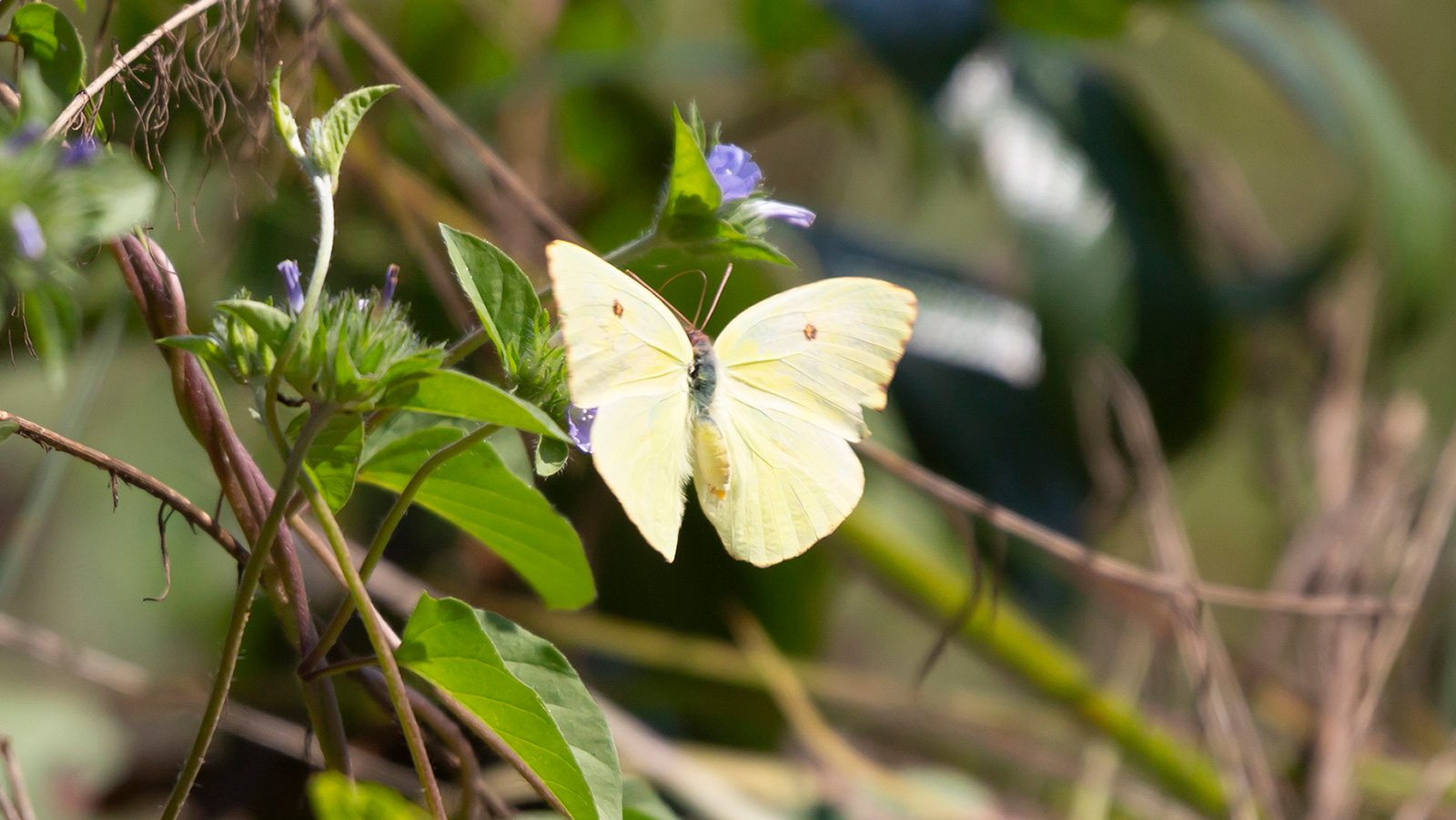
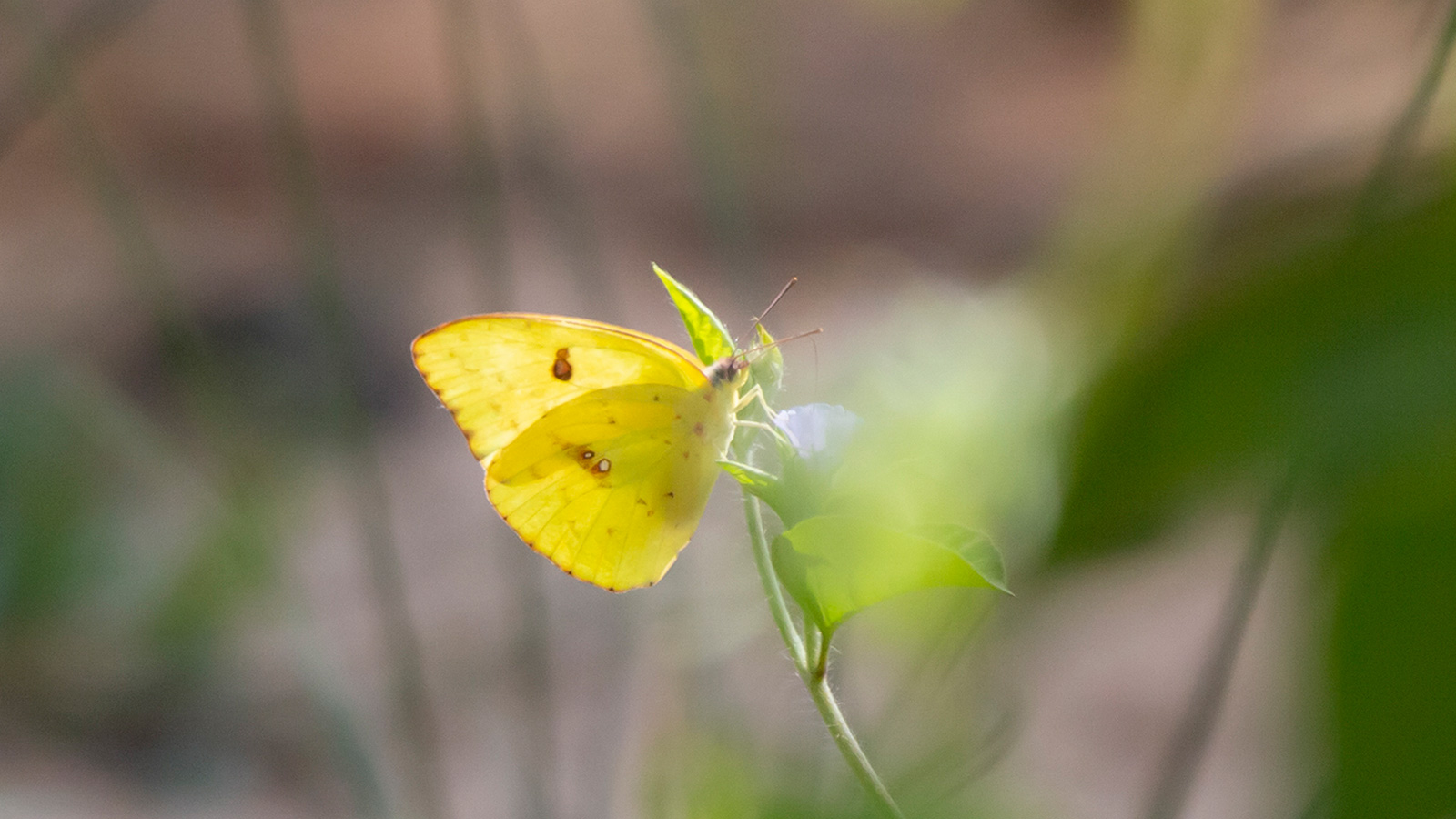
The adult spans two and a quarter to two and three-quarter inches, large for a sulphur, large enough to draw attention at distance before wing pattern detail becomes legible. The male upperside shows clean lemon-yellow with no markings, the most saturated single-color yellow of any North Louisiana butterfly. The female upperside shows yellow to greenish-yellow with a dark spot on the forewing and variable dark border markings, more heavily marked than the male.
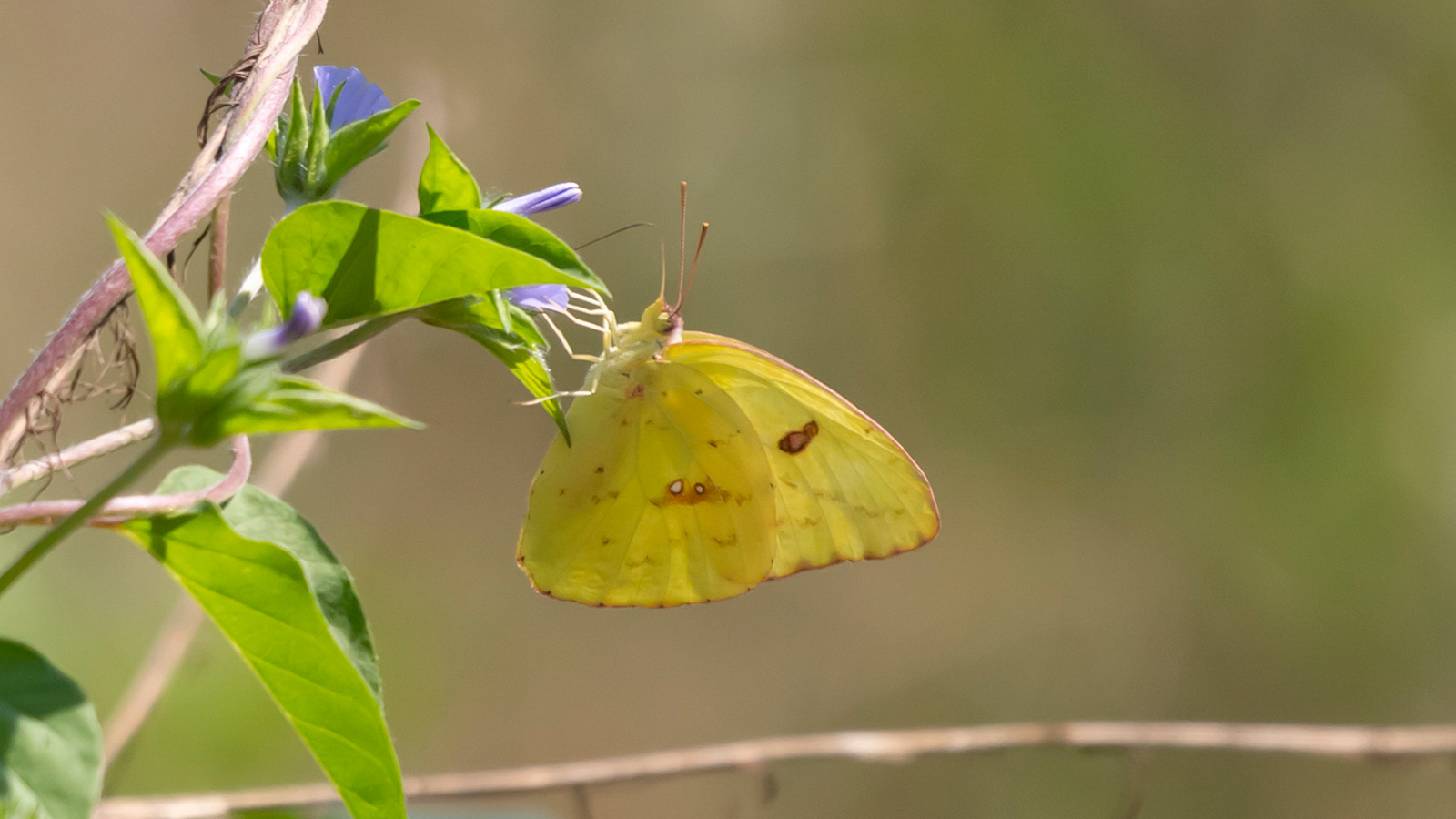
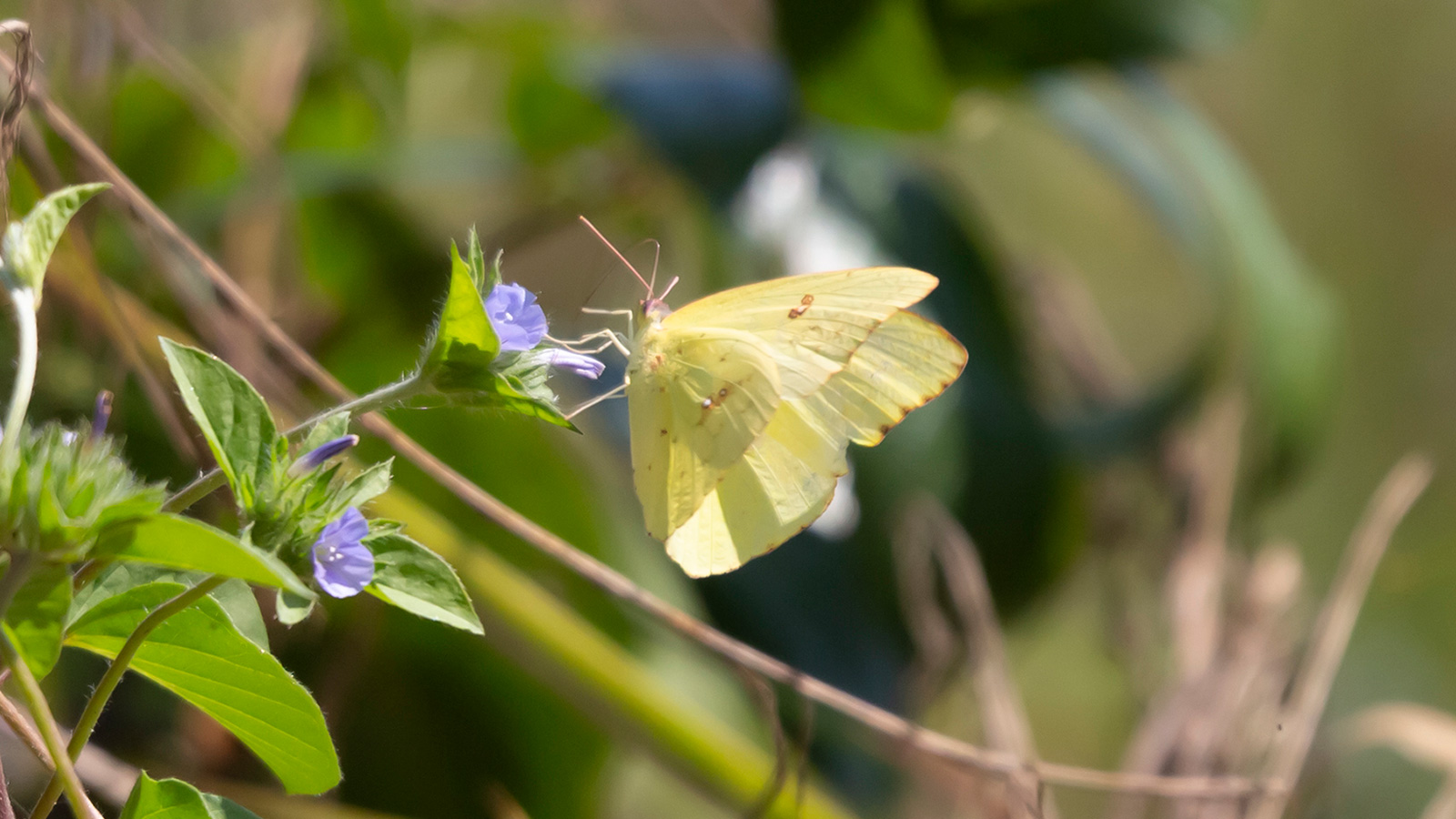
Underside, visible when the butterfly perches with wings closed, shows yellow with a single small silver-edged spot on the hindwing and variable pink or orange-edged markings in the female. The underside pattern in the female varies with seasonal form, fall individuals often show more extensive pink edging around hindwing underside marks than summer individuals.
In flight, the cloudless sulphur moves with a fast, powerful, direct stroke that looks different from the lighter, more bouncy flight of smaller sulphurs. A large yellow butterfly crossing a roadside at speed in October without stopping at every flower, moving consistently southwest: cloudless sulphur on migration.
Where the Cloudless Sulphur Lives
Open and semi-open habitats with native senna host plants throughout all 26 North Louisiana parishes. The species uses a broader range of open habitats for adult nectaring and migration staging than its caterpillar host-plant distribution suggests, adults range widely across any open habitat with productive nectar sources, appearing at roadsides, gardens, meadows, agricultural margins, and wetland edges far from any senna.
Host plants include wild senna, Senna hebecarpa, partridge pea, Chamaecrista fasciculata, and various other native Senna and Chamaecrista species throughout the 26 parishes. These plants grow in open, disturbed, and old-field habitats throughout the region, establishing freely in sunny margins and providing the host plant resource that female cloudless sulphurs seek for oviposition from May through October.
The caterpillar's yellow-and-green striped coloration provides camouflage against senna foliage, making caterpillar detection on the host plant the specific skill needed rather than general searching. Examining senna foliage closely in June through September for the distinctive striped caterpillar rewards the attention.
Advertisement
The Caterpillar's Year
Multiple broods in North Louisiana, with adults present from late April through November. The species does not maintain established populations through North Louisiana winters, breeding populations in the 26 parishes rebuild each spring from adults that wintered in Florida and along the Gulf Coast. First adults arrive in late April or early May as temperatures warm and senna foliage begins to grow.
Summer breeding generations cycle through June, July, and August, producing the resident population that feeds into fall. The fall migration through the 26 parishes adds northbound individuals moving south, increasing total adult numbers above resident population levels and producing the October concentrations at productive nectar sites.
Caterpillars feed on senna foliage, progressing through five instars. Early instars show yellow coloration with dark saddle marks. Later instars develop the yellow and green striped pattern with blue spots along the sides that matches mature senna foliage so well that the caterpillar disappears against the plant. The chrysalis, typically lime green with a pointed dorsal keel, attaches to senna stems and woody debris near the host plant.
What the Cloudless Sulphur Eats
Adults show strong preferences for tubular flowers they can probe with a long proboscis, native thistles, cardinal flower, native morning glories, bougainvillea in residential areas, and various other long-tubed flower species draw cloudless sulphurs consistently. This preference for deep-tubed flowers distinguishes adult feeding preferences from smaller sulphurs and blues that work short-tubed clover and aster flowers.
In fall migration, cloudless sulphurs fuel at whatever flowers appear along the migration route, including native asters, goldenrod, and native clovers that do not match peak preference but provide available calories at productive sites. A fall aster patch draws a mix of butterfly species including cloudless sulphurs stopping to fuel before continuing the migration, those adults hold longer than average because fueling needs override flower preference during migration.
Adults also mud-puddle at wet soil for minerals and moisture, with males gathering at productive damp sites through the warm season.
What Eats the Cloudless Sulphur
Large size makes cloudless sulphurs a better energy return than small butterflies for aerial predators that successfully pursue them. Eastern kingbirds take adults in open flight. Loggerhead shrikes impale adults at exposed perch sites. The fast, powerful flight of the cloudless sulphur makes it harder to catch than its size would suggest, and the direct, fast migration flight in October generates fewer interception opportunities than slow, circling territorial or nectaring flights.
The bright yellow upperside provides no cryptic protection. The cloudless sulphur does not attempt camouflage, it moves fast and counts on speed over concealment. Adults at flowers provide stationary targets for crab spiders and ambush predators, which represent the primary predation risk during the nectaring phase.
Caterpillars rely on their senna-matching camouflage for protection. The yellow-and-green striped pattern against senna foliage makes visual detection difficult from above or the side. Parasitoid wasps and tachinid flies locate caterpillars by chemical cue, bypassing the visual camouflage.
Advertisement
Telling the Cloudless Sulphur from Other Large Sulphurs
The cloudless sulphur's combination of large size and clean, unmarked yellow upperside in the male distinguishes it from every other North Louisiana sulphur. No other yellow butterfly in the 26 parishes approaches the cloudless sulphur's size and saturation simultaneously.
Orange sulphurs and clouded sulphurs both show orange or darker yellow with black borders. The southern dogface shows a distinctive dog-head forewing pattern. Female cloudless sulphurs with heavier border markings draw more comparison to female orange sulphurs, but the size difference, cloudless sulphur meaningfully larger, settles most borderline calls.
In flight, the powerful, direct, fast wingbeat of the cloudless sulphur distinguishes it from the lighter, more fluttering flight of smaller sulphurs. An observer who has watched cloudless sulphurs in fall migration and has seen clouded and orange sulphurs at clover patches in summer calibrates the size and flight difference automatically and identifies the cloudless sulphur in flight before any wing pattern becomes legible.
The Fall Migration
October represents the cloudless sulphur's peak period in North Louisiana. Adults from as far north as the mid-Atlantic states and the Midwest funnel through the Gulf Coast states in September and October, joining North Louisiana's resident breeding population in a sustained southwest movement. The concentration of migrants at productive nectar sites, particularly native thistles and native morning glories, produces some of the most accessible large-butterfly observation available in the region in fall.
At a productive native thistle stand at a North Louisiana roadside in mid-October, cloudless sulphurs arrive from the northeast, fuel briefly, and depart to the southwest in a pattern that makes directional migration obvious from a fixed observation point. Five minutes at such a site distinguishes resident behavior, adults that circle the patch and return, from migrant behavior, adults that fuel and depart on a consistent southwest heading without returning. Both behaviors happen simultaneously at peak sites.
Migration responds to the same cold front weather patterns that drive monarch movement. Clear days following cold front passages produce the highest migrant density at productive nectar sites, with adults moving in number on the favorable winds that follow the front. Monitoring weather forecasts for cold front passages in late September and early October and positioning at a productive thistle or morning glory patch on the clear day following a front produces the best cloudless sulphur migration observation available in North Louisiana.
Cloudless Sulphurs and Native Plants
Tubular flower preference makes cardinal flower, Lobelia cardinalis, and wild morning glories among the most effective native plants for drawing adults to garden settings in the 26 parishes. Both plants grow readily in North Louisiana conditions and bloom through the period of peak cloudless sulphur activity, cardinal flower from July through September, wild morning glories from June through October.
Native senna species for caterpillar support: partridge pea, Chamaecrista fasciculata, grows readily as an annual in sunny, sandy soil throughout the 26 parishes and establishes freely from seed in disturbed ground. Wild senna, Senna hebecarpa, grows as a perennial in similar conditions. Both species establish in garden borders, sunny margins, and old field edges without intensive management, producing the host plant resource that keeps cloudless sulphur breeding populations active at garden sites throughout the warm season.
That combination of native senna for caterpillars and native morning glories or cardinal flower for adults at the same site creates a complete cloudless sulphur support system that a residential property can provide without any specialized management beyond planting the right species and leaving them alone.
Advertisement
The Cloudless Sulphur in North Louisiana's Open Landscape
Large size, saturated color, and fast direct flight makes it one of the most visually commanding butterflies in North Louisiana's open habitats through the summer and fall. At a rural roadside in October with native thistles in bloom, the cloudless sulphur appears at scale, large enough to track easily from fifty feet, yellow enough to read clearly against any background, fast enough to look purposeful rather than random. No other North Louisiana butterfly of comparable size generates that same visual impression of something with somewhere specific to go.
That impression reflects a real biological reality. Cloudless sulphurs on fall migration follow wind patterns, topographic corridors, and nectar availability along routes that the species has maintained through this region for as long as the Gulf Coast has provided winter refuge and the southeastern flower belt has provided summer breeding habitat.
That October cloudless sulphur at the North Louisiana thistle patch spent the summer somewhere north, bred on senna somewhere between Louisiana and Ohio, and now moves southwest toward a coast that the individual has never seen but finds anyway.
Navigation works on some combination of sun compass orientation and inherited directional preference that researchers have studied but not fully resolved. The sulphur does not appear concerned about the incomplete understanding.
The Cloudless Sulphur as a Weather Indicator
Experienced North Louisiana naturalists learn to use cloudless sulphur migration activity as a phenological indicator for fall weather and migration timing. High cloudless sulphur numbers at productive roadside nectar sites in October correlate with the same cold front passages that drive monarch concentrations, clear, northwest winds following a front push migrants south faster than calm conditions, and the day after a front often produces the most concentrated migration activity of the week.
A simple field observation: count cloudless sulphurs at a productive roadside thistle patch for fifteen minutes on clear mornings in October. Counts above twenty per fifteen minutes indicate active migration movement at that site. Counts below five indicate light movement or predominantly resident activity. The pattern across days, high counts following fronts and lower counts between fronts, tracks fall migration phenology at a specific North Louisiana location without any instrumentation beyond a timer and a clicker.
That field observation connects the cloudless sulphur's biology directly to North Louisiana's fall weather patterns in a way that makes the butterfly a living phenological instrument. When the sulphurs move in numbers, the season has shifted. When they stop, the resident population has departed and winter approaches the 26 parishes.
Partridge Pea: The Native Annual Every North Louisiana Yard Should Have
Partridge pea, Chamaecrista fasciculata, does three things simultaneously that most native plants do not: it feeds cloudless sulphur caterpillars, it feeds cloudless sulphur and orange sulphur adults with nectar-rich flowers, and it fixes nitrogen in the soil as a legume, improving soil conditions for surrounding plants.
It does all of this as a native annual that reseeds itself freely in sunny, sandy or loamy soil throughout all 26 North Louisiana parishes, needs no watering once established, reaches knee-to-waist height by August when it blooms most heavily, and costs almost nothing to establish from seed.
Every North Louisiana open garden, every roadside restoration project, every sunny disturbed margin in the 26 parishes that gets a handful of partridge pea seed in early spring acquires cloudless sulphur breeding habitat without any additional management. The plant does the work. The sulphurs find it. The nitrogen improvement happens quietly below ground. That amounts to an excellent return on a seed packet.
Wild senna, Senna hebecarpa, provides a perennial alternative to partridge pea's annual cycle at sites where a permanent senna planting serves better than annual reseeding. Both species grow freely in the 26 parishes, both support cloudless sulphur caterpillars, and together they extend senna availability through a broader range of soil and light conditions than either species alone covers.
Advertisement
Watching the Migration
The best cloudless sulphur migration watching in North Louisiana concentrates at sites that combine three features: native thistles or other long-tubed flowers in bloom, open topography that funnels moving butterflies rather than dispersing them, and exposure to the northwest that produces the directional wind assistance following cold front passages.
Rural roadsides in the northern and central upland parishes, where native thistles persist in unmowed margins and the terrain provides some topographic channeling along ridgelines, produce better migration concentration than flat bottomland sites where migrants disperse evenly across the open landscape. Finding a productive thistle stand at a narrow topographic pinch point in the upland parishes and checking it on clear October mornings for three or four days following a cold front passage delivers the most intense cloudless sulphur migration experience available in North Louisiana.
In the bottomland parishes, river levees and elevated roadsides that run perpendicular to the southwest migration direction concentrate passing adults at the elevated corridor, particularly when those features carry blooming goldenrod or native asters at the crest. Any elevated linear feature running northeast to southwest in the agricultural bottomland parishes that carries fall wildflowers provides a productive migration observation corridor in October.
The Cloudless Sulphur and the North Louisiana Senna Network
Senna and partridge pea grow throughout North Louisiana's open habitats in a distribution that covers all 26 parishes wherever sun reaches disturbed soil. Old fields, highway margins, pine savanna openings, agricultural edges, and residential sunny borders all carry these plants in the 26 parishes without any management input. The cloudless sulphur finds that distributed network of host plants each spring and breeds at productive sites through the summer without concentrating at any particular location.
That distributed breeding, spread across hundreds of senna patches throughout the region, produces the summer resident population that swells with fall migrants to create October's abundance. No single senna patch makes the North Louisiana cloudless sulphur population. The network of patches across all 26 parishes does.
For observers who want to understand the species across a season rather than just at the fall migration peak: find a productive senna or partridge pea stand in June and watch it through August. Eggs on the foliage in June, caterpillars developing through July, chrysalises in August, adults emerging and nectaring at the senna flowers while females oviposit on the same plants.
That complete cycle at a single senna stand through the summer delivers the species' North Louisiana biology more completely than any October roadside observation, however dramatic the October numbers become.
Documentation Value
Cloudless sulphur observations from North Louisiana contribute most meaningfully to the regional record at two ends of the seasonal window: first spring arrivals in late April and early May, which document the recolonization timing from southern wintering populations, and last fall migrants in November, which document how late the migration extends into the fall season at specific sites in the 26 parishes.
The peak October migration period generates abundant observations automatically, observers at productive nectar sites in October submit cloudless sulphur records without any specific documentation effort. The early-season and late-season endpoints of the annual cycle receive less attention and provide more information per observation about how North Louisiana's climate and landscape position affect the species' seasonal timing.
An iNaturalist observation from a Louisiana cloudless sulphur on November 10th at a native aster patch in any of the northern parishes documents the end of the species' season at that latitude. An observation from late April at a highway margin partridge pea patch documents the beginning. Both endpoints matter to the regional phenological record. The October peak, however spectacular, documents what anyone standing at a roadside thistle already knew was happening.
Advertisement
The October Commitment
North Louisiana's status as prime cloudless sulphur migration real estate comes down to geography: the 26 parishes sit at the latitude where fall migration concentrates before the final push across the Gulf Coast into Florida and the Gulf States' winter range. Migrants from as far north as Virginia and Missouri funnel through Louisiana in October, and the state's east-west width provides a long corridor of potential nectar resources that concentrations use before the final leg of the journey.
An October morning at a productive North Louisiana thistle stand delivers numbers that feel disproportionate to the season, this many large yellow butterflies, moving with this much purpose, at a roadside that most drivers pass without slowing, belongs to a migration system that spans the continent even if the roadside itself spans only a few hundred feet.
The scale of the event visible at the thistle patch and the scale of the event happening across the eastern half of North America in that same October window belong to the same species making the same annual decision.
That continental commitment made at individual scale, each cloudless sulphur navigating southwest on its own inherited program, produces the roadside spectacle that makes October the best month for cloudless sulphur watching in North Louisiana. The 26 parishes provide the flowers.
The sulphurs provide the direction and the urgency. Neither party required any particular coordination with the other to produce the arrangement. Both arrived at it independently, over millions of years, and the October roadside thistle stand represents where both decisions converge simultaneously for anyone willing to stand at the edge of the field and count.
Every October Without Exception
The cloudless sulphur migration through North Louisiana does not skip years. Cold years, warm years, wet years, dry years: the October movement happens on the same schedule, driven by day length more than temperature, shifting a few days earlier or later with weather but maintaining its overall position in the calendar regardless of what that specific October brings. The 26 parishes have received this migration every October since the thistles and the morning glories and the sennas established here, and they will receive it every October after this one.
Standing at a productive site in mid-October with the northwest wind picking up and the clear sky from a front the day before: that experience belongs to anyone who shows up at the right place on the right day in North Louisiana. The thistle does not move. The front delivers the clearing. The cloudless sulphur delivers itself, large and saturated yellow and fast, headed somewhere it has never been but knows how to find. Every October. Every parish. Without missing.
The sulphur does not pause at the parish line. It does not check whether the thistle at the next stop qualifies as native. It moves southwest because it moves southwest, the same direction every October individual moves, and North Louisiana's 26 parishes sit in the path of that movement every year.
Native thistles, morning glories, and partridge pea along those roadsides convert the movement to a visible event at each productive stop. Every observer who shows up at the right thistle stand in the right October week participates in something that scaled continent-wide and arrived at their particular roadside without any special arrangement with them specifically. The sulphur was coming through regardless. The observer just showed up at the intersection.
Every October. All 26 parishes. The thistle and the sulphur, same arrangement, every year. Without fail. The only part that never varies. The October roadside delivers.
In all 26 North Louisiana parishes, every fall, on the day after the front clears, the cloudless sulphur crosses the road headed southwest and lands briefly at the thistle on the way. That covers the whole arrangement. It holds.
Every October. Every roadside thistle worth stopping at. Every one of the 26 North Louisiana parishes that still has open land with fall wildflowers in the margin, which as of this writing means all of them, and the cloudless sulphur passes through every single one going southwest like it always has, like it will next October too, without pausing to inform anyone of the schedule. The deal holds. Without exception. Without schedule posted. The sulphur comes through. North Louisiana provides the flowers and the corridor. Both sides keep their end.
The cloudless sulphur at the October roadside thistle: large, saturated yellow, moving southwest on a schedule built from day length and continental geography rather than anything visible in the individual butterfly. That schedule produces the same October event in North Louisiana's 26 parishes every year without variation in the timing or the direction, only in the numbers that any given year's breeding season delivers to the migration stream. Show up at the thistle in October. The rest arrives on its own.
Every October. All 26 parishes. The thistle and the sulphur, same arrangement, every year. The sulphur was coming through regardless of whether anyone arrived to watch.
The sulphur arrives at the October thistle on its own schedule, headed southwest, fueling at whatever North Louisiana provides along the route. The 26 parishes provide. The sulphur moves on.
Advertisement
Accessibility
The cloudless sulphur in fast directional migration flight produces an audible wingbeat at close range — a clean, regular stroke that differs from the lighter flutter of smaller sulphurs and from the rowing flap of monarchs at the same roadside sites. At productive fall nectar sources, particularly native thistles and morning glories at North Louisiana roadside margins, migrating adults refueling before continuing southwest produce repeated landings and brief wing-open postures that allow clear views of the yellow upperside at arm's length from a standing observer on maintained road surface.
At mud-puddling sites — damp clay road shoulders and stream crossings throughout the 26 parishes — adults hold for extended periods at ground level, showing the underside silver spot and the forewing spot at close range. Any native thistle stand, cardinal flower planting, or wild morning glory at a maintained North Louisiana roadside from May through November holds cloudless sulphur adults from the resident breeding population and, in October, migrating individuals from farther north. Both categories appear from road-shoulder level without requiring any access beyond a parking spot.
More Information
The North American Butterfly Association at naba.org maintains Louisiana identification resources. Journey North at journeynorth.org tracks cloudless sulphur migration reports during fall movement periods alongside monarch and other migratory species. iNaturalist accepts cloudless sulphur observations from all 26 North Louisiana parishes with expert Lepidoptera review. Butterflies and Moths of North America at butterfliesandmoths.org carries Louisiana range data.
META TITLE: Cloudless Sulphur Butterfly in North Louisiana | NLW
META DESCRIPTION: The cloudless sulphur migrates through North Louisiana every October in large numbers. Large, clean yellow, fast direct flight. Breeds on native senna. Peaks at fall flowers before heading southwest.
FOCUS KEYPHRASE: cloudless sulphur butterfly North Louisiana
SECONDARY KEYWORDS: Phoebis sennae Louisiana, cloudless sulphur migration, large yellow butterfly Louisiana, cloudless sulphur identification, cloudless sulphur senna, fall butterfly migration North Louisiana, cloudless sulphur October, sulphur butterfly Louisiana, yellow butterfly migration Gulf South
OG DESCRIPTION: The cloudless sulphur breeds on senna throughout North Louisiana and migrates southwest in large numbers every October. The biggest yellow butterfly in the region. Fast, purposeful, and hard to miss at fall flowers.
SLUG: cloudless-sulphur-north-louisiana
Photo Gallery

Advertisement
Accessibility
## Accessibility
The cloudless sulphur in fast directional migration flight produces an audible wingbeat at close range — a clean, regular stroke that differs from the lighter flutter of smaller sulphurs and from the rowing flap of monarchs at the same roadside sites. At productive fall nectar sources, particularly native thistles and morning glories at North Louisiana roadside margins, migrating adults refueling before continuing southwest produce repeated landings and brief wing-open postures that allow clear views of the yellow upperside at arm's length from a standing observer on maintained road surface.
At mud-puddling sites — damp clay road shoulders and stream crossings throughout the 26 parishes — adults hold for extended periods at ground level, showing the underside silver spot and the forewing spot at close range. Any native thistle stand, cardinal flower planting, or wild morning glory at a maintained North Louisiana roadside from May through November holds cloudless sulphur adults from the resident breeding population and, in October, migrating individuals from farther north. Both categories appear from road-shoulder level without requiring any access beyond a parking spot.
Advertisement