Advertisement
Fun Facts
Did You Know?
The dark-eyed junco (Junco hyemalis) arrives in North Louisiana every fall like a weather forecast with feathers.
If This Animal Could Talk...
"Look at my habitat, season, and behavior first. Those clues tell you what I am before you need a close-up."
The dark-eyed junco (Junco hyemalis) arrives in North Louisiana every fall like a weather forecast with feathers. The bird breeds across Canada and the northern United States, nests on the ground in boreal and montane forests, and heads south when the temperature drops, landing in North Louisiana somewhere between mid-October and early November and staying until April. Generations of Southerners called the bird "snowbird" long before anyone consulted a field guide, and the name stuck because the timing never missed. Cold front rolls through, juncos show up at the feeder, and everybody digs out a jacket. The bird did not cause the weather. The bird just read the calendar better than most people. North Louisiana gets the slate-colored form almost exclusively, the subspecies group that wears dark gray above and clean white below with a pink bill and white outer tail feathers that flash during takeoff and landing. Other forms exist across the continent (Oregon, pink-sided, gray-headed, white-winged, and the Guadalupe Mountains form), and occasional Oregon juncos turn up in North Louisiana during winter, but the slate-colored bird dominates the winter flocks here by a margin that makes every other form a conversation piece rather than an expectation. A junco at your feeder in Ruston, Natchitoches, or Monroe almost certainly wears the slate-colored uniform. The Oregon form dressed in a dark hood with rusty sides would stand out as a tourist, which, technically, it would be. If you find one, photograph it, because the next birder who sees your photo will want to know exactly where you were standing. The Bird in the Tuxedo's Shadow Dark slate-gray from the head through the back, wings, and tail. Clean white belly. Where the dark upper parts meet the white belly, the line sits sharp and obvious, giving a two-toned look that birders call "the bird wearing a hood" and non-birders describe as "that gray and white thing at the feeder." One glance at the underside from any angle settles it. That pink bill pops against the dark face in a way no other winter sparrow's bill does. Every other sparrow-shaped bird at the feeder wears a bill that blends into the head coloring: song sparrow's dark bill against a brown face, white-throated sparrow's grayish bill against a streaked head. A small bird with a pink bill hopping under the feeder in December? Junco. Nothing else at ground level matches that combination. White outer tail feathers flash during every takeoff, every landing, and every flushed departure. A junco feeding on the ground shows no white in the tail. A junco launching from the ground fans the tail and exposes the white outer feathers in a flash that looks like someone flicked a white lighter in the underbrush. A flock flushing from a brushpile lights up with white tail flashes that give away the whole group from fifty yards before any individual resolves into focus. White on takeoff, invisible on the ground. Same trick the pine siskin pulls with yellow wing stripes: visible when active, hidden when still. Females and first-year birds wear a slightly paler gray than adult males, trending toward brownish-gray on the back and flanks rather than the clean charcoal of the breeding male. Within a winter flock, some birds look dark as wet pavement, others closer to dishwater, and the temptation to sort them by sex based on shade intensity gives you an exercise that stays educational and never reaches reliable. A very dark bird? Probably adult male plumage. A very pale bird? Probably female or immature plumage. Everything in between earns a shrug and a note that says "junco, gray, moved on." About five and a half to six and a quarter inches, roughly the same size as a chipping sparrow, slightly smaller than a song sparrow. Round body, short tail relative to the body, and a habit of hopping rather than walking that gives the junco a compact, bouncy look on the ground no other winter sparrow quite matches. A chipping sparrow moves with a nervous quickness. A white-throated sparrow moves with a deliberate heaviness. The junco hops with the energy of a bird that just remembered something important on the other side of the yard. The Smacking Sound and the Trill A sharp, metallic "tik" from the brushpile means juncos. That chip note carries a slight metallic ring that sets it apart from the chipping sparrow's drier chip and the song sparrow's softer "chimp." A brushpile producing sharp "tik" notes in December contains juncos, and you can bet on that before the binoculars come up. When those "tik" notes speed up and stack on top of each other, the flock just noticed something the birder did not see yet. Quiet brushpile to rapid "tik-tik-tik" means hawk, cat, or you stepped too close. On the rare occasion a junco sings in North Louisiana, the song comes out as a simple musical trill on one pitch. Late March and early April occasionally produce singing juncos as the hormonal clock starts ticking before the bird departs, and a junco delivering the breeding trill from a Ruston backyard in late March sounds like a chipping sparrow that took voice lessons and came back with better tone. The trill rings cleaner, carries more music, and lasts slightly longer than the chipping sparrow's dry mechanical rattle. The similarity between the two trills trips people up in early spring, but the junco's version carries a sweetness the chipping sparrow's version never approaches. A softer, high-pitched "tsee" note passes between flock members during relaxed feeding. The "tsee" barely carries beyond ten or fifteen feet and works as a whispered roll call: still here, still feeding, still fine. If you can hear the "tsee," you already stand close enough that the birds know you exist and decided you did not warrant the louder alarm chip. Congratulations. The junco granted a security clearance by continuing to whisper. Not many birds do that. The Ground Game Juncos feed on the ground. No qualifier needed. While other birds split time between feeders, branches, and ground, the junco commits to the ground with a dedication that borders on philosophical. Seeds that fell from the feeder, seeds that fell from the grass, seeds that fell from the weed stalk: the junco works the lowest available surface and lets the other birds argue about the perches above. If a seed touched dirt, the junco claimed it. Both feet kick backward at the same time, clearing leaf litter and exposing seeds underneath. The motion looks like the bird tried to start a tiny motorcycle and the motorcycle did not cooperate. That double-scratch repeats every few seconds, and a junco working through leaf litter under an oak tree makes a rhythmic scratching sound you can hear from behind the tree before you see a thing. The scratching sounds lighter than a fox sparrow's excavation and heavier than a chipping sparrow's surface-picking, and the rhythm stays steady enough that you could set a metronome to it if anyone made a metronome that small. A fox sparrow scratches louder, a towhee scratches harder, but the junco scratches more often per minute than either one. The dedication to the scratch exceeds the body weight by a factor the bird never calculated. Ragweed, crabgrass, foxtail, pigweed, and smartweed seeds make up the wild portion of the winter menu. Millet, cracked corn, and black oil sunflower seeds that hit the ground from the feeder make up the feeder portion. Because the junco feeds on the ground, platform feeders and ground-scattered seed beat tube feeders and hanging feeders for attracting the bird every time. A tube feeder full of sunflower seed draws house finches and goldfinches to the perches. The same seed scattered on a tray two inches off the ground draws juncos to the tray. The bird wants the food where the bird already planned to be: on the ground, kicking leaves. A homeowner who hung a tube feeder and wondered why the juncos ignored it designed a restaurant on the second floor for a customer that only eats on the first floor. Insects supplement the seed diet during early fall arrival and late spring departure, when bugs still crawl and the junco still eats them. Beetles, caterpillars, ants, and spiders get picked from the ground and from low vegetation during the warmer weeks of the winter window. The protein boost peaks in March and April, when every calorie counts and the junco eats whatever the habitat offers. A junco gleaning insects from a Ouachita Parish lawn in March fuels the flight north that a junco eating ragweed seeds in January kept alive long enough to attempt. Juncos visit gravel driveways, dirt road shoulders, and exposed soil patches to pick up small stones that help the gizzard grind food. A small gray bird hopping along a gravel driveway in Union Parish in January got there through dietary need, not curiosity. The gravel works as a blade. The bird works as its own food processor. Winter Real Estate Forest edges, brushy field margins, hedgerows, suburban yards with shrub borders, overgrown fencerows, and the weedy margins of agricultural fields all support wintering junco flocks. Every one of those habitats shares one feature: ground-level access to seeds under some form of overhead cover. The bird avoids open ground with no cover nearby, avoids dense closed-canopy forest with no understory, and avoids manicured lawns where the landscaping crew removed every weed the junco planned to eat. The ideal junco habitat looks like the yard the neighbors wish you would clean up: a brushpile in the corner, some dead leaves under the hedge, a few weedy patches along the fence, and a feeder that drops seed on the ground. Winter flocks range from a dozen to several dozen birds, and a productive feeding area may attract flocks that overlap and merge into loose groups of fifty or more juncos scattered across a hundred-yard stretch of habitat. No tight formation, no coordinated movement. Individual birds maintain spacing of a few feet while feeding, closing ranks when flushed and spreading back out when the alarm passes. The flock structure resembles a cocktail party more than a military unit: everyone showed up to the same place for the same reason, nobody coordinated outfits, and the group moves in the same general direction without anyone admitting to following anyone else. Dense cover at dusk means roost time: evergreen shrubs, brushpiles, vine tangles, and low-branching conifers that block wind and hold warmth above the ground. The whole flock converges on a single roosting site within a ten-minute window as daylight fades, producing a procession of small gray birds with flashing white tails all heading the same direction. If you ever wondered where the juncos go at sunset, follow the white tail flashes. They all point the same way. That roost site stays consistent through the winter. The same brushpile or hedge that hosted the flock last Tuesday will host the flock next Tuesday. A junco will fly farther to reach the familiar roost than the junco will fly to reach an unfamiliar feeder. The bird cares more about where it sleeps than where it eats, which tracks with human behavior more than most people want to admit. Cold nights get serious. The bird puffs into a sphere, tucks the bill, and drops into torpor to burn fewer calories overnight. Body temperature drops several degrees, burning fewer calories through the coldest hours when the bird cannot feed and the heat bleeds out fastest. The morning warm-up involves a slow resumption of activity (feather-fluffing, stretching, tentative hops) that looks like a bird that needs coffee before the bird needs breakfast. First feeding activity starts within minutes of leaving the roost, because a junco that burned calories all night staying warm needs to replace those calories before the morning gets any older. A junco that lost weight overnight and did not feed by mid-morning will not make it to the afternoon. The math sits cold and the bird sits colder. The Hierarchy Nobody Voted For Winter junco flocks run on a pecking order that sorts by age and sex. Adult males dominate adult females. Adults dominate immatures. Males boss females of the same age. The top bird eats first, eats in the safest spot, and bumps subordinates with a head-forward lunge the subordinate reads instantly and obeys without a fight. The whole system works because every bird in the flock already knows the ranking. That ranking got established through brief encounters during the early weeks of flock formation in October and November, and by December the entire flock operates on a social map nobody needs to redraw. Here is where it gets interesting. Dominant adult males winter farther north, closer to the breeding grounds, where the risk of severe cold sits higher but the spring migration distance sits shorter. Subordinate females and immatures winter farther south, deeper into the range, where the risk of severe cold sits lower but the spring return flight stretches longer. North Louisiana sits in the southern end of the junco's winter range, which means the flock at a Lincoln Parish feeder in January skews female and young compared to a flock at a Tennessee feeder on the same day. The dominant males allowed themselves to stay closer to home. The subordinate birds flew to Louisiana. Nobody consulted the subordinate birds about the arrangement. Aggressive encounters within the flock stay brief and ritualized. A dominant bird lunges with the bill forward and the body feathers slicked tight. The subordinate hops back, yields the feeding position, and resumes feeding two feet away. Physical contact almost never occurs. The entire interaction takes under two seconds and nobody gets hurt. Memory and body language run the system rather than violence, which makes the junco flock one of the more efficiently governed social units at the feeder. Compare that to the pine siskin, which governs through continuous, escalating, and seemingly recreational combat. The junco settled the argument with a look. The siskin settled the argument with a wrestling match and then started another argument. What Hunts the Snowbird Sharp-shinned hawks and Cooper's hawks pick off juncos from feeding flocks throughout the winter. The ground-feeding habit puts the bird at the lowest elevation in the feeding area, and an accipiter approaching from a tree line or a rooftop gains speed during the descent the junco cannot match with a ground-level launch. The primary defense involves the flock. A hawk approaching twenty juncos faces the confusion of twenty gray birds exploding in different directions with white tail feathers flashing, and the visual overload of multiple targets moving simultaneously slows the hawk's target lock enough that most individual juncos escape. A junco feeding alone under a feeder without flock companions loses that confusion benefit and faces the hawk one-on-one, which favors the hawk in every metric except the junco's ability to reach dense cover within two wing-beats. Twenty juncos flushing in different directions give the hawk too many targets. One junco feeding alone under the feeder gives the hawk one. Domestic and feral cats rank high on the predator list because juncos feed on the ground within pouncing range of a cat hiding under a shrub, behind a deck post, or alongside a foundation wall. A junco feeding within two feet of dense cover survives. A junco feeding in the open three feet from the nearest escape route does not. A feeder placed near a brushpile gives the junco an option. A feeder placed in the middle of an open lawn gives the cat an advantage the junco cannot overcome with reflexes alone. The cat that learned the feeder schedule did not share the schedule with the homeowner, and the homeowner who noticed fewer juncos at the feeder may not realize the cat filled in the explanation. Screech owls grab roosting juncos from dense cover after dark. The junco that chose the roosting spot for thermal protection chose the same spot the screech owl learned to hunt. Hawks by day, cats at dusk, owls by night. The rotation leaves no safe shift, and the junco's survival through a North Louisiana winter depends less on avoiding all predators and more on making the statistical bet that the predator picks somebody else from the flock tonight. The odds beat the alternative, which involved not being in a flock at all. Window strikes kill juncos because the bird flies low and lives near buildings. A junco flushing from a ground-feeding position near a house launches at window height, and the reflected sky in the glass presents a flight path through a surface the bird cannot detect. Feeders placed within three feet of a window or more than thirty feet from a window produce fewer lethal strikes than feeders in the ten-to-twenty-foot zone where the junco reaches full flight speed before reaching the glass. Moving the feeder closer or farther reduces the risk. The bird did not calculate the distance. The homeowner should. The window does not care about the homeowner's intentions, and neither does gravity. Migration Without the Fanfare The dark-eyed junco migrates at night. Departure from North Louisiana starts in late March, builds through April, and wraps up by early May. A feeder that hosted twenty-five juncos throughout winter loses five in late March, another ten in early April, and the last stragglers by mid-April. The disappearance happens so gradually that the feeder owner notices the absence rather than the departure. Nobody watches the juncos leave because the juncos leave after dark. The morning headcount drops by a few birds, and one morning in April the headcount drops to zero, and winter ended without a going-away party. Fall arrival reverses the pattern. First juncos reach North Louisiana in mid-October, with numbers building through November and stabilizing by December. The arrival gets more attention than the departure because the junco shows up with the first cold fronts, and even non-birders notice. A gray bird with a white belly hopping under the feeder where no gray bird hopped last week means the temperature dropped, the season shifted, and the feeder needs restocking. The junco announces winter to people who never checked a forecast. The bird beat the weatherman to the story and did not charge a subscription fee. The junco flies north at night alongside the warblers, thrushes, and sparrows that also travel after dark, and the same hazards (towers, buildings, wind turbines) hit the junco the same way they hit every other night flier. A junco that survived the entire North Louisiana winter, dodged the hawk, dodged the cat, dodged the owl, and accumulated enough fat to fly to Ontario faces a final gauntlet of illuminated structures, weather systems, and exhaustion during the northbound flight. The winter was the easy part. The commute home carries the real risk. The junco that made it through five months of Louisiana predators can still lose the whole game to a lit-up cell tower in Arkansas at two in the morning. Site fidelity brings returning juncos back to the same winter territory year after year. A junco that wintered in a Bossier City backyard in 2024 returned to that same backyard in 2025, found the same feeder, joined a flock that may contain some of the same individuals from last winter, and resumed the same ground-feeding routine under the same shrubs. The bird remembers the specific yard, the specific feeder, the specific cover, and returned to it after spending the summer two thousand miles away raising a family in a Canadian forest. The homeowner may not realize the same junco came back. The junco knew exactly where the sunflower seeds fall. Where to Look Everywhere with ground-level seed access and nearby cover. Suburban yards rank first for accessibility, because juncos visit feeders from October through April across every parish in North Louisiana, and a platform feeder or ground-scattered seed near a brushpile or hedge produces juncos within the first week of cold weather. The bird comes to the seed. The seed comes to the ground. The combination rarely fails. A homeowner who scattered a dollar's worth of millet near a hedge in October attracted a winter's worth of entertainment. The return on investment beats streaming services. Away from feeders, check forest edges, brushy field margins, overgrown fencerows, and the weedy borders of agricultural fields. Any habitat that combines standing weed seeds with dense low cover attracts wintering junco flocks. Walking a trail through mixed pine-hardwood forest with brushy edges in Kisatchie National Forest in December produces juncos at ground level along the trail margins, flushing ahead of the walker with white tail flashes and sharp "tik" chips. The Longleaf Trail, any Kisatchie forest road with brushy shoulders, and the trails at Caney Lakes all deliver juncos from October through March without fail. Urban parks, cemeteries, and college campuses with landscaped edges and mulched beds support juncos throughout winter. Louisiana Tech's campus, Forsythe Park in Monroe, and any Shreveport park with mature trees and brushy borders host wintering flocks that feed on landscaping seed debris and scattered birdseed. The junco tolerates people well enough that every one of these sites puts the bird in front of you without early mornings, specialized equipment, or any effort beyond walking slowly and looking down. A December lunch break walk across a college campus counts as birding if the juncos showed up, and the juncos always show up. Where to Learn More Cornell Lab of Ornithology's All About Birds covers the dark-eyed junco's full range map, subspecies variation, call recordings, and winter ecology. The slate-colored form that dominates North Louisiana gets detailed coverage alongside the Oregon, pink-sided, gray-headed, and white-winged forms that show up elsewhere. Sibley's Guide to Birds illustrates the subspecies variation better than any other single reference, and the side-by-side comparisons make sorting the occasional Oregon junco from the expected slate-colored birds straightforward. For anyone tracking the rare winter forms in North Louisiana, eBird's regional frequency data shows which forms get reported in the 26 parishes and how often. Experiencing This Bird: Accessibility Notes That sharp "tik" chip note carries a metallic quality that cuts through background noise and sits at a mid-frequency range most people hear without difficulty. A flock feeding under a brushpile or along a hedge keeps up a steady rhythm of "tik" notes that tells you where the birds are, how many showed up, and what mood they are in by sound alone. Steady "tik" notes mean normal feeding. Rapid overlapping "tik-tik-tik" notes mean the flock just noticed a hawk, a cat, or a person who stepped too close. For anyone with mobility limitations, the junco comes to you. That deserves repeating because most birds do not. A platform feeder or scattered seed near a window, a porch, or any accessible outdoor area brings the bird to the observer at ground level, and the dark gray body against pale ground gives a high-contrast visual for people with limited vision at close feeder-watching distances. Zero trail access needed, zero hiking, zero equipment beyond the feeder and a comfortable seat. The bird flew from Canada to eat seeds on the ground near a shrub. A feeder near a window does that job perfectly.
Advertisement
Seasonal Activity Pattern
When you're most likely to spot Dark-Eyed Junco in North Louisiana, broken down by season. Activity shifts with temperature and daylight — what's nocturnal in a Louisiana summer may be out at midday in January.
Spring
Mar – May
Dawn
Morning
Midday
Evening
Night
Active when weather and habitat conditions fit the species profile.
Summer
Jun – Aug
Dawn
Morning
Midday
Evening
Night
Often most visible around food, cover, flowers, water, or breeding habitat described on the page.
Fall
Sep – Nov
Dawn
Morning
Midday
Evening
Night
Fall activity depends on migration, temperature, food supply, and habitat conditions.
Winter
Dec – Feb
Dawn
Morning
Midday
Evening
Night
Winter visibility is reduced unless the source profile describes winter residency or mild-weather activity.
Photo Gallery


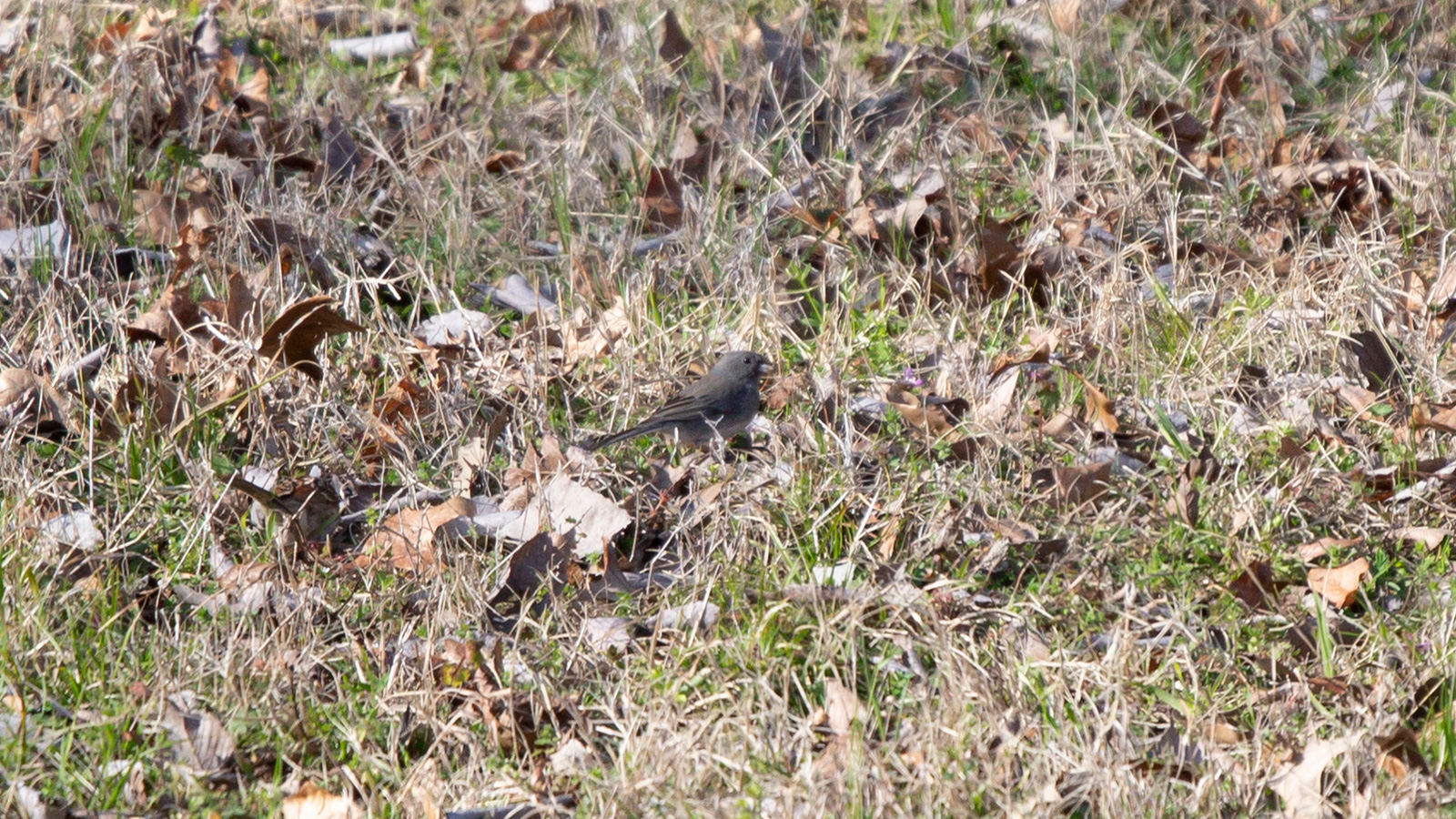

What Is the Dark-Eyed Junco Often Confused With?
White-Throated Sparrow, White-Crowned Sparrow, Vesper Sparrow
Drag the handle left and right to compare Dark-Eyed Junco side by side with the species it gets mistaken for most.
Dark-Eyed Junco vs. White-Throated Sparrow

- Compare the specific field marks, size, behavior, and habitat that separate these similar animals.
- These animals share a more specific category, so this comparison is meant for realistic field confusion.
1 of 3
Advertisement
Accessibility
That sharp "tik" chip note carries a metallic quality that cuts through background noise and sits at a mid-frequency range most people hear without difficulty. A flock feeding under a brushpile or along a hedge keeps up a steady rhythm of "tik" notes that tells you where the birds are, how many showed up, and what mood they are in by sound alone. Steady "tik" notes mean normal feeding. Rapid overlapping "tik-tik-tik" notes mean the flock just noticed a hawk, a cat, or a person who stepped too close.
For anyone with mobility limitations, the junco comes to you. That deserves repeating because most birds do not. A platform feeder or scattered seed near a window, a porch, or any accessible outdoor area brings the bird to the observer at ground level, and the dark gray body against pale ground gives a high-contrast visual for people with limited vision at close feeder-watching distances. Zero trail access needed, zero hiking, zero equipment beyond the feeder and a comfortable seat.
The bird flew from Canada to eat seeds on the ground near a shrub. A feeder near a window does that job perfectly.
Advertisement