Advertisement
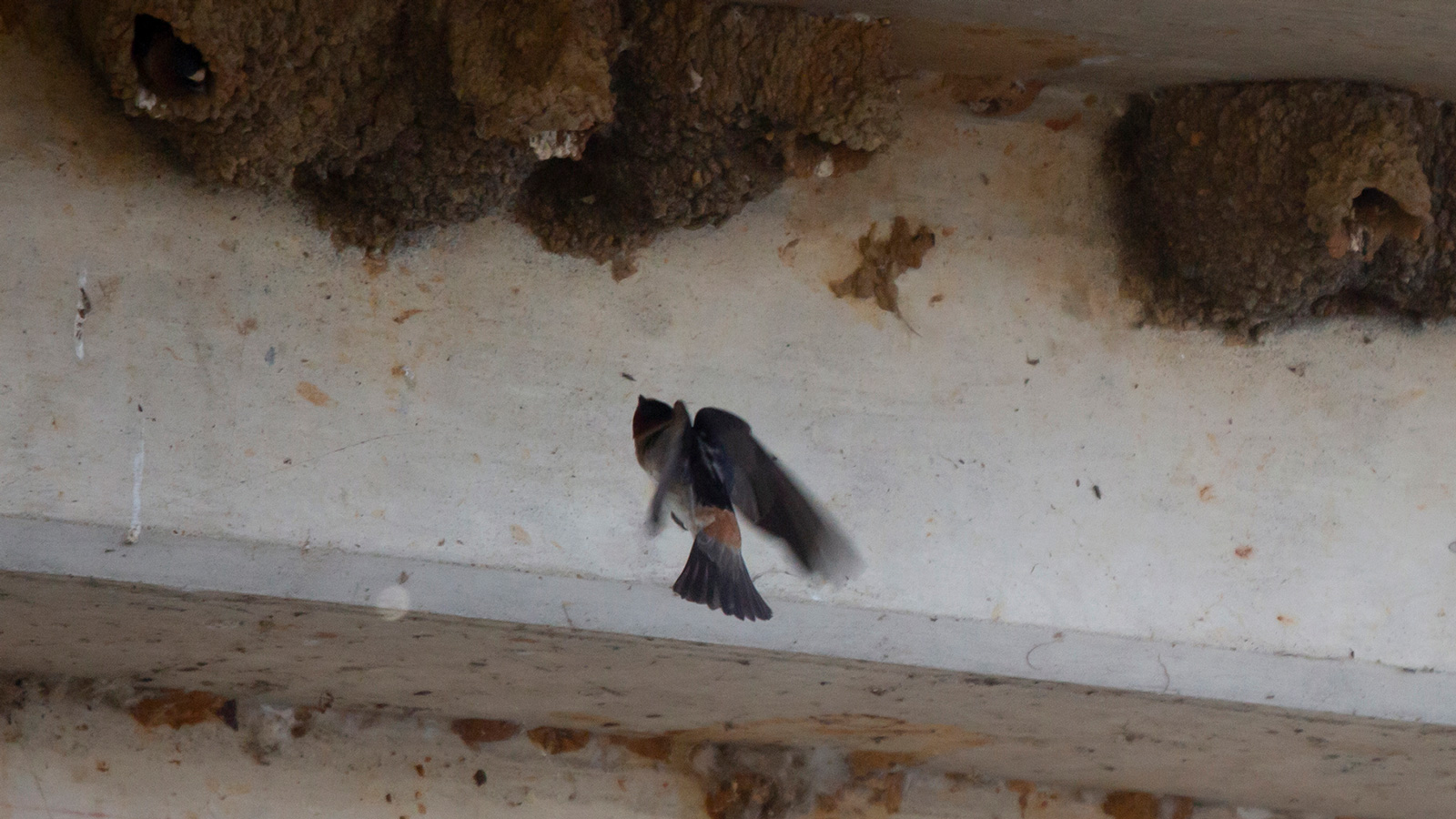
The cliff swallow builds enclosed mud nests shaped like gourds. Not cups. Gourds. Each nest has a small circular entrance hole at one end and a closed chamber at the other, constructed from hundreds of mud pellets carried one at a time to the colony site and pressed into shape over the course of a week. The engineering exceeds the barn swallow's open cup the way an apartment building exceeds a carport. The cliff swallow (Petrochelidon pyrrhonota) took the concept of mud architecture, added walls, added a roof, added a hallway entrance, and stopped just short of adding a mailbox. The bird did not consult an architect. The bird did not need one.
Cliff swallows breed in colonies that can number from a dozen nests to over a thousand, typically under highway bridges, concrete overpasses, and dam faces across North Louisiana. The coverage area's network of bridges and concrete structures offers thousands of potential colony sites, and the cliff swallow has evaluated most of them. A bridge that supports a cliff swallow colony one year usually supports a colony every year, because the birds return to the same structure and often to the same nest from the previous season. The bird has invested in the real estate. The bird has no interest in starting over.
What a Cliff Swallow Looks Like
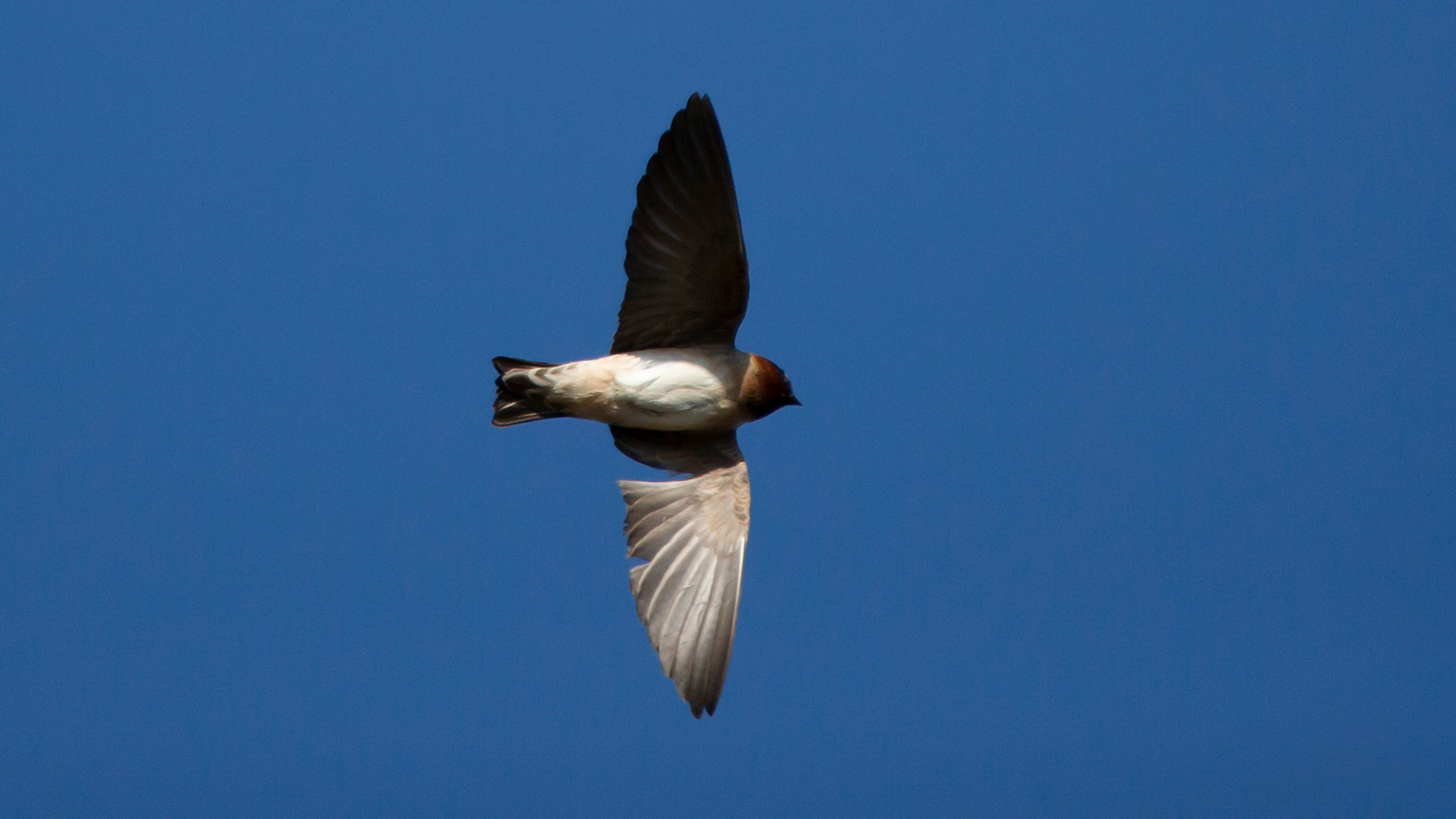
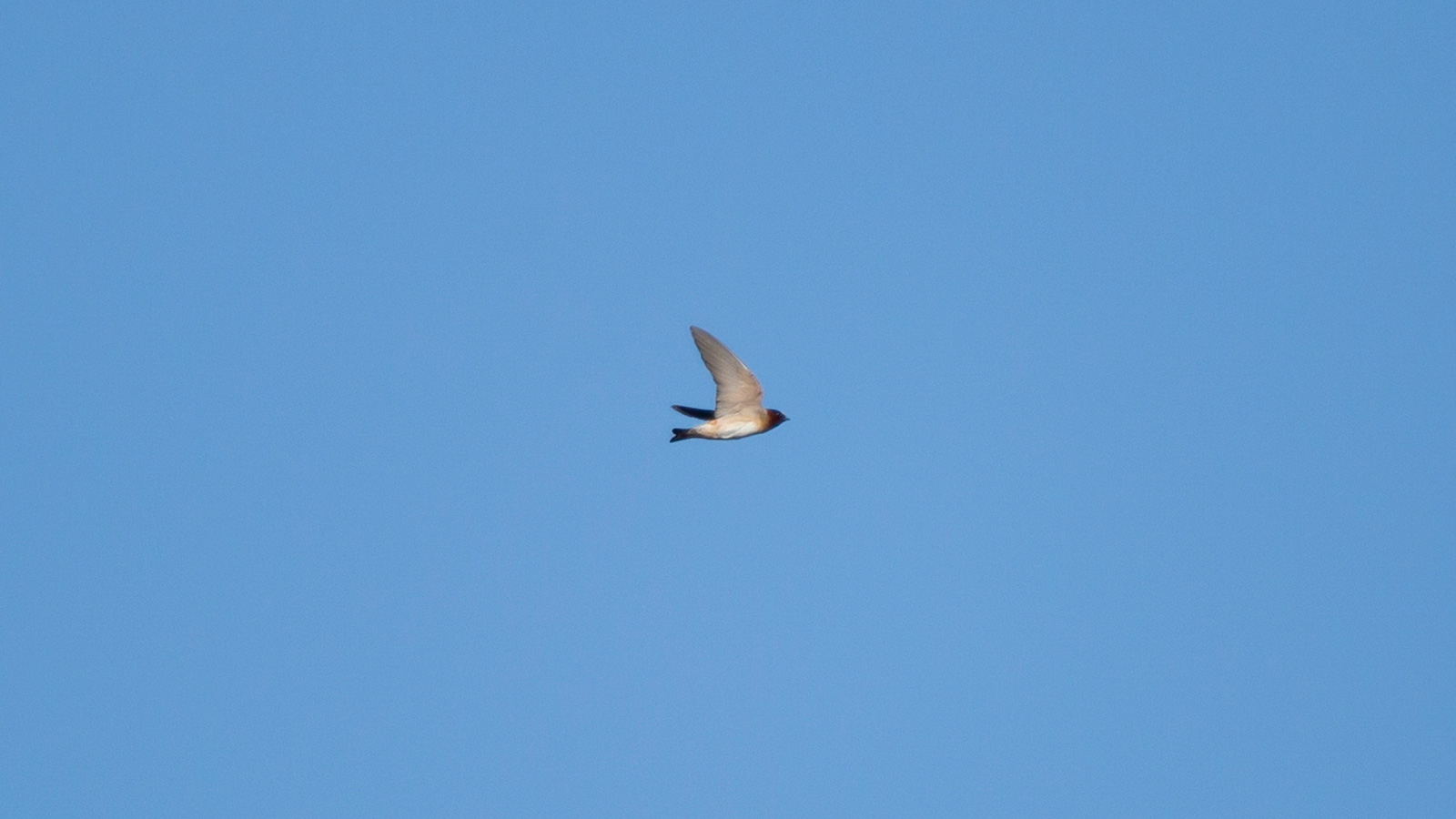
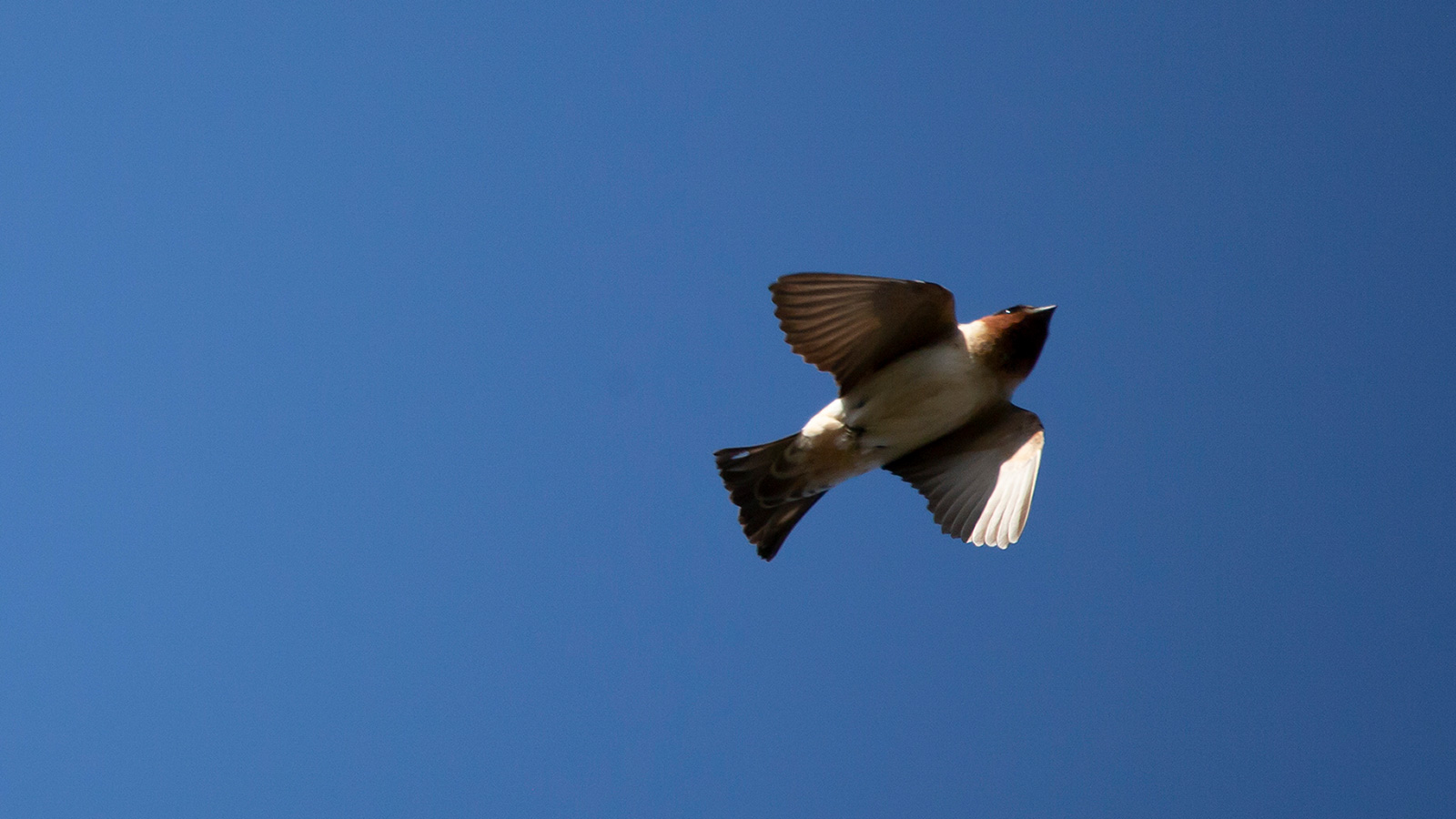
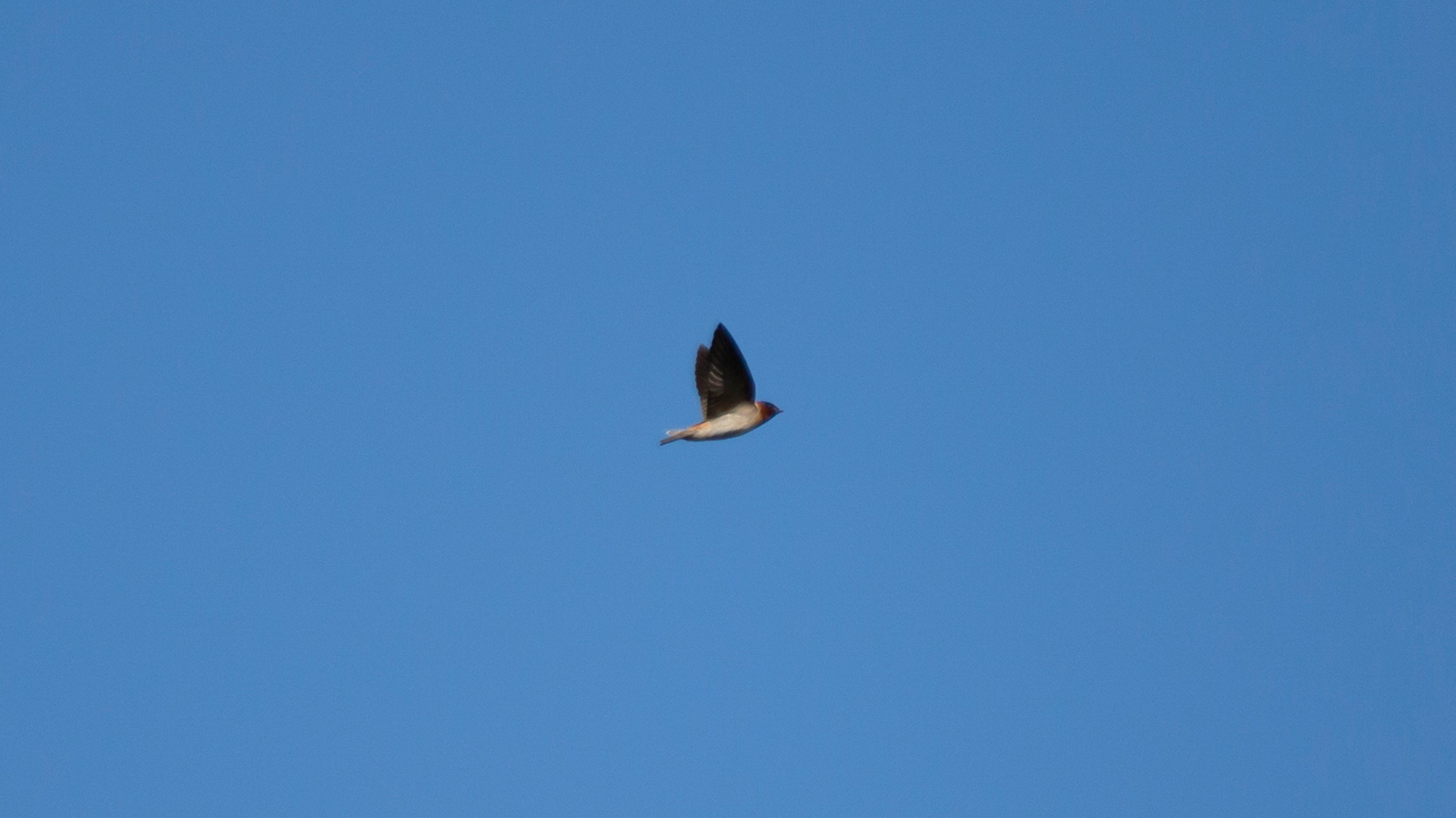
Dark steel-blue above with a buffy-white rump patch that flashes in flight and settles the identification from a hundred yards. The rump patch stands as the single most useful field mark for separating cliff swallows from every other swallow in North Louisiana airspace. Dark swallow, pale rump: cliff. The rest of the details confirm what the rump already told you.
The face wears a dark cap, a pale forehead patch that varies from buff to white, and a dark throat. The underparts come in pale with a darker chest band. The tail sits squared, not forked. Side by side with a barn swallow, the cliff swallow wears a shorter, squared tail, a pale rump, a darker throat, and a paler forehead. The barn swallow's deeply forked tail and orange throat separate the two species at any distance, but in mixed swallow flocks wheeling over a bridge, the rump patch on the cliff swallow does the sorting faster than any other feature.
Males and females look identical in the field. Young birds show duller coloring and a darker forehead. The bird has not invested in visual sex distinction and has not suffered from the lack of it. The nests get built. The eggs get laid. The babies get fed. The architect's gender has not affected the blueprints.
The Sounds a Cliff Swallow Makes
The colony puts out a continuous, low, chattering hum generated by hundreds of birds in close proximity, each one producing a quiet, creaky, slightly buzzy call that individually carries about ten feet and collectively carries several hundred. A large cliff swallow colony under a bridge makes a sound that the bridge amplifies, creating an echo-chamber effect that makes the colony sound larger than it actually measures. Stand under a bridge with five hundred cliff swallow nests and the sound wraps around you from every direction. The first visit to an active colony teaches you that "quiet bird" and "quiet colony" describe two completely different volumes.
The alarm call, a sharp, nasal "nyeer," cuts through the colony chatter when a predator approaches. The alarm triggers a mass departure that sends hundreds of birds off the bridge simultaneously, and the visual spectacle of five hundred swallows boiling off a concrete structure in two seconds deserves a spot on any birding highlight reel. The return happens gradually, with birds spiraling back to the bridge in loose groups over the next several minutes, each one checking the situation before committing to landing. The caution lasts about ninety seconds. The cliff swallow has a short memory for danger and a long memory for real estate.
Advertisement
What a Cliff Swallow Eats
Flying insects caught in aerial pursuit. Beetles, flies, winged ants, leafhoppers, and whatever else flies within the colony's foraging range. Cliff swallows feed in flocks, which separates their hunting strategy from the more solitary barn swallow approach. A flock of cliff swallows feeding over a field or pond moves as a group, with individual birds darting out to catch prey and then rejoining the formation. The collective feeding creates a visual pattern of birds swirling, rising, dipping, and recirculating that looks chaotic and functions efficiently. The chaos has a plan. The birds have not shared the plan with observers.
Cliff swallows follow insect swarms and will travel several miles from the colony to reach productive feeding areas. The flock-feeding strategy helps locate patchy food sources because any individual bird that finds a dense insect concentration gets followed by every other bird in the flock. Information about food location moves through the colony in minutes. Nobody sends a memo. The birds watch each other. The bird that found food gets company. The company has not been invited but has arrived anyway.
What a Cliff Swallow's Life Actually Looks Like
Males arrive on colony sites in late March to early April and immediately start renovating last year's nests or building new ones. Nest-site competition at established colonies escalates quickly. A prime nest location under the center of a bridge, protected from rain and wind, attracts multiple males. The disputes involve aerial chasing, bill-grappling at the nest entrance, and occasionally entering a competitor's nest and destroying it. Cliff swallow colony politics make HOA meetings look civil.
Nest construction takes about one to two weeks. Both parents build, collecting mud pellets from the nearest available source and pressing them into the gourd shape one pellet at a time. A completed nest contains between nine hundred and twelve hundred pellets. The entrance tunnel extends outward from the gourd, creating a corridor that the bird enters head-first, turns inside, and faces back toward the entrance while incubating. The interior stays dark. The bird sits in the dark for two weeks straight. The bird has not complained about the lighting.
She lays three to five eggs. Both parents sit on them for about fifteen days. Both parents feed the nestlings for about twenty-three days. Colony-nesting creates opportunities for brood parasitism by other cliff swallows. A female cliff swallow will sometimes lay an egg in a neighbor's nest, a behavior that transfers the cost of raising one chick to a different pair. The freeloading happens often enough in large colonies that researchers track it as a real factor in colony breeding dynamics. The cliff swallow has invented the cuckoo trick independently and practices it on her own species. Nobody in the colony has unionized against the practice. The practice continues.
Advertisement
What Gets Confused With a Cliff Swallow
The barn swallow shares the "dark swallow at a bridge" impression and the mud-nest-on-structure habit. The rump separates them instantly: cliff swallow shows pale buff, barn swallow shows dark. The tail separates them at any distance: cliff squared, barn forked. The nest shape separates them at the colony: cliff builds enclosed gourds, barn builds open cups. Three different field marks, any one of which settles the ID. The two species often nest on the same bridge, which puts the differences side by side that makes the differences obvious. The bridge has no preference between tenants.
The cave swallow, a rare vagrant to North Louisiana, wears a similar pattern but with a darker rump and a cinnamon-buff face. Any cliff-swallow-shaped bird in the coverage area with an unusually warm-colored face during fall migration deserves a second look and probably a photograph. The record would generate more excitement than the photograph suggests.
Tree swallows and bank swallows share the aerial habitat but wear different plumage and lack the pale rump. Neither species builds mud nests. Neither species colonies reach the density that cliff swallows achieve. The cliff swallow operates at a social scale that other North Louisiana swallows have not attempted.
Predators
Rat snakes and other climbing predators reach cliff swallow colonies on bridges and buildings. A snake that gains access to a colony can empty multiple nests in a single night, eating eggs and nestlings through the entrance tunnels. The enclosed nest design that protects from weather stops nothing shaped to fit through the tunnel entrance. The colony's sheer number of nests means a single predator event damages a fraction of the total, which amounts to the colony's only real defense: too many nests for any single predator to empty in one visit.
Cooper's hawks and American kestrels take adult cliff swallows in flight near colonies. The mass departure triggered by a hawk alarm temporarily overwhelms the hawk's ability to target a single bird, which explains why the colony evacuates simultaneously rather than individually. Five hundred birds in the air at once makes targeting harder. One bird in the air at once makes targeting easy. The colony strategy works because the colony stays together.
House sparrows and European starlings take over cliff swallow nests at some colony sites, though the small entrance hole of the cliff swallow nest deters starlings more effectively than the barn swallow's open cup does. Sparrows fit through the entrance and will claim nests. The cliff swallow has not developed a sparrow-proof entrance design. The cliff swallow has been building the same entrance for millions of years and has not scheduled a renovation.
Cliff Swallows and Humans
Highway bridges created the primary nesting habitat expansion for cliff swallows in North Louisiana. Before bridges, the species nested on cliff faces, canyon walls, and natural overhangs in the western United States. As highway construction spread concrete bridges across the landscape, the cliff swallow followed. Every new bridge offered a potential colony site. The Interstate Highway System functioned as a cliff swallow habitat creation program that nobody planned and nobody funded for that purpose. The bird got a housing subsidy from the Department of Transportation. The Department of Transportation did not know.
Bridge maintenance creates periodic conflicts. Pressure-washing or repainting a bridge during nesting season destroys active nests, which violates the Migratory Bird Treaty Act. Bridge crews have to schedule major maintenance outside the nesting window, which compresses the maintenance calendar and frustrates infrastructure managers who didn't plan on building their schedule around a bird. The bird's legal protection has not made the bird popular with bridge maintenance departments. The bird's legal protection has made the bird someone else's problem to schedule around.
Cliff swallows have declined in parts of the range, though the bird's ability to colonize new bridge sites partially offsets losses at older ones. The cliff swallow's future in North Louisiana tracks the future of concrete bridges, which currently sit abundant and show no signs of demolition.
Advertisement
Where to Find Cliff Swallows in North Louisiana
Highway bridges, concrete overpasses, and dam faces across every parish in the coverage area all carry colonies. Any bridge crossing a river, creek, or drainage in the coverage area can support a cliff swallow colony. Interstate highway bridges, state highway bridges, and parish road bridges all carry colonies at various sites.
Finding a colony takes nothing more than driving slowly across or under the bridge and looking for the gourd-shaped mud nests clustered on the concrete surfaces. Active colonies show birds streaming in and out continuously during breeding season, April through July. The pale rump patches flashing in the colony airspace identify the species before any individual bird perches.
The Red River, Ouachita River, and their tributary crossings throughout the coverage area carry cliff swallow colonies at bridge after bridge. A drive along any major highway in the coverage area during breeding season, watching the underside of each bridge crossed, picks up cliff swallow colonies at regular intervals. The birds have colonized the infrastructure. The infrastructure has not objected.
More Information
The Cornell Lab of Ornithology's All About Birds page covers cliff swallow range maps, sound recordings, and the species' colonial nesting ecology. Charles Brown's long-term research on cliff swallow colonies in Nebraska provides some of the most detailed colonial-breeding ecology data for any North American bird. The Sibley Guide to Birds covers the cliff swallow alongside the other North American swallows with rump-patch and tail-shape comparisons.
For North Louisiana specifically, the coverage area's bridge network has more colony sites per square mile than most regions, and the species' abundance at bridge crossings makes it one of the more reliable swallows to find during any driving survey of the coverage area.
Experiencing Cliff Swallows: Accessibility Notes
The colony chatter arrives as a continuous low hum from under the bridge, audible from a car passing over or parked near any active colony site. The sound carries a buzzy, creaky quality that doesn't project far but fills the space under the bridge completely. From a car parked near a bridge with an active colony during breeding season, the sound reaches the vehicle within seconds of stopping and rolling down the windows.
The mass departure alarm, triggered by disturbance or predator approach, creates a dramatic acoustic shift from steady chatter to sudden silence as the colony evacuates. The return involves individual chattering calls from birds circling back to the bridge, building the colony soundscape back up gradually over the next few minutes. The sound cycle, from steady hum to silence to gradual return, plays out at every colony visit and follows the same pattern every time. The cliff swallow's response to disturbance has not been updated. The cliff swallow sees no reason to update it.
Meta Title: Cliff Swallow in North Louisiana: Apartment Complexes Under Every Bridge Meta Description: Cliff swallows build enclosed gourd-shaped mud nests in colonies of dozens to hundreds under highway bridges across every North Louisiana parish. Focus Keyphrase: cliff swallow North Louisiana Secondary Keywords: cliff swallow nest, Petrochelidon pyrrhonota Louisiana, cliff swallow identification, cliff swallow colony bridge, North Louisiana swallows, cliff swallow rump patch, cliff swallow mud nest, cliff swallow vs barn swallow, cliff swallow sounds, North Louisiana bridge birds OG Description: The cliff swallow took mud architecture, added walls, a roof, and an entrance tunnel, and built colonies of hundreds under highway bridges across North Louisiana. Full field guide with sounds, diet, and where to find them. Slug: cliff-swallow-north-louisiana
Advertisement
Photo Gallery
Advertisement
Accessibility
## Experiencing Cliff Swallows: Accessibility Notes
The colony chatter arrives as a continuous low hum from under the bridge, audible from a car passing over or parked near any active colony site. The sound carries a buzzy, creaky quality that doesn't project far but fills the space under the bridge completely. From a car parked near a bridge with an active colony during breeding season, the sound reaches the vehicle within seconds of stopping and rolling down the windows.
The mass departure alarm, triggered by disturbance or predator approach, creates a dramatic acoustic shift from steady chatter to sudden silence as the colony evacuates. The return involves individual chattering calls from birds circling back to the bridge, building the colony soundscape back up gradually over the next few minutes. The sound cycle, from steady hum to silence to gradual return, plays out at every colony visit and follows the same pattern every time. The cliff swallow's response to disturbance has not been updated. The cliff swallow sees no reason to update it.
Meta Title: Cliff Swallow in North Louisiana: Apartment Complexes Under Every Bridge Meta Description: Cliff swallows build enclosed gourd-shaped mud nests in colonies of dozens to hundreds under highway bridges across every North Louisiana parish. Focus Keyphrase: cliff swallow North Louisiana Secondary Keywords: cliff swallow nest, Petrochelidon pyrrhonota Louisiana, cliff swallow identification, cliff swallow colony bridge, North Louisiana swallows, cliff swallow rump patch, cliff swallow mud nest, cliff swallow vs barn swallow, cliff swallow sounds, North Louisiana bridge birds OG Description: The cliff swallow took mud architecture, added walls, a roof, and an entrance tunnel, and built colonies of hundreds under highway bridges across North Louisiana. Full field guide with sounds, diet, and where to find them. Slug: cliff-swallow-north-louisiana
Advertisement