Advertisement
The American Bird Grasshopper earned the "bird" in their name the honest way, by flying so well that early naturalists compared them to birds in flight. American Bird Grasshopper launches from vegetation with a wingbeat strong enough to sustain level flight across open fields, over tree canopies, and down highways at speeds that put most other North Louisiana grasshoppers to shame. Where a Differential Grasshopper hops and flutters a few yards before crash-landing in the nearest clump of grass, the American Bird Grasshopper takes off, gains altitude, and cruises. The flight looks intentional, directed, and powerful, nothing like the panicked, tumbling escapes of the smaller species. The American Bird Grasshopper doesn't flee. The American Bird Grasshopper commutes.
The body matches the flight performance. Adults rank among the largest grasshoppers in North Louisiana, with females reaching 43 to 55 millimeters (nearly two and a quarter inches) and males running 35 to 45 millimeters. The body color varies from green to yellowish-brown to brownish-gray, with a pale dorsal stripe running along the pronotum and continuing onto the head. The forewings extend well past the abdomen tip, providing the wing area needed for sustained flight. The hind wings, visible only in flight, flash a pale yellow that contrasts with the darker forewings and adds a visual splash to the already impressive aerial display.
The genus Schistocerca contains the most famous grasshoppers on Earth. The Desert Locust (Schistocerca gregaria), the species that forms the billion-strong swarms depicted in biblical accounts of plagues, belongs to the same genus. The American Bird Grasshopper doesn't form the apocalyptic swarms of its Old World cousin, but the family resemblance shows in the flight ability, the large body size, and the occasional population outbreaks that draw attention from agricultural agencies across the southeastern United States.
North Louisiana sits squarely in the core range. American Bird Grasshopper thrives across the full southeastern quadrant of the United States, from New York south to Florida and west to eastern New Mexico and Nebraska. Every one of the 26 parishes carries populations in habitats ranging from agricultural fields to forest edges to suburban landscapes.
The Outbreak Potential
The American Bird Grasshopper usually maintains moderate population densities, present and visible, but not economically damaging in most years. Warm winters change the equation. In the Gulf South, where North Louisiana sits, warm winters allow a percentage of adults to survive from fall through spring rather than dying off and relying solely on dormant eggs. The surviving adults begin reproducing earlier, get a head start on the season, and kick out a first generation that matures before conditions would normally allow. The compounding effect of warm-winter adult survival plus early reproduction plus normal summer reproduction can push populations to outbreak densities by late summer.
During outbreaks, American Bird Grasshoppers damage citrus orchards, vegetable crops, ornamental plantings, and garden plants. Citrus, not a major crop in North Louisiana but present in some home landscapes, attracts particular attention because the grasshoppers defoliate young citrus trees aggressively during outbreaks. In the 26 parishes, the more relevant crop damage involves cotton, soybeans, and garden vegetables, though the damage rarely reaches the economic thresholds that trigger management responses except during the heaviest outbreak years.
The gregarious behavior of nymphs concentrates the damage. Young American Bird Grasshopper nymphs feed in groups, often clustering on a single plant or in a small area of a field before dispersing as they mature. A cluster of 50 third-instar nymphs on a single hibiscus bush in a Monroe backyard can strip the plant of leaves in 48 hours. The homeowner goes to work on Monday with a beautiful hibiscus and comes home Wednesday to a stick. The same 50 nymphs, spread across an acre of mixed vegetation, would cause no noticeable damage to any individual plant. The clumping creates the visual impression of catastrophic feeding even when the total population density sits well below outbreak levels.
The Density-Dependent Color Change
The American Bird Grasshopper pulled a trick straight from the locust playbook. Nymphs that grow up in crowded conditions look completely different from nymphs that develop with room to breathe. At low densities, nymphs wear plain green or brown coloring that blends into the surrounding vegetation, the standard-issue camouflage that most grasshopper nymphs carry. At high densities, the nymphs develop brighter colors, patterns of yellow, orange, and black that make the animals conspicuous rather than camouflaged. Same species. Same genetics. Completely different outfit depending on how many roommates shared the nursery.
The color shift operates through a density-dependent mechanism that senses how many other grasshopper nymphs occupy the same area. Physical contact between nymphs, visual stimulation from seeing other nymphs, and possibly chemical signals from frass (fecal material) and body secretions all contribute to the density assessment. When the assessment says "crowded," the developmental program shifts toward the bright, gregarious color form. When the assessment says "sparse," the program builds the cryptic, solitary color form.
The behavioral changes accompany the color changes. Crowded nymphs behave more gregariously than sparse nymphs, staying closer together, feeding in tighter groups, and moving as loose aggregations rather than as dispersed individuals. The gregarious behavior concentrates the feeding damage (bad for plants) but also concentrates the warning signal (bad for predators that might otherwise pick off isolated individuals). The bright coloring in crowded populations may serve a function similar to the Eastern Lubber's warning coloration, signaling to predators that a large group of conspicuously colored grasshoppers probably tastes different from (or at least presents more risk than) a solitary green individual.
The density-dependent color and behavior shift connects the American Bird Grasshopper directly to the locust biology that makes the genus Schistocerca globally famous. The Desert Locust (Schistocerca gregaria) shows the most extreme version of this density-dependent phase change, solitary-phase individuals look and behave so differently from gregarious-phase individuals that early taxonomists classified them as separate species. The American Bird Grasshopper's density-dependent color shift looks like a milder version of the same biological mechanism, operating on a shorter spectrum but through the same fundamental process.
During outbreak years when nymph densities run high, the American Bird Grasshopper nymphs marching through a Morehouse Parish soybean field may wear yellow-orange-and-black patterns that look nothing like the green nymphs that developed in the same field during a low-density year. The color difference between outbreak-year and normal-year nymphs can confuse observers who expect consistency within a species and find instead that the species changes its appearance based on how many neighbors it grew up with.
The Flight Machine
The American Bird Grasshopper's flight deserves detailed attention because the performance exceeds what most people expect from any grasshopper. Where most North Louisiana grasshoppers make short, panicked escape flights of 5 to 30 feet, the American Bird Grasshopper makes sustained, directional flights measured in hundreds of feet or more. The difference in flight quality between American Bird Grasshopper and a typical Melanoplus species resembles the difference between a hawk soaring across a field and a chicken flapping across a farmyard.
The flight musculature tells the story. The thorax of an American Bird Grasshopper contains proportionally more flight muscle than any other grasshopper in the 26 parishes, the dorsal longitudinal and dorsoventral muscles that power the wing strokes packed into the thoracic cavity like an engine too big for the chassis. More muscle means more power per wing stroke, more sustained output over longer flights, and the ability to climb rather than just maintain level altitude during escape. The American Bird Grasshopper doesn't just get airborne. The American Bird Grasshopper gains altitude, clears the tree line, and keeps going.
The hindwings, large, membranous, and pale yellow, provide the primary lift and thrust surfaces during flight. The forewings (tegmina), being stiffer and heavier, serve more as airfoils that generate lift during gliding phases between active wingbeat sequences. A flying American Bird Grasshopper alternates between powered wingbeats (rapid, audible, driving the buzzing flight sound) and brief gliding phases (wings held steady, losing altitude gradually) in a pattern that extends total flight distance while conserving energy. The flight style resembles a woodpecker's undulating flight pattern more than the straight-line buzzing of a bee or a blow fly.
The flight altitude reaches 15 to 30 feet above ground level during sustained flights, high enough that the grasshopper shrinks to a dark silhouette against the sky. Up there, the wide-angle compound eyes scan a panoramic view of the landscape below, reading the green-versus-brown map that guides navigation toward food, mates, and landing spots. The altitude also puts the grasshopper above the reach of every ground-based predator in the parish, a safety margin that the Red-Legged Grasshopper's panicked five-foot hop never achieves.
Wind changes everything about where a flight ends up. American Bird Grasshoppers launching into a headwind cover less ground but maintain directional control. Grasshoppers launching with a tailwind cover dramatically more ground but may arrive at unintended destinations. During the dispersal flights that occur when local food resources decline, the movements that carry grasshoppers from one field to the next during dry summers, the wind direction shapes where the arriving grasshoppers concentrate. A northeast wind carrying American Bird Grasshoppers away from a harvested cotton field in Tensas Parish deposits them on the vegetable gardens and ornamental plantings of the nearest downwind community. The gardeners experience the arrival as a sudden invasion. The grasshoppers experienced the flight as lunch relocation. Neither side planned the meeting, and neither side enjoys the terms.
The Two-Generation South
North Louisiana hands the American Bird Grasshopper something the northern populations never get: enough warm season to breed twice. The spring generation hatches from dormant eggs in April and May, with nymphs developing through the summer and reaching adulthood by late June or July. Those summer adults mate, deposit eggs, and crank out a fall generation that matures by September and October. The fall adults either die with the first hard freezes or, during warm winters, survive to reproduce the following spring without bothering with the egg dormancy step at all.
Two generations per year doubles the math. Each female deposits up to three egg clutches, each containing 60 to 80 eggs. Run two generations of females through that math and a single winter-surviving female's lineage can theoretically yield thousands of descendants by December. Predators, parasitoids, disease, and bad luck keep actual numbers far below the theoretical ceiling, but the reproductive potential explains why populations spike so fast when conditions line up. The American Bird Grasshopper doesn't build slowly. The American Bird Grasshopper compounds.
The egg pods sit two to four inches below the surface, cemented together with a frothy secretion that hardens into a waterproof shell. Deep freezes (sustained temperatures below 20 degrees Fahrenheit at soil depth) can kill a percentage of eggs, providing a natural population reset that keeps multi-year outbreak compounding in check. But the pods sit deep enough that the insulating soil column above them buffers the embryos against surface temperature swings. A cold night that drops the surface to 20 degrees may only cool the egg pod at two inches depth to 28 or 30, and those eight degrees of insulation draw the line between a dead embryo and one that hatches in April like nothing happened.
The mild winters of the past several decades across the Gulf South have reduced this cold-weather mortality, so the natural population reset button gets pressed less often. The grasshoppers noticed the trend before the climate scientists published the paper.
Identification Among the Bird Grasshoppers
North Louisiana supports at least two common bird grasshopper species, the American Bird Grasshopper and the Mischievous Bird Grasshopper, plus occasional appearances by the Olive-Green Grasshopper and possibly the Spotted Bird Grasshopper. Separating them in the field comes down to size, color, wing length, and where you found the thing.
The American Bird Grasshopper stands largest, with females pushing past 50 millimeters. The body color runs variable, green, yellow-brown, or gray, with that pale dorsal stripe. The forewings extend well past the abdomen, and the flight performance exceeds every other species in the genus at this latitude. When a large grasshopper flushes from vegetation, gains altitude to 15 feet or more, and sustains level or climbing flight for 50 or more yards before descending to land, the identification resolves to American Bird Grasshopper by flight performance alone. No other grasshopper in North Louisiana flies like that except the other bird grasshopper species, and the size difference separates americana from the smaller alternatives.
The Mischievous Bird Grasshopper (covered in a separate article) runs smaller, browner, and more uniformly colored. The females of Schistocerca damnifica carry shorter wings than males, a unique feature within the genus that makes the females functionally flightless. No American Bird Grasshopper female suffers that limitation. A large female grasshopper with full-length wings that flies strongly across a Richland Parish field belongs to americana. A large female grasshopper with short wings that hops heavily through the understory of a Jackson Parish forest gap belongs to damnifica.
The Obscure Bird Grasshopper wears a greenish to olive-brown coloring with less distinct dorsal striping. The Spotted Bird Grasshopper carries more distinct speckling or spotting on the body. Both show up less often than americana and damnifica in the 26 parishes, which makes the identification puzzle slightly easier in practice, and most bird grasshoppers you encounter here come down to a two-species coin flip rather than a four-species headache.
One structural trick separates all Schistocerca species from other large grasshoppers: the mesosternal lobes. Flip a large grasshopper over and look between the middle legs. In Schistocerca, the lobes on the underside of the middle thoracic segment run wider than long. Other large grasshopper genera (Melanoplus, Dissosteira) carry differently shaped lobes. The check needs a hand lens or a decent close-up photo, but it settles the genus question when size and color leave you guessing, which happens more often than the field guides admit, because individual American Bird Grasshoppers come in every shade from lime green to dusty brown.
Habitat Across the 26 Parishes
American Bird Grasshoppers occupy a broader habitat range than most other grasshopper species in the region. Open fields, pastures, roadsides, garden beds, forest edges, woodland clearings, and suburban landscapes all support populations. The habitat flexibility comes from the generalist diet, the species eats both grasses and broadleaf plants, including crops, ornamentals, and wild vegetation. A grasshopper that eats everything and flies everywhere occupies every available habitat by default.
The highest densities concentrate in the agricultural and suburban zones where food abundance and open habitat structure combine. The cotton and soybean parishes, Morehouse, Richland, Franklin, Tensas, Concordia, Avoyelles, grow American Bird Grasshopper habitat in the crop canopies, field margins, and fencerow vegetation. The feeding damage on soybeans during outbreak years concentrates along the field edges nearest the fencerows and ditch banks where dormant eggs hatched the previous spring. The first 10 to 20 rows of a soybean field may lose 30 to 50 percent of their leaf area while the interior of the field escapes with minimal damage, the classic edge effect that shows up in grasshopper crop damage across every agricultural parish.
The suburban parishes, Caddo, Ouachita, Rapides, grow populations in residential landscapes where ornamental plantings, vegetable gardens, and the weedy margins around developed areas put food and egg sites within hopping distance. A homeowner in a Shreveport subdivision who plants hibiscus, fig trees, and a vegetable garden basically built a bird grasshopper bed-and-breakfast without knowing it. The irrigated landscape stays green through summer droughts that stress everything outside the sprinkler zone, pulling grasshoppers from the drying wild vegetation into the one green oasis on the block. The grasshoppers follow the water the way everybody in Louisiana follows the crawfish boil.
Forest habitats support lower densities because the closed canopy reduces the open, sunlit conditions the species prefers. But forest edges, logging roads, power-line cuts, and natural openings within the forested parishes (Vernon, Natchitoches, Winn, Grant, Claiborne, Bienville, Jackson) all carry American Bird Grasshoppers where light reaches the ground and vegetation grows in the open. The Kisatchie National Forest, with its extensive system of open pine savannas, fire-maintained clearings, and logging road margins, grows bird grasshopper habitat distributed throughout the forest matrix rather than concentrated at the forest boundary.
The Delta parishes, Tensas, Madison, East Carroll, West Carroll, Richland, Franklin, hold the most extensive continuous agricultural habitat for the American Bird Grasshopper. The flat, field-dominated landscape, crops stretching from tree line to tree line, fencerows connecting egg-laying sites to feeding areas in an unbroken grid, generates the conditions for the largest potential populations anywhere in the 26 parishes. Drive Highway 65 through the Tensas Basin in August and you drive through miles of bird grasshopper habitat without interruption. Every soybean field, every cotton field, every weedy fencerow carries the species at densities that shift with the year but never reach zero. The Delta didn't build the habitat on purpose, but the American Bird Grasshopper accepted the offer like it came with a written invitation.
The flight ability means habitat connectivity rarely limits the species. An American Bird Grasshopper that runs out of food in one field simply flies to the next. The flight range of individual adults, potentially measured in miles rather than yards, connects habitat patches across the landscape at a scale that ground-bound grasshopper species can't match. The "bird" name captures this landscape-scale mobility perfectly.
Food Web and Predators
The large body size of the American Bird Grasshopper makes each individual a significant caloric package for predators. Birds eat them eagerly, loggerhead shrikes, American kestrels, mockingbirds, blue jays, and roadrunners all capture and consume American Bird Grasshoppers. The shrikes sometimes impale captured grasshoppers on thorns or barbed wire, creating the characteristic "larder" displays that decorate fence lines across North Louisiana pastures. A Loggerhead Shrike working a fencerow in Caddo Parish during August may accumulate three to five impaled bird grasshoppers on a single stretch of barbed wire, creating a macabre but ecologically fascinating pantry visible from the road.
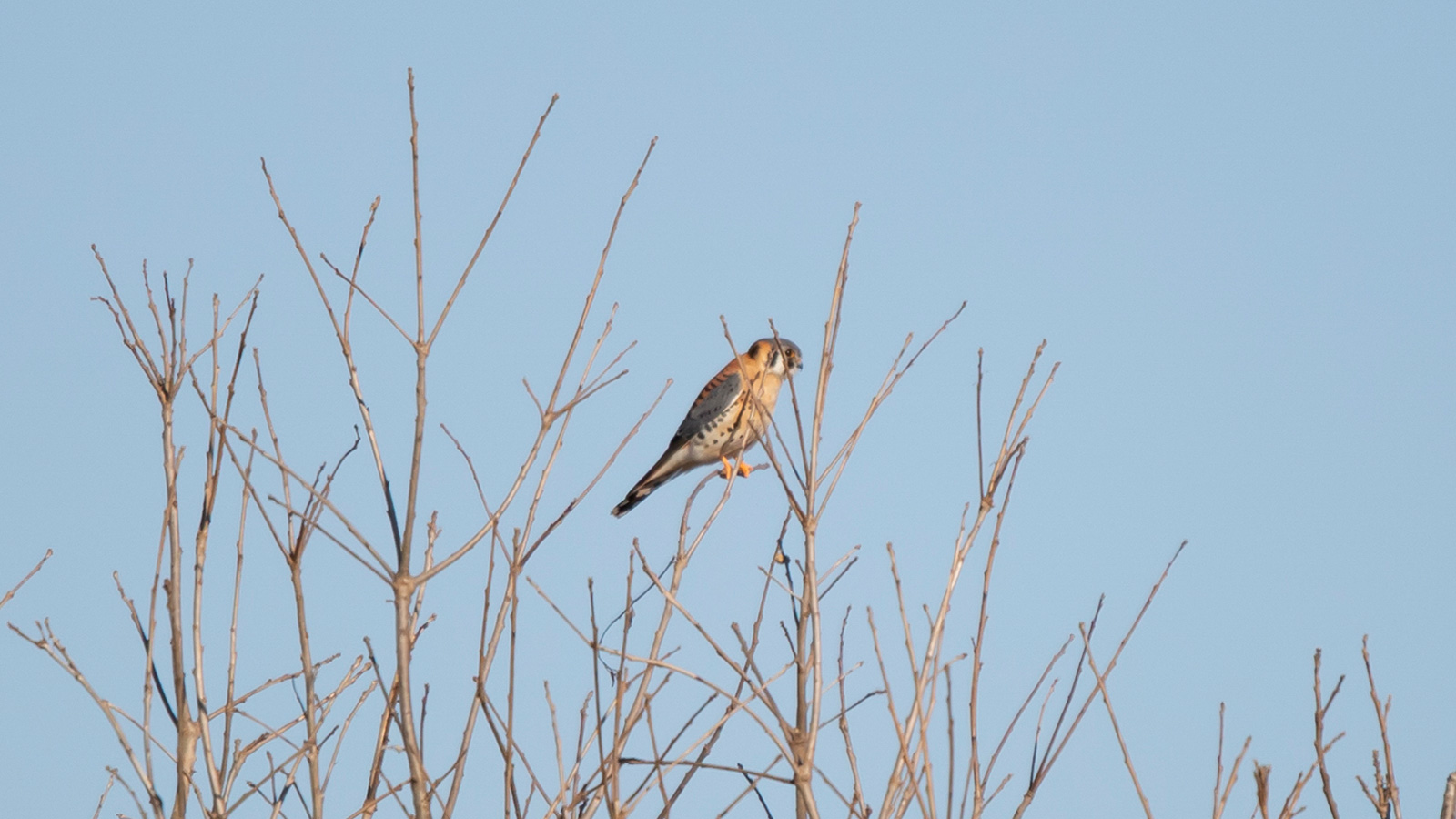
American Kestrels, the small, hovering falcons that work open landscapes across every parish, feed heavily on American Bird Grasshoppers during the fall months when the kestrel's southward migration overlaps with peak adult grasshopper activity. A kestrel hovering over a Richland Parish soybean field in September scans the crop canopy for the large, conspicuous grasshoppers that provide more calories per capture than the smaller Melanoplus species sharing the same field. The kestrel's ability to hover and then dive vertically onto a perched grasshopper bypasses the escape flight that works against approach-from-the-ground predators.
Parasitoid flies in the family Tachinidae lay eggs on adult American Bird Grasshoppers, and the fly larvae develop inside the grasshopper's body, eventually killing the host. The tachinid parasitoids show remarkable host-finding ability, tracking adult grasshoppers through a combination of visual detection (the tachinid follows the grasshopper during flight) and acoustic cues (the grasshopper's wing sounds during flight attract the pursuing tachinid). A parasitized American Bird Grasshopper keeps feeding and flying for days or weeks after the tachinid egg hatches, completely unaware that a fly larva grows inside the thoracic cavity like the world's worst houseguest, consuming flight muscles and other tissues that the grasshopper needs to function. The parasitoid eventually kills the host when the larva exits through the body wall to pupate in the soil.
The parasitoid pressure helps regulate populations between outbreaks. Surveys of American Bird Grasshopper populations across the Southeast consistently find that 10 to 30 percent of adults carry tachinid parasitoids during normal years. During outbreak years, the percentage may drop temporarily because the grasshopper population grew faster than the parasitoids could keep up. Then the parasitoid population catches up during the next generation, and the crash hits. The parasitoids always run one to two generations behind the grasshopper spike, which explains why most outbreaks last only a year or two before the flies finish what the outbreak started.
Mermithid nematodes add another mortality source. These long, thin worms develop inside the grasshopper's body cavity, consuming body fluids and soft tissues over several weeks. The nematodes grow to six inches or more inside an animal that measures two inches externally, coiled in the abdominal cavity like a tightly wound spring. When the nematode matures, the worm exits through the body wall, killing the host. An American Bird Grasshopper dropping dead near a wet ditch in Catahoula Parish may release a nematode that coils on the soil surface beside the corpse, startling anyone unfamiliar with the parasite's life history. The nematode infection rate varies with habitat moisture, the worms depend on wet soil to complete the free-living phase of the life cycle, so grasshopper populations near waterways and irrigated fields carry heavier nematode loads than populations in dry upland habitats.
Between the birds, the tachinid flies, the nematodes, the fungal diseases, and every other natural enemy with a taste for large grasshoppers, a substantial percentage of each American Bird Grasshopper generation never reaches adulthood. The species compensates the way all high-mortality species compensate: by making more. Up to 240 eggs per female, two generations per year, and the math stays ahead of the death toll in most years. The population absorbs losses that would collapse a less prolific species and keeps showing up across every parish like the mortality report never arrived.
The Generalist Diet
The American Bird Grasshopper eats virtually everything green in North Louisiana. Grasses (bermudagrass, bahiagrass, bluestem, johnsongrass), broadleaf crops (cotton, soybeans, corn, garden vegetables), ornamental plants (hibiscus, citrus, oleander, crape myrtle), and wild vegetation (ragweed, goldenrod, various composites and legumes). The menu reads like an index of North Louisiana plants, and the American Bird Grasshopper treats the entire list as a buffet. If the plant grows in the 26 parishes and the grasshopper can reach it, the grasshopper eats it.
American Bird Grasshoppers prefer the soft stuff: young leaves, fresh shoot tips, developing flowers. The lean toward young tissue concentrates the damage on the most photosynthetically active parts of the plant, magnifying each bite beyond what the sheer volume of consumed tissue would suggest. A grasshopper that eats 10 young terminal leaves causes more growth reduction than a grasshopper that eats 10 old basal leaves, because the terminal leaves were driving the plant's current growth while the basal leaves had already contributed most of their photosynthetic value.
The American Bird Grasshopper's combination of size, flight ability, and generalist ecology makes them one of the most ecologically prominent insects in North Louisiana. They eat the plants, feed the predators, respond to climate through their population dynamics, and fly across the landscape with a confidence that most insects can't muster. The "bird" grasshopper label fits, not because the species weighs enough to compete with actual birds, but because the flight performance crosses the line between "insect making a desperate escape" and "animal that actually chose to go somewhere."
Accessibility
The rapid wingbeats during takeoff and sustained flight kick out a buzzing or crackling sound audible from several feet, a brief, loud burst rather than a sustained song. The sound registers in a frequency range detectable by all ages. Multiple individuals flushing simultaneously create a collective crackling recognizable as large grasshoppers launching. No sustained calling song or nighttime chorus, all sound ties to flight events during daylight hours.
American Bird Grasshoppers occupy open, flat terrain, field margins, maintained roadsides, garden borders. The ground surface in primary habitat runs firm, level, and usually adjacent to paved or mowed areas. No rough terrain access needed. More Information
iNaturalist: inaturalist.org, observation records for American Bird Grasshopper BugGuide: bugguide.net, identification resources for Schistocerca species NABA: naba.org, general insect ecology references Orthoptera Species File: orthoptera.speciesfile.org, taxonomy and distribution data
Frequently Asked Questions
Why do they call it a bird grasshopper? The flight performance. American Bird Grasshoppers launch from vegetation, gain altitude, and sustain level or climbing flight across open fields at heights of 15 to 30 feet, a flight style that early naturalists compared to birds in transit rather than insects escaping a threat.
Do American Bird Grasshoppers damage gardens? During outbreak years, absolutely. The nymphs cluster on individual plants and strip them bare. Hibiscus, citrus, vegetable gardens, and ornamental shrubs all take heavy damage during population spikes, particularly along the edges of landscapes bordering unmaintained areas.
How big do they get? Females reach 43 to 55 millimeters (nearly two and a quarter inches), ranking among the largest grasshoppers regularly encountered in North Louisiana. Males run smaller at 35 to 45 millimeters.
Why do nymphs change color in crowds? Density-dependent color change mirrors the locust phase-change mechanism. At low densities, nymphs wear green or brown camouflage. At high densities, nymphs develop bright yellow, orange, and black warning coloring that may signal the group's collective defense to predators.
How many generations per year in North Louisiana? Two. The spring generation hatches from dormant eggs in April-May and reaches adulthood by late June-July. The summer adults kick out a fall generation that matures by September-October.
What parasites attack American Bird Grasshoppers? Tachinid flies lay eggs on the adults, and the fly larvae develop inside the grasshopper's body. Mermithid nematodes grow up to six inches long inside the abdominal cavity. Fungal pathogens (Entomophaga grylli) kill adults during humid weather.
METADATA Title: American Bird Grasshoppers (Schistocerca americana) Subtitle: The Biggest Grasshopper in the Parish That Flies Like It Means It Slug: american-bird-grasshoppers-north-louisiana Species: Schistocerca americana Category: Insects Subcategory: Crickets and Grasshoppers Parish Coverage: All 26 parishes Featured Image Alt Text: Large American Bird Grasshopper perched on vegetation showing pale dorsal stripe and long forewings
SEO Focus Keyphrase: American Bird Grasshopper North Louisiana Meta Description: The American Bird Grasshopper ranks among the largest and strongest-flying grasshoppers in North Louisiana, reaching outbreak densities after warm winters across all 26 parishes. Secondary Keywords: Schistocerca americana Louisiana, bird grasshopper identification, large grasshopper flight, grasshopper outbreak, Schistocerca species
Advertisement
Advertisement
Accessibility
## Accessibility
The rapid wingbeats during takeoff and sustained flight kick out a buzzing or crackling sound audible from several feet, a brief, loud burst rather than a sustained song. The sound registers in a frequency range detectable by all ages. Multiple individuals flushing simultaneously create a collective crackling recognizable as large grasshoppers launching. No sustained calling song or nighttime chorus, all sound ties to flight events during daylight hours.
American Bird Grasshoppers occupy open, flat terrain, field margins, maintained roadsides, garden borders. The ground surface in primary habitat runs firm, level, and usually adjacent to paved or mowed areas. No rough terrain access needed. More Information
iNaturalist: inaturalist.org, observation records for American Bird Grasshopper BugGuide: bugguide.net, identification resources for Schistocerca species NABA: naba.org, general insect ecology references Orthoptera Species File: orthoptera.speciesfile.org, taxonomy and distribution data
Advertisement