Advertisement
The common buckeye stops most people the first time they see it perched on bare ground in a sunny spot, wings spread, the four large eyespots staring back at an implausible intensity. Junonia coenia does not look subtle, and it knows it.
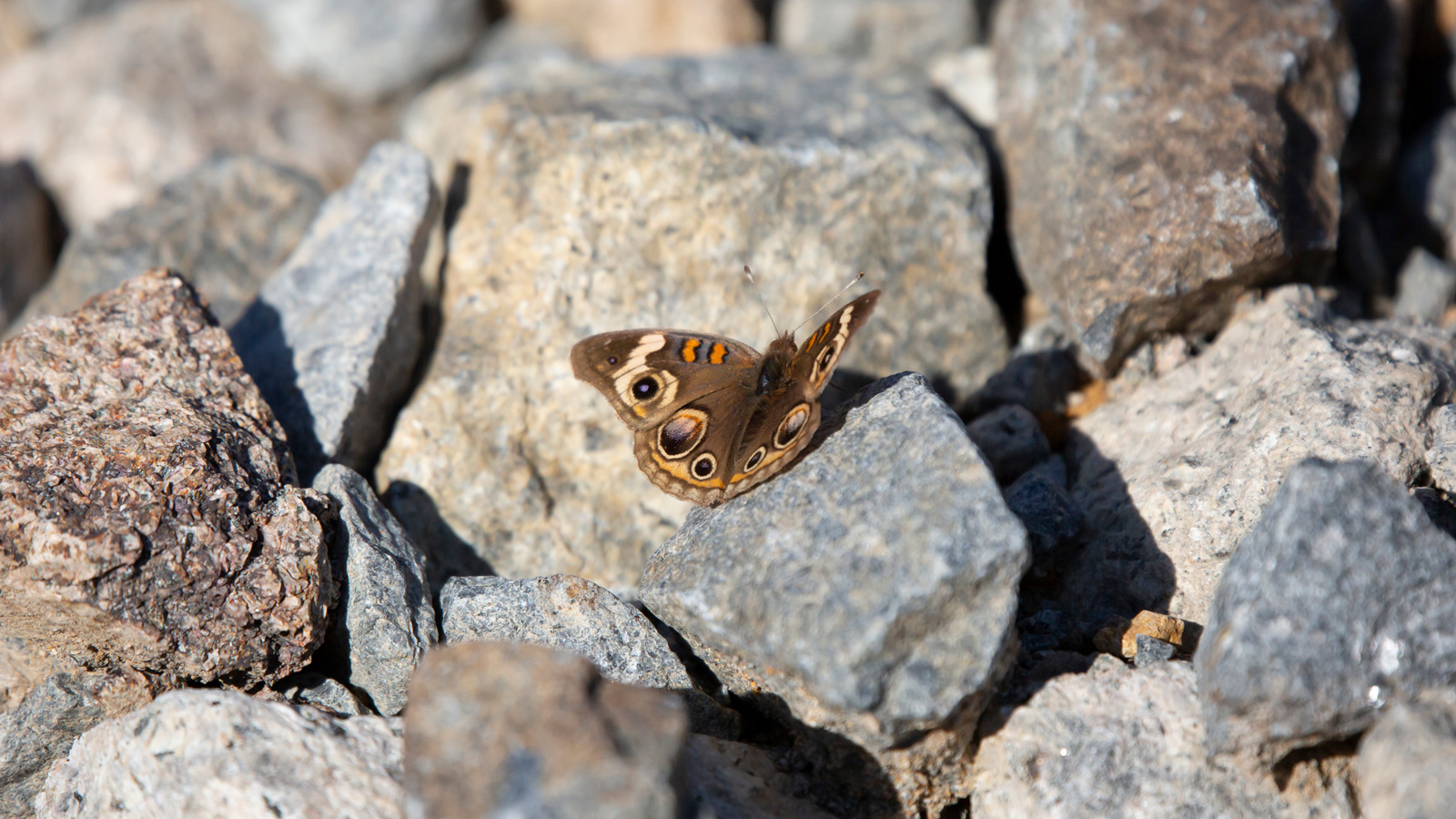
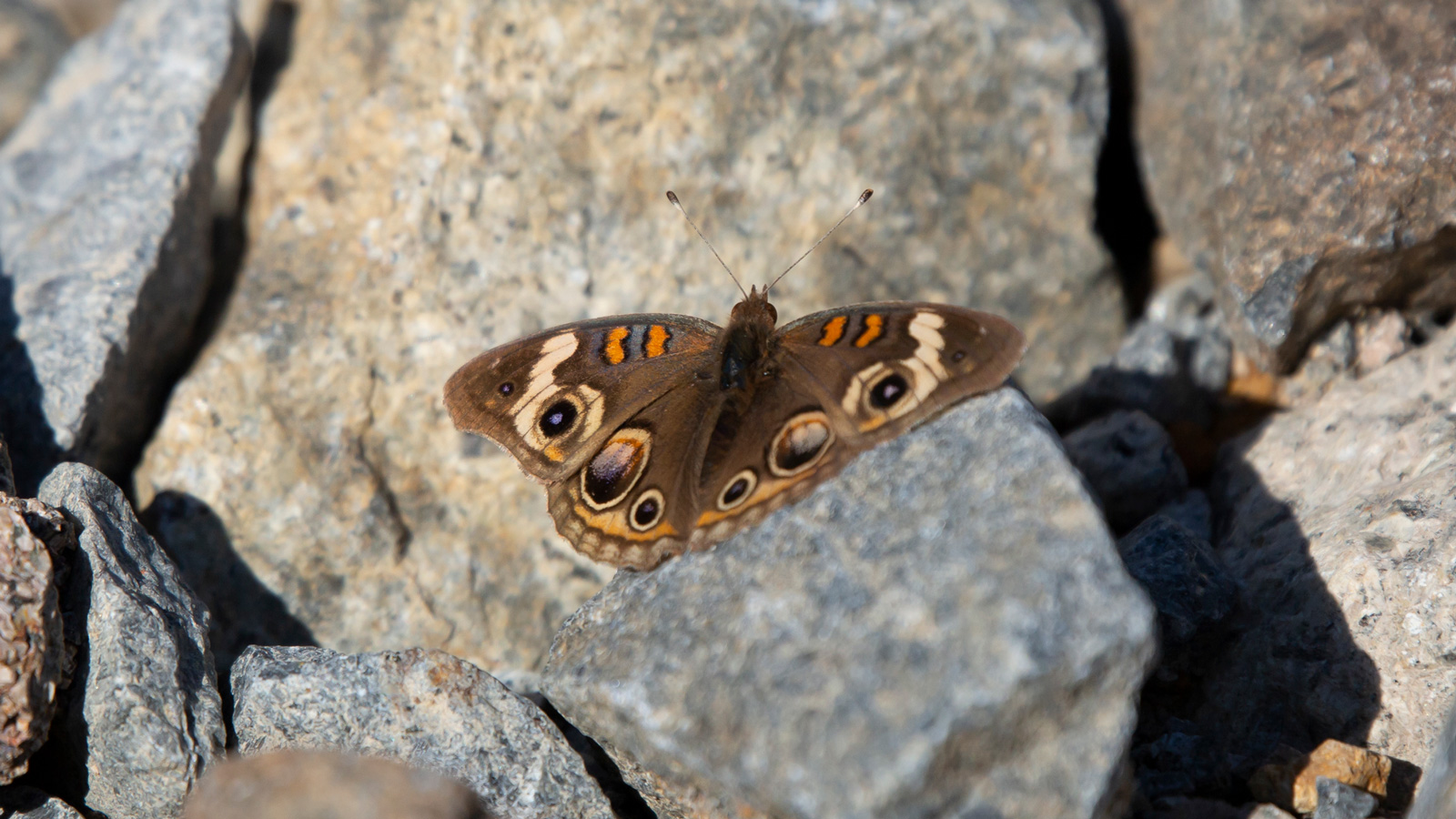
Three eyespots on the upperside, two large on the hindwing and two on the forewing, surrounded by orange, white, and purple, seem designed to unsettle any predator that approaches closely enough to see what landed on that dirt path. They succeed at this more often than predators would prefer.
Junonia coenia ranges through the eastern United States, the Gulf Coast, and into the Caribbean, with North Louisiana's 26 parishes well within its core range. Adults fly from late February through November in most years, with the northern parishes seeing slightly later spring emergence and earlier fall termination than the southern parishes.
The species breeds wherever its host plants grow in open, disturbed, or edge habitats throughout the region, which in North Louisiana covers most of the landscape outside of closed-canopy forest. Junonia coenia turns up genuinely common, present in every parish, active across a long season, and findable at any open or semi-open site with bare ground and flowering plants from early spring through late fall.
What the Common Buckeye Actually Looks Like
Adults span two to two and a half inches. The upperside shows brown with the characteristic eyespot arrangement that makes identification immediate. Two large hindwing eyespots carry blue-violet iridescent centers ringed with orange, yellow, and black concentric circles. Two smaller forewing eyespots carry the same ringed pattern at reduced scale. An orange bar crosses the forewing in the costal area. White bands mark the outer forewing margin.
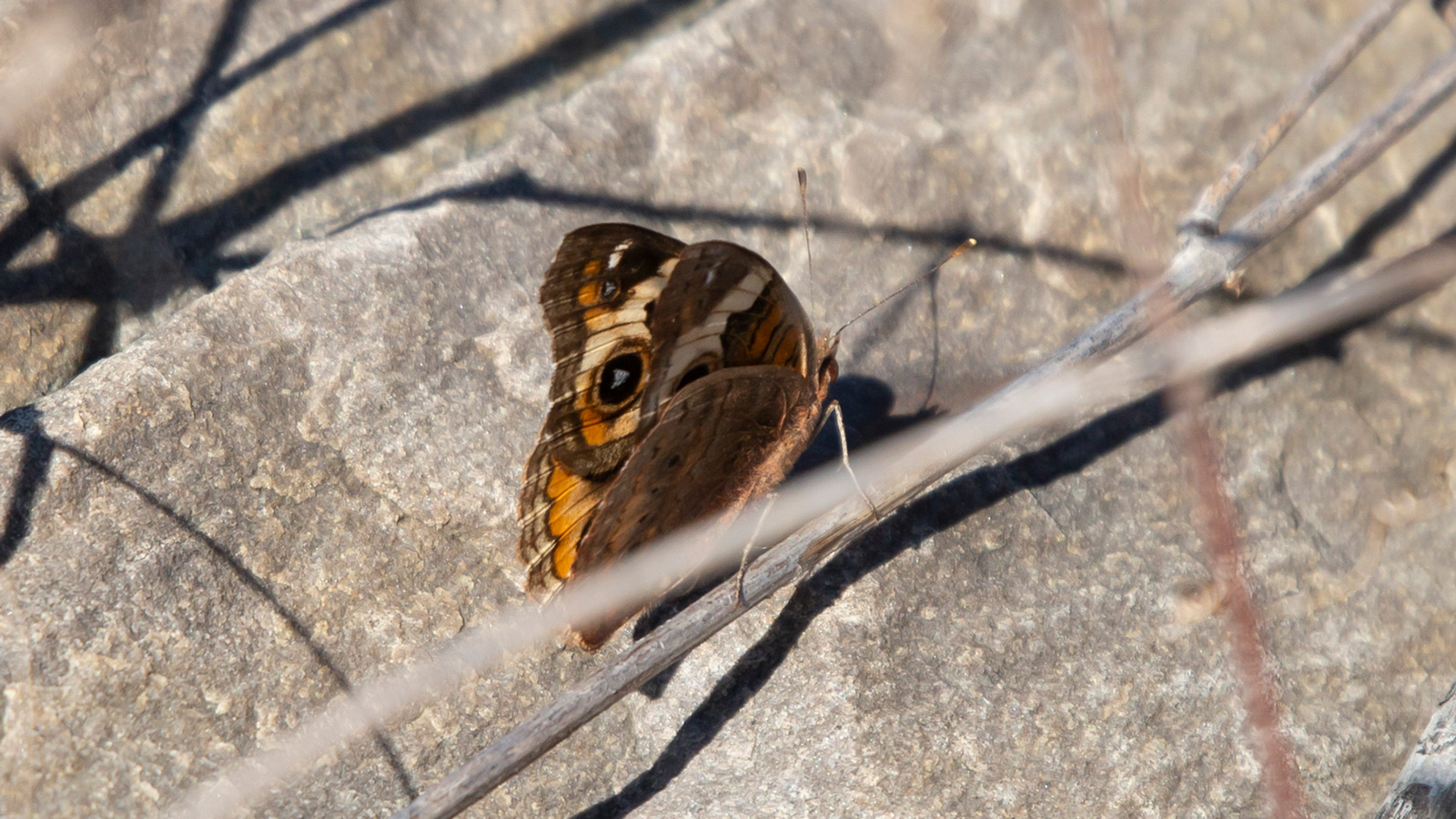
Hindwing underside shows pale brown with reduced eyespot pattern in spring and summer individuals and a reddish-brown coloration in the fall generation, the "rosy" form that produces more richly colored adults in the late season. Both forms belong to the same species. The seasonal color shift reflects developmental responses to temperature and day length during the pupal stage rather than any genetic distinction between populations.
Males hold territories on bare ground, low perches, and open paths, launching to investigate passing insects and other objects, including you. The common buckeye will fly up to a standing human, circle at close range, apparently decide you do not qualify, and return to the perch. Compliment or insult, depending on perspective.
Where the Common Buckeye Lives
Open, disturbed habitats with bare ground components throughout all 26 parishes. Roadsides, fields, beaches, sand flats, agricultural margins, gardens, power line rights-of-way, and any open or disturbed area where host plants grow and bare ground provides thermoregulation and territorial perching sites. The species avoids closed-canopy forest and dense vegetation but uses every open habitat type in North Louisiana including open residential areas, park lawns with flowering borders, and athletic fields with adjacent native plant margins.
Host plants include plantain species, Plantago lanceolata and Plantago major, both common roadside and lawn weeds throughout the 26 parishes, as well as gerardia species, false foxglove, toadflax, and members of the snapdragon family. The host plant list includes many of the most common weedy plants in North Louisiana's disturbed habitats, which partly explains the species' abundance. Where there are roads, lawns, and disturbed ground, plantain grows. Where plantain grows, buckeyes breed.
Advertisement
The Caterpillar's Year
Multiple broods in North Louisiana, with adults present from late February through November. First-generation adults emerge from winter-dormant chrysalises or arrive from farther south in late February and early March. Each subsequent warm-season generation takes four to six weeks from egg to adult. Late-season caterpillars form the chrysalises that produce the fall rosy-form adults, some of which migrate south and some of which attempt winter survival in the southern parishes.
Caterpillars run dark, almost black, with orange lateral stripes and rows of branched spines. The coloration advertises toxicity despite the caterpillar lacking significant chemical defense, a case of false advertising in which the spiny appearance and dark coloration suggest defensiveness to predators that have learned to avoid defended caterpillars elsewhere. Iridescent blue spots appear on late-instar caterpillars above the lateral stripes.
Eggs land singly on host plant leaves. The caterpillar feeds exposed on the leaf surface, no shelter, warning colors fully displayed, zero subtlety. Multiple caterpillars on one plantain plant in late summer look alarming from a distance and less alarming once identified. Still a lot of spines for a roadside weed situation.
What the Common Buckeye Eats
Adults nectar at a wide range of flowering plants. Preferred nectar sources in North Louisiana include native thistles, chicory, ironweed, asters, native clovers, and any open-faced flower accessible to the buckeye's proboscis. The species shows strong preference for low-growing flowers in open areas, consistent with its ground-perching habits and open-habitat orientation.
Adults also mud-puddle at damp bare soil for moisture and dissolved minerals. Wet road shoulders, stream margins, and damp sandy areas throughout the 26 parishes draw puddling adults, particularly males, through the warm season.
Caterpillars feed on the foliage of host plants in the plantain and snapdragon families. Plantain foliage provides the primary diet at most North Louisiana sites given plantain's ubiquity in disturbed habitats. The feeding does not damage plantain plants significantly at the individual level, and caterpillar populations on a plantain colony cause no lasting harm to the host plant population.
What Eats the Common Buckeye
The eyespots function as predator deflection structures by mimicking the eyes of a larger animal, triggering a startle or avoidance response in birds and lizards approaching from above or the side. Experimental work confirms that eyespot patterns on butterfly wings reduce predation rates by causing hesitation in naïve predators. For experienced predators that have learned that eyespots on butterflies do not indicate a dangerous animal, the deflection value diminishes but the eyespot may still redirect strikes away from the body toward the wing margin.
Eastern kingbirds, summer tanagers, and loggerhead shrikes take adults in flight and at perch sites from April through October. Robber flies intercept adults in flight. Crab spiders ambush adults at nectar sources. The ground-perching territorial behavior of males increases their exposure to terrestrial and aerial predators compared to species that spend less time perched in open exposed positions.
Caterpillar predation moves through parasitoid wasps, tachinid flies, and direct predation by birds. The branched spines make caterpillars mechanically difficult for some bird species to handle without preparation, reducing but not eliminating direct avian predation. Paper wasps take caterpillars for larval provisions.
Advertisement
Telling the Common Buckeye from Similar Species
No other butterfly in North Louisiana carries the common buckeye's four-eyespot arrangement. The identification ranks among the most straightforward in the region for any observer who sees the upperside of a perched individual. Even at distance, the eyespot pattern visible on a perched buckeye identifies the species from across a path before any detail examination begins.
The hindwing underside of fall rosy-form individuals shows less of the eyespot pattern and more uniform reddish-brown, which creates brief uncertainty in observers who have only seen the upperside. Flipping the mental image from the upperside pattern to expect a different underside pattern in fall individuals resolves that uncertainty. The size, around two and a half inches, and the open-habitat perching behavior remain consistent between forms.
The Common Buckeye and North Louisiana's Open Landscapes
Junonia coenia did not decline when people altered the North Louisiana landscape. It moved in. Every mowed right-of-way, every lawn margin with plantain, every bare dirt path through a park, every gravel road shoulder, these are buckeye habitat. The species responded to the human-modified landscape of North Louisiana's 26 parishes not by declining but by expanding, following the spread of disturbed open habitat across the region wherever it appeared.
Being common does not make the eyespots less interesting. Nothing else in North Louisiana looks like this. The territorial male returns to the same perch every time. In October it carries a different hindwing color. Both things reward showing up. A species that turns up on every open path and every bare road shoulder through most of the year and still carries that eyespot display earns a second look every time it lands.
Seasons and the Rosy Fall Form
The common buckeye flies in North Louisiana from late February through November in most years. The spring and summer generations produce the standard brown-above, pale-below adults. The fall generation, developing under shorter day length and cooler temperatures in August and September, produces the rosy-form adults with reddish hindwing undersides that appear in October and November.
Some fall-form adults migrate south toward coastal areas. Others attempt winter survival as adults in the southern parishes in warm years. Neither outcome produces reliable winter records in North Louisiana, and the population that initiates spring breeding in most years arrives from farther south rather than surviving locally as adults through winter. Chrysalises survive short cold periods but do not withstand extended freezes in the northern parishes.
The Eyespot Mechanism
The eyespot pattern on the common buckeye's upperside represents one of the better-studied predator deterrence mechanisms in butterfly biology, and the North Louisiana buckeye population carries a version of it that researchers have used in wing-clipping experiments, digitally modified image studies, and field observations to understand how it works.
Those large hindwing eyespots probably do two things, possibly at the same time. First: they startle birds and lizards that have never seen the pattern. Something that size staring back at you from the ground when you expected a brown leaf, that moment of hesitation has a name, and the buckeye lived off it for millennia.
A bird approaching a perched buckeye from above receives a sudden view of two large eyes staring directly at it from what was previously a brown object on the ground. That startle response, even if brief, gives the butterfly time to escape.
Second, for experienced predators that have learned that butterfly eyespots do not indicate a dangerous animal, the eyespot may still redirect attacks toward the wing margin rather than the body. A bird striking at the largest visual element in the target pattern, the eyespot, misses the body and removes or damages wing tissue that the butterfly survives without fatal consequence.
Wing damage patterns in wild buckeye populations show the beak marks and missing scales consistent with near-miss strike patterns concentrated at the eyespot position, which supports the deflection hypothesis.
Both mechanisms need the predator to be looking. Against parasitoid wasps that find caterpillars by smell, the eyespots do nothing. That's a different problem with different defenses.
Advertisement
The Common Buckeye and North Louisiana's Roadsides
North Louisiana's roadside habitat supports the common buckeye at higher density than most other open-country habitats in the region, because roadsides combine several requirements simultaneously: bare or sparsely vegetated shoulders for thermoregulation and territorial perching, abundant plantain and snapdragon-family host plants in the disturbed soil margins, and diverse native wildflowers at the roadside edge for adult nectar foraging. That combination of requirements in a linear habitat threading through every parish in the 26-parish region explains the buckeye's ubiquity in North Louisiana better than any single factor.
Roadsides with native plant diversity, where mowing schedules allow the full roadside flora to develop, support the highest-density buckeye populations. The native thistles, ironweed, asters, and goldenrod that persist in unmowed roadside margins through August and October provide the nectar that fuels fall-generation adults and migrants. Roadsides mowed in September, just before or during peak fall adult abundance, remove that nectar resource at the time of highest demand.
The plantain host plants in roadside disturbed margins tolerate mowing and resprout rapidly, so mowing does not eliminate the breeding habitat in the way that total vegetation removal would. But the nectar reduction from late-season mowing reduces adult foraging success and fall migration fuel availability. In parishes where roadsides go unmowed from August through October, the native wildflower diversity and the adult butterfly populations that depend on them both show the benefit of that management choice.
Behavior at Territorial Perch Sites
Territorial perching behavior gives field naturalists one of the more reliably watchable behaviors in North Louisiana's butterfly community. Males at established perch sites on bare ground or low perches in open areas return to the same location repeatedly after investigation flights, making them predictable and approachable in a way that nectaring butterflies at visited flowers are not.
A male at an established perch site investigates virtually everything that moves within its territory. Other butterflies, insects, falling leaves, shadows, and human observers who stand within territory range all trigger investigation flights. The buckeye launches, circles the intruder at close range, sometimes hovering briefly in direct examination, and returns to the perch if the intruder does not represent a rival male or a female.
That close-approach behavior makes the common buckeye one of the most intimately observable species in North Louisiana, with the eyespot pattern and wing details resolvable at the distance the male itself closes during investigation.
A female doing oviposition work on plantain, hovering, touching leaves, moving on, tells you exactly where to find eggs. Follow her instead of searching on your own.
Supporting Common Buckeyes in North Louisiana
Plantain, both Plantago lanceolata and Plantago major, grows freely in disturbed soil throughout North Louisiana and needs no planting assistance in most gardens and lawns. The more practical support for buckeye populations comes down to what to not do: not treating plantain as a lawn weed that needs elimination, not mowing roadsides and margins in late August through October when native wildflowers provide peak nectar, and not applying broadleaf herbicides to roadside and field margins where buckeye host plants and nectar sources grow together.
Gerardia species and false foxgloves in native plant margins and old field edges provide additional host plant options for gardeners who want to move beyond plantain tolerance into active planting. Several snapdragon-family plants available from native nurseries in the Gulf South support buckeye breeding and add flowering interest to open garden borders through summer and fall.
Native nectar sources, native thistles, ironweed, and asters in particular, planted or maintained in open sunny areas attract and support adult buckeye populations through the fall peak period when fall-generation adults are most abundant and the rosy-form coloration peaks.
Advertisement
Migration and the Fall Generation
Fall migration in the common buckeye moves south and southwest through North Louisiana in September and October, with the rosy-form adults of the fall generation participating in this movement. The migration lacks the concentration of the monarch migration and does not produce roost aggregations, running instead as a steady directional movement of individuals through open habitat during the migration window.
At a productive native wildflower patch on a north-facing roadside in October, the common buckeye activity includes both resident individuals nectaring at local flowers and migrants passing through and fueling briefly before continuing south. Distinguishing resident from migrant behavior needs sustained observation of individual movements: a resident male returns to a perch site repeatedly; a migrant nectars for a period and then departs in a southward direction without returning.
Fall migration timing in North Louisiana correlates roughly with cold front passages, with adult abundance increasing ahead of fronts and directional movement increasing in the period of clear weather following frontal passage. That same weather pattern produces the largest monarch concentrations, and fall days with active monarch movement often carry simultaneous buckeye movement through the same open corridors.
Documentation Value
Common buckeye documentation from North Louisiana, while representing a common species, contributes useful data to questions that remain imperfectly answered. The timing of the rosy-form appearance varies by year and location, and systematic documentation of when the first rosy-form adults appear in the 26 parishes and how that timing tracks with temperature patterns improves the understanding of the developmental cues that trigger the seasonal color shift.
Migration timing relative to weather patterns, especially in how buckeye movement correlates with or diverges from monarch migration timing, remains undocumented in North Louisiana in any systematic way. iNaturalist observations with date, GPS location, and notes about directional movement versus resident behavior contribute to that record more usefully than simple presence observations.
How to Find Common Buckeyes in North Louisiana
Bare ground in full sun during warm weather from February through November. That summary covers the habitat requirement. A dirt path through a park, a gravel road shoulder, a bare patch in a garden border, a sandy landing at a public boat ramp, any of those holds territorial males through the warm season. The male returns to the same perch site repeatedly, which means locating one male at a specific spot and staying nearby produces a sustained close observation without any chasing involved.
For caterpillar observation, examine the plantain plants growing in roadside margins and lawn edges throughout the 26 parishes from May through October. Plantain grows in disturbed soil throughout all 26 parishes without any planting assistance, and caterpillar presence on plantain leaves shows up as feeding damage and frass on the leaf surface before the caterpillar itself becomes visible. Once frass appears on a plantain plant, examining the leaf underside and stem surfaces near the feeding damage locates the caterpillar at whatever instar it has reached.
The rosy fall form deserves specific searching in October and November. At a native thistle or aster patch in bloom during October, nectaring common buckeyes in the fall generation show the reddish hindwing underside that summer individuals lack. Comparing the October individual to a summer individual in field notes or photographs documents the seasonal variation that the rosy form represents, which improves both the observer's understanding of the species and the regional phenology record.
Advertisement
North Louisiana's Common Buckeye in Context
Junonia, the genus, covers tropical and subtropical open-habitat butterflies spread globally. The common buckeye got the North American assignment, which involves a lot of bare dirt paths and roadside plantain rather than tropical beaches, and seems perfectly content with the arrangement. Other Junonia species occur in the Caribbean and Central America. The white peacock, Junonia coenia's Caribbean relative, sometimes turns up in coastal Louisiana following tropical weather systems and represents a southern Junonia occasionally reaching the Gulf South.
That global context for what looks like a common roadside butterfly underscores the biogeographic interest of North Louisiana's position at the northern edge of the Gulf Coast subtropical zone. Species with tropical affinities reach their northern limits in or near North Louisiana, and the common buckeye, a warm-climate species whose populations do not survive harsh northern winters as adults, represents one of the more successful examples of a warm-climate butterfly that extended its range northward by tracking the modified human landscape.
The eyespots, the territorial perching, the rosy fall form, the plantain host plant association: all of these belong to a species that managed to colonize an entire continent's disturbed habitats by being flexible about host plants, aggressive about territory, and dramatic about presence.
Advertising works on predators and observers alike. That combination of traits, paired with a wing pattern that stops people mid-walk, explains why the common buckeye tends to generate more field observation time per individual than many more celebrated butterfly species. Something about those eyespots commands the attention. Every naturalist who has had a male buckeye investigate them at close range understands the mechanism from both directions.
The Fall Window
October represents the optimal observation window for common buckeyes in North Louisiana, for several reasons that converge in that single month. First, the fall-generation rosy-form adults appear in October, adding a color variation that summer observation does not produce. Second, fall migration pushes adults from farther north through the 26 parishes, increasing local adult density at nectar sources. Third, native wildflowers, asters, goldenrod, and late-season thistles reach peak bloom in October, concentrating both residents and migrants at the same flowers.
A roadside native wildflower patch in October in any of the upland parishes, walking distance from a vehicle, reliably carries common buckeyes alongside monarchs, cloudless sulphurs, and other fall-migrating species.
The concentration of multiple butterfly species at one nectar site rewards the extended observation time that separates an incidental sighting from a meaningful field encounter. The common buckeye at such a site in October carries the rosy hindwing underside that makes it worth documenting as a fall individual distinct from the summer form.
For observers who have only seen common buckeyes in summer, the October form at a native wildflower patch in October provides a reference experience that adds a seasonal dimension to the species' natural history in North Louisiana. Both forms belong to the same butterfly, present in the same 26 parishes, on the same open paths and roadsides, with the same eyespot display and the same territorial behavior. The season changes the hindwing color. Everything else stays constant.
That constancy, the reliable presence from February through November on the same open paths in the same 26 parishes, means the common buckeye accommodates observation at whatever season a person decides to pay attention. The species does not hold back for optimal conditions. It shows up on the path and waits for whoever arrives to notice it.
Advertisement
Accessibility
Male common buckeyes at territorial perch sites on bare ground or low perches in open areas produce a soft, rapid wingbeat audible at close range in still conditions. The perch-and-return behavior of territorial males makes them predictable at specific locations, audible from a few feet before they become visible against the ground, and reliably present at the same perch site over the course of hours or days.
The eyespot display on a perched individual shows from several yards and identifiable across a garden, park path, or roadside margin without close approach. Males at perch sites in open areas across the 26 parishes sit at standing height from maintained paths, road shoulders, and park surfaces from late February through November. Any open, sunny path with bare ground qualifies as a territorial perch site during the warm season.
More Information
Resources: the North American Butterfly Association at naba.org maintains Louisiana identification resources including both common and rosy-form documentation. iNaturalist accepts common buckeye observations from all 26 North Louisiana parishes with expert Lepidoptera review. Butterflies and Moths of North America at butterfliesandmoths.org carries Louisiana range data and distinguishes seasonal form variation in the documentation.
Every open path in North Louisiana has a common buckeye on it at some point between February and November. The eyespots stare back. The territorial male investigates and returns to the perch. The rosy-form adults in October carry a color that summer individuals do not.
All of that happens on the dirt path behind the house, the gravel road to the deer stand, the sidewalk through the park. The species does not require special trips to find. It needs only looking down at the open ground where it already sits.
Common buckeyes sit on the paths of North Louisiana in every warm month of the year. The eyespots draw attention every time. The territorial male investigates every observer who enters the territory and returns to the perch when the observer does not qualify as a rival or a mate.
The rosy form appears in October and persists through November in warm years. None of this needs a specific destination or a rare weather event. It needs a path with bare ground and a month with warmth. North Louisiana provides both for most of the calendar year. It needs only the path and the willingness to look down. North Louisiana has all three conditions covered for ten months of every year.
That counts. Considerably. The buckeye sits on the path and waits. That part has not changed. The path existed before. The buckeye found it. Nothing about that arrangement needs to change. North Louisiana keeps that promise every October. Every warm month of the year. Same path. Same eyespots. Same buckeye. Every year that North Louisiana has open paths and warm months, which covers every year on record, the common buckeye holds its territory on them. It always has.
META TITLE: Common Buckeye in North Louisiana | NLW
META DESCRIPTION: The common buckeye turns up on open paths and bare ground throughout North Louisiana from February through November. The four eyespots identify it immediately. The fall rosy form rewards fall watching.
FOCUS KEYPHRASE: common buckeye butterfly North Louisiana
SECONDARY KEYWORDS: Junonia coenia Louisiana, buckeye butterfly Louisiana, butterfly eyespot identification, common buckeye caterpillar, rosy form buckeye fall, open habitat butterfly Louisiana, common buckeye host plant, North Louisiana butterfly identification, buckeye butterfly garden
OG DESCRIPTION: The common buckeye sits on open ground throughout North Louisiana with four eyespots staring at whatever approaches. It breeds on roadside plantain, peaks in fall in a rosy color form, and turns up on every open path in the 26 parishes from February through November.
SLUG: common-buckeye-north-louisiana
Advertisement
Photo Gallery

Advertisement
Accessibility
## Accessibility
Male common buckeyes at territorial perch sites on bare ground or low perches in open areas produce a soft, rapid wingbeat audible at close range in still conditions. The perch-and-return behavior of territorial males makes them predictable at specific locations, audible from a few feet before they become visible against the ground, and reliably present at the same perch site over the course of hours or days.
The eyespot display on a perched individual shows from several yards and identifiable across a garden, park path, or roadside margin without close approach. Males at perch sites in open areas across the 26 parishes sit at standing height from maintained paths, road shoulders, and park surfaces from late February through November. Any open, sunny path with bare ground qualifies as a territorial perch site during the warm season.
Advertisement