Advertisement
Fun Facts
Did You Know?
Broad white patches on the wings of a stocky dragonfly perched on a sun-warmed rock at the pond edge, and the white flashed with every territorial launch the way a referee's shirt flashed at every foul.
If This Animal Could Talk...
"Look at my habitat, season, and behavior first. Those clues tell you what I am before you need a close-up."
Broad white patches on the wings of a stocky dragonfly perched on a sun-warmed rock at the pond edge, and the white flashed with every territorial launch the way a referee's shirt flashed at every foul. The common whitetail (Plathemis lydia) wore the most recognizable wing pattern of any North Louisiana dragonfly: mature males carried broad white pruinose patches across the center of each wing that gave the dragonfly a flying billboard visible at distances where every other dragonfly's wings read as clear or faintly tinted. A whitetail landing on a rock did not arrive quietly. A whitetail arrived waving white flags. About an inch and a half to an inch and three-quarters long, the common whitetail perched on rocks, bare ground, docks, sidewalks, and any flat horizontal surface at North Louisiana ponds from May through October. The dragonfly preferred the hard surfaces the dashers and pondhawks did not claim (rocks, pavement, bare dirt) and occupied the lowest perch stratum at the pond alongside the pondhawk, adding a second ground-perching dragonfly to every North Louisiana pond that offered both vegetation perches and hard surfaces at the waterline. The White Wing Show Mature males earned the "whitetail" name from the broad chalky-white pruinescence that covered the abdomen (the "tail") and from the white-pruinose patches across the center of each broad hindwing. The wing patches sat unique among North Louisiana dragonflies: no other dragonfly wore white on the wings at any life stage, and the white wing patches identified the mature male whitetail at every distance where the patches resolved against the background. The wing patches developed alongside the abdominal pruinescence over the first one to two weeks of adult life. A freshly emerged male wore brown-and-yellow body coloring and clear wings with dark basal patches (wing bases) and dark bands near the wing tips, showing zero white. A two-week-old male wore full white pruinescence on the abdomen and the wing patches had developed enough white to show against the dark bands, creating a three-band wing pattern: dark base, white middle, dark tip. The three-band pattern on each wing looked so distinctive in flight that the whitetail's wingbeat flashed a white-dark-white-dark strobe at every observer and every rival within visual range. Females and immature males wore brown-and-yellow bodies with dark-banded wings (dark base, clear middle, dark tip) that matched the immature male's pattern without ever developing the white patches or the white abdomen. A brown-bodied, dark-winged dragonfly at a North Louisiana pond with the whitetail's stocky body shape and flat-perching posture belonged to the female or immature whitetail, and the wing bands (dark at base and tip without white in the middle) confirmed the identification at close range. The body shape sat stockier and broader than the blue dasher's slender build, and the whitetail's wide, flat abdomen (widest in the middle, tapering toward the tail) gave the dragonfly a chunky profile that no other North Louisiana skimmer matched. A whitetail on a rock looked wider, flatter, and more compact than a dasher on a weed tip, and the body shape told the observer "whitetail" before the wing pattern confirmed the whitetail. The Rock Percher Common whitetails perched on flat, sun-warmed horizontal surfaces: rocks at the waterline, bare dirt, dock boards, sidewalk edges near water, flat logs, and any hard surface the sun heated above the ambient air temperature. The hard-surface perching preference set the whitetail apart from the vegetation-perching dashers, the ground-perching pondhawks (which also used bare ground but preferred soil over rock), and the twig-perching skimmers. A whitetail on a sun-warmed rock at a North Louisiana farm pond in July absorbed heat from the rock through the ventral body surface while absorbing heat from the sun through the dorsal surface, and the dual-source heating gave the rock-perching whitetail a faster warm-up and a higher sustained body temperature than the vegetation-perching species achieved from solar heating alone. The rock functioned as a thermal battery that the dragonfly plugged into, and the battery advantage explained why whitetails claimed rocks over vegetation when both perch types sat available at the same pond. Perch fidelity to a favorite rock ran as strong as the dasher's fidelity to a favorite weed tip. A male whitetail on a flat rock at a Ouachita Parish pond returned to the same rock after every sally, every chase, and every patrol flight, and the observer who found the rock watched the whitetail's entire behavioral cycle from one spot. Dock perching put common whitetails within arm's reach of fishermen, boaters, and lakeside visitors who noticed the white-winged dragonfly landing on the dock boards without knowing the dragonfly's name. A whitetail on a sun-warmed dock plank at a North Louisiana lake behaved as though the dock existed for the dragonfly's thermal needs, and the human traffic on the dock did not dislodge the whitetail from the warm plank unless the human stepped directly at the perching position. The Wing-Flash Display Male whitetails displayed the white wing patches during territorial confrontations by raising the wings above the body and flashing the white surfaces toward the rival male. The wing-flash display happened during the hovering phase of territorial encounters, when two males faced each other over the disputed territory at knee height and each male raised and lowered the wings in alternating flashes that showed the white patches to the rival. The wing-flash display served the same territorial-advertisement function the other dragonflies' aerial chases served, but the whitetail's display added a visual signal (the white flash) that the clear-winged species' chases did not include. A whitetail territorial confrontation gave the observer a visible display to watch: two stocky dragonflies hovering face to face over a rock, each flashing white wings at the other, neither touching, until one male flew away and the winner returned to the contested rock. Display intensity correlated with the territory quality. A male defending a premium rock (large, sun-warmed, at the waterline near good oviposition habitat) flashed more aggressively and for longer duration than a male defending a marginal rock (small, shaded, away from the water). The premium-territory holder invested more display energy because the premium territory attracted more rival challenges, and the display needed to escalate to match the escalating challenge frequency. What the Whitetail Eats Common whitetails hunted from rock perches using the same perch-and-sally technique every skimmer in North Louisiana used, but the rock-perch position gave the whitetail access to a prey stream the vegetation-perching species missed. Flying insects that cruised at six inches to a foot above the ground surface (the height zone between the ground and the lowest weed tips) crossed the whitetail's detection field without crossing the dasher's higher detection field, and the whitetail caught low-flying gnats, midges, and small flies that the dasher's waist-height perch put below the dasher's scanning angle. Mosquitoes got eaten in volume during the summer flight season, and a whitetail on a rock at a North Louisiana farm pond sallied for mosquitoes at the same rates the blue dashers sallied from the weed tips at the same pond. Both species ate mosquitoes. Both species ate gnats and midges. The whitetail added the ground-level prey that the dasher's altitude missed, and the dasher added the waist-level prey that the whitetail's rock position sat too low to intercept efficiently. Butterflies crossed the whitetail's flight path occasionally, and a whitetail that launched from a rock and caught a passing skipper butterfly consumed a prey item that weighed more than a dozen gnats and delivered a calorie bonanza the gnat-by-gnat sallying did not match. Butterfly catches happened less frequently than gnat catches because butterflies crossed the rock less frequently than gnats did, but the calorie payoff per butterfly catch exceeded the payoff per gnat catch by an order of magnitude. The May-to-October Calendar Common whitetails in North Louisiana flew from May through October, with peak numbers in June and July when the spring emergence wave put maximum adults on the rocks at every pond in the 26 parishes. May brought the first adults at warm-water ponds with sunny rock edges. June peaked the population. July maintained peak density. August and September gradually thinned the adult count as the oldest dragonflies died and the emergence rate slowed. October brought the last adults at warm, sunny ponds before the cooling weather ended the flight season. The long flight season matched the blue dasher's calendar almost exactly, and both species coexisted at shared ponds for the entire May-through-October window. A North Louisiana farm pond with rocks at the waterline and weed tips above the rocks held whitetails on the rocks and dashers on the weed tips simultaneously from May through October without either species displacing the other, and the perch-type separation (rock versus vegetation) kept the two common pond dragonflies out of each other's territories. Cool mornings delayed the whitetail's first flight until the rocks warmed above the air temperature, and a whitetail on a cold rock at 7 a.m. sat motionless waiting for the sun to heat the rock before the rock heated the body. A dasher on a weed tip at the same hour waited for the sun to heat the air and the body directly without any rock intermediary. The whitetail's warm-up depended on rock temperature. The dasher's warm-up depended on air temperature. Both reached flight readiness at roughly the same mid-morning hour on most summer days. The Obelisk on the Hot Rock Common whitetails performed the obelisk posture on hot rocks during peak afternoon heat, pointing the white abdomen straight at the sun to minimize the solar heat load the same way the blue dasher pointed the blue abdomen skyward. A whitetail in obelisk posture on a sun-warmed rock at a July pond absorbed heat from the rock below and from the sun above simultaneously, and the dual heat source pushed the whitetail into the obelisk posture earlier in the afternoon than the vegetation-perching dashers reached the same thermal stress. The obelisk on the rock created a visual spectacle: a stocky dragonfly with white wings spread flat on a dark rock and a white abdomen pointing straight up at the sky. A field of obelisk-posture whitetails on the rocks at a North Louisiana pond margin in July looked more monument than insect, and the obelisk posture earned more photographs from casual visitors than the normal flat-perching posture because the pose looked so unusual to non-dragonfly observers. Hot-rock avoidance during the hottest afternoon hours pushed whitetails off the rocks entirely and onto cooler perches (shaded ground, vegetation, or a different rock in partial shade) until the afternoon heat broke. A whitetail that abandoned a premium sunlit rock at 2 p.m. and returned to the same rock at 4 p.m. lost two hours of territorial defense and two hours of mating opportunity to the thermal budget, and the lost hours mattered at ponds where rival males waited for exactly this thermal vacancy to claim the abandoned rock. The Pond-Bottom Naiad Common whitetail naiads developed in the mud and debris at the bottom of ponds, lakes, and slow waterways, following the standard skimmer naiad pattern. Development lasted several months to a year in North Louisiana's warm water. The naiad fed on mosquito larvae, midge larvae, and small aquatic invertebrates, and the naiad's wide, flat body shape (matching the adult's stocky build) gave the naiad a low profile in the sediment that the rounder-bodied naiads of other species did not share. The flat naiad body sat an adaptation to concealment in shallow sediment: a whitetail naiad partially buried in the pond-bottom mud showed less vertical profile above the sediment surface than a round-bodied dasher naiad at the same burial depth, and the lower profile reduced the naiad's visibility to fish scanning the bottom for prey. Flat meant hidden while round meant exposed, and the adult's stocky build traced back to the naiad's flat concealment strategy in the mud. Emergence peaked in May and June at North Louisiana ponds, with the first adults appearing on sun-warmed rocks at the waterline within hours of climbing free of the larval skin. A freshly emerged whitetail on a rock at a Lincoln Parish pond dried the wings, waited for the flight muscles to harden, and launched into the first adult flight before noon on the emergence day. Mating and the Rock Territory Males defended territories centered on the best sun-warmed rocks at the pond margin, and the territory included the rock (perching and display station), the adjacent waterline (oviposition habitat), and the airspace above both (patrol and feeding zone). Mating involved the tandem grab, wheel formation on the rock or in flight, and immediate separation followed by the female's oviposition flight over the open water near the defended rock. Females oviposited by tapping eggs onto the water surface in rapid dipping flights that covered ten to twenty feet of waterline per bout. Males guarded the ovipositing female from the rock perch, launching to chase rival males that approached within the territory during the female's egg-tapping run. A male on a rock and a female dipping eggs over the adjacent water ran the same division of labor every other skimmer pair ran, with the rock substituting for the weed tip as the guard station. Multiple matings per day happened at busy ponds during peak season, and a territorial male at a premium rock mated with every visiting female that entered the territory and accepted the approach. A male at a Lincoln Parish farm pond mated with three different females during a single afternoon observation session, and each mating-to-oviposition sequence lasted under five minutes. The White Abdomen The white pruinescence on the mature male's abdomen served the same species-identification and territorial-display functions the white wing patches served, and the white abdomen combined with the white wing patches to make the mature male whitetail the most visually conspicuous dragonfly at any North Louisiana pond. A male whitetail perched on a dark rock with white wings spread and a white abdomen pointing skyward in obelisk posture created a white-on-dark contrast that caught every eye at the pond, including the eyes the whitetail would have preferred to avoid. Conspicuousness cost the whitetail predation exposure that the darker, less visible species did not pay. A kingbird scanning the pond margin for dragonfly prey spotted the white whitetail on the dark rock before the kingbird spotted any darker-bodied dragonfly at the same pond, and the white coloring that attracted mates and warned rivals also attracted predators at the same visual range. The whitetail paid for territorial advertisement with predation risk, and the trade worked because the mating success the white coloring earned exceeded the predation cost the white coloring imposed across the population. The Whitetail and the Pondhawk Common whitetails and eastern pondhawks shared ground-level perching habitat at many North Louisiana ponds, and the two species' overlap at the lowest perch stratum created interactions that the higher-perching species avoided. A pondhawk on bare ground and a whitetail on a rock three feet away sat at the same altitude in the same light in the same temperature zone, and territorial encounters between the two species happened regularly at shared ponds during peak season. The pondhawk won most confrontations through aggression rather than through size (both species measured roughly the same length). A pondhawk that approached a whitetail's rock chased the whitetail off the rock with a pursuit intensity the whitetail's wing-flash display could not counter, and the pondhawk's willingness to escalate from display to chase to physical contact exceeded the whitetail's willingness to fight at every level. A whitetail displaced from a rock by a pondhawk relocated to a different rock rather than contesting the eviction. Pondhawk dominance over the whitetail at ground level matched the pondhawk's dominance over the blue dasher at the same pond, and the pondhawk's aggressive temperament gave the green (or blue) dragonfly territorial priority at every shared perch regardless of the competitor's species. A North Louisiana pond with pondhawks, whitetails, and dashers sorted the three species by aggression tolerance: pondhawks took what the pondhawks wanted, whitetails took the remaining rocks, and dashers took the weed tips above both. What Hunts the Common Whitetail Eastern kingbirds and other sallying birds caught whitetails from utility wires and high branches above the pond margin. A kingbird on a wire above a farm pond sallied for a whitetail on a rock below, and the whitetail's exposed rock-perching position gave the bird a visible, stationary target at a predictable location. Larger dragonflies (common green darners) caught whitetails from above during patrol. A darner descending from head height intercepted a whitetail launching from a rock with the same size advantage the darner used on every smaller dragonfly. Bullfrogs at the waterline caught whitetails from rocks within tongue range, and the whitetail's rock-perching habit put the dragonfly on the same flat surfaces the bullfrogs used for basking. A bullfrog and a whitetail on adjacent rocks at a pond margin sat predator and prey within one tongue-length of each other. Spiders caught whitetails in webs at the pond margin, and the whitetail's broad wings and stocky body gave the web more contact surface per encounter than the slender-winged damselflies provided. Where to Look Every North Louisiana pond, lake, and reservoir with rocks, bare ground, or hard surfaces at the waterline from May through October. Scan the rocks, the dock boards, the bare dirt, and every flat sun-warmed surface within ten feet of the water. A white-winged dragonfly on a dark rock belonged to the common whitetail before any other field mark entered the conversation, and the white wings told the whitetail from fifty feet without binoculars. Farm ponds with rocky edges, fishing piers and boat docks at North Louisiana lakes, concrete spillways at municipal reservoirs, and any hard surface near water attracted whitetails during the summer flight season. Black Bayou Lake docks, Poverty Point Reservoir fishing piers, and the rock edges at Caney Lakes put whitetails within arm's reach of every lakeside visitor. Sidewalks, parking lots, and paved paths near water attracted whitetails that treated the human-made surfaces as oversized warm rocks, and a whitetail perched on a parking lot at a North Louisiana lake sat the most commonly encountered dragonfly by non-dragonfly-watchers because the dragonfly chose the surface the humans walked on. Photographing the Whitetail The common whitetail gave photographers the highest-contrast dragonfly portrait in North Louisiana because the white wing patches and white abdomen on a dark rock created a composition the camera's exposure meter handled better than any low-contrast dragonfly-on-vegetation shot. White wings on dark rock gave the camera a contrast target the autofocus locked on immediately. The photograph showed the wing pattern at full resolution without the focus-hunting problems that green-on-green or brown-on-brown dragonfly portraits created. A phone camera at two feet captured the three-banded wing pattern, the white abdomen, and the stocky body shape clearly enough that the photograph identified the whitetail on the screen without any field-guide cross-reference. The rock-perching habit kept the whitetail stationary for minutes at a time, and the stationary subject on a stable platform (rock, dock, sidewalk) gave the photographer a focus opportunity that the weed-tip-swaying dashers and the ground-shuffling pondhawks did not match. The wing-flash display between rival males gave the action photographer a behavioral sequence worth waiting for: two whitetails hovering face to face, wings flashing white in alternating strokes, both dragonflies within three feet of the observer's rock-level camera position. A camera at rock height aimed at a territorial confrontation caught the display at eye level with both combatants in the frame, and the white-flash sequence gave the burst-mode photographer multiple usable frames per confrontation. The Dock Visit Easiest common whitetail encounter in North Louisiana required no binoculars, no field guide, and no walk through the vegetation: sit on a fishing dock at any North Louisiana lake during a summer afternoon and wait. A whitetail landed on the dock boards within ten minutes at most lakeside docks during the May-through-October flight season, perched within arm's reach of the seated observer, and displayed the white wing pattern at a distance measured in inches rather than in feet. Dock encounters introduced more non-birders to dragonfly watching than any other dragonfly encounter in the 26 parishes because the encounter happened on the human's surface rather than on the dragonfly's vegetation, and the human did not need to enter the dragonfly's habitat to see the dragonfly. A fisherman who came to the dock to fish and noticed "that white-winged bug" on the dock plank between the tackle box and the bait bucket saw a common whitetail at closer range than most dedicated dragonfly watchers achieved at the waterline, and the fisherman's encounter happened without any intent to watch dragonflies at all. Parking lots near North Louisiana lakes attracted whitetails to the sun-warmed asphalt during summer, and a whitetail perched on the black pavement at a boat ramp parking area sat the most accessible dragonfly encounter available because the observer arrived at the dragonfly by driving rather than by walking. A vehicle parked at any North Louisiana boat ramp between June and August found whitetails on the pavement within twenty feet of the parking spot, and the dragonfly's tolerance for vehicle traffic put the whitetail within viewing range without anyone opening a car door. The First Dragonfly For many North Louisiana residents, the common whitetail sat the first dragonfly they ever noticed by name because the white wing patches gave the dragonfly a visual distinctiveness that the clear-winged, brown-bodied majority of dragonflies did not carry. A blue dasher on a weed tip blended into the pond's visual background. A whitetail on a rock flashed white against dark and demanded the viewer's attention whether the viewer intended to watch dragonflies or not. The whitetail's dock-and-sidewalk habit put the dragonfly in front of people who never visited a pond edge for wildlife purposes, and the casual encounters at human-built surfaces converted more non-watchers into "I saw this dragonfly with white wings" conversations than any other North Louisiana dragonfly converted through deliberate observation. The whitetail did not wait for the observer to come to the pond. The whitetail came to the parking lot, the dock, and the sidewalk, and the encounter happened on the observer's terms rather than on the dragonfly's terms. Where to Learn More Dennis Paulson's Dragonflies and Damselflies of the East covers the common whitetail's three-banded wing pattern, the rock-perching behavior, and the wing-flash territorial display that no other North Louisiana dragonfly attempted. OdonataCentral.org maintained records and photographs for the common whitetail's Louisiana distribution. Experiencing This Dragonfly: Accessibility Notes Common whitetails make no sound human ears detect, but the white wing patches and the rock-perching habit made visual detection among the easiest of any North Louisiana dragonfly. A white-winged dragonfly on a dark rock at the pond margin caught the eye at distances where every other dragonfly's wings stayed invisible, and the high-contrast white-on-dark pattern identified the whitetail without binoculars from across the pond. For anyone with mobility limitations, the common whitetail perched on docks, sidewalks, and paved surfaces near water that offered the most accessible dragonfly-watching positions at any North Louisiana lake or pond. A wheelchair on a fishing pier, a park bench at a lakeside sidewalk, or a vehicle parked near a boat ramp put the observer on the same hard surfaces the whitetails used, and the dragonfly landed within arm's reach of the observer's position without anyone needing to leave the accessible surface.
Advertisement
Seasonal Activity Pattern
When you're most likely to spot Common Whitetail in North Louisiana, broken down by season. Activity shifts with temperature and daylight — what's nocturnal in a Louisiana summer may be out at midday in January.
Spring
Mar – May
Dawn
Morning
Midday
Evening
Night
Active when weather and habitat conditions fit the species profile.
Summer
Jun – Aug
Dawn
Morning
Midday
Evening
Night
Often most visible around food, cover, flowers, water, or breeding habitat described on the page.
Fall
Sep – Nov
Dawn
Morning
Midday
Evening
Night
Fall activity depends on migration, temperature, food supply, and habitat conditions.
Winter
Dec – Feb
Dawn
Morning
Midday
Evening
Night
Winter visibility is reduced unless the source profile describes winter residency or mild-weather activity.
Photo Gallery


What Is the Common Whitetail Often Confused With?
Slaty Skimmer, Great Blue Skimmer, Four-Spotted Pennant
Drag the handle left and right to compare Common Whitetail side by side with the species it gets mistaken for most.
Common Whitetail vs. Slaty Skimmer
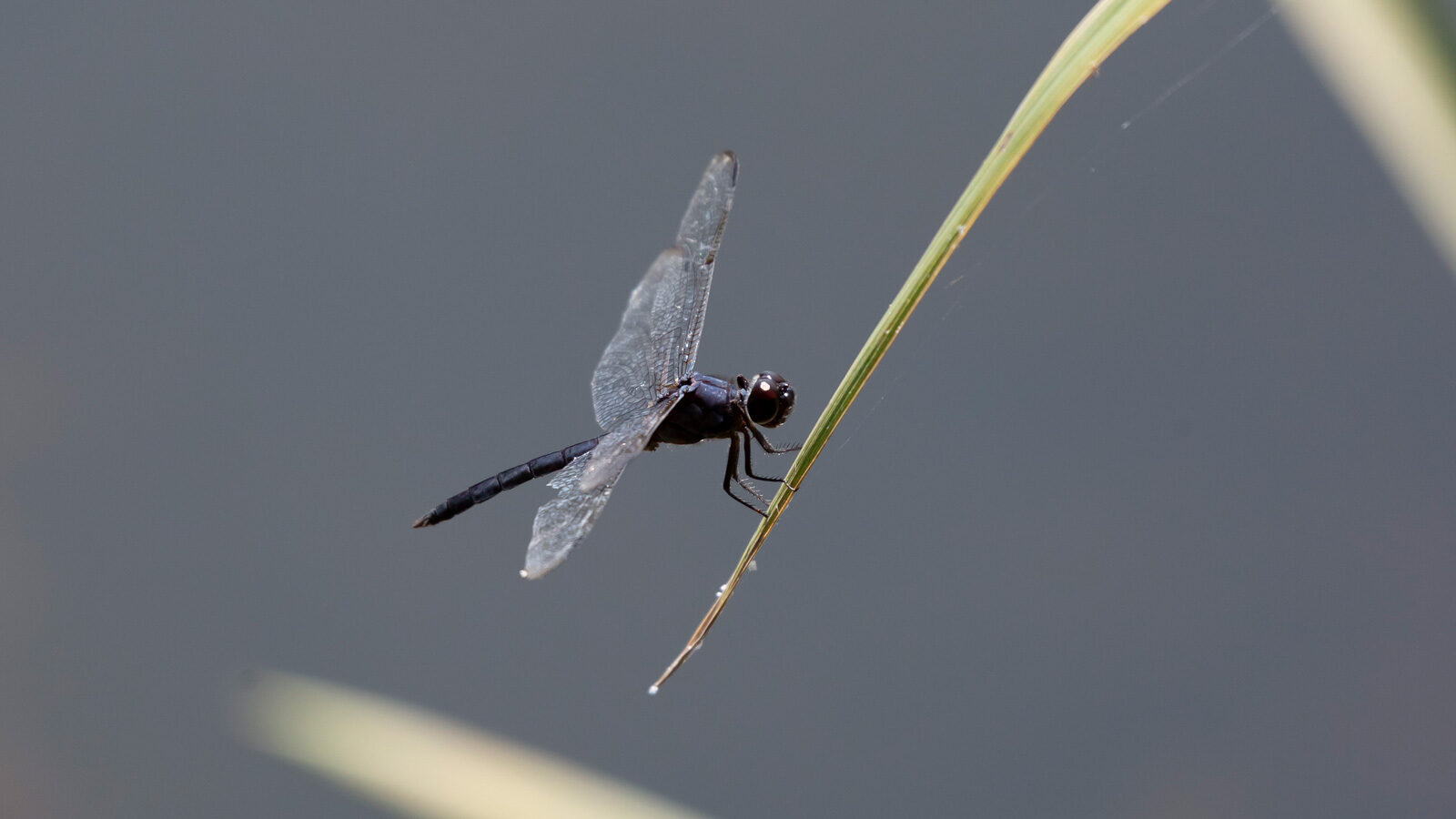
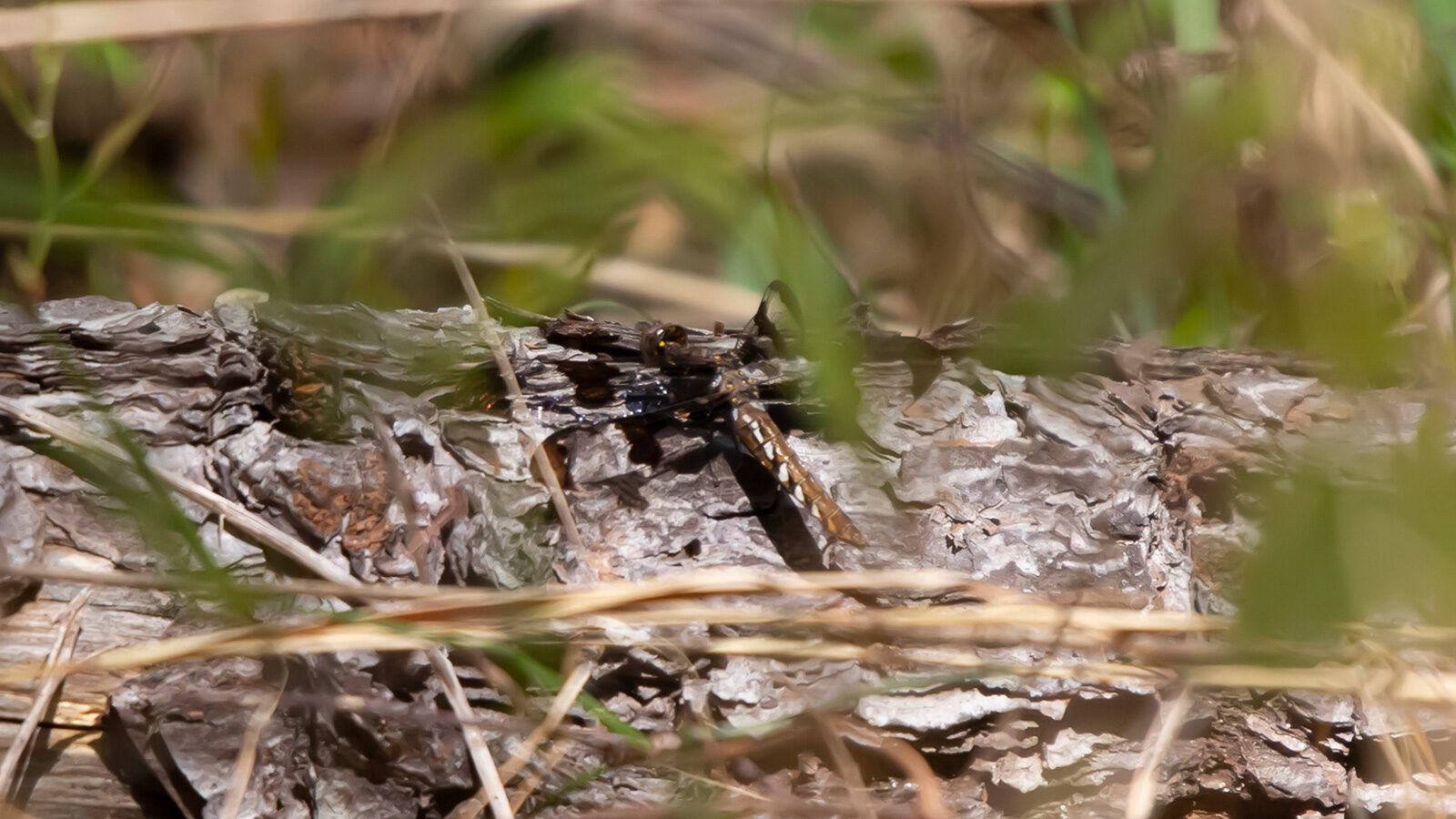
- Compare the specific field marks, size, behavior, and habitat that separate these similar animals.
- These animals share a more specific category, so this comparison is meant for realistic field confusion.

1 of 3
Advertisement
Accessibility
Common whitetails make no sound human ears detect, but the white wing patches and the rock-perching habit made visual detection among the easiest of any North Louisiana dragonfly. A white-winged dragonfly on a dark rock at the pond margin caught the eye at distances where every other dragonfly's wings stayed invisible, and the high-contrast white-on-dark pattern identified the whitetail without binoculars from across the pond.
For anyone with mobility limitations, the common whitetail perched on docks, sidewalks, and paved surfaces near water that offered the most accessible dragonfly-watching positions at any North Louisiana lake or pond. A wheelchair on a fishing pier, a park bench at a lakeside sidewalk, or a vehicle parked near a boat ramp put the observer on the same hard surfaces the whitetails used, and the dragonfly landed within arm's reach of the observer's position without anyone needing to leave the accessible surface.
Advertisement