Advertisement
The American snout has a nose. Not a metaphorical nose, an actual elongated mouthpart structure, the labial palpi, projecting forward from the head like a beak extension that the butterfly uses as a sensory organ and that makes every snout look like it has a face. That projection: the feature everyone notices and the feature that identifies the species immediately. No other North Louisiana butterfly walks around with that projection. The snout earns its common name completely.
Libytheana carinenta ranges across the southern United States, Mexico, and Central America, and throughout North Louisiana's 26 parishes it breeds wherever hackberry trees grow, which covers every parish. Adults fly from late spring through fall in most years, with population explosions in some years that produce migrating swarms visible at woodland edges and roadsides.
In off years the butterfly appears in modest numbers as a routine woodland-edge species. In good years it produces the kind of roadside butterfly event that causes people to pull over and check what they are seeing, the answer: snouts, thousands of them, all heading the same direction, all with that nose.
What the American Snout Actually Looks Like
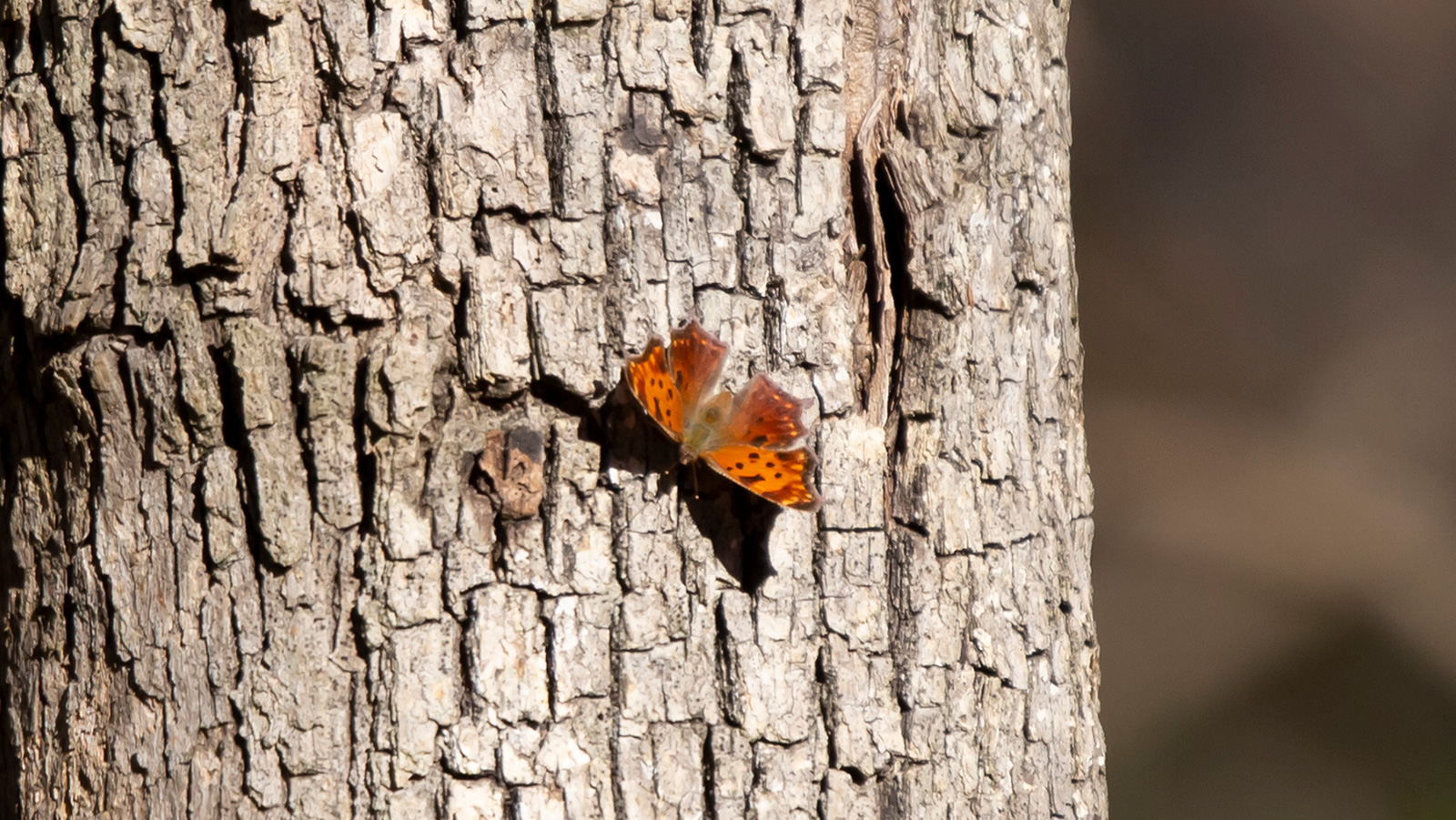
The adult spans one and three-quarters to two inches. The elongated labial palpi project forward from the head and, combined with a brown forewing against a twig, create the convincing impression of a dead leaf with a petiole when the wings close and the snout points forward. The upperside shows orange-brown with a black forewing border carrying white spots near the tip, and a patch of orange on the forewing that gives it the partial-orange, partial-brown patterned look distinctive to the species.
Hindwing underside shows plain gray-brown with minimal patterning, producing another effective bark-and-twig camouflage when the butterfly perches with wings closed and the snout pointing outward. From a distance, a perched closed-wing snout with the labial palpi extended forward looks like a dead leaf attached by its petiole to a twig, the snout serves as the petiole, a clever second use for an anatomical feature that the species already uses for sensory functions.
Where the American Snout Lives
Any habitat with hackberry trees throughout North Louisiana's 26 parishes. Woodland edges, riparian corridors, residential areas, rural roadsides, old field margins with hackberry in the tree layer, the snout's distribution across the region maps directly onto hackberry distribution. Hackberry establishes freely in disturbed ground, fence rows, woodland edges, and residential landscapes, and wherever it grows, snouts breed.
Host plants: hackberry trees exclusively. Both Celtis laevigata, the sugarberry hackberry common in bottomland and lowland settings, and Celtis occidentalis, the common hackberry of upland sites, serve as hosts. The snout does not use other host plants, hackberry only, always, without exception. This strict host specificity ties the species completely to hackberry distribution and explains why snout population explosions occur precisely when hackberry reaches peak production of young, tender foliage that caterpillars eat most efficiently, and why snout abundance correlates with hackberry abundance across the landscape.
Advertisement
The Caterpillar's Year
Multiple broods in North Louisiana, with adults present from late spring through October. Eggs land singly on hackberry leaves. Caterpillars feed on hackberry foliage from spring through fall, cycling through multiple generations on the same trees. Late-season caterpillars produce adults that, in mild years, attempt to survive winter as adults in sheltered locations and reappear at the first warm days of late winter.
The caterpillar wears dark green with yellow lateral stripes, cryptically colored against hackberry foliage and easy to miss on a casual examination of the leaf surfaces. Late instars eat large portions of hackberry leaves and produce visible feeding damage on small trees and the lower canopy of large ones, but established hackberry trees tolerate caterpillar pressure through the season without lasting harm.
Chrysalises attach to hackberry twigs and foliage and show green coloration that blends with the leaf background. Finding chrysalises on hackberry needs searching branch tips and leaf undersides at accessible canopy height, a productive exercise in late spring and again in summer when the second generation develops.
What the American Snout Eats
Adults nectar at a variety of flowering plants, showing more interest in flowers than most brushfoot species that prefer sap and fruit. Native asters, goldenrod, dogbane, and butterfly milkweed draw snout adults reliably in open areas adjacent to hackberry woodland. Adults also mud-puddle at stream margins and wet road shoulders for moisture and minerals, and in dry years mud-puddling snouts concentrate at any available wet site.
The migration swarms associated with snout irruption years involve adults moving together in numbers large enough that directional movement becomes apparent from a fixed observation point, adults arriving from one direction, nectaring briefly, and departing in the same direction, creating a stream of butterflies through an observation area rather than the diffuse, multi-directional activity of a normal nectar site.
That stream behavior, hundreds of snouts per hour moving the same direction through a rural roadside site, represents one of the more memorable butterfly spectacles available in North Louisiana in years when populations build to irruption levels.
What Eats the American Snout
Dead-leaf camouflage in closed-wing posture provides the primary adult defense against visually hunting predators. A snout perched with wings closed, snout pointing forward against a twig, disappears into the dead-leaf background as effectively as the goatweed leafwing against bark, the structure of the disguise differs but the functional result matches. Eastern kingbirds take adults in flight during migration swarms, when the sheer density of adults in open flight overrides the benefit of individual camouflage. Robber flies intercept adults in open areas.
Caterpillar predation proceeds through parasitoid wasps, tachinid flies, and direct predation by insectivorous birds. The green cryptic coloration of caterpillars on hackberry foliage reduces visual detection but does not provide chemical protection.
The Snout Migration
Snout irruption events in North Louisiana occur periodically, driven by population buildups following favorable breeding seasons on hackberry. When caterpillar survival rates stay high through spring and summer and the hackberry foliage stays productive, adult populations build to levels that exceed local carrying capacity and trigger directional movement. That movement concentrates adults at narrow landscape features, valley corridors, river crossings, woodland edge clearings, where the stream of adults becomes obvious.
In North Louisiana, snout migration events have been documented in years following wet springs that promoted hackberry foliage growth and moderate summers that supported larval survival. The directionality in North Louisiana moves generally southwest to northeast in spring movement and northeast to southwest in fall movement, consistent with the broader pattern of this species' migrations through the Gulf Coast region.
The magnitude varies enormously. A modest year produces a noticeable increase in snout abundance at woodland edge sites. A major irruption year produces roadside butterfly events where thousands of adults pass a fixed point over the course of an afternoon. Neither event gets consistently predicted in advance, regional butterfly community platforms like iNaturalist provide the best real-time signal when irruption events begin, as observers across multiple parishes report simultaneous abundance spikes.
Advertisement
Telling the American Snout from Similar Species
Labial palpi projection settles identification immediately. No other North Louisiana butterfly has that nose. An observer who sees the snout from any angle at any distance where the head structure becomes visible identifies the species without needing to examine any other feature.
Without a clear head view, the snout's combination of orange-brown upperside with black and white forewing tip and the small average size distinguishes it from fritillaries, larger brushfoots, and the question mark and eastern comma. From below with wings closed, the plain gray-brown underside without distinctive markings separates it from the patterned undersides of the Polygonia species and the leafwings.
Once the labial palpi pattern becomes familiar, snouts appear constantly in habitats near hackberry trees across North Louisiana that casual observers visited without specifically noticing the species. The nose makes the butterfly once it becomes part of the observer's field search image.
The Hackberry Triangle Revisited
American snouts join the question mark, hackberry emperor, and tawny emperor on hackberry trees in North Louisiana, adding a fourth species to the hackberry-dependent community that concentrates at any large hackberry tree through the warm season. A large hackberry at a woodland edge in September potentially holds all four simultaneously, which turns any accessible hackberry tree into a multi-species butterfly observation site without any specialized knowledge beyond knowing what a hackberry tree looks like.
Snout's addition to that community brings a directional migration component that the other three hackberry-associated species lack, hackberry emperors, tawny emperors, and question marks hold relatively stable local populations without irruption behavior, while the snout builds to migration-level numbers in some years and contributes to those mass movement events that pass through hackberry-containing landscapes.
A September hackberry tree in a year of snout irruption holds the full community plus a migrating population moving through, which produces an observation density that rewards extended time at the tree rather than a quick pass.
The Nose in Detail
Labial palpi of the American snout serve as chemosensory organs, they detect chemical signals in the environment and help the butterfly assess potential food sources, host plants, and mates. The elongated structure found in the snout represents an extreme development of a feature all butterflies possess in some form, but no North American butterfly takes the structure to the length the snout does. The projection looks absurd up close. It also works.
Camouflage function of the labial palpi comes as a bonus rather than a primary evolutionary driver, the structure probably elongated first for sensory reasons, and the dead-leaf disguise value it adds when the butterfly perches in closed-wing posture facing a twig came later as a secondary benefit. The two functions reinforce each other without either being the original purpose, which makes the snout's nose one of those evolutionary features that gets multiple uses simultaneously without having been designed for any of them.
Up close on a feeding or perching adult, the labial palpi show hairy texture and a slightly downward curve that enhances the leaf-petiole impression. Adults at flowers, perched with wings closed between nectar visits, aim the labial palpi forward and hold still long enough that the full leaf-with-petiole illusion becomes apparent without any movement to break it. The observer who examines a snout at rest at a native aster in August gets the full camouflage demonstration alongside the sensory biology lesson at no additional cost.
Advertisement
Hackberry: The One Tree That Feeds Five Brushfoot Species
Five butterfly species in North Louisiana breed on hackberry trees: the American snout, the question mark, the hackberry emperor, the tawny emperor, and occasionally the eastern comma. That concentration of species on a single tree genus makes hackberry the highest wildlife value native tree in North Louisiana for butterfly productivity, measured purely by number of species that use it as the sole or primary larval host plant.
The tree does its part without asking for anything in return. Hackberry grows fast, tolerates a wide range of soil conditions from rich bottomland to rocky upland, establishes freely in disturbed and undisturbed settings, produces abundant fruit that wildlife uses, and maintains a bark texture that many butterfly species use for perching and winter-dormant shelter.
It grows in fence rows, urban street plantings, residential yards, and every woodland edge type in all 26 parishes. Planting a hackberry in a North Louisiana yard and leaving it alone for a decade produces an active butterfly community without any additional management.
For the snout specifically, hackberry matters because the snout uses nothing else. The butterfly has committed entirely to one tree and built its population dynamics, its irruption cycle, and its migration behavior around the availability of hackberry foliage. When hackberry does well, snouts do well. When something suppresses hackberry, snouts decline locally. The snout's fortunes track hackberry's in a way that no multi-host-plant butterfly experiences, making it both more dependent and more predictable in its habitat associations than generalist species.
Irruption Events in North Louisiana
The periodic mass migrations of American snouts rank among North Louisiana's more spectacular butterfly events, and they occur without warning in years when conditions align. A wet spring that promotes hackberry leaf flush, moderate temperatures that support larval survival through multiple instars, and low parasitoid pressure on caterpillar populations combine to produce adult populations that exceed local resources and trigger directional movement.
Observers who have seen a snout irruption in progress describe streams of butterflies passing a fixed roadside point at rates of hundreds per minute during peak flow periods. The adults move purposefully in the same direction rather than circling or nectaring at random, refueling briefly at nectar sources along the route and continuing. The stream behavior, visible from a stationary point at a productive vantage, communicates the scale of the event even to observers who have never seen large butterfly movements before.
North Louisiana's geography channels snout movement along river corridors and through topographic gaps between ridgelines in the northern parishes. Sites at valley crossings in the hill parishes, any narrow point where moving butterflies concentrate before dispersing on the other side, produce higher apparent density during irruption events than broad flat areas where movement disperses evenly.
A valley crossing on a snout migration day in October in Bienville or Bossier Parish, with a good hackberry stand adjacent and native asters at the edge of the crossing, can hold thousands of adults per hour that would otherwise spread invisibly across miles of woodland.
Advertisement
Documentation During Irruption Years
American snout irruption documentation from North Louisiana helps researchers understand where population explosions originate, which corridors they follow, and what landscape features concentrate or disperse the migration stream. The current documentation record from the 26 parishes consists primarily of incidental observations submitted during events rather than systematic monitoring at fixed points.
Systematic observation during an irruption event, counting individuals passing a fixed point over a measured time interval and noting weather conditions, flight direction, and nectaring behavior, produces data of a different quality than incidental sightings. A thirty-minute count at a productive snout site during an irruption event, submitted to iNaturalist with count data rather than just presence, contributes to the understanding of event magnitude and timing in ways that presence-only records does not.
Not every year produces an irruption. Some years the snout population stays at background levels throughout the season without any detectable directional movement. The contrast between irruption years and background years, documented over multiple seasons from the same observation sites, builds a regional picture of what conditions produce irruption events and how frequently North Louisiana experiences them.
Supporting Snout Populations
Hackberry. That's the full recommendation. A mature hackberry tree in a North Louisiana yard, residential margin, or public space provides host plant, adult shelter, and adult food through the hackberry fruit without requiring any active management or supplemental planting. The tree does the work. The snouts find it.
For landowners and municipalities considering native tree plantings in North Louisiana, hackberry produces the highest butterfly community value per tree of any locally native species. The five brushfoot species that breed on it, plus the wildlife value of the fruit and the bark texture value for roosting butterflies, make it a single-tree investment that returns butterfly value across multiple species and multiple seasons for the life of the tree.
The snout brings its nose, its occasional thousands, and its reliable presence wherever hackberry grows throughout all 26 parishes. North Louisiana provides the hackberry. The snout handles the rest.
The Snout in a Normal Year
In years without irruption events, the American snout appears at hackberry woodland edges throughout North Louisiana as a routine but not particularly abundant species. Adults nectar at wildflowers in open areas adjacent to hackberry, perch on hackberry trunks in closed-wing posture between feeding bouts, and respond to intruders at territorial perch sites with investigation flights similar to other brushfoot species.
A North Louisiana woodland edge survey in June or August will turn up snout adults at most sites with mature hackberry, usually in ones and twos rather than the streaming hundreds of irruption years.
Those background-year encounters reward close observation precisely because the number of adults stays low enough to watch individual behavior rather than tracking a mass movement. A single snout at a native aster, feeding with wings partially open, labial palpi extended forward, provides a better look at the face than any irruption-year observation where the abundance overwhelms the ability to watch any individual closely.
Up close, hairy and downward-curved, with the full leaf-petiole impression available from the correct angle, delivers the species more completely than a stream of hundreds passing overhead.
Background-year snout population at a productive hackberry site includes multiple age classes and both sexes working the same trees over extended periods. The full behavioral repertoire, nectaring, territorial investigation, sap feeding, oviposition on hackberry foliage, plays out at accessible canopy height from trail-side positions throughout the 26 parishes on any warm morning from May through October.
Advertisement
Snouts and North Louisiana's Roadsides
American snouts turn up regularly at roadside nectar sources throughout the 26 parishes, particularly at native asters, goldenrod, and late-season wildflower patches in the fall migration window. Adults refueling at roadside flowers in October represent either local residents or passing migrants depending on abundance and directional movement, an observer standing at a productive roadside wildflower patch in October in an irruption year sees both modes simultaneously, local adults nectaring in random directions and migrant adults fueling and departing consistently southward.
That distinction, resident versus migrant behavior at the same nectar source, comes from watching directionality after fueling rather than during. A resident adult finishes at a flower and moves to the next flower in the patch or returns to a nearby perch. A migrant finishes at a flower and departs on a consistent heading. At a mixed site in an irruption year, both patterns operate side by side, and the migrant stream becomes visible as the subset of adults that consistently heads southwest after leaving the flowers.
Native wildflower plantings at North Louisiana roadsides and public areas that persist through late September and October contribute to snout migration fueling at the population level in ways that midsummer plantings do not. The coincidence of fall migration timing and fall wildflower peak, native asters and goldenrod in bloom through October, gives migrating snouts a resource base along their routes that reduces energy cost for the journey.
A Final Note on the Nose
The American snout's labial palpi remain the most immediately distinctive anatomical feature of any butterfly in North Louisiana, and they produce a more consistent identification result than any wing pattern. Butterfly watchers at all experience levels identify snouts correctly on first encounter by nose alone, before learning any wing pattern details. Children identify snouts correctly by nose alone before knowing the species name. The feature works as identification before it works as natural history knowledge, which makes it unusual among field marks.
Understanding what the labial palpi actually do, sensing the chemical environment, assessing foliage quality before committing to a landing, detecting pheromones in mate-finding, adds a layer of functional meaning to what looks at first like an evolutionary joke. The snout was not designed to look funny. The nose grew long because long noses sensed the world better. The dead-leaf disguise came along for the ride. The appearance that makes people stop their cars in October and check what they are looking at came along for the ride too.
The nose identifies the butterfly. The butterfly identifies the hackberry. The hackberry grows in all 26 North Louisiana parishes. The system closes on itself cleanly, and the snout navigates it with a sensory apparatus pointing forward out of its face that no other butterfly in the region decided to develop.
Advertisement
Snout as Entry Point
An excellent entry point to North Louisiana butterfly watching because the identification never fails.
Any observer who has seen the labial palpi on a snout at close range identifies every subsequent snout correctly from the first glance without needing to check wing pattern details. That reliability at identification gives beginners a species to anchor on and build outward from, once the snout gets learned, the hackberry tree it breeds on becomes familiar, and the hackberry emperor, tawny emperor, and question mark that share the tree come into focus in sequence.
Starting with the snout also provides exposure to the idea that butterfly identification sometimes needs looking at face structures rather than wing patterns, which prepares observers for other species where head features matter.
The snout takes the most obvious anatomical feature of any North Louisiana butterfly and uses it as the primary field mark. That simplicity, one distinctive feature, always present, always visible from the right angle, builds confidence faster than species where the field mark sits in a subtle hindwing pattern that needs close examination and good light to resolve.
Bring a snout image to any North Louisiana school group or family with young children. Show them the nose. Let them find the nose on the next butterfly they see at a hackberry tree. They will identify the species before any adult who has not specifically learned it, because children understand noses in a way that adults sometimes overcomplicate.
Accessibility
Labial palpi of active adults in flight produce no specific sound, but adults at flowers produce normal wing-sound on landing audible at close range. The projecting snout, visible in profile from several feet when the butterfly faces the observer, identifies the species by silhouette before wing pattern detail becomes legible.
Any hackberry tree in North Louisiana from late spring through October holds snout adults in residence or in transit. Accessible hackberry at woodland edges throughout the 26 parishes, in residential yards, and along roadsides puts this species in close observation range without any site-specific planning. In irruption years, snouts appear at roadside nectar sources in numbers that require no searching at all, they find the observer rather than requiring any effort in return.
More Information
Resources: the North American Butterfly Association at naba.org maintains Louisiana identification resources and migration documentation for irruption years. iNaturalist accepts American snout observations from all 26 North Louisiana parishes and provides real-time regional abundance data that signals irruption events as they develop. Butterflies and Moths of North America at butterfliesandmoths.org carries Louisiana range data and irruption year documentation.
The American snout has a nose, breeds on hackberry, and occasionally migrates in the thousands. All three features are findable in North Louisiana's 26 parishes, in varying proportions depending on the year. The nose shows every time. The hackberry grows in every parish. The thousands show up when they feel like it, which, in the right year, means every roadside and woodland edge in the 26 parishes sees them simultaneously.
Find a hackberry tree in North Louisiana. Leave it alone long enough to attract a snout. Watch the snout land on the bark, close its wings, and point the labial palpi forward at the twig. Watch it disappear. That sequence, tree to closed-wing dead leaf with a nose, takes about thirty seconds and summarizes the species completely.
The snout did it without any help. The hackberry did it by existing. North Louisiana provided both, as it does in all 26 parishes, for as long as anyone has kept track of what grows and flies here, which in the case of both the hackberry and the snout goes back considerably further than the record shows.
Both of them, tree and butterfly, knew this landscape before North Louisiana had a name for any of its parishes. Show them the nose on the next butterfly at the hackberry tree. They will know before anyone explains it to them. The snout has that kind of face. That's the whole story. The nose tells them. In North Louisiana's 26 parishes, the nose always tells them. Every time. Every parish. Every hackberry. The snout delivers. Without exception, in every parish that still has a hackberry tree standing at a woodland edge, which as of this writing means all 26 of them.
META TITLE: American Snout Butterfly in North Louisiana | NLW
META DESCRIPTION: The American snout breeds on hackberry throughout North Louisiana and migrates in thousands during irruption years. The labial palpi projection makes it the only butterfly in the region with a nose.
FOCUS KEYPHRASE: American snout butterfly North Louisiana
SECONDARY KEYWORDS: Libytheana carinenta Louisiana, American snout identification, snout butterfly hackberry, snout butterfly migration, butterfly irruption Louisiana, hackberry butterfly Louisiana, American snout labial palpi, North Louisiana butterfly identification, snout butterfly swarm
OG DESCRIPTION: The American snout has a nose, breeds exclusively on hackberry, and migrates in thousands during irruption years in North Louisiana. Once you know the nose, you see it everywhere hackberry grows.
SLUG: american-snout-butterfly-north-louisiana
Advertisement
Advertisement
Accessibility
## Accessibility
Labial palpi of active adults in flight produce no specific sound, but adults at flowers produce normal wing-sound on landing audible at close range. The projecting snout, visible in profile from several feet when the butterfly faces the observer, identifies the species by silhouette before wing pattern detail becomes legible.
Any hackberry tree in North Louisiana from late spring through October holds snout adults in residence or in transit. Accessible hackberry at woodland edges throughout the 26 parishes, in residential yards, and along roadsides puts this species in close observation range without any site-specific planning. In irruption years, snouts appear at roadside nectar sources in numbers that require no searching at all, they find the observer rather than requiring any effort in return.
Advertisement