Advertisement
The brown-headed nuthatch (Sitta pusilla) uses tools. Actual tools, not the "the bird's bill counts as a tool" semantic gymnastics that ornithologists use to pad a résumé. The brown-headed nuthatch picks up a loose flake of pine bark, grips it in its bill, and uses the bark flake to pry other bark flakes off the tree to get at the insects underneath. A bird the size of your thumb, with a brain the size of a pea, independently invented the lever and was using it in pine forests across the southeastern United States while the rest of the bird world continues to rely on bills alone. The list of North American birds documented using tools fits on an index card. The brown-headed nuthatch earned a spot on that card and did not filed for a patent.
Year-round resident of mature pine forest, the brown-headed nuthatch lives across North Louisiana. The bird does not migrate, does not wander, and does not leave the pines. The bird hatches in a pine cavity, feeds on pine bark, caches pine seeds, and spends its entire life within a territory measured in acres of pine forest. Take the pines away and the brown-headed nuthatch goes with them. The relationship between bird and tree qualifies as absolute. Other nuthatches have options. The white-breasted feeds in hardwood forest. The red-breasted shows up wherever the irruption takes it. The brown-headed nuthatch married the pines and never looked at another tree.
The Look
The brown-headed nuthatch comes small, compact, and built for headfirst descents. A brown cap sits flat on the head, extending from the bill base over the crown to the nape, giving the bird its name and its most obvious field mark. The cap color varies from warm chocolate brown to a cooler grayish brown depending on individual and lighting. A white nape spot sits at the back of the cap where the brown meets the blue-gray of the upper back. The nape spot can be hard to see in the field but tells the brown-headed apart from the red-breasted nuthatch when the two species occur in proximity during irruption winters.
Blue-gray covers the back, wings, and tail. The underparts wash pale, from white to buff, without streaking or pattern. The bill comes short, straight, and sharp, shaped for probing bark crevices and extracting pine seeds from cone scales. The eyes sit dark against the brown cap. The overall impression at feeder distance: a small, neckless, compact bird wearing a brown helmet and moving down a tree trunk with a casual disregard for the concept of gravity. Gravity filed a complaint. The nuthatch did not respond.
The body shape shares the standard nuthatch blueprint: short tail, large head relative to body, strong feet with long toes and curved claws built for bark-gripping in any orientation. The brown-headed sits at the smallest end of the North American nuthatch size range, noticeably smaller than the white-breasted nuthatch and slightly smaller than the red-breasted. A brown-headed nuthatch next to a white-breasted looks like the compact model from the same production line.
Advertisement
The Sound
The brown-headed nuthatch sounds squeaky. Emphatically, persistently, unapologetically squeaky. The brown-headed nuthatch's call was compared to a rubber duck being squeezed, which captures the pitch and the quality but understates the frequency. The bird calls constantly. A foraging group of three or four brown-headed nuthatches produces a continuous stream of rapid, squeaky "yank-yank-yank" notes that bounce through the pine canopy and announce the flock's location to everything within earshot. The rubber duck comparison falls short in one respect: the rubber duck sits passive in a bathtub. The brown-headed nuthatch has places to be and will not stop announcing the itinerary.
At a frequency most listeners hear without difficulty, well below the golden-crowned kinglet's ceiling-scraping "tsee" and well above the white-breasted nuthatch's low, measured "ank." In a pine forest holding all three nuthatch species during an irruption winter, the call pitch alone sorts them: high and squeaky for the brown-headed, mid-range and nasal for the red-breasted, low and deliberate for the white-breasted. Three nuthatches, three pitches, three different sounds coming from three different-sized birds doing the same thing on the same tree in different directions.
A flock of brown-headed nuthatches that goes silent usually means a hawk has entered the area. The sudden absence of the squeaky chorus in a pine stand that was full of it thirty seconds ago tells an experienced listener more than the alarm call tells: something dangerous arrived and every nuthatch in the flock froze. The silence breaks when the hawk passes. The squeaking resumes immediately, at full volume, as though the interruption never happened.
The call also functions as a flock-coordination tool. A feeding group of brown-headed nuthatches moves through pine forest in a loose cluster, and the constant squeaking keeps every bird in the group informed of every other bird's location without requiring visual contact. A bird that falls behind the group calls more loudly until it catches up. A bird that moves ahead calls from the front until the group follows. The coordination sounds chaotic because every bird calls simultaneously, but the flock moves through the forest with a cohesion that suggests each bird knows exactly where the others feed. The system works without a leader, without a schedule, and without any obvious signal for when the group moves to the next tree. The group just moves, squeaking the whole way, and somehow nobody gets left behind.
The sound carries a seasonal shift. Breeding-season calls add a softer, more varied repertoire that the winter calls lack. Pair contact notes between mates sound different from the flock-coordination squeaks, and a careful listener can distinguish between "I'm feeding over here" calls and "get away from my cavity" calls by pitch and tempo alone. The bird's vocal range shows more complexity than the rubber-duck comparison suggests, but the rubber duck remains the most accurate shorthand for the sound that first hits your ear when you walk into a pine stand with a healthy population.
Advertisement
Advertisement
How It Actually Lives
Year-round territories in mature pine forest, occupied by small family groups that include the breeding pair, their current-year offspring, and sometimes a helper bird from a previous year's brood. Cooperative breeding puts the brown-headed nuthatch in a small club of North American songbirds where a non-breeding bird assists with nest building, incubation, and chick feeding. The helper contributes labor without producing its own offspring that season. The evolutionary logic involves shared genetics: helping raise siblings or half-siblings passes along shared genes without the overhead of an independent nesting attempt. The helper did not negotiated compensation beyond continued membership in the family territory.
Nest cavities get excavated by the pair in dead pine stubs and snags, using the bill to chip out a small chamber in soft, rotting wood. The excavation can take weeks. The cavity entrance measures roughly one inch in diameter, small enough to exclude larger birds and most predators but large enough for the nuthatch pair to enter and exit freely. The cavity interior gets lined with bark strips, fur, feathers, and any soft material available. A brown-headed nuthatch nest cavity in a dead loblolly pine looks tidy from the inside and invisible from the outside. The design handles temperature, keeps predators out, and hides the nest all at once.
She lays three to seven eggs. Both adults incubate, plus the helper if one joined the group. Chicks fledge after about eighteen days and remain with the family group through the following winter, at which point they either disperse to find their own territory or stay on as helpers. The family dynamic keeps the territory occupied year-round and provides the continuous watching for hawks that a solitary pair could not maintain.
The Helper at the Nest (And Why a Bird Works for Free)
The cooperative breeding system in brown-headed nuthatches puts a non-breeding bird at the nest, feeding chicks that belong to the breeding pair. The helper, usually a male from the previous year's brood, did not find a mate, did not establish a territory, and did not leave the family group. Instead of dispersing, the bird stayed and now feeds, incubates, and defends a nest that contains none of its own offspring. The arrangement sounds like bad economics until the genetics enter the conversation.
The helper shares roughly half its genes with the chicks in the nest, because the chicks have the same parents the helper had. Feeding a sibling passes along shared genes without the overhead of finding a mate, defending a territory, building a nest, and competing for a cavity. The helper bird invests labor. The breeding pair produces offspring carrying the helper's genes. Both parties benefit genetically, even though only one party laid the eggs. The system was described as "paying rent in childcare," which captures the economics but misses the fact that the helper did not choose the arrangement consciously. The helper stayed because the territory still had resources and the dispersal options looked worse than staying.
Helpers increase nest success. Nests with a helper produce more fledged chicks per attempt than nests without. The extra adult feeding the chicks means each chick gets more food per day, grows faster, and fledges in better condition. The math favors helped nests consistently enough that the helper system has persisted in the brown-headed nuthatch population for as long as researchers have been watching. The helper did not run a cost-benefit analysis. The helper's genes ran one millions of years ago, and the results came back positive.
Advertisement
Who Gets Mistaken for Who
Red-breasted nuthatches during irruption winters. Both species hitch down tree trunks, both call nasally, both occupy pine forest. The brown-headed wears a brown cap with a white nape spot. The red-breasted wears a black cap with a bold white eyebrow stripe and an orange-washed breast. Cap pattern and breast color separate them instantly at close range. At distance or in poor light, the call pitch handles it: squeaky rubber duck for the brown-headed, nasal tin horn for the red-breasted.
White-breasted nuthatches. Size, habitat, and call separate these two without difficulty. The white-breasted stands noticeably larger, wears a black cap against a white face, feeds in hardwood forest, and calls with a low, slow "ank-ank-ank" completely different from the brown-headed's rapid squeaking. Both species occasionally feed at the same suet feeder, where the size difference becomes impossible to miss.
What Eats It (And What Tries)
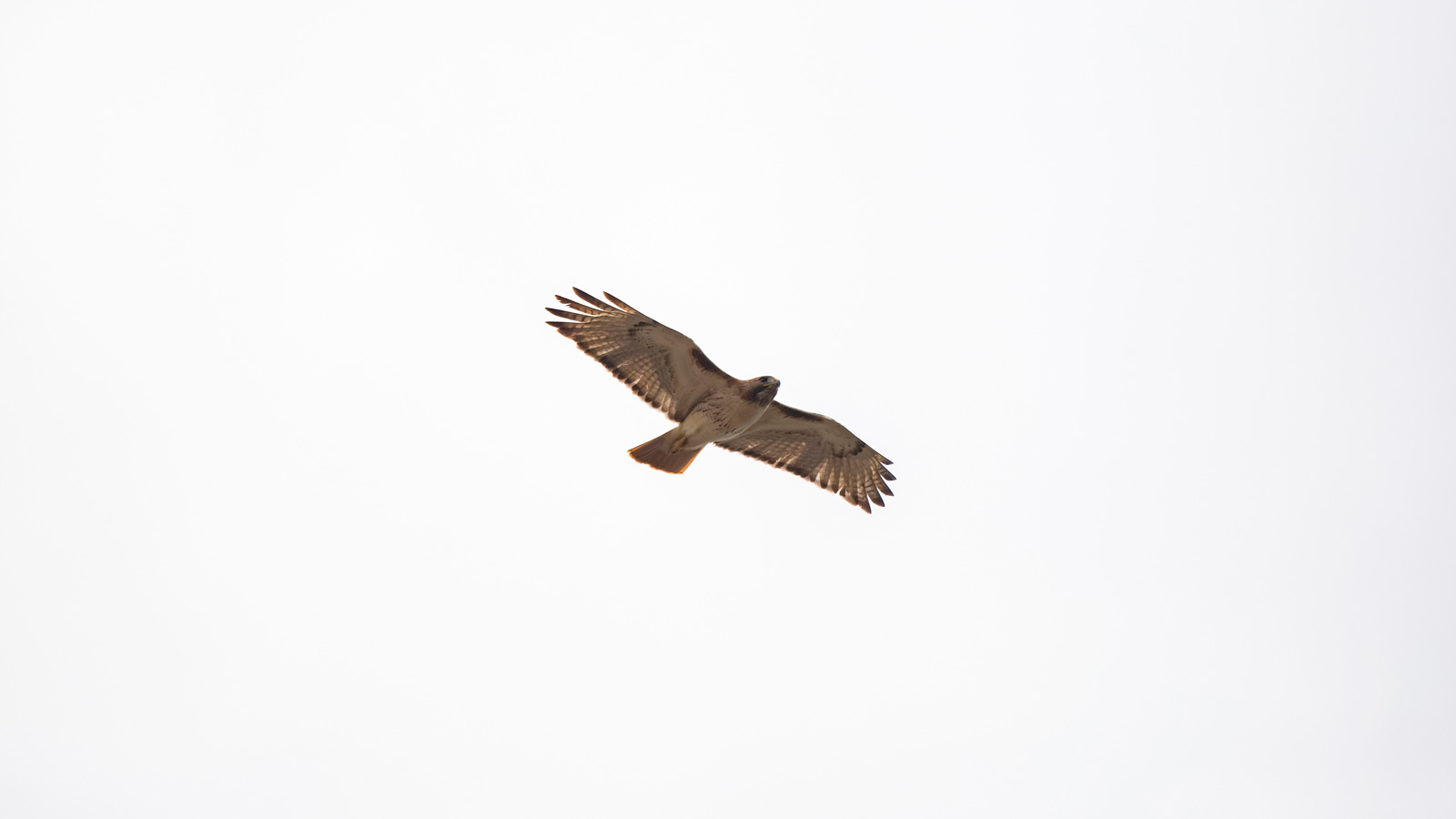
Sharp-shinned hawks and Cooper's hawks take brown-headed nuthatches from pine stands. The nuthatch's defense involves freezing flat against the bark, camouflaged back outward, and waiting until the hawk passes. The freeze response works against a hawk scanning from a distance. A hawk that already spotted the bird before the freeze does not get fooled by a motionless nuthatch pressed against a tree trunk.
Rat snakes and corn snakes raid nest cavities. A climbing snake that locates the cavity entrance can consume every egg and nestling inside. The one-inch cavity entrance excludes larger predators but does not exclude snakes. The nuthatch's small cavity size, an advantage against cowbirds and larger cavity competitors, becomes irrelevant when the predator can compress through any opening larger than the snake's head.
Fire suppression threatens the brown-headed nuthatch indirectly. The brown-headed nuthatch depends on mature, open pine forest maintained by periodic fire. A pine forest without fire develops a dense hardwood understory that eventually shades out the pines and converts the stand to hardwood. The nuthatch cannot use the hardwood forest. The snags that the nuthatch excavates for nesting come from pine trees that died standing, and fire-suppressed forests produce fewer standing-dead pines as live hardwoods crowd the canopy. Prescribed burning in pine stands across North Louisiana maintains the habitat. Every controlled burn that keeps a pine stand open keeps it viable for brown-headed nuthatches. The burn also creates the dead snags the bird needs for nesting by killing individual pines that then stand dead for years, providing soft wood that the nuthatch's small bill can excavate. A pine stand that burns regularly produces a rotating supply of dead snags. A pine stand that never burns produces no new snags and eventually loses the existing ones to decay and windfall. The nuthatch's nesting supply depends on trees dying at a rate that fire regulates and that fire suppression eliminates.
Advertisement
The Bird That Can't Leave the Pines
Most birds in North Louisiana use pine forest as one option among several. Brown-headed nuthatches treat pine forest as the only option. Period. The bird hatches in a pine cavity, feeds on pine bark, caches pine seeds, nests in dead pine snags, and spends its entire adult life within a territory measured in acres of pine. Remove the pines and the brown-headed nuthatch vanishes. Not gradually. Not with a transition period. The bird goes because the bird cannot adapt to hardwood forest, cannot adapt to mixed forest with insufficient pine component, and cannot adapt to young pine plantations that lack the mature bark, dead snags, and cone production that the species depends on.
The relationship between the brown-headed nuthatch and longleaf pine forest deserves particular attention because longleaf pine forest in North Louisiana was reduced to a fraction of its original extent. The longleaf ecosystem that once covered millions of acres across the Southeast was logged, converted to loblolly plantation, and developed to the point where the remaining mature longleaf stands can be counted by name. Kisatchie National Forest protects the largest blocks in North Louisiana. The brown-headed nuthatches that live in those blocks depend on fire management that keeps the stands open and produces the standing dead snags the bird needs for nesting. Stop the fires and the hardwood understory closes in. Close in the understory and the pine stand stops being brown-headed nuthatch habitat. The bird's entire North Louisiana future depends on a management decision that a federal employee makes every year about when and where to burn.
The brown-headed nuthatch does not move to a new forest when its forest degrades. The bird does not have the behavioral flexibility to colonize novel habitat. A pair that loses its territory to hardwood encroachment does not relocate to the next pine stand down the road if the next pine stand sits beyond the bird's dispersal range. The pair loses the territory and the pair's genetic contribution to the population ends. The replacement comes from young birds dispersing from healthy pine stands, which means the healthy pine stands produce the next generation for the degraded ones. Every mature pine stand that stays healthy sends young nuthatches outward. Every mature pine stand that degrades stops sending and starts needing.
Why Your Pine Stand Matters
The brown-headed nuthatch carries a narrow enough habitat requirement that human land management decisions affect the bird directly. A pine plantation on a short rotation cycle, harvested before the trees mature enough to produce cones and snags, does not support the bird. A mature, fire-maintained pine forest with standing dead trees for nesting supports the bird reliably. The management difference between those two outcomes comes down to rotation length and fire frequency, both of which human foresters control.
Feeder visitation brings the bird into contact with suburban residents who live near mature pine stands. The brown-headed nuthatch takes sunflower seeds and suet from feeders and caches the seeds in nearby pine bark, converting the feeder into a supply depot that the bird distributes across the territory. A homeowner who fills a suet feeder near a pine stand may notice brown-headed nuthatches arriving, taking a seed, and immediately flying to a nearby pine trunk to wedge the seed into a bark crack. The feeder became a wholesale supply point. The bird became a logistics operation with feathers.
Pine plantation rotation length directly affects whether the brown-headed nuthatch survives in a given tract. A plantation harvested at twenty-five years produces lumber but never produces the mature bark, the cone crops, or the dead snags that the nuthatch needs. A plantation left to forty or fifty years starts producing all three. The difference between a twenty-five-year rotation and a forty-year rotation amounts to the difference between a pine desert and a functioning nuthatch territory, and the forester who sets the rotation schedule keeps the bird's local future in a spreadsheet.
Nest boxes supplement natural cavities in managed pine stands where dead snags have been removed. A nest box with a one-inch entrance hole, mounted on a pine at eight to fifteen feet, attracts brown-headed nuthatches reliably in habitat that otherwise lacks nesting sites. The box does not replace the dead snag. The box fills the gap until the next tree dies and the next snag forms. The bird accepts the box with the same matter-of-fact approach it applies to everything else: the hole fits, the height works, the pine stand has food. Good enough. Moving in. The box never been redecorated. The bird's interior design standards start and end with 'dry and dark.'
Advertisement
Where to Look
Kisatchie National Forest carries the strongest brown-headed nuthatch populations in North Louisiana. Mature longleaf and loblolly pine stands with open canopy, periodic fire history, and standing dead snags hold the bird year-round. The squeaky call announces the bird's presence within minutes of entering suitable habitat. Any mature pine stand in North Louisiana with fire history and dead snags carries the potential to hold brown-headed nuthatches.
D'Arbonne National Wildlife Refuge, Lake Claiborne State Park, and any pine-dominated tract with mature trees and snags in Lincoln, Bienville, Natchitoches, or Vernon parishes can produce brown-headed nuthatches. The bird does not appear in young pine plantations, hardwood forests, or open agricultural land. The habitat question settles the search question: find the old pines, listen for the squeak.
Winter and early spring provide the best conditions for finding the species. The squeaky calling increases in frequency and volume during the pre-nesting season in February and March, and territorial activity puts the birds in more conspicuous positions on the trunks. A visit to any mature pine stand in North Louisiana on a calm February morning will produce the call within ten minutes if the population exists there. Silence after twenty minutes means the stand either lacks the bird or lacks the mature pine conditions the bird needs.
Suet feeders positioned near mature pine stands attract brown-headed nuthatches reliably. A suet cage hung on a pine trunk at eye level in a Kisatchie campground or a rural property adjacent to mature pines will draw the bird within days. The nuthatch approaches the feeder with the same headfirst bark-hitching movement it uses on every other surface, which means the bird arrives at the suet cage upside down, eats upside down, and departs upside down without any apparent awareness that other birds use feeders right-side up.
Where to Learn More
The Cornell Lab of Ornithology's All About Birds covers the brown-headed nuthatch with range maps, call recordings, and cooperative breeding ecology. The Sibley Guide to Birds provides the three-nuthatch comparison that sorts brown-headed, red-breasted, and white-breasted by cap pattern and size.
Published behavioral ecology research on brown-headed nuthatch tool use documents the bark-flake lever technique in peer-reviewed detail. The research confirmed what birders in pine forests had been watching for years.
Experiencing This Bird: Accessibility Notes
The brown-headed nuthatch's squeaky "yank-yank" sounds like a rubber duck being stepped on, rapidly, with purpose. The pitch sits well within normal hearing range, well below the frequencies that fade with age. The sound carries thirty to fifty feet through pine forest on a quiet day. A foraging group calls almost nonstop, which means finding the bird depends more on being in the right pine stand than catching the right moment. Any mature pine stand in North Louisiana with a healthy population will produce audible nuthatches within minutes of arriving.
A flock of brown-headed nuthatches that suddenly goes silent usually means a hawk entered the area. The abrupt absence of squeaking in a pine stand that was full of it thirty seconds ago tells a listener more than an alarm call would: something dangerous arrived and every nuthatch froze. The silence breaks when the hawk passes. The squeaking resumes at full volume.
Meta Title: Brown-Headed Nuthatch in North Louisiana: The Six-Gram Bird With a Toolbox | NLW Meta Description: The brown-headed nuthatch uses bark flakes as tools, squeaks nonstop, and depends entirely on mature pine forest in North Louisiana. Full guide. Focus Keyphrase: brown-headed nuthatch North Louisiana Secondary Keywords: brown-headed nuthatch Louisiana, brown-headed nuthatch tool use, brown-headed nuthatch call, nuthatch identification, pine forest birds Louisiana, Kisatchie nuthatch, cooperative breeding nuthatch, North Louisiana year-round birds, nuthatch cavity nesting, brown-headed vs red-breasted nuthatch OG Description: The brown-headed nuthatch picks up bark flakes and uses them as levers, squeaks with the urgency of a rubber duck in distress, and depends entirely on mature pine forest. Full guide to identification, behavior, and where to find them. Slug: brown-headed-nuthatch-north-louisiana
Advertisement
Advertisement
Accessibility
## Experiencing This Bird: Accessibility Notes
The brown-headed nuthatch's squeaky "yank-yank" sounds like a rubber duck being stepped on, rapidly, with purpose. The pitch sits well within normal hearing range, well below the frequencies that fade with age. The sound carries thirty to fifty feet through pine forest on a quiet day. A foraging group calls almost nonstop, which means finding the bird depends more on being in the right pine stand than catching the right moment. Any mature pine stand in North Louisiana with a healthy population will produce audible nuthatches within minutes of arriving.
A flock of brown-headed nuthatches that suddenly goes silent usually means a hawk entered the area. The abrupt absence of squeaking in a pine stand that was full of it thirty seconds ago tells a listener more than an alarm call would: something dangerous arrived and every nuthatch froze. The silence breaks when the hawk passes. The squeaking resumes at full volume.
Meta Title: Brown-Headed Nuthatch in North Louisiana: The Six-Gram Bird With a Toolbox | NLW Meta Description: The brown-headed nuthatch uses bark flakes as tools, squeaks nonstop, and depends entirely on mature pine forest in North Louisiana. Full guide. Focus Keyphrase: brown-headed nuthatch North Louisiana Secondary Keywords: brown-headed nuthatch Louisiana, brown-headed nuthatch tool use, brown-headed nuthatch call, nuthatch identification, pine forest birds Louisiana, Kisatchie nuthatch, cooperative breeding nuthatch, North Louisiana year-round birds, nuthatch cavity nesting, brown-headed vs red-breasted nuthatch OG Description: The brown-headed nuthatch picks up bark flakes and uses them as levers, squeaks with the urgency of a rubber duck in distress, and depends entirely on mature pine forest. Full guide to identification, behavior, and where to find them. Slug: brown-headed-nuthatch-north-louisiana
Advertisement