Advertisement
Great horned owls are the apex predator of North Louisiana's nighttime ecosystem, and the prey list that earns them that title reads like an inventory of everything that moves after dark plus several things that probably should not have been moving where an owl could reach them.
Bubo virginianus — the "tiger owl," named by early naturalists who recognized the bird as the nocturnal equivalent of a big cat — kills and eats rabbits, rats, skunks, opossums, raccoons (juveniles), feral cats, hawks, other owls (including barred owls and screech-owls), crows, herons, ducks, snakes, frogs, crawfish, scorpions, and essentially anything else that a two-to-four-pound owl with a wingspan exceeding four feet can overpower with talons that exert 28 pounds of crushing force when clenched.
That talon grip — stronger than a German Shepherd's bite, stronger than a human hand can squeeze, and strong enough to sever the spine of a cottontail rabbit on contact — makes the great horned owl the most powerful avian predator per pound in North Louisiana and one of the most formidable nocturnal hunters on the continent.
Great horned owls occupy every habitat type across all 26 parishes in North Louisiana — forest, farmland, suburban neighborhoods, swamps, pine savanna, urban parks, and anywhere else that combines elevated perches with accessible prey. They nest earlier than any other North Louisiana bird, beginning courtship hooting in December and sitting on eggs in January while ice still coats the branches, and they maintain territories year-round with a permanence and aggression that ensures no other large owl or raptor challenges their dominance in any habitat they occupy.
What They Look Like
Great horned owls are large — 18 to 25 inches in body length, with a wingspan of 40 to 60 inches and a weight of 2 to 5.5 pounds, with females averaging substantially larger than males. The prominent ear tufts (feather tufts, not actual ears) give the species its "horned" appearance and create the silhouette that defines the word "owl" in most people's mental image.
The facial disk — the concave arrangement of feathers surrounding the face — is rusty-brown to buff, framed by a dark border, and functions as a sound-collecting dish that funnels noise to the asymmetrically placed ears hidden beneath the feathers. Large, forward-facing, deep yellow eyes dominate the face with an intimidating stare that has earned the species more anthropomorphic descriptions of "wisdom" and "menace" than any other North American bird.
Plumage varies geographically, but North Louisiana's subspecies (B. v. virginianus — the nominate form, described from Virginia) displays warm brownish-buff upperparts mottled with darker brown and black, paler underparts with heavy dark barring, and a white throat patch visible when the bird calls. The overall coloring provides effective camouflage against tree bark during daytime roosting, and a great horned owl pressed against a trunk with ear tufts raised and eyes closed can be remarkably difficult to detect despite the bird's substantial size.
Flight is silent — exceptionally soft feathers with fringed leading edges break up air turbulence, eliminating the whooshing sound that most birds produce during flight. A great horned owl dropping from a perch onto a rabbit in a North Louisiana field makes no sound until the talons strike, and the prey's first awareness of the attack is the last sensation the prey experiences.
Advertisement
The Deepest Hoot
Great horned owl vocalizations include the deepest, most resonant hooting of any North Louisiana owl — a low, powerful "hoo-hoo-hoooo hoo-hoo" that carries through forest, across fields, and into bedrooms with windows cracked open on cool winter nights. Males and females duet — the male's voice is deeper despite his smaller body size (he has a larger voice box), and the female responds at a slightly higher pitch — creating paired hooting sequences that establish territory, reinforce pair bonds, and announce to every other owl within earshot that the territory is occupied and defended.
Hooting begins in earnest in December and January in North Louisiana, weeks before egg-laying, making the great horned owl's voice the first consistent nocturnal bird sound of the new year. On a clear January night in any North Louisiana parish, a great horned owl duet rolling across a frozen landscape represents the opening act of the annual breeding cycle — a sound so low, so resonant, and so perfectly suited to carrying through cold, dense winter air that it functions as an auditory landmark for anyone who has learned to listen for owls.
Beyond the territorial hoot, great horned owls produce a variety of barks, screams, hisses, and bill claps used during nest defense, aggressive encounters, and communication between parents and young. Nestlings produce loud, raspy begging calls that carry through the forest and announce the nest location with a volume that seems poorly designed for a species whose survival depends on avoiding detection by predators — though given that great horned owls have essentially no natural predators in North Louisiana, nest concealment matters less for this species than for virtually any other bird in the region.
What They Eat
Great horned owls are generalist predators with a dietary breadth unmatched by any other owl in North Louisiana and rivaled among North Louisiana's raptors only by the red-tailed hawk — the species' diurnal ecological counterpart that occupies the same niche during daylight hours.
Ornithologists have long recognized this parallel: the great horned owl and the red-tailed hawk share similar habitat preferences, overlapping prey bases, comparable territory sizes, and even use each other's nests — the owl taking over a hawk nest for its January breeding attempt, the hawk reclaiming the nest (or building a new one nearby) for its March breeding attempt. Together, the two species provide 24-hour raptor predation pressure across North Louisiana's landscape, with the hawk covering the day shift and the owl covering the night.
Rabbits and hares constitute the largest single prey category by biomass — eastern cottontails and swamp rabbits are staple foods that a hunting owl can locate by sound alone across open or semi-open habitat. Rats, mice, cotton rats, voles, and other rodents supplement the rabbit diet and may dominate the prey base in habitats where rabbits are scarce or in suburban settings where house mice and Norway rats provide abundant, concentrated prey. Beyond mammals, the prey list expands into categories that demonstrate the owl's willingness and ability to attack anything it can physically overpower regardless of the prey's own defensive capabilities.
Skunks are regular prey — great horned owls are one of the few consistent predators of striped skunks, protected from the spray by their poorly developed olfactory sense. A great horned owl cannot smell the skunk's musk, which eliminates the chemical deterrent that protects skunks from nearly every other North Louisiana predator. Biologists who handle great horned owls during banding operations learn to associate the species with skunk odor as a reliable occupational constant, because an owl that has recently consumed a skunk carries the musk on its feathers, talons, and face with an intensity that no amount of hand-washing removes from the biologist's gloves and clothing.
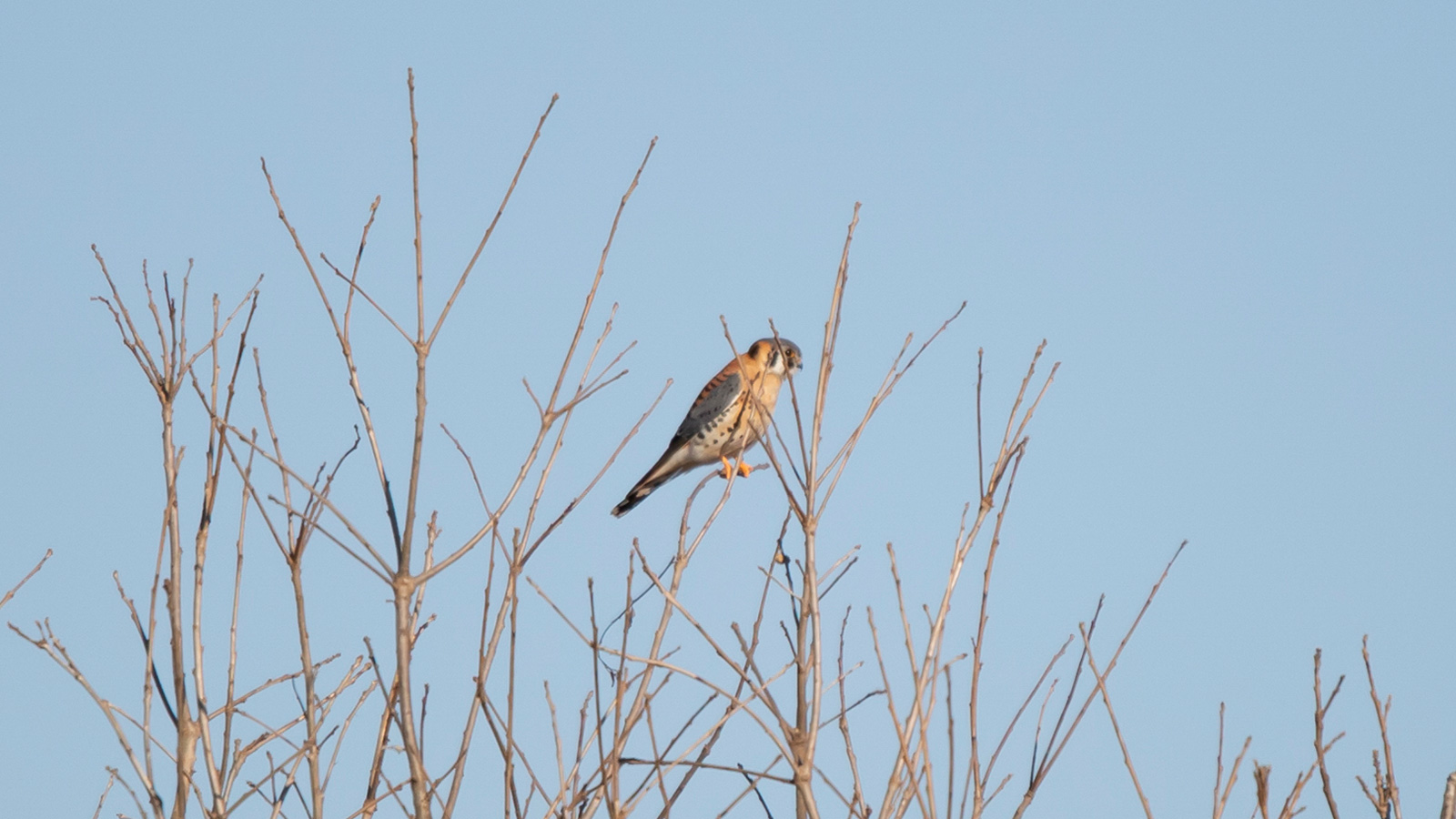
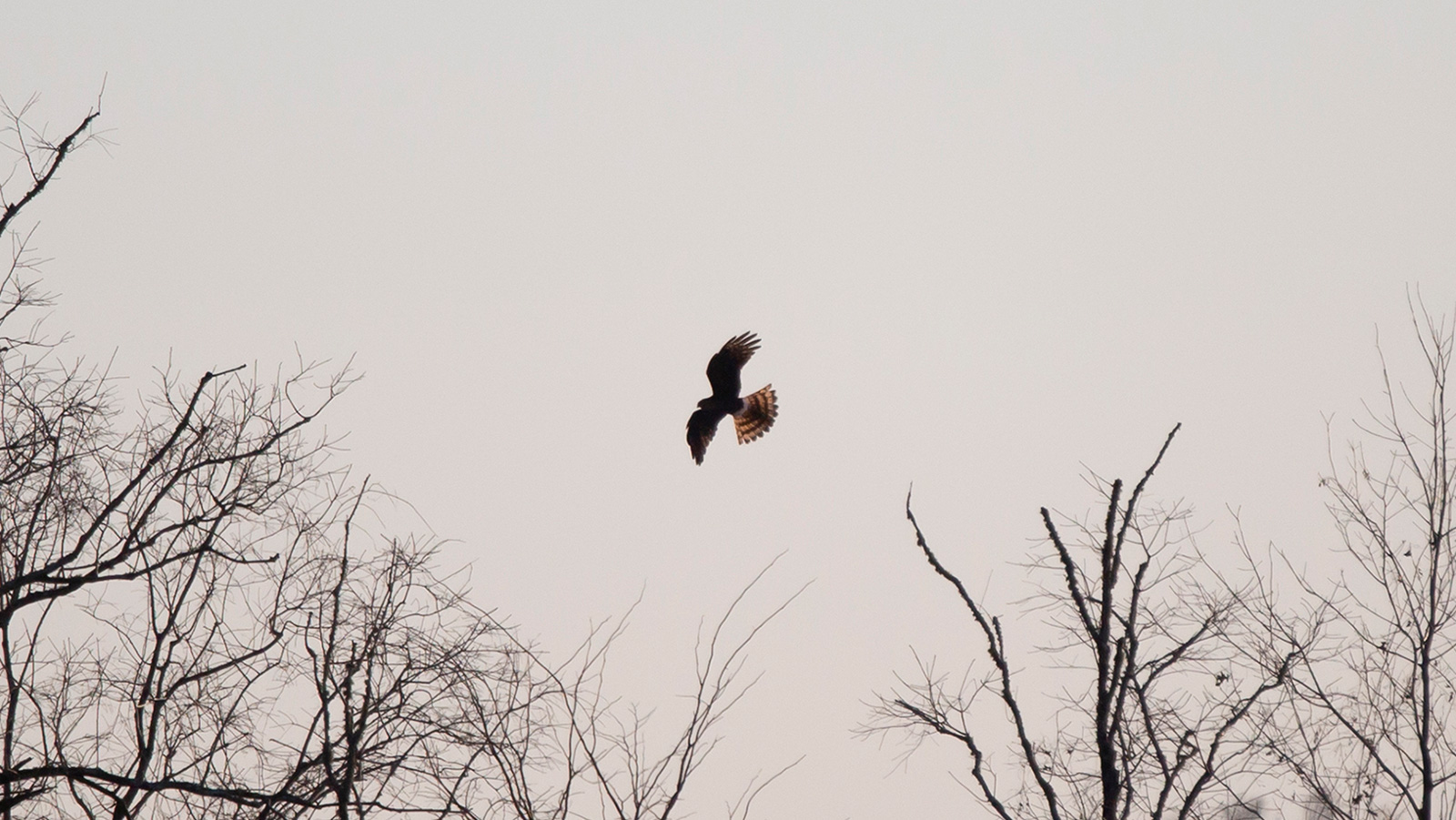
Raptors appear on the prey list with a frequency that establishes the great horned owl as the dominant predator in North Louisiana's entire raptor community: red-tailed hawks, red-shouldered hawks, barred owls, eastern screech-owls, American kestrels, and even ospreys have been documented as great horned owl prey. Crows, which mob great horned owls during the day with passionate, sustained aggression, have excellent reason for their hostility — the great horned owl is the crow's most dangerous predator, and crows that fail to detect a roosting owl before nightfall face genuine mortality risk once darkness hands the advantage to the owl.
When you hear a flock of crows screaming with particular fury in a North Louisiana woodlot, follow the sound — there is almost certainly a great horned owl at the center of the disturbance, enduring the daytime harassment with the stoic patience of a predator that knows the balance of power shifts comprehensively at sunset.
Herons, ducks, domestic poultry, feral cats, opossums, juvenile raccoons, snakes (including venomous species — great horned owls have been documented killing copperheads and cottonmouths), frogs, crawfish, large insects, and occasional porcupines round out a diet that can only be summarized as "everything." Porcupine predation sometimes proves fatal for both parties when quills penetrate the owl's facial disk, throat, and digestive tract — a prey choice that demonstrates the great horned owl's aggression exceeds its risk-assessment capability in certain encounters.
Advertisement
Where They Live
Great horned owls occupy every habitat type in North Louisiana with a generalist flexibility that rivals or exceeds any other raptor in the region. Mature bottomland hardwood forest, pine-hardwood mixed forest, open pine savanna, agricultural land with scattered trees, suburban neighborhoods with mature shade trees, urban parks, swamp margins, bayou corridors, and any other landscape that combines elevated perches with accessible prey works fine for the species. The species avoids only treeless open water and completely barren ground — if a single large tree stands in an otherwise empty landscape, a great horned owl can use that tree as a roost, a nest platform, and a hunting perch.
In North Louisiana, great horned owl density tracks prey density and nesting-site availability more closely than any specific habitat type. A bottomland forest with abundant rabbits and old hawk nests supports high owl density. A suburban neighborhood with mature oaks, cottontail rabbits in the gardens, and old crow nests in the canopy also supports territorial pairs.
Even urban settings — university campuses, city parks, cemetery grounds with large trees — can host breeding great horned owls if prey, perches, and nest sites meets the species' modest requirements. The great horned owl's habitat flexibility exceeds even the red-tailed hawk's, which is why ornithologists describe the species as adapted to survive in every climate and habitat type across the Americas except arctic-alpine regions.
Home ranges average roughly 2.5 square kilometers (about 600 acres) in studied populations, though the size varies substantially with habitat quality and prey availability. In prey-rich suburban and agricultural landscapes, home ranges contract because the owl can meet its food needs without ranging as far. In prey-poor forest interior, home ranges expand to cover the larger area needed to find sufficient rabbits, rodents, and other prey to sustain the pair and their nestlings.
Early Nesting
Great horned owls nest earlier than any other bird species in North Louisiana — a breeding timeline so far ahead of every other raptor and songbird that the owls are already incubating eggs while most other birds have not yet begun courtship. The sequence begins with courtship hooting in November and December, when paired birds exchange deep, resonant duets from established territories, strengthening pair bonds that may persist for the birds' entire reproductive lives.
Egg-laying begins in January — sometimes in the first week of the month — and incubation proceeds through January and February while ice storms, freezing rain, and subfreezing overnight temperatures test the female's metabolic ability to keep eggs warm on a nest platform exposed to winter weather.
The early nesting schedule confers a developmental advantage: by the time most other raptors begin nesting in March and April, young great horned owlets are already large, mobile, and sprouting flight feathers. They occupy nest sites and surrounding perch trees before hawks, barred owls, or any other large bird begins competing for similar resources. The timing also means that great horned owlets are fledging and learning to hunt during the spring peak of prey availability (baby rabbits, migrating songbirds, emerging amphibians) rather than during the leaner summer or fall months.
Great horned owls do not build nests — a fact that bears repeating because the species' nest-appropriation habit directly affects other raptor populations in North Louisiana. They take over existing structures: abandoned red-tailed hawk nests (the most common platform in North Louisiana), old crow nests, great blue heron nests, squirrel dreys, hollow tree cavities, cliff ledges (rare in North Louisiana), and artificial platforms. The male selects the nest site during courtship, leading the female to prospective locations and displaying at each one. Once the female accepts a site, she adds nothing to the structure — eggs are laid directly on whatever surface the appropriated nest or cavity provides.
Females lay 1 to 4 eggs (typically 2 to 3 in North Louisiana), white and roughly spherical, and incubate for approximately 30 to 37 days. Incubation is performed almost exclusively by the female, who sits on the nest through every weather event that January and February can deliver — ice storms, heavy rain, freezing fog, and overnight temperatures that drop into the twenties — maintaining egg temperature near 37°C through metabolic heat production and the insulating properties of her exceptionally soft, dense body feathers.
The male provides all food during incubation, hunting through the night and delivering prey to the nest at intervals that sustain the female's metabolic demands without requiring her to leave the eggs.
Nestlings hatch blind and covered in white down, growing rapidly on the steady diet of rabbits, rats, birds, and whatever else the parents deliver. Growth rate is impressive — from a 35-gram hatchling to a nearly adult-sized fledgling in approximately 9 weeks.
Young owls begin branching (climbing out of the nest onto nearby limbs using feet, wings, and bill as climbing tools) at 6 to 7 weeks and achieve powered, independent flight at 9 to 10 weeks. Branching owlets that fall from the nest tree before achieving flight can often climb back up using their strong feet and hooked bill — a recovery ability that saves many young owls from ground-level predation during the vulnerable pre-flight period.
Parental feeding continues for several months after fledging as the young owls gradually develop the hunting proficiency needed for independent survival. Family groups remain loosely associated through the summer, with fledglings making increasingly competent hunting attempts while the parents supplement with delivered prey. Juveniles disperse in autumn, sometimes traveling over 250 kilometers from the natal territory to find and establish their own home ranges in unoccupied habitat.
Advertisement
Territory
Great horned owl pairs maintain territories year-round with a permanence and aggression that ensures no other large owl or competing raptor establishes itself within the pair's defended area. Pairs may hold the same territory for as many as 8 consecutive years — and sometimes for the entire span of both birds' lives, which can exceed 13 years in the wild and approach 30 years in captivity.
Territory size averages roughly 2.5 square kilometers (about 600 acres) in studied populations, though size varies substantially with habitat quality, prey density, and the proximity of neighboring pairs. Both members of the pair defend the territory through hooting duets — the deep, rolling exchanges that carry across North Louisiana's nighttime landscape from November through March — and, when vocal defense fails, through direct physical aggression toward intruding owls that includes aerial pursuit, talon strikes, and forceful displacement from perches.
Nest defense reaches a level of ferocity that exceeds every other North Louisiana bird species and that represents a genuine safety concern for humans who approach active nests. A great horned owl defending an active nest will attack any perceived threat — including humans, dogs, and livestock — with talons-first strikes directed at the head, face, and eyes.
Biologists who climb to great horned owl nests for research purposes wear helmets, eye protection, and thick clothing because the defending adult (usually the female, who sits tight until the intruder reaches the nest tree and then launches with lethal intent) will strike repeatedly from behind, delivering blows with 28 pounds of talon force that can cause lacerations, puncture wounds, and serious injury.
The aggression is not bluff behavior — great horned owls defending nests intend to cause harm, possess the physical equipment to cause serious harm, and have caused enough injuries to researchers, tree trimmers, and curious hikers that the species' nest defense capability warrants genuine caution from anyone who discovers an active nest during the January-through-April nesting period.
Territorial permanence means that great horned owl pairs become fixtures of the landscape they occupy. A pair that establishes territory in a North Louisiana woodlot, suburban neighborhood, or forest tract will occupy that same area year after year, hooting from the same perch trees, nesting in the same or nearby structures, and hunting the same prey base with an intimate familiarity that comes from years of continuous residence.
Knowing where a great horned owl pair lives is knowing where they will live next year and the year after that — a predictability that makes the species one of the most reliably observable owls in the region for birders willing to learn the territory locations.
Population
Great horned owls are abundant and stable across North America, with populations large enough that the species serves as the baseline "common large owl" against which rarer owl species are compared. Captive birds have lived 29 to 38 years, and wild birds regularly exceed 13 years, providing the long reproductive lifespan that sustains populations even with the modest annual clutch sizes typical of large raptors. In North Louisiana, great horned owls occupy every parish and every habitat type with consistent density, and their deep hooting is audible on winter nights in locations ranging from the interior of Tensas River NWR to the campus of Louisiana Tech University.
Advertisement
Accessibility
You do not need to see a great horned owl to know one lives nearby. That deep, rolling "hoo-hoo-hoooo hoo-hoo" carries a quarter mile on calm winter nights, and anyone who hears the sound once recognizes the species forever.
Visitors with low or no vision get one of the richest owl encounters available anywhere — duetting pairs produce minutes-long vocal exchanges from December through February that tell you exactly where the birds are and which direction the territory boundary runs. During the day, follow the sound of furious crows. A mob of screaming corvids in a woodlot almost always surrounds a roosting great horned owl, and the crow alarm gives away the predator's location better than any binocular scan.
Advertisement
Advertisement