Advertisement
The clay-colored sparrow (Spizella pallida) passes through North Louisiana during spring and fall migration, stops just long enough to confuse everyone trying to identify Spizella sparrows, and continues on without offering a clear look, a clean photograph, or a satisfying field note. The bird breeds on the northern Great Plains and the southern Canadian prairies, winters in Mexico and southern Texas, and treats North Louisiana as a rest stop on the highway between the two. A clay-colored sparrow in a North Louisiana weedy field in October arrived from Saskatchewan, will leave for Tamaulipas, and will spend approximately four to ten days eating weed seeds in your parish before disappearing south. The bird did not come to stay. The bird came to refuel.
Clay-colored sparrow's chief contribution to North Louisiana birding consists of making the already-frustrating winter Spizella identification puzzle significantly worse. A winter chipping sparrow in dull plumage sits difficult enough. A clay-colored sparrow in the same flock, wearing nearly identical dull brown plumage, with a nearly identical face pattern, at a nearly identical size, feeding in nearly identical posture, turns the identification from "challenging" to "bring a field guide, a spotting scope, and a willingness to accept defeat." The two birds share the same genus for a reason, and that reason currently works against every birder who encounters them together in a North Louisiana ragweed patch.
The clay-colored sparrow's breeding range sits entirely north and west of North Louisiana, centered on the northern Great Plains grasslands and the aspen parklands of southern Canada. The bird nests in brushy grasslands, prairie edges, and young jack pine plantations across Manitoba, Saskatchewan, Alberta, Minnesota, Montana, and the Dakotas. The population sits healthy and widespread across the breeding range, with numbers in the tens of millions, but virtually none of those millions spend any time in North Louisiana outside the migration windows. The bird treats the 26 parishes as a gas station between home and winter quarters, and the gas station gets approximately six weeks of business per year. The rest of the year, the parking lot sits empty.
The Face That Almost Tells You Something
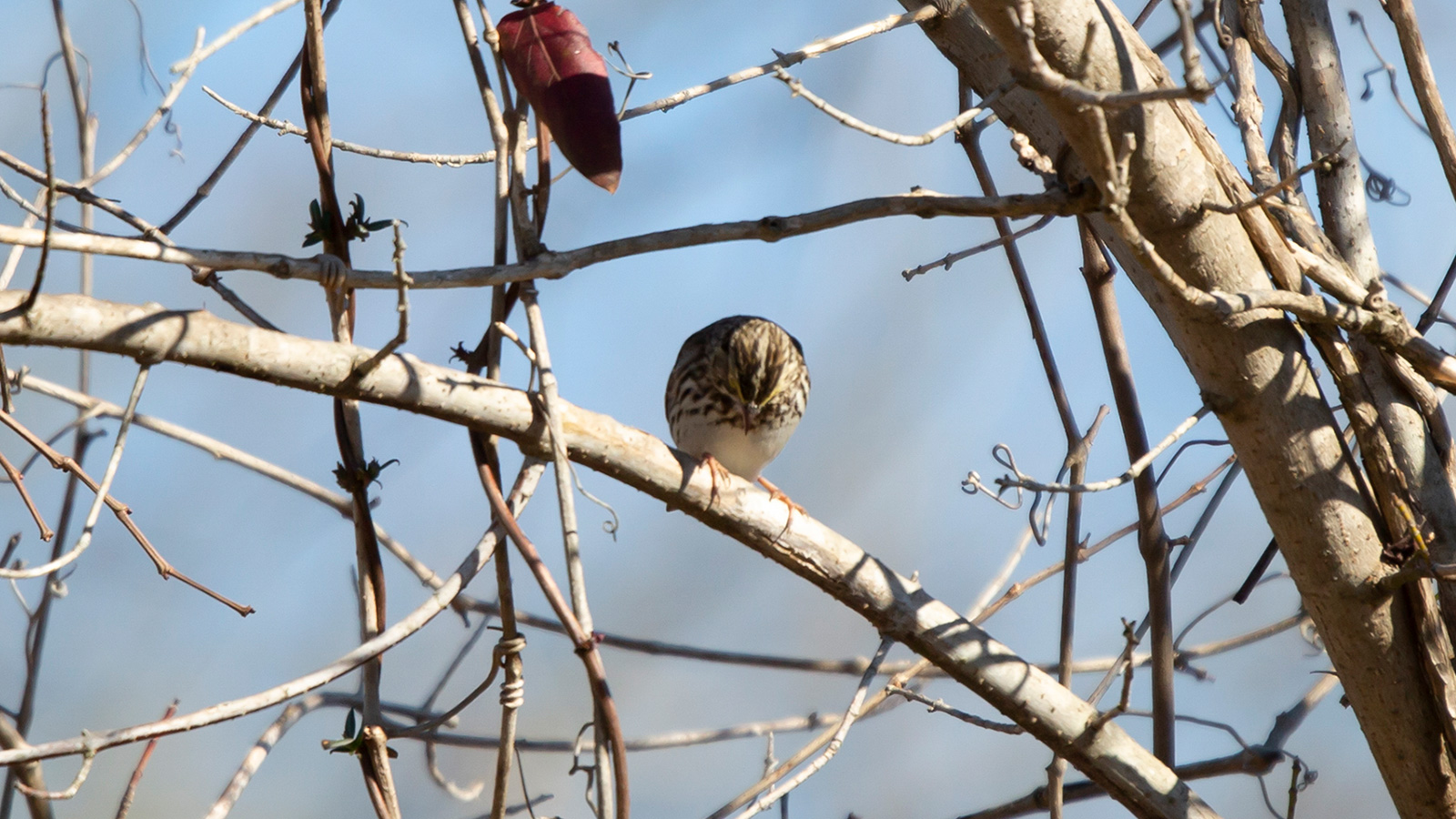
Face pattern on a clay-colored sparrow gives you the best shot at identification and the most frequent source of getting it wrong, all in the same set of markings. Brown crown with a pale central stripe. Pale gray nape.
Brown ear patch outlined with darker brown borders. Pale eyebrow stripe. The face pattern sits cleaner and more contrasting than the winter chipping sparrow's face, with the ear patch standing out as a distinct bordered brown panel rather than blending into the surrounding head coloring. The ear patch distinction works when the bird cooperates, which the bird frequently does not.
That brown ear patch outlined by darker brown lines does more work than any other field mark when you are trying to tell a clay-colored from a winter chipping sparrow. The chipping sparrow's ear patch blends into the crown and nape without clear dark borders. The clay-colored sparrow's ear patch sits framed by dark lines above and below, creating a rectangular panel of warm brown on the side of the head that contrasts with the grayer nape behind it. A Spizella sparrow in a North Louisiana field with a clearly bordered ear patch and a pale gray nape belongs to the clay-colored. A Spizella sparrow with an ear patch that melts into the surrounding head without clear borders probably belongs to the chipping sparrow. The word "probably" does real work in that sentence.
Second-best clue: the pale gray nape. The clay-colored sparrow wears a distinctly gray collar across the back of the neck that contrasts with the warmer brown of the crown above and the brown-streaked back below. The chipping sparrow's nape shows less contrast, blending more evenly into the crown and back. In good light, at close range, with a cooperative bird, the gray nape stands out. In overcast light, at forty feet, with the bird hopping through ragweed stems, the gray nape becomes a suggestion rather than a field mark.
The breast sits buffy and largely unstreaked, matching the chipping sparrow's clean breast but wearing a warmer, more tan-washed tone in most individuals. The buffy breast coloring does not separate the clay-colored from the chipping in the field with any reliability because the chipping sparrow also picks up a buffy wash in some winter individuals. The breast color backs up the case but never closes it alone, and you need the ear patch, the nape, and the breast color all pointing the same direction before you commit.
Pink bill in all seasons, matching the chipping sparrow's winter bill and removing another potential separator from the toolkit. Size matches the chipping sparrow. Shape matches the chipping sparrow.
Posture matches the chipping sparrow. The clay-colored sparrow committed to looking exactly the same as its closest relative in every measurement except the face pattern, and even the face pattern only works in favorable conditions. The bird did not evolve for easy identification. The bird evolved for Great Plains brush country, and the resemblance to the chipping sparrow apparently caused no survival problems on the breeding grounds where the two birds segregate by habitat.
One more subtle clue: the rump color. The clay-colored sparrow wears a brown rump that matches the brown back. The chipping sparrow in winter wears a gray rump that contrasts with the brown back. A Spizella sparrow flying away from the observer shows the rump, and a brown rump supports clay-colored while a gray rump supports chipping. The rump flash lasts about one second during takeoff, and the observer who noticed the rump color in that one-second window earned the identification. The observer who blinked missed it.
Juvenile clay-colored sparrows in fall migration wear finer breast streaking than juvenile chipping sparrows, but the difference sits so subtle that using it as a primary field mark guarantees frustration. The juveniles of both birds streak their breasts during the first summer and then molt into the dull, clean-breasted winter plumage that makes them nearly identical. A streaky-breasted Spizella sparrow in August or September could belong to either bird, and the ear patch and nape color still provide more reliable separation than the streaking pattern. The identification shortcuts do not exist. The identification demands the full field mark suite every time.
Advertisement
The Buzzy Insect Song Nobody Hears Here
The clay-colored sparrow's breeding song, a series of two to five flat, buzzy notes on the same pitch, rarely gets heard in North Louisiana because the bird saves the full song for the Great Plains breeding grounds. The song sounds mechanical, insect-like, and distinctly un-musical, earning comparisons to a buzzing cicada and a dying fluorescent light. Birders who travel to Saskatchewan or Manitoba in June hear the song constantly. Birders who stay in North Louisiana hear the song almost never.
By ear? Forget it. A chip note identical to the chipping sparrow's chip note tells you nothing about which bird made it.
A clay-colored sparrow and a chipping sparrow calling from the same flock produce the same sharp, dry "chip" that sounds the same regardless of which throat delivered it. The call note merges the two birds into a single auditory category that the ear cannot sort. The binoculars sort. The call note does not.
Occasional spring migrants passing through North Louisiana in late April or early May may deliver partial songs or practice phrases as the hormonal clock activates before the bird reaches the breeding grounds. A buzzy, insect-like series of notes from a Spizella sparrow in a North Louisiana thicket in late April could indicate a clay-colored sparrow rehearsing the breeding song en route north, and the sound alone would separate the bird from the chipping sparrow whose trill sits faster, longer, and more rattle-like than the clay-colored's flat buzz. The listening window for hearing this sound in North Louisiana lasts about three weeks and rewards birders who know what they are listening for. The window does not reward birders who showed up expecting the bird to announce its name.
Dawn chorus during a migration stopover occasionally puts clay-colored sparrow buzzes into the general sparrow noise of a weedy field at sunrise. The bird may deliver a few tentative buzzes alongside the chipping sparrow trills and white-throated sparrow whistles, and a birder who knows the clay-colored's buzz can detect it in the dawn mix the way a musician detects a wrong note in a chord. The buzz sits flatter, shorter, and more insect-like than anything the other sparrows produce, and the difference registers clearly for birders who spent time on the Great Plains where the sound fills every brushy draw from May through July. For birders who never heard the sound before, the dawn chorus detection method demands a recording comparison first and a field trip second.
The Migration Corridor
The migration corridor clips the western edge of North Louisiana harder than the eastern edge. Parishes west of Monroe (Bienville, Bossier, Caddo, Claiborne, DeSoto, Natchitoches, Red River, Sabine, Webster, Winn) rack up more clay-colored sparrow reports than parishes east of Monroe (Caldwell, Franklin, Madison, Morehouse, Richland, Tensas, West Carroll), though the bird turns up across all 26 parishes during peak migration. More birds fly over the western half. The eastern half still gets visitors.
Fall migration pushes clay-colored sparrows through North Louisiana from late September through late October, with numbers peaking in mid-October. The fall window coincides with the peak confusion period, because the chipping sparrows that bred in North Louisiana also wear dull fall plumage by October, creating mixed Spizella flocks in weedy fields where every bird demands individual scrutiny. A flock of ten Spizella sparrows in a Natchitoches Parish ragweed field in October may contain eight chipping sparrows and two clay-colored sparrows, and identifying the two clay-coloreds from the eight chippings without close observation of every individual's ear patch and nape color sits somewhere between challenging and aspirational.
Spring migration moves faster. Clay-colored sparrows pass through North Louisiana from mid-April through mid-May, spending less time at any given stopover site than they spent during fall. The spring transit serves one purpose: reach the Canadian prairies before the prime nesting territories get claimed. The urgency produces shorter stopovers, thinner flocks, and fewer observations. A spring clay-colored sparrow in North Louisiana may spend two days rather than ten, which reduces the encounter window and makes the spring identification challenge about finding the bird before the bird leaves the parish.
Where the bird stops depends entirely on what grew in the field. A weedy field with a strong ragweed and foxtail seed crop attracts clay-colored sparrows for the full duration of the stopover. An adjacent field with short-mowed grass and no standing seed heads attracts nothing. The quality of the stopover site determines the refueling efficiency, and a clay-colored sparrow that landed in a productive weedy field gains weight faster and departs sooner than a bird that landed in a marginal field and needed extra days to accumulate the fat reserves for the next flight segment. The farmer who left the field edge weedy provided better migratory bird habitat than the farmer who bush-hogged everything to the fence line, and neither farmer factored sparrow nutrition into the mowing schedule.
The migration altitude puts clay-colored sparrows in the low-altitude nocturnal migration stream, traveling at night between five hundred and three thousand feet above ground and landing at dawn in whatever habitat the bird overflew at first light. The landing site selection appears semi-random during fall: a clay-colored sparrow that flew all night from Missouri and reached North Louisiana at sunrise drops into the first weedy field, brushy edge, or overgrown lot that the bird spotted from altitude. The site may turn out to be excellent or terrible, and the bird evaluates the food supply over the first day before committing to a longer stay or departing the following night. A clay-colored sparrow in an urban parking lot median strip in Shreveport at dawn in October misjudged the landing and will correct the error by nightfall.
Advertisement
The Weedy Field Specialist
Clay-colored sparrow feeds on the ground in weedy fields, brushy field margins, overgrown pastures, and agricultural edges during migration through North Louisiana. The diet during stopover mirrors the chipping sparrow's winter diet: small seeds from ragweed, foxtail, smartweed, pigweed, and grasses, picked from the ground and from low seed heads. The feeding behavior matches the chipping sparrow so closely that separating the two by behavior alone cannot work. Both birds hop through the same weedy substrates, pick at the same seed heads, and flush into the same brushy cover when disturbed. The clay-colored sparrow and the chipping sparrow share a feeding niche the way two employees share a cubicle: neither chose the arrangement, but both tolerate it because the food supply works.
Insects bulk up the menu during spring migration, when the bird needs protein for the breeding season ahead on the Great Plains. Caterpillars, beetles, and small invertebrates gleaned from low vegetation provide the protein that seed-only diets lack, and a spring migrant clay-colored sparrow feeding in a North Louisiana brushy field alternates between seed-picking on the ground and insect-gleaning on low stems with a flexibility that keeps the bird fueled for the remaining flight north.
Water attracts migrating clay-colored sparrows to puddles, ditch edges, and any shallow water source near the feeding habitat. The birds drink and bathe at the same water sources the chipping sparrows use, and a puddle in a weedy field during October migration may host both Spizella birds at the same time, side by side, drinking from the same puddle, offering the birder a direct comparison opportunity that the birder will waste because both birds just flushed into the ragweed.
Fall migration flocks throw clay-colored sparrows in with mixed-species feeding groups that include chipping sparrows, savannah sparrows, dark-eyed juncos, white-throated sparrows, and occasionally Lincoln's sparrows. The clay-colored sparrow does not segregate from the other sparrows by feeding position, feeding technique, or feeding schedule. Every bird in the mixed flock feeds on the same seeds in the same weedy patch at the same time of day, and the observer who wants to find the clay-colored sparrow within the flock faces a sorting exercise that the flock did not organize to assist. The flock does not cluster by type. The flock clusters by food.
Come evening, migrating clay-colored sparrows pack into dense brushy cover alongside the rest of the sparrow flock. A brushy fencerow or vine-covered thicket at the edge of a weedy field may host a mixed roosting flock that includes every sparrow feeding in the adjacent field during the day. The roost site delivers the closest encounter opportunity for observers, because the birds call softly as they settle and may perch at eye level for several seconds before dropping into dense cover. The dusk window at a migration-season roost site puts more sparrows at closer range for longer durations than any other encounter scenario in North Louisiana Spizella birding.
Advertisement
What Hunts the Clay-Colored Sparrow
The predator list matches the chipping sparrow's predator list because the two birds occupy the same size class, the same habitats, and the same elevation above the ground. Sharp-shinned hawks, Cooper's hawks, American kestrels, and loggerhead shrikes catch clay-colored sparrows from migration flocks and from exposed feeding positions. The clay-colored sparrow's response to a hawk matches the chipping sparrow's response: flush into the nearest dense cover, wait, and resume feeding when the threat passes. The hawk does not distinguish between the two Spizella species either. The hawk catches whichever one reacted slowest.
Domestic cats affect migrating clay-colored sparrows at the same rate they affect every other ground-feeding sparrow that stops in suburban and agricultural habitats. A clay-colored sparrow that chose a stopover field adjacent to a farmhouse with outdoor cats faces the same predation pressure that the resident chipping sparrows face year-round. The migrant bird lacks the local knowledge of escape routes and safe cover that the resident bird accumulated over months, which makes the migrant marginally more vulnerable during the first day at a new stopover site. The vulnerability decreases as the bird learns the local landscape. The stopover duration does not always provide enough time for the learning to finish.
Collisions with lighted structures during nocturnal migration kill clay-colored sparrows the same way they kill chipping sparrows, warblers, thrushes, and every other nocturnal migrant funneling through North Louisiana during October. Lit communication towers, office buildings, and stadium lights attract and disorient migrating birds, and a clay-colored sparrow passing through Shreveport at two in the morning navigates the same light pollution hazards as every other bird in the migration stream. The bird that survived Saskatchewan's predators and North Louisiana's cats faces a window pane in downtown Shreveport. The window does not care which Spizella sparrow it hit.
Exposure and starvation during migration affect clay-colored sparrows that encounter weather systems mid-flight. A cold front that pushes through North Louisiana during peak October migration can ground thousands of migrating sparrows in whatever habitat they find at dawn, and a clay-colored sparrow grounded by rain and wind in a harvested soybean field with no standing weeds faces a food shortage that the bird cannot solve until the weather clears and the bird relocates to a productive field. A grounded migrant burning calories to stay warm without replacing them loses body condition rapidly, and two consecutive days of bad weather during a stopover can thin the fat reserves the bird accumulated over the previous week. The migration schedule left no margin for weather delays, and the weather did not check the schedule.
Competition at stopover sites puts the clay-colored sparrow among larger, more aggressive sparrows that dominate the best feeding positions. A white-throated sparrow weighing nearly twice the clay-colored's body weight displaces the smaller bird from productive seed heads without effort, and the displacement pushes the clay-colored sparrow toward marginal feeding positions at the edges of the flock where seed density drops and predator exposure climbs. The clay-colored sparrow adapted to this dynamic on the Great Plains, where the bird feeds in brushy scrub that the larger sparrows avoid. In the weedy fields of North Louisiana, the brushy scrub niche does not exist in the same form, and the clay-colored sparrow improvises with whatever marginal feeding space the larger birds leave open.
Advertisement
Where to Look (If You Want the Challenge)
Weedy agricultural field edges, overgrown pastures, brushy fencerows, and any scrubby habitat with ragweed, foxtail, and smartweed during mid-September through late October (fall) and mid-April through mid-May (spring). The clay-colored sparrow feeds in the same weedy fields that chipping sparrows, white-throated sparrows, and savannah sparrows use during migration, and finding the clay-colored means sorting through the more common sparrows one bird at a time until the ear patch and the gray nape appear.
Parish roads through agricultural areas in Bossier, Caddo, Natchitoches, Red River, and Bienville parishes produce the highest encounter rates during fall migration. Drive slowly, stop at weedy field edges, and pish softly to bring mixed sparrow flocks to the edge of the brush for closer views. The clay-colored sparrow responds to pishing with the same curiosity that the chipping sparrow shows, which means both birds will approach, both birds will perch briefly, and the observer gets five seconds to check the ear patch before both birds drop back into the weeds.
Sewage treatment ponds and their surrounding weedy margins attract migrating sparrows to a combination of water, seeds, and insects that few other habitats provide in a single package. The weedy berms around rural wastewater ponds in North Louisiana host mixed sparrow flocks during October that may include clay-colored sparrows alongside the expected chipping, savannah, and swamp sparrows. The habitat sits unglamorous. The birding sits productive. The trade-off defines most of the best sparrow-watching locations in the 26 parishes.
Timing matters more than location for the clay-colored sparrow. The bird passes through North Louisiana during specific calendar windows, and birding weedy fields outside those windows produces zero clay-colored sparrows regardless of habitat quality. Mid-October hits the peak fall window. Late April hits the peak spring window. A birder who checks the right habitat during the right week finds clay-colored sparrows. A birder who checks the right habitat during the wrong week finds chipping sparrows and wonders what went wrong.
The identification process improves with patience and repetition. The first clay-colored sparrow a birder identifies takes thirty minutes of comparison looks. The tenth takes thirty seconds. The ear patch and the gray nape become familiar, the gestalt sharpens, and the bird that seemed impossible to separate from the chipping sparrow starts looking obviously different. The learning curve rewards persistence and punishes impatience, which describes most of North Louisiana birding.
Where to Learn More
Cornell Lab of Ornithology's All About Birds covers the clay-colored sparrow with range maps, migration timing, and comparison guides for the Spizella puzzle. The Macaulay Library hosts call and song recordings that let birders learn the buzzy song before a spring migrant drops it from a North Louisiana thicket.
Sibley's Guide to Birds gives the side-by-side Spizella comparison that turns the clay-colored-versus-chipping puzzle from impossible to merely difficult. That illustrated head-pattern comparison between the two birds, showing the clay-colored's bordered ear patch against the chipping's blended ear patch, earns more field use than any other page in the guide for anyone birding weedy fields in October.
Advertisement
Experiencing This Bird: Accessibility Notes
By ear, the clay-colored and the chipping sparrow sound identical during migration, and sorting them by chip note alone sits beyond practical limits. The buzzy breeding song, rarely delivered in North Louisiana, gives the one sound that actually tells them apart, and hearing it during late April or early May migration confirms the bird without any visual identification. The buzz sits at a mid-frequency range that most people hear without difficulty, and the flat, insect-like quality of the sound distinguishes it from every other sparrow song in the region.
For anyone with mobility limitations, the clay-colored sparrow presents an accessibility challenge because the bird does not visit feeders with regularity and feeds in weedy fields that may lack accessible paths or viewing areas. The best approach involves driving parish roads through agricultural areas during October migration, stopping the vehicle at weedy field edges, and observing from the vehicle window. The sparrow flocks feed close to roadsides, and a vehicle parked alongside a weedy field edge in Bossier or Natchitoches Parish during mid-October often produces eye-level views of mixed sparrow flocks from the driver's seat. The bird will not come to the observer. The road brings the observer to the bird.
Pishing from a vehicle window works for drawing mixed sparrow flocks closer. A soft "pssh-pssh-pssh" from the driver's seat brings curious sparrows to the fence line or the nearest perch, and a clay-colored sparrow responding to pishing typically perches briefly at eye level before dropping back into cover. The perch moment lasts five to ten seconds, which gives you enough time to check the ear patch and nape if the binoculars were ready before the pishing started. The technique costs nothing, works consistently, and turns a drive through agricultural North Louisiana into a productive sparrow-sorting exercise. The sparrows cooperate for five seconds. Make the five seconds count.
Meta Title: Clay-Colored Sparrow in North Louisiana: The Prairie Ghost Passing Through | NLW Meta Description: The clay-colored sparrow migrates through North Louisiana in fall and spring, mixes with chipping sparrows in weedy fields, and tests every birder's patience. Focus Keyphrase: clay-colored sparrow North Louisiana Secondary Keywords: clay-colored sparrow Louisiana, clay-colored sparrow identification, clay-colored sparrow vs chipping sparrow, Spizella pallida Louisiana, clay-colored sparrow migration, fall sparrow migration Louisiana, Spizella sparrow identification, clay-colored sparrow range, North Louisiana sparrows, clay-colored sparrow field marks OG Description: The clay-colored sparrow migrates through North Louisiana in fall and spring, wears almost identical plumage to the chipping sparrow, and treats the weedy field as a four-day refueling stop between Saskatchewan and Mexico. Slug: clay-colored-sparrow-north-louisiana
Advertisement
Accessibility
## Experiencing This Bird: Accessibility Notes
By ear, the clay-colored and the chipping sparrow sound identical during migration, and sorting them by chip note alone sits beyond practical limits. The buzzy breeding song, rarely delivered in North Louisiana, gives the one sound that actually tells them apart, and hearing it during late April or early May migration confirms the bird without any visual identification. The buzz sits at a mid-frequency range that most people hear without difficulty, and the flat, insect-like quality of the sound distinguishes it from every other sparrow song in the region.
For anyone with mobility limitations, the clay-colored sparrow presents an accessibility challenge because the bird does not visit feeders with regularity and feeds in weedy fields that may lack accessible paths or viewing areas. The best approach involves driving parish roads through agricultural areas during October migration, stopping the vehicle at weedy field edges, and observing from the vehicle window. The sparrow flocks feed close to roadsides, and a vehicle parked alongside a weedy field edge in Bossier or Natchitoches Parish during mid-October often produces eye-level views of mixed sparrow flocks from the driver's seat. The bird will not come to the observer. The road brings the observer to the bird.
Pishing from a vehicle window works for drawing mixed sparrow flocks closer. A soft "pssh-pssh-pssh" from the driver's seat brings curious sparrows to the fence line or the nearest perch, and a clay-colored sparrow responding to pishing typically perches briefly at eye level before dropping back into cover. The perch moment lasts five to ten seconds, which gives you enough time to check the ear patch and nape if the binoculars were ready before the pishing started. The technique costs nothing, works consistently, and turns a drive through agricultural North Louisiana into a productive sparrow-sorting exercise. The sparrows cooperate for five seconds. Make the five seconds count.
Meta Title: Clay-Colored Sparrow in North Louisiana: The Prairie Ghost Passing Through | NLW Meta Description: The clay-colored sparrow migrates through North Louisiana in fall and spring, mixes with chipping sparrows in weedy fields, and tests every birder's patience. Focus Keyphrase: clay-colored sparrow North Louisiana Secondary Keywords: clay-colored sparrow Louisiana, clay-colored sparrow identification, clay-colored sparrow vs chipping sparrow, Spizella pallida Louisiana, clay-colored sparrow migration, fall sparrow migration Louisiana, Spizella sparrow identification, clay-colored sparrow range, North Louisiana sparrows, clay-colored sparrow field marks OG Description: The clay-colored sparrow migrates through North Louisiana in fall and spring, wears almost identical plumage to the chipping sparrow, and treats the weedy field as a four-day refueling stop between Saskatchewan and Mexico. Slug: clay-colored-sparrow-north-louisiana
Advertisement