Advertisement
Bell's vireos are the vireo that conservation biologists worry about. While white-eyed vireos thrive in every briar patch and red-eyed vireos number in the hundreds of millions, Bell's vireos have been quietly declining across the eastern portion of their range for decades, pushed out by the same combination of habitat loss and cowbird parasitism that threatens grassland birds and shrubland specialists across the continent. They're not yet a crisis species in North Louisiana, but they're uncommon enough and declining fast enough that every sighting deserves attention, documentation, and a moment of appreciation for a bird that's becoming harder to find.
Bell's vireos are scrubland and brushy habitat specialists. They need dense, low, shrubby vegetation of the kind that exists in early-successional fields, brushy fencerows, riparian thickets along streams, and the shrubby margins of open habitats. They overlap in habitat preference with white-eyed vireos but trend toward more open, drier shrubland and not the dense forest-edge thickets that white-eyed vireos favor. The distinction is subtle, and getting a feel for it takes time in the field with both species, but it's the distinction that separates a productive Bell's vireo morning from another morning of nothing but white-eyed vireos in the wrong habitat. Both species want dense shrubs, but Bell's vireos want them in a more open, prairie-adjacent context and not a forest-adjacent one. Learning to read that difference in habitat character is the first step toward finding a Bell's vireo in North Louisiana.
Small, Plain, and Hard to Pin Down
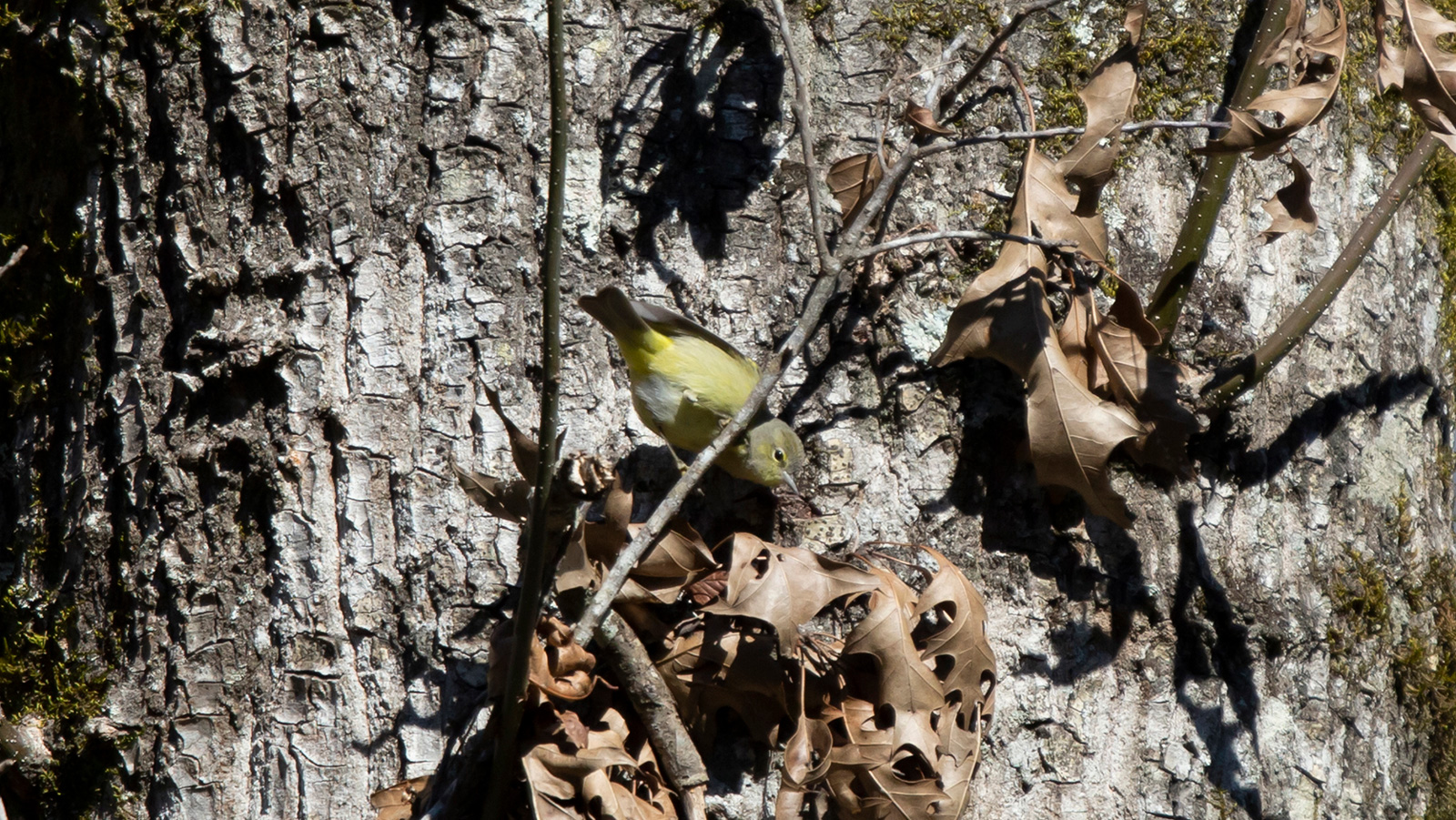
Bell's vireos, Vireo bellii, are small vireos, about 4.5 to 5 inches long, weighing roughly a third of an ounce, slightly smaller than white-eyed vireos. They're also plainer. The plumage is olive-gray above and whitish below with a faint yellowish wash on the flanks. The spectacles are thin and incomplete, a faint, narrow eye ring that's often broken at the top, connected to a faint loral stripe. The overall facial expression is less bold than any other North Louisiana vireo. Where white-eyed vireos have thick yellow spectacles and blue-headed vireos have bold white spectacles, Bell's vireos carry a suggestion of spectacles that you have to squint to confirm.
The wing bars are faint, two thin, pale bars that are visible in good light but nothing like the bold white bars of blue-headed vireos. The underparts are pale with minimal markings. The bill is the standard vireo shape, thick with a slight hook, but appears proportionally large on the small body. No single bold field mark exists. Bell's vireos are identified by the combination of small size, faint spectacles, plain plumage, and, most reliably, song and habitat.
The song is the best identification tool. Bell's vireos sing a rapid, chattery, warbling phrase that has been described as a hurried question-and-answer: "cheedle-cheedle-chee? cheedle-cheedle-chew!" The phrases often alternate between a rising inflection and a falling inflection, creating a back-and-forth quality that's distinctive once learned. The song is less emphatic than the white-eyed vireo's sharp "chick-a-per-wee-o-chick" and doesn't carry the bookending chip notes. It's faster, more continuous, and slightly more musical, a buzzy warble and not an explosive declaration. Once you know it, you won't confuse it again.
In size and plumage, Bell's vireos can initially read as washed-out white-eyed vireos that lost their spectacles in the wash. The comparison is useful for finding them, not just for identification. A vireo in low shrubs that seems slightly off for white-eyed, slightly smaller and plainer and quieter-looking, is worth stopping for. The song settles the question immediately.
The plumage also varies slightly between the subspecies that occur in and near North Louisiana. The eastern Bell's vireo subspecies tends toward slightly greener tones on the upperparts than the western populations, though the difference is subtle and not useful in field identification without direct comparison. The relevant comparison in North Louisiana is always against white-eyed vireo, and that comparison is resolved by the faint spectacles, the dark eye, the plain underparts without any yellow on the flanks, and the song. A bird that clears all four of those checks is a Bell's vireo.
Advertisement
The Song in Full
Bell's vireo song is one of those bird sounds that rewards patience to learn because it sounds meaningless until it sounds unmistakable. The quality is chattery and rapid, delivered without the emphatic punctuation marks that characterize most vireo songs. Where a white-eyed vireo drives each phrase to a sharp conclusion, a Bell's vireo runs its phrases into each other in a musical cascade that covers ground quickly and loops back before the listener has fully parsed the first phrase.
The question-and-answer structure is the key acoustic signature: a rising phrase followed by a falling phrase, over and over, with the inflection switch between them being the element that holds the pattern together and separates Bell's vireo from every other vireo in the region. Field guide descriptions of the sound consistently produce some version of "cheedle-cheedle-chee, cheedle-cheedle-chew," which is phonetically accurate but doesn't convey the speed or the quality of the delivery. The best preparation is audio recordings before the field visit and enough repetition with those recordings that the pattern locks in as a whole instead of being parsed note by note.
Males sing persistently through the breeding season, from arrival in late April through July, and a singing male is audible at distances of 100 yards or more in open shrubland where sound carries without obstruction. The persistency is one of the species' detection advantages: a Bell's vireo in suitable habitat on a May or June morning may sing for hours with minimal interruption, so a slow walk through appropriate habitat with good listening conditions will encounter the bird acoustically even if visual contact is impossible.
The call note, given in alarm and during interactions with other birds, is a sharp, buzzy "djep" or "djit" that's shorter and less musical than the song. It's less useful for initial detection than the song but confirms the species' presence when a singing male goes quiet and the call continues from the same shrub. In June and July, when the song begins to tail off for some individuals, the call note becomes a more important secondary detection cue.
Shrubland Dependency
Bell's vireos need early-successional shrubland, the specific habitat stage that occurs a few years after a disturbance, fire, clearing, or abandonment, when dense shrubs have grown up but trees haven't yet formed a closed canopy. In North Louisiana, this translates to overgrown pasture edges, brushy fencerows, riparian scrub along streams and bayous, and early-successional growth in abandoned agricultural fields.
This habitat specificity is limiting in a way that most people don't intuit when they look at a map of the southeastern United States and see what appears to be abundant brushy cover. The key word is successional stage. Dense shrubland of the right height, density, and structure isn't as common in North Louisiana as the forest-edge thickets that white-eyed vireos use, because fire suppression allows shrubland to mature into forest, clean farming eliminates brushy fencerows, and mowing and herbicide application along road margins and field edges remove the scrubby growth that Bell's vireos need. The habitat is transient by nature. It grows into something else within a few years unless disturbance maintains it, and the species that depends on it is caught in a perpetual search for patches that are in the right successional stage at the right time.
Foraging is similar to white-eyed vireo behavior, gleaning insects from leaves and twigs in the dense shrub layer at heights of 3 to 10 feet. Caterpillars, beetles, ants, spiders, and various insect larvae make up the bulk of the diet. Berry consumption is minimal compared to white-eyed vireos. The low foraging height is one of the clearest field cues for Bell's vireo: a vireo consistently foraging below 10 feet in open shrubland is Bell's until the song or a good face view rules it out.
The nesting habitat mirrors the foraging habitat. Nests are built low in dense shrubs, most often 1 to 5 feet off the ground, a cup of plant fibers, bark strips, and spider silk suspended from a fork in a stem. The low nest placement in open, edge-dominated habitat is precisely the configuration that makes Bell's vireo nests most accessible to cowbird monitoring females, which compounds the habitat problem with a parasitism problem.
Advertisement
Breeding Biology
Bell's vireos arrive in North Louisiana in late April and establish territories in shrubland habitat almost immediately after arrival. Territories are small by vireo standards, often less than an acre, because the dense shrubland the species uses can support multiple pairs in a small area if enough structure exists. Males sing persistently to advertise territory and attract mates, and the song continues through most of the breeding season, tapering in July as nesting wraps up.
Both parents build the nest, a neatly woven cup of grass, bark strips, plant down, and spider silk suspended from a fork in a low shrub stem. The female incubates the 3 to 5 eggs for about 14 days, with the male bringing food and occasionally relieving her on the nest. Both parents feed nestlings, which fledge at about 11 to 12 days. The short nestling period and the persistent singing of the male during the full breeding cycle mean that a Bell's vireo pair is acoustically conspicuous from arrival through late June even when the nesting activity itself is completely concealed in dense shrubs.
Second nesting attempts follow failed first attempts and sometimes follow successful first attempts if time permits. A pair that loses a nest to predation or cowbird parasitism in May may attempt again in June, and a June nest can produce fledglings by mid-July. The window of opportunity in North Louisiana's long warm season allows multiple attempts, though cowbird pressure often compromises the first attempt before the second chance begins.
The birds depart the breeding range in August and September, heading to wintering grounds from western Mexico through Central America. Fall departure is quiet compared to spring arrival. Males stop singing by mid-July in most years, and the birds become genuinely difficult to detect from late July onward as song fades and the birds spend more time foraging low in dense shrubs without the persistent advertising that makes them findable in May and June. The window of high detectability is narrow: late April through late June for singing males, with the peak in May and early June.
Brown-headed cowbird parasitism is the second major driver of Bell's vireo decline, compounding the habitat loss problem. Bell's vireo nests are highly vulnerable to cowbird parasitism. They build open cup nests in low shrubs, in exactly the kind of edge habitat where cowbirds concentrate their nest-searching activity. Parasitism rates in some studied populations exceed 50 percent, meaning more than half of all Bell's vireo nests receive cowbird eggs.
The impact is severe because Bell's vireos are poor at rejecting cowbird eggs. They almost always accept the foreign egg, incubate it, and raise the cowbird chick, usually at the expense of their own offspring. In heavily parasitized populations, cowbird chicks outnumber vireo chicks in fledgling output, effectively converting Bell's vireo nesting effort into cowbird reproductive output. The combination of shrinking habitat and cowbird pressure has driven the eastern population of Bell's vireo to critically low levels in several states, with the species extirpated from parts of its former range in the upper Midwest and Mid-Atlantic.
In North Louisiana, cowbird parasitism is a persistent pressure on the small Bell's vireo population, though the overall cowbird density in this region is lower than in the most heavily fragmented agricultural landscapes where parasitism rates peak. The presence of extensive forest cover may provide some buffer by supporting lower cowbird densities than a fully deforested landscape, but the pressure remains significant for a species whose nest placement puts it in the cowbird's sweet spot.
The western subspecies of Bell's vireo, the least Bell's vireo of California, is federally listed as endangered, with cowbird management through trapping and removal as a primary conservation action. The eastern subspecies in North Louisiana isn't listed but is declining and classified as a species of conservation concern in multiple states. No active cowbird management programs target Bell's vireo breeding sites in North Louisiana, and the species' status in the 26 parishes is incompletely known. More observer effort in appropriate habitat during May and June would significantly improve the regional picture and might reveal that the species is more widespread than current records suggest, or confirm that the decline documented elsewhere in the eastern range has reduced the North Louisiana population below the level that existing records imply.
Advertisement
Population Trends
The overall Bell's vireo population across North America shows a long-term declining trend on Breeding Bird Survey routes, with steeper declines in the eastern portion of the range where both habitat quality and cowbird pressure are most acute. The IUCN lists the species as Least Concern based on its broad range, but the eastern subspecies faces pressures serious enough to warrant concern independent of the overall population trend. States that historically held strong eastern Bell's vireo populations, including Missouri, Illinois, Indiana, and Kentucky, have seen populations drop to isolated remnants or disappear entirely from large portions of the former range. What the species' trajectory looks like in North Louisiana over the next 20 years depends almost entirely on whether fire-maintained open habitat continues to exist in the Kisatchie corridor and whether cowbird management becomes part of any active conservation program for the region.
In North Louisiana, the species is an uncommon breeding bird with scattered records from appropriate habitat across the western and central parishes. Historical accounts suggest the species was more widespread in brushy riparian corridors and open shrubland before the widespread suppression of fire and the intensification of agriculture that simplified the landscape over the past century. The records that do exist cluster in the parishes with the most extensive early-successional and fire-maintained shrubland, particularly areas adjacent to Kisatchie National Forest where prescribed fire management creates and maintains the open shrubby habitat the species needs.
Monitoring Bell's vireo populations in North Louisiana is difficult because the species occupies scattered, often inaccessible shrubland patches and because its song can be overlooked by observers not specifically searching for it. The current understanding of the species' distribution in the 26 parishes is based almost entirely on incidental eBird records and not systematic survey effort, which almost certainly underrepresents the true distribution. A targeted survey effort during May and June in appropriate habitat across the Natchitoches, Sabine, Vernon, and DeSoto parish corridors would likely reveal more breeding locations than are currently documented, and it would cost nothing beyond observer time and the willingness to drive slowly down Kisatchie fire roads with a window open.
Commonly Confused With
White-Eyed Vireo: The primary confusion species and the one Bell's vireo identification most often comes down to. White-eyed vireos carry bold yellow spectacles, white eyes in adults, and a sharper, more emphatic song with distinctive "chick" bookend notes. Bell's vireos show faint, incomplete spectacles, dark eyes, and a faster, chattier song without the sharp framing notes. Habitat overlap exists, but Bell's vireos trend toward drier, more open shrubland while white-eyed vireos prefer denser, forest-adjacent thickets. A vireo in a brushy fencerow along an open field is a better Bell's candidate than the same species in a forest-edge tangle.
Warbling Vireo: Warbling vireos are larger, grayer, and deliver a flowing, continuous warble instead of Bell's chattery question-and-answer song. Warbling vireos forage higher in the canopy, at tree height and not in low shrubs. Habitat and height separate them quickly.
Orange-Crowned Warbler: A potential source of confusion during migration, when orange-crowned warblers pass through brushy habitat. Orange-crowned warblers are thinner-billed and more active than vireos, with a thin eye line and yellowish-green plumage without the vireo's hooked bill or heavier build. Bill shape and foraging pace resolve the question.
Advertisement
Where to Find Bell's Vireos in North Louisiana
Bell's vireos are uncommon in North Louisiana, present primarily during the breeding season from April through September in scattered locations where suitable shrubland habitat exists. Targeted searching in specific habitats during May and June, when males are singing at peak intensity, gives the best detection odds.
Brushy riparian corridors along streams and small bayous, overgrown pasture edges with dense shrub growth, and early-successional habitat in fallow fields and abandoned agricultural land are the target habitats. The Kisatchie National Forest districts with fire-maintained openings adjacent to brushy regeneration support Bell's vireos in the mosaic of open and shrubby habitat that prescribed fire creates. Natchitoches Parish, Sabine Parish, and Vernon Parish hold the most extensive suitable habitat in the North Louisiana coverage area.
Song is the primary detection method. A slow walk through suitable shrubland habitat during May and June, listening for the rapid, chattery, question-and-answer song, is more effective than visual searching. If a vireo is singing from dense shrubs in open, dry habitat, take the time to confirm by checking for the faint, incomplete spectacles and the overall plain plumage that distinguishes Bell's from the bolder-marked white-eyed vireo.
Every confirmed Bell's vireo sighting in North Louisiana deserves documentation on eBird with habitat details and, if possible, audio or photographic evidence. The species' status in the 26 parishes is poorly known, and observer data fills knowledge gaps that formal surveys don't address.
Accessibility
The Bell's vireo song leads every detection, and it arrives well before any visual confirmation is possible. In open shrubland habitat on a May or June morning, the rapid, chattery question-and-answer warble carries 100 yards or more across low scrub, arriving clearly before any movement in the vegetation becomes visible. The alternating rise-and-fall structure of the phrases, the rising question followed by the falling answer, repeating in a loop that covers ground quickly, is the acoustic signature that confirms the species from any accessible position within earshot.
For visitors who are blind or have low vision, Bell's vireo song is the complete detection experience. The song carries at shrub height in open habitat more clearly than it would in dense forest or canopy cover, because the open character of the habitat the species uses allows sound to travel without the obstruction that muffles canopy songs. A companion familiar with the song can confirm identification from the song alone, describe the approximate location of the singing male in the shrubland, and note any movement at the shrub surface. The call note, the sharp "djep" given in alarm or during territorial interactions, tracks the bird's position when the song pauses.
For visitors using wheelchairs or with limited mobility, fire road corridors through Kisatchie National Forest in Natchitoches and Sabine parishes provide the most accessible routes through potential Bell's vireo habitat. These roads run through open pine-shrub mosaic terrain on flat, maintained surfaces and put the observer within acoustic range of shrubland patches where Bell's vireos occur during the breeding season. Vehicle-based listening on any rural road that borders brushy fencerows and open shrubland in the western parishes during May and June delivers the song through an open window without terrain navigation.
The air at a Bell's vireo site smells like warm sand and longleaf pine and the particular herbal sharpness of native bluestem grass in the sun. The song cuts through the pine savanna from somewhere in the knee-high scrub ahead, a rapid chattery warble that rises and falls and rises again before it's fully parsed. The bird is in there, singing from a twig at face height if you were standing at the shrub. The song is what you get, and in a species this uncommon and this declining, the song is enough. Hearing a Bell's vireo in North Louisiana is a genuinely rare thing. Documenting it adds something to the understanding of a bird that's losing ground, quietly and without much fanfare, and that counts for more than the three seconds of sound that registers in the moment.
Advertisement
More Information
Cornell Lab of Ornithology, Bell's Vireo (All About Birds): https://www.allaboutbirds.org/guide/Bells_Vireo
Xeno-canto, Bell's Vireo Song Recordings: https://xeno-canto.org/species/Vireo-bellii
eBird, Bell's Vireo Louisiana Occurrence: https://ebird.org/species/belvir/US-LA
Kisatchie National Forest: https://www.fs.usda.gov/kisatchie
Louisiana Bird Records Committee: https://www.losbird.org/lbrc/lbrc.htm
Frequently Asked Questions
How common are Bell's vireos in North Louisiana? Uncommon to rare during the breeding season, April through September, in appropriate shrubland habitat. The species is declining across the eastern portion of its range and is not encountered on routine outings the way white-eyed vireos are. Targeted searching in specific habitats during May and June, when males are singing persistently, gives the best detection odds. A Bell's vireo sighting in North Louisiana is genuinely notable and worth full documentation.
How do I tell a Bell's vireo from a white-eyed vireo? Song first, then face. Bell's vireos sing a rapid, chattery, question-and-answer warble without the sharp bookend notes that white-eyed vireos use to frame their phrases. Visually, white-eyed vireos carry bold yellow spectacles and, in adults, strikingly white eyes. Bell's vireos show faint, incomplete spectacles and dark eyes. Habitat context helps too: a vireo in open, dry scrubland away from forest edges is a better Bell's candidate than one in dense forest-adjacent thickets.
When is the best time to look for Bell's vireos? May and June, when males are singing at peak intensity during the breeding season. Early morning, within the first two hours of dawn, delivers the highest singing activity. Suitable shrubland habitat in the western and central North Louisiana parishes, particularly in and around Kisatchie National Forest, is the target. The species is present from late April through September but becomes harder to detect as the breeding season winds down and singing frequency drops.
Why are Bell's vireos declining? Two interacting pressures. First, habitat loss: the early-successional shrubland the species depends on is disappearing from the landscape as fire suppression allows shrubs to mature into forest, as agriculture eliminates brushy fencerows, and as mowing and herbicide remove scrubby roadside growth. Second, cowbird parasitism: Bell's vireos build low, accessible nests in edge habitat, and brown-headed cowbirds find and parasitize those nests at high rates. The vireos almost never reject cowbird eggs, so parasitized nests often produce cowbird chicks instead of vireo chicks. Both pressures are ongoing and compound each other.
Should I report Bell's vireo sightings? Yes, emphatically. The species' status in North Louisiana is poorly known, and eBird records from observers in suitable habitat during May and June are the primary data source for understanding where the species occurs in the 26 parishes. A documented sighting with audio or photographic evidence is especially valuable. Any record from a parish with few or no historical Bell's vireo records is worth detailed documentation and submission to the Louisiana Bird Records Committee.
What habitat should I search for Bell's vireos? Brushy riparian corridors along streams and small bayous, overgrown pasture margins with dense low shrubs, early-successional growth in abandoned agricultural land, and fire-maintained open pine scrub in Kisatchie National Forest. The key habitat character is dense, low shrubby vegetation in an open context, not close to mature forest but adjacent to open land. Shrub height of 3 to 10 feet in a matrix of grassland or open pine is the target condition. Brushy fencerows along active pastures are worth checking if the shrub growth is dense enough to provide nesting cover.
Advertisement
Advertisement
Advertisement
Frequently Asked Questions
How common are Bell's vireos in North Louisiana?
Uncommon to rare during the breeding season, April through September, in appropriate shrubland habitat. The species is declining across the eastern portion of its range and is not encountered on routine outings the way white-eyed vireos are. Targeted searching in specific habitats during May and June, when males are singing persistently, gives the best detection odds. A Bell's vireo sighting in North Louisiana is genuinely notable and worth full documentation.
How do I tell a Bell's vireo from a white-eyed vireo?
Song first, then face. Bell's vireos sing a rapid, chattery, question-and-answer warble without the sharp bookend notes that white-eyed vireos use to frame their phrases. Visually, white-eyed vireos carry bold yellow spectacles and, in adults, strikingly white eyes. Bell's vireos show faint, incomplete spectacles and dark eyes. Habitat context helps too: a vireo in open, dry scrubland away from forest edges is a better Bell's candidate than one in dense forest-adjacent thickets.
When is the best time to look for Bell's vireos?
May and June, when males are singing at peak intensity during the breeding season. Early morning, within the first two hours of dawn, delivers the highest singing activity. Suitable shrubland habitat in the western and central North Louisiana parishes, particularly in and around Kisatchie National Forest, is the target. The species is present from late April through September but becomes harder to detect as the breeding season winds down and singing frequency drops.
Why are Bell's vireos declining?
Two interacting pressures. First, habitat loss: the early-successional shrubland the species depends on is disappearing from the landscape as fire suppression allows shrubs to mature into forest, as agriculture eliminates brushy fencerows, and as mowing and herbicide remove scrubby roadside growth. Second, cowbird parasitism: Bell's vireos build low, accessible nests in edge habitat, and brown-headed cowbirds find and parasitize those nests at high rates. The vireos almost never reject cowbird eggs, so parasitized nests often produce cowbird chicks instead of vireo chicks. Both pressures are ongoing and compound each other.
Should I report Bell's vireo sightings?
Yes, emphatically. The species' status in North Louisiana is poorly known, and eBird records from observers in suitable habitat during May and June are the primary data source for understanding where the species occurs in the 26 parishes. A documented sighting with audio or photographic evidence is especially valuable. Any record from a parish with few or no historical Bell's vireo records is worth detailed documentation and submission to the Louisiana Bird Records Committee.
What habitat should I search for Bell's vireos?
Brushy riparian corridors along streams and small bayous, overgrown pasture margins with dense low shrubs, early-successional growth in abandoned agricultural land, and fire-maintained open pine scrub in Kisatchie National Forest. The key habitat character is dense, low shrubby vegetation in an open context, not close to mature forest but adjacent to open land. Shrub height of 3 to 10 feet in a matrix of grassland or open pine is the target condition. Brushy fencerows along active pastures are worth checking if the shrub growth is dense enough to provide nesting cover.